23-09-2026
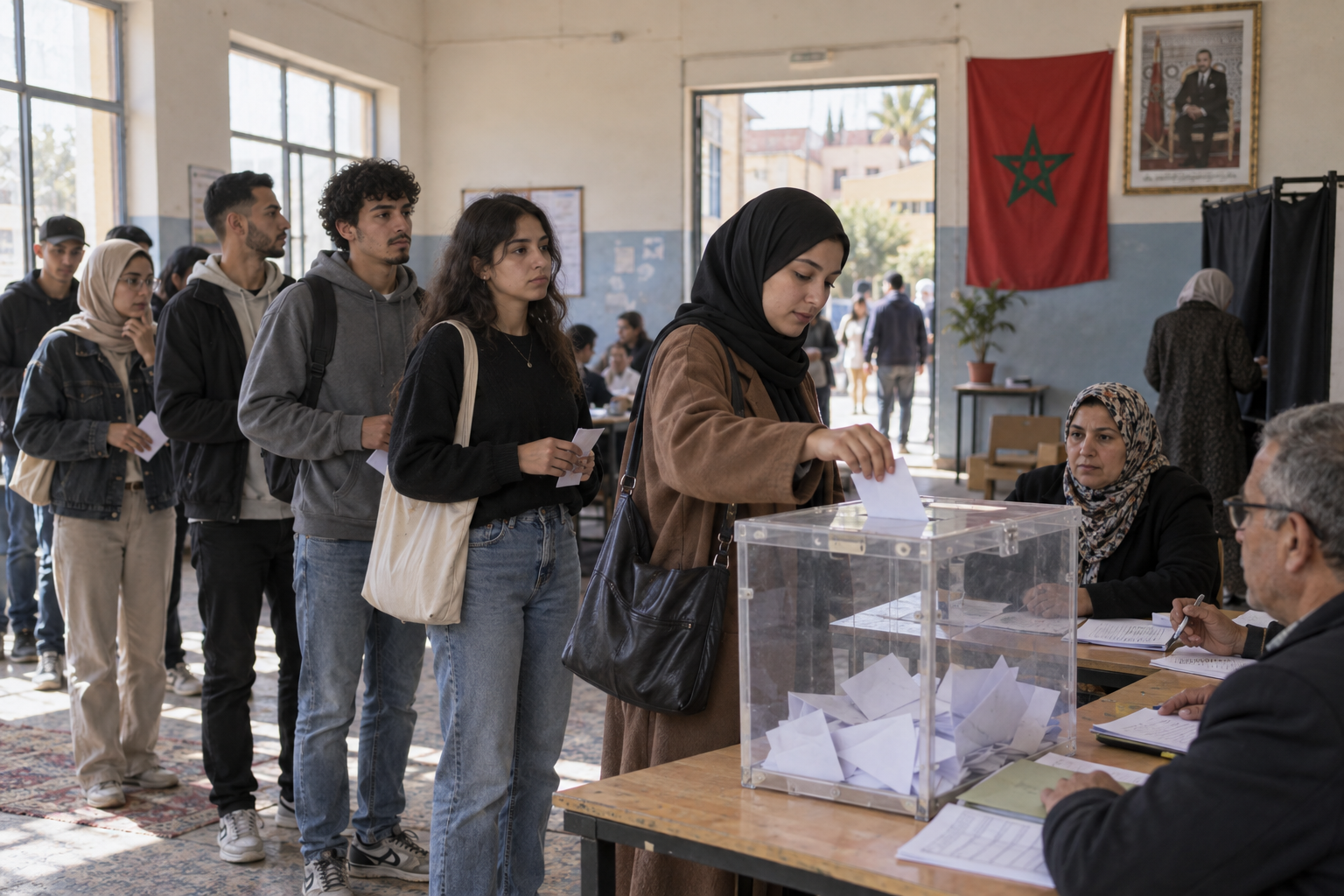
Morocco’s upcoming parliamentary election is presented as a test of whether the country’s political system can regain the trust of young people, many of whom feel disengaged or believe political promises will not improve their lives. Nearly 16 million people are registered to vote for the 395-seat House of Representatives, but only four percent of registered voters are aged 18 to 24. The article describes contrasting views among Moroccans: Zoubaida, a 34-year-old mother in Tangier, says she will not vote and expects little from the parties, while 28-year-old Haitham Arakchou plans to vote in hopes of social improvements and a higher minimum wage. Twenty-year-old graduate Haitham Atifi, unable to find work, also plans to abstain, saying campaign promises are empty and no party can create jobs for young people.
Youth unemployment and social disparities are central campaign concerns. The election follows demonstrations by the youth-led Gen Z movement, which called for better health and education services. Public frustration has also been highlighted by a July rush in which tens of thousands of people, predominantly young Moroccans, crossed into the Spanish enclave of Ceuta. Zoubaida says she would attempt the crossing herself if she had the opportunity. The incident heightened tensions between Rabat and Madrid but received little attention during the campaign; former prime minister Abdelilah Benkirane criticized it as a major scandal.
Morocco has recorded strong economic growth—about five percent last year—and is pursuing major development projects ahead of the 2030 World Cup, which it will co-host with Spain and Portugal. Yet unemployment stood at 13 percent, and reports of pregnant women dying at a hospital in Agadir helped spark the protests. Political scientist Mohamed Chiker identifies restoring voters’ trust, especially among young people, and promoting an honest political elite as key challenges. The article portrays an election set against a gap between national economic ambitions and young people’s experiences of limited opportunity and unmet social needs.
Entities: Morocco, House of Representatives, Zoubaida, Tangier, Gen Z movement • Tone: analytical • Sentiment: negative • Intent: inform
23-09-2026
Moroccans voted to elect 395 members of parliament in an election shaped by economic pressures and widespread distrust of political parties. Nearly 16 million people were registered, but young voters may be underrepresented: only four percent of registered voters are aged 18 to 24, making youth turnout an important measure of engagement. Polls opened at 8 a.m. and were scheduled to close at 7 p.m., with preliminary results expected overnight. The prime minister is appointed by the king from the party winning the most seats, while the monarch retains control over major policy decisions.
The campaign focused on unemployment, rising prices, inequality and quality of life. The election followed a mass migration of mostly young Moroccans into Spain’s Ceuta enclave, an event that strained relations between Rabat and Madrid but did not become a central campaign issue. The National Rally of Independents (RNI), which leads the governing coalition, was considered a favourite, although opinion polls are prohibited. Its leader, Prime Minister Aziz Akhannouch, promoted the government’s record on social security, education, health and salary increases. He has also faced conflict-of-interest allegations connected to his fuel company and calls for his resignation from a youth-led protest movement.
The RNI’s main rival, the Authenticity and Modernity Party (PAM), campaigned on improving wages and young people’s prospects. Its prominent figures include Budget Minister Fouzi Lekjaa and territorial planning minister and Marrakesh mayor Fatima Ezzahra Mansouri, who could become Morocco’s first woman prime minister. The party has also been affected by a drug-trafficking corruption case involving two senior figures. Other contenders include Istiqlal, which emphasized social issues, and the Islamist Justice and Development Party, which campaigned against corruption and opposed inheritance equality and the decriminalisation of consensual extramarital sex.
Entities: Morocco, Rabat, Ceuta, Madrid, House of Representatives • Tone: neutral • Sentiment: neutral • Intent: inform
23-09-2026
Millions of Moroccans voted on September 23, 2026, to elect all 395 members of the House of Representatives. Twenty-seven parties are contesting the country’s 12th legislative election since independence, with nearly 16 million people eligible to vote. Although King Mohammed VI retains most executive powers, the elected parliament will shape the government’s handling of public affairs. The king is expected to appoint the head of government from the leading party, which must secure the support of 198 deputies to win parliamentary confidence.
The election is taking place amid public frustration over high prices, inflation, employment and the cost of living. Mohammed Masbah, head of the Moroccan Institute for Policy Analysis, linked the mood to broader social and economic pressures, including youth dissatisfaction, protests the previous year and an attempt by people to cross into Ceuta. A new funding system intended to support candidates aged 35 may encourage youth participation, but Moroccans living overseas—nearly six million people, many of them young—must appoint proxies in the country to vote.
The National Rally of Independents and the Authenticity and Modernity Party have made economic concerns central to their campaigns. Masbah said clashes between the leading governing parties, including accusations of waste and candidate poaching, could further alienate voters. The country also faces major investment demands ahead of the 2030 World Cup.
Authorities have recorded fewer election-related complaints than in 2021, but legal amendments now criminalise certain digital offences, including spreading fake news or false allegations intended to defame candidates or voters. Online activity accounted for 22 complaints. Despite dissatisfaction with the government, Masbah expects turnout to remain broadly steady, supported by traditional local elites and networks of influential notables, though a decline is possible. He said any drop was unlikely to be sharp or catastrophic.
Entities: Morocco, Mohammed Mansour, Mohammed VI, Mohammed Masbah, Moroccan Institute for Policy Analysis • Tone: analytical • Sentiment: neutral • Intent: inform
23-09-2026
Moroccans are voting in a parliamentary election that will determine the government responsible for the final preparations for the 2030 World Cup and for initiatives intended to respond to economic pressures and youth discontent. The poll is not expected to substantially shift power: King Mohammed VI retains broad authority over policy direction, defence and foreign affairs. Under the 2011 constitution, he appoints the prime minister from the party winning the largest share of the 395 parliamentary seats; that prime minister must form a coalition and submit cabinet appointments for royal approval.
The election follows recent signs of dissatisfaction, including a mass rush toward the Spanish enclave of Ceuta and deadly protests led by Gen Z last year. Voter turnout, especially among young people, will be watched as an indicator of public engagement and confidence in elected institutions. Although about 27 million Moroccans are of voting age, 15.8 million are registered—around 12% fewer than in 2021.
The governing National Rally of Independents (RNI) and Authenticity and Modernity Party (PAM) have each promised roughly one million jobs over the next five-year term, along with improvements to housing, wages and hospitals. Their coalition has been strained by disputes over rising food prices and other shortcomings. PAM leaders have said they would not join another coalition with RNI if RNI comes first. Prime Minister Aziz Akhannouch, who has led the government since 2021, is not seeking another term and stepped down as RNI leader this year. Fouzi Lekjaa, the budget minister and a leading World Cup organizer, joined PAM’s leadership shortly before the vote.
Morocco’s World Cup preparations include major spending on stadiums, railways and other infrastructure. The country will co-host the tournament with Spain and Portugal and aims to double per-capita economic output by 2035. The IMF estimates planned spending at about 190 billion dirhams (US$20 billion), nearly 12% of Morocco’s 2024 GDP. Other parties contesting the election include Istiqlal, the Islamist Justice and Development Party, and several leftist parties.
Entities: Morocco, Rabat, 2030 FIFA World Cup, King Mohammed VI, National Rally of Independents (RNI) • Tone: analytical • Sentiment: neutral • Intent: inform