23-09-2026
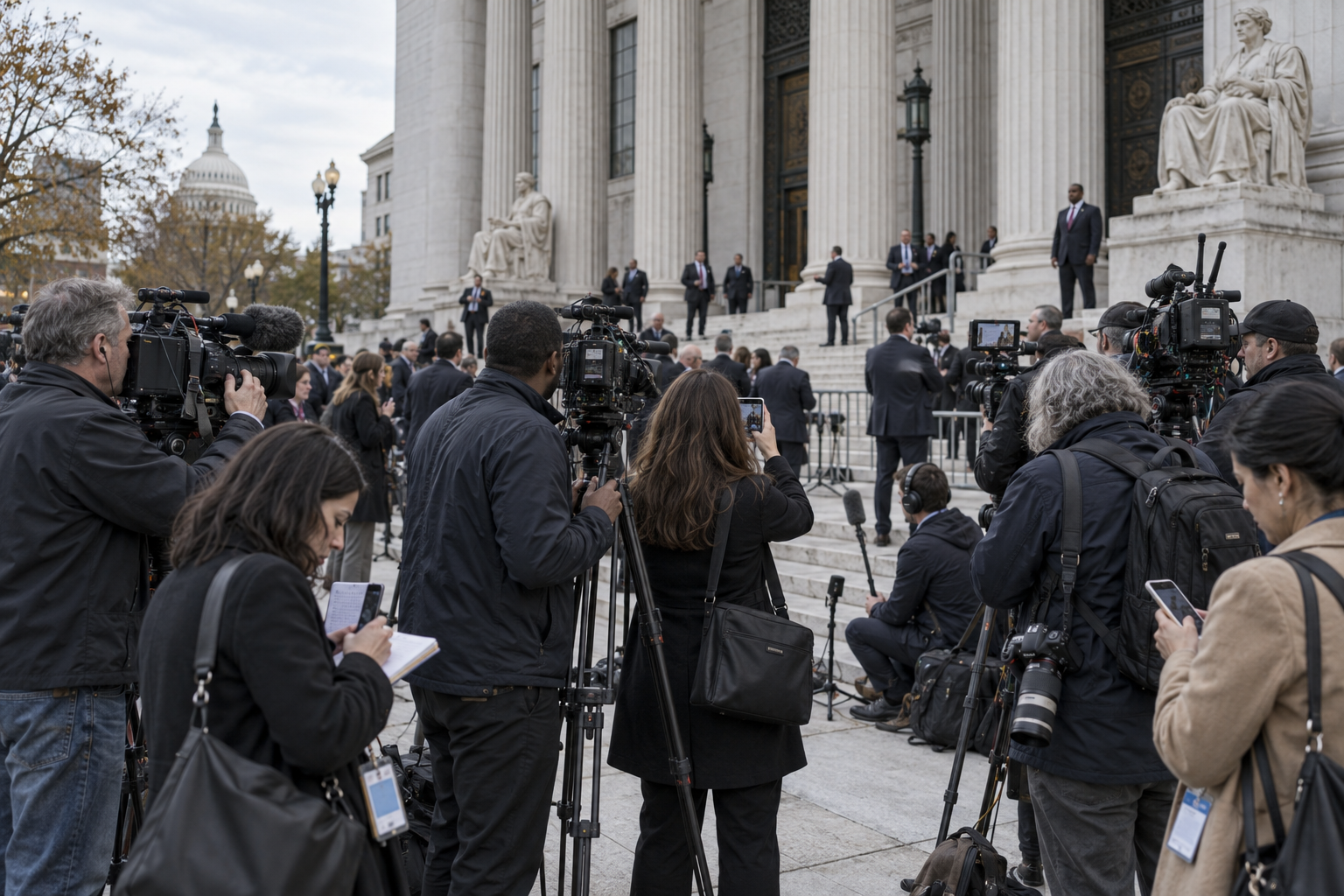
The US Justice Department has filed a court submission defending President Donald Trump’s decision to bar CNN, Politico and MS NOW from the White House. It accuses the outlets of publishing “verifiable falsehoods” and reporting that “threatened national security.” The filing says the White House gave the organisations a list of reporting incidents, including stories about construction at the White House—among them a security bunker and a proposed ballroom—as well as a report on an internal leak investigation. It argues that White House access is a privilege rather than a right.
The three outlets have jointly challenged the ban, saying it violates the First Amendment and that their journalists’ credentials were revoked without notice or due process because the administration objected to their reporting. They argue that leaving the decision unchallenged would threaten press freedom and the public’s access to independent journalism. A judge is expected to decide whether to temporarily lift the ban while the wider case proceeds.
The dispute has also affected media operations: major television networks withdrew from the shared White House pool of video and images in protest, after which the White House launched Trump TV, a continuous stream of clips of the president. The article reports further tension at the United Nations General Assembly, where Trump told CNN correspondent Kaitlin Collins she should not be covering him and claimed the network had said it would not. Collins later said on air that CNN had made no such pledge. Trump also attacked her on social media and again called the three outlets “treasonous.”
Entities: Donald Trump, Kaitlin Collins, Harry Sekulich, Madeline Halpert, US Department of Justice • Tone: analytical • Sentiment: negative • Intent: inform
23-09-2026
The Department of Justice has asked a federal judge not to stop President Donald Trump from barring MS NOW, CNN and Politico from the White House. In a court filing submitted Tuesday evening, the DOJ argued that White House access is a privilege rather than a right and said Trump imposed the ban because he believed the outlets had reported classified or sensitive information related to national security.
The filing was submitted before a Wednesday teleconference hearing in U.S. District Court in Washington, D.C. Judge Timothy Kelly is scheduled to hear arguments from a lawyer representing the outlets. The organizations sued Trump on Monday and asked the judge to prevent the ban from continuing. They contend that the decision was viewpoint discrimination, targeting them because of their perceived ideology or perspectives.
The DOJ disputes the outlets’ claim of a First Amendment right for reporters to access the White House. It argued that the president has a compelling interest in limiting access to organizations he considers a national security risk. The filing also included letters dated Tuesday giving each outlet an opportunity to challenge the initial ban and its factual basis. The letters cite stories that the administration says purportedly threatened national security and set a deadline of 5 p.m. Friday, September 25, 2026, for responses. If the outlets do not respond by then, the filing says, the initial decision will become final.
Entities: U.S. Department of Justice (DOJ), Donald Trump, MS NOW, CNN, Politico • Tone: analytical • Sentiment: neutral • Intent: inform
23-09-2026
The France 24 programme “A propos” reports that US media organizations CNN, Politico and MS NOW are suing the Trump administration after their press credentials were removed and they were barred from covering the White House. The programme describes the action as part of President Donald Trump’s escalating conflict with the media. Its cover caption says the three organizations were banned from the White House on Friday, September 18; the item was issued on September 23, 2026, and runs for 11 minutes and 53 seconds.
France 24 says it spoke with Steven Herman, executive director of the Jordan Center for Journalism Advocacy and Innovation at the University of Mississippi. The discussion concerns whether the administration’s move is legal and what its broader implications may be. The supplied page text does not include Herman’s answers, the programme transcript, or further details about the lawsuit, so it is not possible to establish the arguments made by either side or the interview’s conclusions from this material alone.
Overall, the article introduces a dispute over access to the White House and press credentials, framing it as a significant media and government issue. It presents the lawsuits and identifies legal questions and wider ramifications as the focus of the interview. The available content is a short programme description rather than a full report; the embedded video is not accessible in the provided text, and the page also contains unrelated loading and website messages.
Entities: Donald Trump, CNN, Politico, MS NOW, France 24 • Tone: analytical • Sentiment: negative • Intent: analyze
23-09-2026
The NPR Up First briefing covers the political outlook before the midterm elections, President Trump’s U.N. speech and diplomacy with Iran, a lawsuit over White House media access, and plans by Immigration and Customs Enforcement (ICE) to create mobile detention facilities. An NPR/PBS News/Marist poll finds that registered voters favor electing Democrats to Congress by 12 points. It also reports Trump’s approval at 39%, with 53% disapproving, and finds that many voters say they are motivated to vote against him. NPR’s Stephen Fowler cautions that these figures do not necessarily predict who will turn out, and that any Democratic gains could vary across states and districts. The briefing also notes declining trust in mail-in ballot delivery and concerns that Trump might deploy the military to polling places, an action prohibited by state and federal laws.
At the United Nations General Assembly, Trump discussed the Iran conflict and said a U.S. delegation had met with Iranian officials. NPR’s Deepa Shivaram describes the meeting as a shift toward diplomacy after summer tensions, although its progress remains unclear. Separately, CNN, MS NOW and Politico are challenging their exclusion from the White House, arguing that the administration violated constitutional protections. The Justice Department says the outlets’ reporting raises national-security concerns. The briefing also reports criticism of a new administration-run YouTube channel, “Trump TV.”
ICE is planning mobile detention facilities in Pennsylvania as part of a wider expansion. The plan has drawn opposition from local communities and immigration activists amid record immigrant detention levels. The deep dive examines a new Justice Department program to restore federal gun rights for some people with felony convictions. Applications will open in stages; violent offenders are excluded. Supporters say the program offers a second chance, while critics question its implementation and point to past cases of restored gun rights followed by serious arrests. State laws may also prevent some applicants from possessing firearms even if their federal rights are restored.
Entities: Donald Trump, Stephen Fowler, Deepa Shivaram, David Folkenflik, Todd Lyons • Tone: analytical • Sentiment: neutral • Intent: inform