22-09-2026
The African Union is expected to use the United Nations General Assembly’s annual high-level meeting to seek a stronger role in global decision-making. A central objective is securing permanent African representation on the UN Security Council, reflecting long-standing concerns that the continent is underrepresented in the body responsible for addressing international peace and security.
The gathering begins amid heightened security at UN headquarters in New York, where flags were raised and police officers, canine teams, and law-enforcement drones were deployed ahead of the arrival of world leaders. The security measures are presented as preparations for the high-level event rather than as a response to a specific incident.
On Monday, the leaders of the African Union and the United Nations met to discuss issues affecting Africa’s position in the international system. Their agenda included reforms to international financial institutions, debt sustainability, and ways to ensure that African countries gain greater economic value from their mineral resources. These priorities link political representation with broader demands for fairer financial arrangements and more beneficial resource management.
Kenyan President William Ruto is also expected to promote several issues during his visit, including climate finance, reform of global governance, peace and security, and digital cooperation. In addition, the UN Development Programme will present an Africa-focused package addressing artificial intelligence, natural resources, data, talent, and access to capital.
Overall, the article highlights a coordinated African effort to influence debates at the UN, expand the continent’s formal representation, and secure stronger economic, technological, and financial support. It also places those diplomatic priorities within the context of the security preparations surrounding the General Assembly.
Entities: African Union (AU), United Nations (UN), UN General Assembly, UN Security Council, New York • Tone: analytical • Sentiment: neutral • Intent: inform
22-09-2026
Africanews’ “Pix of the Day” roundup, dated September 22, 2026, presents a brief overview of major political, humanitarian, public-health, sports-governance, and military-legal developments around the world, with a strong focus on Africa and nearby regions. In the United States, major television networks reportedly paused White House pool coverage in response to a media ban associated with Donald Trump, highlighting tensions between the administration and news organizations. At the United Nations, the African Union is expected to advocate for a larger and more influential role for Africa in global decision-making.
The roundup also reports a severe Ebola situation in the Democratic Republic of the Congo, where confirmed cases have surpassed 7,600 and deaths have reached 3,699. In Yemen, the International Organization for Migration says that 130,000 people have been displaced by an advance by the Houthi movement, underscoring the continuing humanitarian consequences of conflict. In international football, FIFA President Gianni Infantino has called for a review of football governance following backlash over investment, suggesting pressure for institutional reassessment within the sport.
The final item concerns The Gambia, where a former commander of the Junglers is facing a military court over alleged desertion. Taken together, the entries provide a concise, headline-style snapshot of events involving media freedom, African diplomatic representation, disease, forced displacement, sports administration, and military accountability. The article does not offer detailed background, responses, or analysis beyond the individual headlines, and instead functions as a compact digest of significant current-affairs developments.
Entities: Donald Trump, United States television networks, White House, African Union, United Nations • Tone: neutral • Sentiment: negative • Intent: inform
22-09-2026
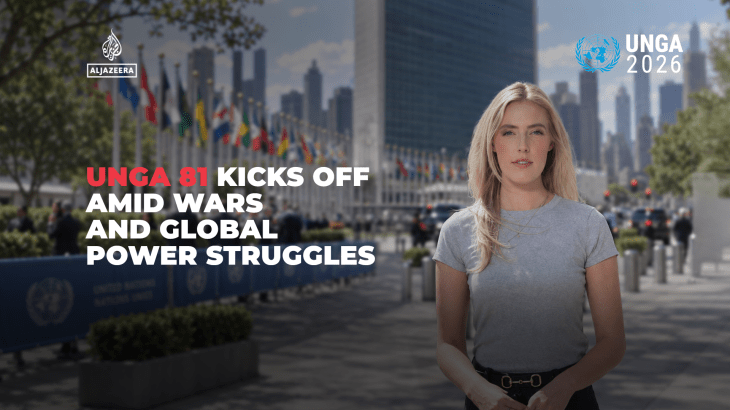
The article is a brief Al Jazeera video explainer previewing the major issue expected to shape the 81st United Nations General Assembly (UNGA) in New York. It notes that world leaders are gathering at a time when armed conflicts are increasing and confidence in international institutions is weakening. Against this backdrop, the report focuses less on the formal agenda of the gathering and more on the credibility and practical relevance of the international system.
According to Al Jazeera’s Emma Withrow, the central question is whether global rules continue to matter when powerful countries can disregard them without facing meaningful consequences. This framing points to concerns about the erosion of international norms, the unequal application of those norms, and the difficulty of preserving cooperation when influential states act outside established rules.
The preview presents UNGA 81 as an important test of the United Nations’ authority and of the broader rules-based international order. While the short article does not identify specific conflicts, countries, or diplomatic initiatives, it establishes a wider context of multiplying wars and declining trust. The report therefore directs attention to the gap between the principles expressed at the United Nations and the actions of states with the greatest political or military influence.
Published on 22 September 2026, the item is designed as an analytical video introduction to the themes viewers should follow during the UNGA. Its emphasis is ultimately on accountability, international legitimacy, and whether global institutions can still constrain powerful actors.
Entities: United Nations General Assembly (UNGA), UNGA 81, New York, Al Jazeera, Emma Withrow • Tone: analytical • Sentiment: negative • Intent: analyze
22-09-2026
The France 24 article is a brief liveblog notice about the opening of the 81st United Nations General Assembly in New York on September 22, 2026. UN Secretary-General Antonio Guterres opened the session, doing so for the final time before his term was scheduled to end on December 31. The article says that Brazilian President Luiz Inacio Lula da Silva, US President Donald Trump, and French President Emmanuel Macron followed Guterres at the podium. Its headline highlights Macron’s message: “No peace without justice.”
The page invites readers to consult the liveblog for highlights and replays of the leaders’ addresses, but notes that the liveblog is no longer being updated. The supplied text does not provide details of the speeches beyond the headline, nor does it report reactions, policy announcements, or outcomes. It is therefore best read as a short event update and pointer to the now-closed live coverage rather than a full account of the leaders’ remarks. A photograph caption identifies Macron addressing the General Assembly at UN headquarters in New York City. The article credits France 24, with AFP, AP, and Reuters, and was issued on September 22, 2026, with a later modification that day.
Entities: Emmanuel Macron, Antonio Guterres, Luiz Inacio Lula da Silva, Donald Trump, United Nations General Assembly • Tone: neutral • Sentiment: neutral • Intent: inform
22-09-2026
In his final address to the United Nations General Assembly, Secretary-General Antonio Guterres urged world leaders to respond collectively to several major global challenges. His speech focused on the need to regulate artificial intelligence, end ongoing wars, intensify action on climate change and reform United Nations institutions that he said are struggling to deal effectively with mounting international pressures.
The address was delivered on Tuesday, September 22, 2026, and was presented as Guterres’s final speech to the General Assembly. The central message was that existing international systems are not adequately equipped to manage the scale and complexity of today’s crises. Guterres therefore called for stronger global governance and institutional changes, alongside action on urgent security, technological and environmental issues.
Artificial intelligence was identified as an area requiring international regulation, reflecting concerns about the technology’s rapid development and its potential consequences when left without common rules. Guterres also emphasized the need to end wars, placing conflict prevention and peace efforts among the priorities for world leaders. Climate change was another key issue on the agenda, with the secretary-general urging governments to maintain focus on a challenge affecting countries worldwide.
The report provides a full replay of the address rather than a detailed account of the speech’s individual proposals or the reactions of member states. Its framing presents Guterres’s remarks as a broad appeal for international cooperation and a warning that the United Nations and other global institutions face serious difficulties in confronting current crises. The video is accompanied by a brief description and was issued by France 24 on September 22, 2026.
Entities: Antonio Guterres, United Nations, United Nations General Assembly, France 24, Artificial intelligence regulation • Tone: urgent • Sentiment: negative • Intent: inform
22-09-2026
France 24’s short video report previews the main issues expected to dominate this year’s United Nations General Assembly: armed conflicts, artificial intelligence and climate change. The report frames the gathering against what it describes as an “unrelenting succession of global crises,” suggesting that international cooperation is being tested by several overlapping emergencies.
The General Assembly’s stated theme is “Restoring trust, managing transformation: A United Nations that delivers for all”. This theme emphasizes the need to rebuild confidence in multilateral institutions while managing major technological, environmental and geopolitical changes. The reference to restoring trust indicates concerns about the UN’s ability to respond effectively and maintain credibility among member states and the wider public.
The report specifically identifies AI as an agenda item, reflecting the growing importance of the technology in global policy discussions. It also highlights climate change as a continuing international challenge and places ongoing wars within the broader discussion of global instability. However, the available text does not identify particular conflicts, climate initiatives, AI regulations or statements by individual leaders.
The article is primarily an introductory overview rather than a detailed analysis. It alerts viewers to the major subjects under discussion as world leaders gather at the UN and presents the Assembly as an opportunity to address interconnected crises. Its focus is on the scope of the agenda and the institution’s stated goal of delivering for all, rather than on specific decisions or outcomes.
Entities: France 24, United Nations, United Nations General Assembly, World leaders, Global crises • Tone: analytical • Sentiment: negative • Intent: inform
22-09-2026
World leaders are gathering in New York for the 81st United Nations General Assembly amid wars, geopolitical polarization, economic disruption, climate pressures and growing anxiety about artificial intelligence. The meeting will examine whether the 193-member organization can still coordinate international action on crises that cross national borders, including conflicts in the Middle East, Gaza, Ukraine, Sudan, Congo and Myanmar.
The future of the United Nations itself is also central to the discussions. Member states have agreed to a broad reform package, including changes to the Security Council, whose five permanent members—the United States, Russia, China, Britain and France—retain disproportionate influence through their veto powers. The selection of a successor to Secretary-General Antonio Guterres, whose second term ends on December 31, is another issue likely to be discussed.
Approximately 130 heads of state and government are expected to address the General Assembly. Speakers include U.S. President Donald Trump, French President Emmanuel Macron, Ukrainian President Volodymyr Zelenskyy, Iranian President Masoud Pezeshkian and Israeli Prime Minister Benjamin Netanyahu. Palestinian President Mahmoud Abbas will participate by video after the United States refused to grant him a visa. The absence of Chinese President Xi Jinping, Russian President Vladimir Putin and Indian Prime Minister Narendra Modi is also notable.
The United Nations is experiencing severe financial and political strain. U.S. arrears have damaged its finances, forcing cuts to peacekeeping and humanitarian programs, although a recent payment of $725 million preserved Washington’s voting rights. Analysts describe the organization as no longer in freefall but still trapped in a prolonged crisis.
Artificial intelligence has moved toward the center of the agenda. AI executives have warned that the technology could escape human control, while President Trump has dismissed such concerns and advocated continued U.S. development. The Security Council will hold a high-level meeting on AI, alongside discussions on Ukraine. Despite the gravity of the challenges, diplomats and experts argue that personal meetings and multilateral cooperation can still produce practical agreements and offer grounds for cautious hope.
Entities: United Nations, 81st United Nations General Assembly, New York City, Antonio Guterres, Donald Trump • Tone: analytical • Sentiment: negative • Intent: inform
22-09-2026
U.S. President Donald Trump is scheduled to address the 81st session of the United Nations General Assembly as tensions over trade, tariffs and international cooperation continue to intensify. The Assembly’s theme is “Restoring trust, managing transformation: A United Nations that delivers for all,” but Trump’s administration has pursued policies that challenge the organization and broader multilateral institutions.
Trump has demanded major reforms at the UN, withheld funding and withdrawn the United States from several UN organizations, including the World Health Organization and UNESCO. He is also expected to criticize the UN again during his speech, as he did in 2025 when he argued that the body had failed to end wars and claimed he had been the target of a UN conspiracy after an escalator and TelePrompTer malfunctioned at its headquarters.
Canadian Prime Minister Mark Carney is expected to attend the General Assembly opening. The article presents Carney as an increasingly prominent defender of multilateralism and international cooperation on issues such as climate change, financial instability and armed conflict. For nearly a year, he has encouraged middle powers to cooperate around shared interests and values, rather than relying solely on existing institutions.
Carney has also attempted to build stronger links between the European Union and the CPTPP, a Pacific Rim trade bloc, to help countries resist economic pressure from the United States and China. His efforts have drawn attention from Trump’s administration, particularly after Canada-U.S. trade talks ended acrimoniously. Trump recently warned that closer ties between Canada and the European Union could be a “hostile act.”
Carney may face additional pressure while co-hosting an event with France and the United Kingdom on a two-state solution, one year after the three countries recognized an independent Palestinian state. Relations between Canada and the United States remain strained as their trade war escalates and prospects for a new bilateral trade agreement deteriorate.
Entities: Donald Trump, Mark Carney, United Nations General Assembly, United Nations, Canada-U.S. trade war • Tone: analytical • Sentiment: negative • Intent: inform
22-09-2026
The National’s live coverage of the 2026 United Nations General Assembly in New York highlights a series of diplomatic, security and humanitarian developments. G7 foreign ministers are demanding that Iran end its support for Houthi rebels in Yemen, underscoring continuing concerns about regional instability and the Houthis’ role in the Middle East conflict. The United Nations is also prepared to investigate alleged chemical-weapons use in Sudan’s civil war, adding an international accountability dimension to the gathering.
Security concerns extend to New York, where the US Secret Service has warned the public against flying drones in the city. The coverage also reports that no network travel pool will accompany President Donald Trump to the UN General Assembly. Alongside these security and geopolitical issues, the page emphasizes diplomacy, with UAE Foreign Minister Sheikh Abdullah bin Zayed leading the country’s delegation and declaring that dialogue is “more important than ever.”
The 2026 assembly’s theme is “restoring trust, managing transformation.” The High-Level General Debate is scheduled to begin on Tuesday and continue through Monday. The live page also features short videos and related updates, including a report on the congestion surrounding the General Assembly, comments from UAE Ambassador Lana Nusseibeh advocating diplomacy and optimism, an explainer on speaking order at the UN General Assembly, and remarks by New York City Mayor-elect Zohran Mamdani that he will not join anti-Benjamin Netanyahu protests during the event. The supplied material consists primarily of headlines, brief descriptions and media links rather than full reports on each development.
Entities: 2026 United Nations General Assembly (UNGA), G7 foreign ministers, Iran, Houthi rebels, Yemen • Tone: urgent • Sentiment: negative • Intent: inform
22-09-2026
The United Nations General Assembly’s high-level debate is underway in New York, where intense security measures, motorcades and thousands of diplomats have transformed the area around UN headquarters. More than 1,000 bilateral meetings have been requested between member states, making the gathering a major venue for discreet, face-to-face diplomacy.
Brazilian President Luiz Inácio Lula da Silva opened the high-level debate on Tuesday, followed by US President Donald Trump. While the formal speeches attract global attention, much of the week’s diplomacy is taking place in half-hour meetings between delegations. Middle Eastern countries are using the event for intensive discussions on regional conflicts, especially the Iran war, which has affected the global economy.
UN Secretary-General António Guterres is seeking renewed commitment to the organization’s principles while urging member states to address what his spokesman Stéphane Dujarric calls “runaway risks,” including artificial intelligence, climate change and inequality. Dujarric compares the hectic week to surfing a giant wave and says participants are running on adrenaline.
The article captures the atmosphere around the UN: officials and journalists move through heavily guarded streets, nearly everyone carrying coffee, while delegates try to find rare breaks between meetings. One journalist describes the week as exhausting but exciting. Dujarric, attending his 26th General Assembly, says he still feels a sense of awe when entering the chamber.
The report also recalls the drama surrounding Trump’s visit the previous year, when an escalator stopped and his teleprompter reportedly malfunctioned. A UN staff member jokingly expressed hope that the escalator would work this time, as delegates gathered in the cafeteria for expensive snacks during brief pauses in the proceedings.
Entities: United Nations General Assembly (UNGA), United Nations headquarters, New York City, Luiz Inácio Lula da Silva, Donald Trump • Tone: analytical • Sentiment: neutral • Intent: inform
22-09-2026
In this opinion article, Damien McElroy argues that the United Nations’ future depends less on expanding or defending its bureaucracy and more on strengthening its political and diplomatic capabilities. Written during the annual “UN week” in New York, the piece acknowledges the organization’s credibility problems and the worsening conflicts confronting the international system. However, it rejects the idea that the UN should simply be dismissed, emphasizing that no other institution possesses comparable global infrastructure for addressing conflict, disease, climate change, hunger and other major crises.
McElroy uses the recent memorial for Nicholas Haysom, a respected UN envoy and political operator, as an example of the type of diplomatic expertise the organization needs. Haysom worked with Nelson Mandela, played significant roles in post-Saddam Hussein Iraq and post-Omar Al Bashir Sudan, and operated within the senior leadership around the Secretary General. His career illustrates the value of experienced intermediaries who can navigate political tensions and quietly pursue settlements.
The article contrasts this approach with administrative or grassroots programs that may be less effective in an era characterized by concentrated national power, internal political divisions and conflicts that spill across borders. Citing observations from David Miliband and Robert Pape, McElroy contends that traditional supranational programs and technical management cannot adequately address today’s political crises.
The author therefore calls on the next Secretary General, who is due to take office in 2027, to reinforce the UN’s political team and give diplomacy a more prominent role. An internal reshuffle should consolidate the organization’s most effective tools rather than signal retreat. With military and technical power failing to prevent escalation in the Middle East, and with climate change, fragile global supply systems and artificial intelligence creating additional long-term pressures, McElroy concludes that the UN’s diplomatic engagements remain vital and consequential.
Entities: United Nations (UN), UN General Assembly, Antonio Guterres, Nicholas Haysom, Nelson Mandela • Tone: analytical • Sentiment: neutral • Intent: analyze
22-09-2026
Russia has called for reform of the United Nations Security Council but said its current system of permanent members and veto power should be preserved. Kremlin spokesman Dmitry Peskov made the comments in Moscow on September 22 while responding to Turkish President Recep Tayyip Erdogan’s renewed criticism of the council.
Erdogan has argued that the five permanent members—Britain, China, France, Russia and the United States—do not adequately represent the international community and prevent the United Nations from taking swift decisions. He has urged the abolition of both permanent membership and the veto, which allow the five countries to block substantive Security Council resolutions.
Peskov said Moscow supports expanding the council’s permanent membership beyond the existing five countries. However, he rejected the idea of removing the veto, describing both permanent membership and veto rights as important components of the UN’s institutional structure. His remarks therefore position Russia in favor of broadening representation while retaining the privileges that give the current permanent members substantial influence over international security decisions.
The comments highlight a central disagreement in longstanding debates over Security Council reform. Countries seeking greater representation generally argue that the council’s structure reflects the balance of power at the end of World War II rather than the modern international system. Russia, while supporting an expansion of permanent membership, maintains that the veto remains essential to the council’s design. The report does not specify which additional countries Moscow would support for permanent seats or describe any immediate reform proposal. It presents the Kremlin’s position as a response to Erdogan’s call for a more fundamental restructuring of the council.
Entities: United Nations Security Council, Russia, Kremlin, Dmitry Peskov, Recep Tayyip Erdogan • Tone: analytical • Sentiment: neutral • Intent: inform
22-09-2026
The Partners for Multilateralism Summit (P4M), held during the United Nations General Assembly High-Level Week, brought together countries from several regions to discuss how to defend and strengthen the multilateral system. Australia, Barbados, Brazil, Canada, the European Union, India and Kenya co-hosted the gathering, which focused on shared commitments to international law, peace, sustainable development and inclusive prosperity.
The summit took place amid growing geopolitical tensions, armed conflicts and global challenges including climate change and artificial intelligence. These pressures have raised questions about whether existing multilateral institutions are sufficiently representative, effective and trusted. P4M therefore aimed to encourage high-level political debate, strengthen international cooperation and develop practical responses to common problems.
At the launch of the “Partners for Multilateralism” platform, European Council President António Costa described it as an open network for countries willing to defend shared principles and pursue concrete solutions. He said the platform would support dialogue, coalition-building and practical cooperation while reinforcing the work of the United Nations and other multilateral forums.
Kenyan President William Ruto used the summit to call for reforms to the global financial system. He argued that institutions lacking adequate representation of the people they serve will struggle to maintain public trust. Ruto also challenged the traditional focus on how much financing international partners can bring to Africa. Instead, he urged partners to help unlock the financial resources already available on the continent by reforming the international financial architecture.
Ruto said multilateral and development finance institutions should do more than provide loans. In his view, they should act as catalysts for mobilizing African capital and supporting development. His remarks linked broader efforts to renew multilateralism with a specific demand for fairer and more effective global financial institutions.
Entities: William Ruto, António Costa, Kenya, Partners for Multilateralism Summit (P4M), Partners for Multilateralism platform • Tone: analytical • Sentiment: neutral • Intent: inform
22-09-2026
French President Emmanuel Macron used his final address to the UN General Assembly as president to urge countries to defend international law and the United Nations system against what he described as a return to a “law of the jungle” and the abuse of power by empires. He framed the choice as one between a world governed by force and a “civilised international society,” urging nations not to accept the weakening of sovereignty or international norms.
Macron called for a moratorium on attacks against civilian and energy infrastructure in the Russia-Ukraine war, as well as a separate halt to attacks on commercial shipping in the Black Sea, a vital route for grain exports from both countries. He cited the destruction of civilian infrastructure and human-rights violations, describing the situation as a new era of “barbaric acts.” Macron has long supported Ukraine and had raised the issue in a meeting with US President Donald Trump the day before.
The French president also criticized the humanitarian situation in Gaza, questioning the international community’s credibility if it remained inactive. He said claims that peace had been achieved were not reflected in the continued lack of humanitarian deliveries, calling the situation a spectacle that shamed the world.
On artificial intelligence, Macron contrasted his position with Trump’s opposition to global AI regulation. He advocated international cooperation to develop an open-source frontier AI model that would not depend on either China or the United States. His broader argument was that countries should avoid becoming “vassals” of major powers and work together to maintain greater technological independence.
Entities: Emmanuel Macron, United Nations General Assembly, United Nations, France, Russia-Ukraine war • Tone: analytical • Sentiment: negative • Intent: inform
22-09-2026
France 24 examines the United Nations’ difficulty in maintaining international peace and security amid a more fragmented and unpredictable global order. The report features Fanny Badache, a researcher at Sciences Po and lecturer at the University of Geneva, in conversation with Rochelle Ferguson Bouyahi. The discussion focuses on the structural limits of the UN system rather than on a single conflict.
The article explains that the UN’s ability to fulfill its mandate depends heavily on cooperation among sovereign states, particularly the five permanent members of the Security Council. These powerful states are central to the collective-security mechanisms intended to prevent and resolve conflicts. However, when they are divided, the same mechanisms can become ineffective, resulting in institutional paralysis rather than coordinated action.
The headline frames the crisis as exceptionally severe, stating that the world has not seen this level of violence in decades. The accompanying text links that violence to an increasingly volatile international environment in which major powers are unable or unwilling to reach common positions. The article therefore presents the UN’s weakness as a consequence of geopolitical divisions and the organization’s dependence on member-state cooperation.
The supplied material is a short France 24 video introduction rather than a full transcript or detailed report. It does not identify particular wars, explain Badache’s proposed remedies, or provide evidence for the headline’s comparison with previous decades. Its main purpose is to introduce an expert analysis of why the UN’s collective-security framework is struggling to respond effectively to contemporary conflicts.
Entities: United Nations (UN), UN Security Council, Fanny Badache, Rochelle Ferguson Bouyahi, Sciences Po • Tone: analytical • Sentiment: negative • Intent: analyze