22-09-2026
French President Emmanuel Macron has urged the European Commission to take emergency measures to prevent a further deterioration in Europe’s supply of diesel and jet fuel. In a letter to Commission President Ursula von der Leyen, Macron warned that the prolonged disruption of the Strait of Hormuz, attacks on energy infrastructure in Russia and the Middle East, and recovering Asian demand could trigger another major oil-price shock.
Macron said global markets have so far been supported by higher refinery output, weaker Asian demand, redirected trade and the use of existing stockpiles. However, he argued that these buffers are rapidly disappearing. Global oil inventories have declined by more than 500 million barrels, while 14% of French service stations were experiencing shortages or near-shortages on 22 September. A continued closure of the Strait of Hormuz and the failure of Saudi Arabia’s East-West pipeline to resume operations could remove at least 4 million barrels per day from global supply.
To increase fuel availability, Macron proposed temporarily relaxing selected EU fuel-quality requirements. Adjustments to specifications such as density, volatility and desulphurisation could, depending on the refinery, increase output by 5% to 20%. France also wants the EU to permit wider use of B10 diesel, which contains up to 10% biodiesel, subject to safety agreements with vehicle manufacturers.
Macron additionally called for a one-year delay to methane-reporting obligations for oil and gas importers, arguing that the rules could create legal uncertainty during a supply crisis. He proposed examining whether the EU’s joint gas-purchasing mechanism could be expanded to diesel and jet fuel. The Commission said potential shortages were a major priority and would be discussed with governments and industry at a high-level meeting.
Entities: Emmanuel Macron, Ursula von der Leyen, France, European Union, European Commission • Tone: urgent • Sentiment: negative • Intent: inform
22-09-2026
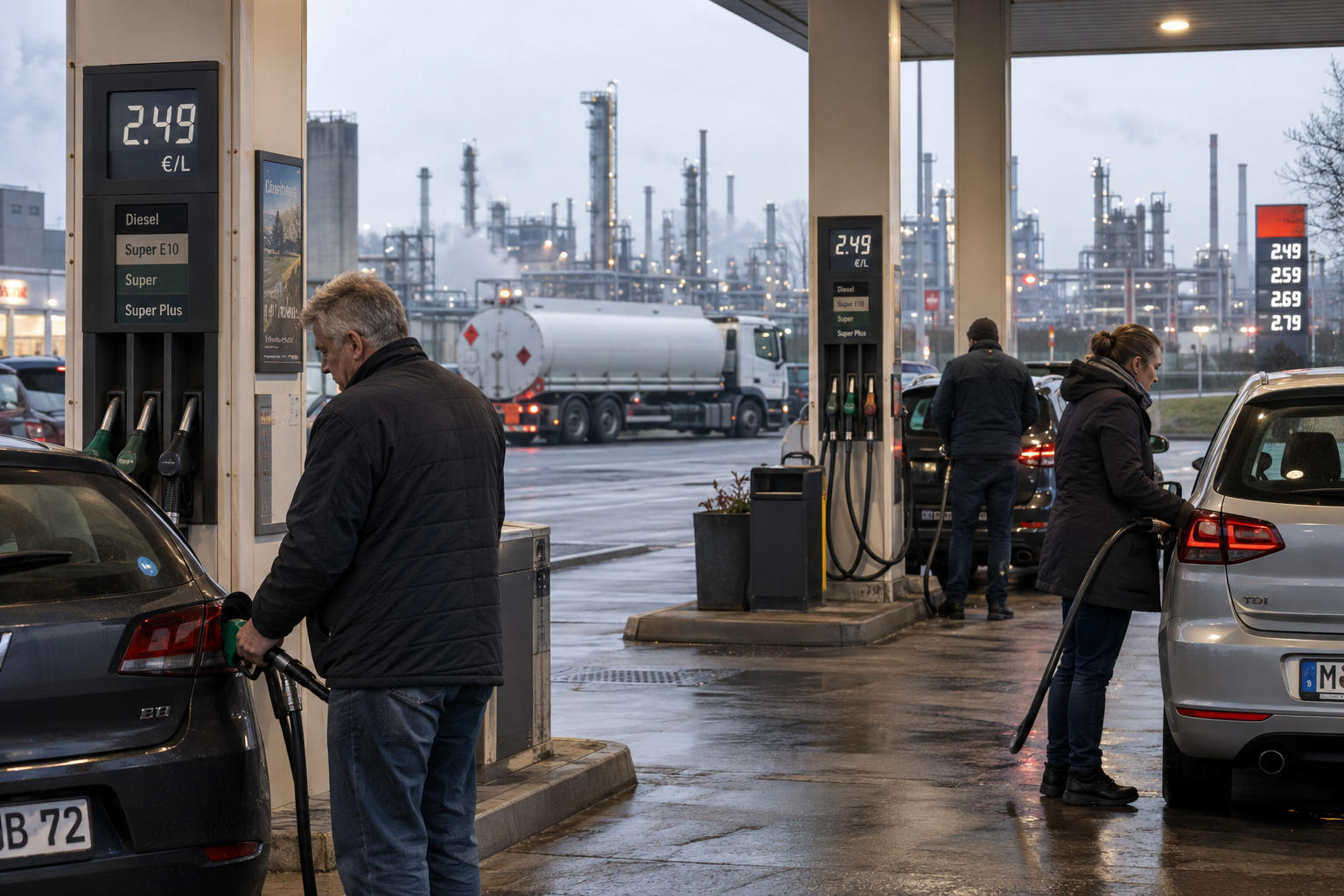
European petrol prices have reached record levels, with Euro-super 95 averaging €2.063 per litre across the EU on 14 September, the highest level in the European Commission’s data series since 2005. The article attributes the surge to a war with Iran that disrupted energy flows through the Strait of Hormuz, pushing Brent crude from about $72 to more than $100 per barrel for next-month delivery. Refining margins have also increased, adding an estimated €0.17 per litre to petrol prices and €0.41 to diesel prices in the euro area.
Taxes account for a substantial share of the price paid at the pump. EU drivers paid an average of €0.976 per litre in taxes, or 47.3% of the final petrol price. The tax burden generally consists of fixed excise duties, carbon or other levies, and VAT, which is applied after those charges have been added. This means motorists effectively pay VAT on fuel taxes as well as on the underlying fuel price.
The Netherlands has the highest petrol tax burden in the EU at €1.270 per litre, followed by Denmark at €1.230 and Finland at €1.193. Germany, Greece, France and Italy also collect more than €1 per litre. Portugal, Estonia and Latvia complete the top ten. Denmark has the EU’s most expensive petrol overall at €2.564 per litre, but the Netherlands collects more tax because of its higher excise duty. Greece has the largest tax share among the ten countries, with taxes representing 52.5% of the pump price. The article details the specific excise, carbon, security-of-supply and VAT charges used in each country.
Entities: Piero Cingari, Euronews, European Union, European Commission, European Central Bank (ECB) • Tone: analytical • Sentiment: negative • Intent: analyze
22-09-2026
European transport fuel prices have reached record highs, but the size of the increases and governments’ responses vary substantially across the EU. The article attributes the surge to rising oil prices since the conflict in the Middle East began, alongside Ukrainian attacks on Russian refineries. Crude oil has risen from about $70 to roughly $100 per barrel, while refined products such as diesel, petrol and aviation kerosene have faced additional pressure. Gulf countries are major exporters of refined fuels, but higher maritime shipping costs and risks to vessels in the Red Sea and Strait of Hormuz have made exports less viable. Ukrainian strikes have also reduced global supplies of engine fuels, particularly diesel, while increasing refiners’ operating margins and raising concerns about shortages.
Differences in pump prices reflect national tax policies as well as supply pressures. EU rules set minimum fuel taxes, and value-added tax adds further costs; individual countries may impose additional taxes. On September 14, diesel cost about €2.50 per litre in Denmark and Finland, €2.29 in France and €1.83 in Spain. Taxes can account for more than two-thirds of the price, helping explain why European diesel can cost more than in Asia despite the region’s exposure to the conflict.
Governments have adopted different measures. Portugal and Romania have cut fuel taxes, while Bulgaria plans one-off €50 payments for nearly 550,000 vulnerable people. At EU level, the European Commission has authorised state aid for agriculture, fisheries and transport, the sectors considered most affected. French President Emmanuel Macron has also urged Commission President Ursula von der Leyen to relax some European fuel-quality standards. The article cautions that prices could rise further if the conflicts continue.
Entities: European Union, Middle East conflict, Ukrainian strikes on Russian refineries, Russia’s invasion of Ukraine, Red Sea • Tone: analytical • Sentiment: negative • Intent: inform
22-09-2026
France 24 reports that French President Emmanuel Macron has urged the European Union to take immediate action to bring down rapidly increasing energy prices. Macron made the appeal in a letter to European Commission President Ursula von der Leyen, calling on Brussels to respond to the worsening pressure on energy costs. The report links the price rises to two major geopolitical developments: the expansion of conflict in the Middle East and continuing Ukrainian attacks on Russian diesel refineries. These events are presented as factors contributing to instability in energy markets and higher prices for consumers and businesses. The brief video report does not specify the measures Macron proposed, nor does it include a response from von der Leyen or other EU officials. It instead focuses on the French president’s request for coordinated European action. The appeal reflects broader concerns about the EU’s vulnerability to geopolitical shocks and disruptions affecting fuel supplies. Macron’s call also places responsibility on EU institutions to address the problem collectively rather than leaving individual member states to manage rising costs alone. The item was issued by France 24 on 22 September 2026 as a 1-minute-48-second video. Its central message is that the European Union should act quickly to limit the impact of soaring energy prices amid intensifying international tensions and continued disruption involving Russian fuel infrastructure.
Entities: Emmanuel Macron, Ursula von der Leyen, European Union (EU), European Commission, Brussels • Tone: urgent • Sentiment: negative • Intent: inform
22-09-2026
France 24 reports that the French government plans to expand targeted energy relief as businesses and workers face soaring fuel prices. The newly announced measures will cost €450 million, bringing the total amount committed to this form of support so far to €1.4 billion. The article presents the assistance as targeted at those most affected, rather than describing a universal fuel-price subsidy. It does not provide further details in the supplied text about eligibility, how the new funding will be allocated, or when the measures will take effect.
The report also addresses a proposal by French President Emmanuel Macron to allow more biofuels to be blended into diesel. France 24 says it speaks with an expert about the potential environmental impact of rapidly increasing biofuel use. The supplied article text does not include the expert’s name, the substance of the interview, or a conclusion about whether expanded biofuel use would be beneficial or harmful.
Overall, the item links immediate economic support for people and businesses exposed to high fuel costs with a broader question about energy choices and environmental consequences. It reports the government’s financial commitment and identifies the biofuel debate as a subject for expert consideration, without offering enough detail to assess the design or expected effectiveness of the relief measures, or to determine the environmental effects discussed in the interview. The article’s primary purpose is to inform viewers about the announced policy and the related biofuel discussion.
Entities: French government, France, Emmanuel Macron, Yuka Royer, France 24 • Tone: analytical • Sentiment: neutral • Intent: inform