22-09-2026
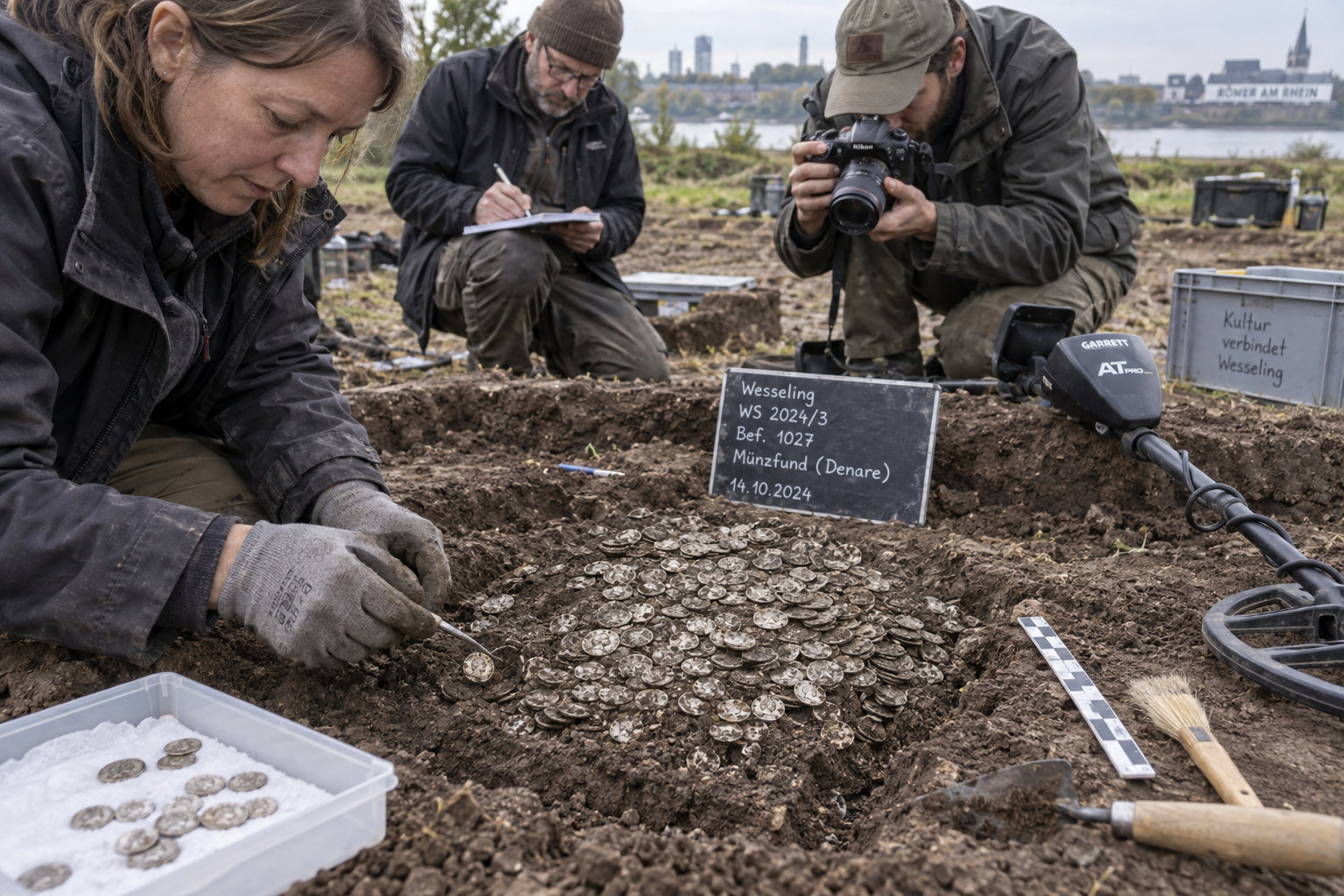
Amateur archaeologist Oliver Riedl discovered a major Roman coin hoard near Wesseling, south of Cologne, in western Germany. After his metal detector continued beeping even after he found several coins, Riedl contacted authorities. Experts excavated the site and recovered 934 Roman silver denarii weighing 3.1 kilograms. The local archaeological monuments office described it as the largest coin treasure found in Germany from the reign of Emperor Hadrian. The hoard went on display at the LVR-LandesMuseum Bonn.
Most of the coins date to the Flavian emperors (A.D. 69–96), while the oldest was minted in 148 B.C., when Rome was still a republic. Archaeologists believe the coins were deliberately buried in the second quarter of the second century A.D., perhaps for safekeeping. State archaeologist Erich Classen said the owner may have died before recovering the money or passing on information about it. The original owner's identity and exact reason for burying the hoard remain unknown.
Research associate Rahel Otte explained that an ordinary Roman legionary earned 300 denarii a year, with about half withheld for food and equipment. Saving all remaining income would have taken roughly six years to accumulate a sum equivalent to the Wesseling hoard, though its precise value at the time is difficult to estimate. The article places the discovery in the historical context of Roman control in the Cologne area, which lasted roughly from 39 B.C. to A.D. 459, and notes other recent Roman-era finds in Wales, England, Poland, and the Mediterranean.
Entities: Oliver Riedl, Erich Classen, Rahel Otte, Wesseling, Cologne • Tone: analytical • Sentiment: neutral • Intent: inform
22-09-2026
An amateur archaeologist, Oliver Riedl, discovered a large hoard of Roman silver coins near Wesseling, south of Cologne, Germany. After finding several coins with a metal detector about a year ago, he contacted authorities, who organized an expert excavation. The team recovered 934 denarii, coins dating to the 2nd century AD. The collection was presented at the LVR-LandesMuseum Bonn and is described by regional heritage officials as the largest hoard from the reign of Emperor Hadrian ever found in Germany.
Archaeologists believe the coins were buried in the second quarter of the 2nd century. Erich Classen, North Rhine-Westphalia’s chief archaeologist, said the owner may have hidden the money for safekeeping, since banks did not exist, but the reason it was never recovered remains unknown. The owner may have died before retrieving the coins or telling anyone where they were hidden.
Although Roman coin hoards are not unusual in the region, officials say few finds from the 2nd century have been as large. The collection’s modern value is difficult to calculate, but researchers can estimate its purchasing power from historical records. Rahel Otte of the state archaeological office said a legionary earned about 300 denarii a year, with roughly half deducted for food and equipment. Saving all remaining income would have taken about six years to amass the hoard.
The discovery also reflects the region’s Roman history. The Cologne area was under Roman control from about 39 BC to AD 459. Under General Marcus Vipsanius Agrippa, the Romans established a military outpost along the Rhine frontier that later grew into Colonia Agrippina, now Cologne.
Entities: Oliver Riedl, Wesseling, 934 Roman denarii, Roman Emperor Hadrian, LVR-LandesMuseum Bonn • Tone: neutral • Sentiment: neutral • Intent: inform
22-09-2026
An amateur archaeologist using a metal detector near Wesseling, south of Cologne, has helped uncover Germany’s largest known hoard of Roman silver coins dating from the reign of Emperor Hadrian. After finding several coins in a field about a year ago, Oliver Riedl contacted authorities when his detector continued to signal that more objects were buried underground. Archaeologists subsequently excavated 934 Roman silver denarii weighing 3.1 kilograms.
The hoard went on display at the LVR-LandesMuseum Bonn on September 22, 2026. Experts from the LVR Office for the Preservation of Archaeological Monuments in the Rhineland believe the coins were deliberately buried during the second quarter of the second century A.D. The reason they were never recovered remains unknown. State archaeologist Erich Classen suggested that the owner may have died before retrieving the money or informing anyone else about it. Since banks did not exist in Roman times, people may have buried valuables for safekeeping.
The discovery is especially significant because relatively few hoards from the second century are as extensive. Researchers cannot determine exactly who accumulated the money or establish its precise value at the time. However, Roman military pay provides a useful comparison. A legionary earned approximately 300 denarii annually, with about half withheld for food and equipment. According to researcher Rahel Otte, a soldier would have needed to save all of his disposable income for roughly six years to amass the collection.
The Cologne region was under Roman control from approximately 39 B.C. to A.D. 459. Under General Marcus Vipsanius Agrippa, the Romans established a military presence along the Rhine frontier, eventually creating Colonia Agrippina, the settlement that became modern Cologne.
Entities: Oliver Riedl, Erich Classen, Rahel Otte, Wesseling, Germany, Cologne • Tone: analytical • Sentiment: neutral • Intent: inform