22-09-2026
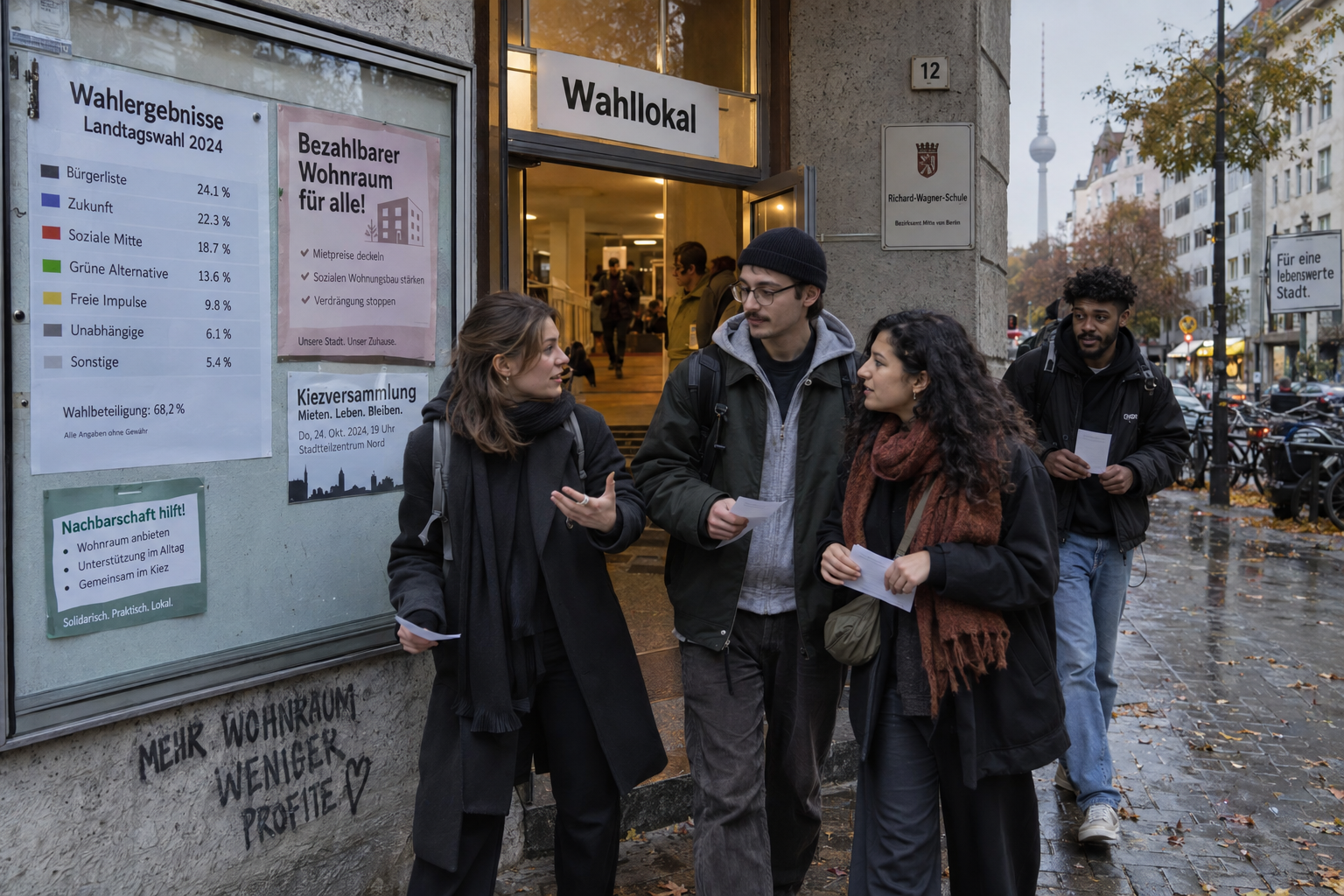
Berlin’s state election was the first in the city’s history to allow 16- and 17-year-olds to vote, adding about 55,000 people to an electorate of 2.5 million. The article examines how young voters contributed to the Left Party’s strong result and what their choices say about youth politics. Exit-poll breakdowns indicate that 43% of voters aged 16–24 supported the Left, a 25-point increase from the previous state election in 2023. Young voters interviewed by DW cited rising rents, affordable housing, and concerns about cuts to education budgets as central issues. Berlin rents have risen by about 7% in two years, and many young people approaching the age when they might move out find housing unaffordable. The Left was also seen by more voters than any other party as most likely to create affordable housing.
Researchers and youth advocates argue that the result reflects young people’s practical concerns and a desire to be heard, rather than simply a tendency toward political radicalism. Although some young voters described their generation as more extreme, the data complicates that stereotype: the Left’s largest age group was 25–34-year-olds, while the AfD’s strongest age group was 60–69-year-olds. Only 12% of voters aged 16–24 chose the AfD. Political scientist Gefjon Off says younger voters are often less attached to a particular party and more likely to choose based on the issues prominent in each election. She also notes that young people may be less affected by older generations’ associations of the Left with East Germany’s communist dictatorship. A youth study cited by the German Children’s and Youth Foundation found that young people want solidarity, participation, and positive prospects, but often experience these too rarely. The article concludes that such experiences shape their political decisions.
Entities: Berlin, Left Party, German state election, Voting age of 16, Cecilia • Tone: analytical • Sentiment: neutral • Intent: analyze
22-09-2026
Germany’s governing Christian Democratic Union (CDU) and Chancellor Friedrich Merz have come under intense pressure after major defeats in two state elections. In Mecklenburg-Western Pomerania, the CDU failed to clear the 5% threshold required to enter the state parliament—the first such failure in the party’s history. In Berlin, where the CDU had been in government, it suffered substantial losses and is expected to move into opposition.
Merz acknowledged that unpopular federal policies and dissatisfaction with his leadership contributed to the results. He also blamed the broader transformation and polarization of Germany’s political system, arguing that more than 40% of the vote went to parties offering radical or simplistic answers. He was primarily referring to the Alternative for Germany (AfD) and the Left Party. The AfD made particularly significant gains, increasing its vote share to 16% in Berlin and 38% in Mecklenburg-Western Pomerania.
AfD leaders claimed the CDU’s policy of refusing coalitions with both the AfD and the Left had helped their party. Political scientist Wolfgang Muno rejected the idea that the AfD had replaced the CDU as a broad conservative party, describing it instead as right-wing extremist. He viewed the Left Party as increasingly pragmatic and democratic, although the party faces allegations and incidents involving antisemitism connected to criticism of Israel.
In Berlin, the Left Party doubled its result to 26%, while candidate Elif Eralp presented the outcome as a victory for diversity and democracy. Meanwhile, Social Democratic Party (SPD) leader Manuela Schwesig retained a strong position in Mecklenburg-Western Pomerania and may remain premier through talks with the Greens and the Left.
The results also threaten Merz’s plans for welfare cuts and pension reform. Schwesig and some eastern CDU leaders oppose changes that could restrict the right to retire without deductions after 45 years of contributions. The SPD, which governs nationally with the CDU, wants to remain in the coalition but says it must respond to public dissatisfaction and seek compromises on the planned reforms.
Entities: Friedrich Merz, Christian Democratic Union (CDU), Mecklenburg-Western Pomerania, Berlin, Alternative for Germany (AfD) • Tone: analytical • Sentiment: negative • Intent: analyze
22-09-2026
The Kremlin said it welcomes the German far-right Alternative for Germany (AfD) party’s stated interest in opening a dialogue with Moscow, presenting the position as a contrast to what it described as the confrontational approach of German Chancellor Friedrich Merz. Kremlin spokesman Dmitry Peskov said he did not have information about reports that the AfD had been trying to establish direct contact with Moscow. However, he said the party’s growing popularity and support for restoring relations with Russia were appealing to the Kremlin.
The comments came after the AfD won first place in a state election in Mecklenburg-Western Pomerania on Sept. 20. The result followed the party’s victory in Saxony-Anhalt two weeks earlier, increasing political pressure on Merz’s government. The AfD is known for its anti-immigration stance and has gained electoral momentum in Germany.
Reuters reported the previous week that Russian President Vladimir Putin’s top economic envoy and AfD leaders had begun preparations for a meeting in 2027 to discuss the possible resumption of Russian gas supplies to Germany. Peskov did not confirm those reported preparations, but his remarks indicated that Moscow views the AfD’s rising influence and advocacy of renewed relations positively.
The article highlights the widening political divide within Germany over its relationship with Russia. While the Kremlin characterizes Merz’s public statements as hostile, it sees the AfD’s electoral gains and interest in dialogue as potentially favorable developments. The report does not indicate that formal talks have been arranged or that gas supplies will resume; it presents those developments as reported efforts and political positions rather than confirmed policy changes.
Entities: Kremlin, Dmitry Peskov, Vladimir Putin, Friedrich Merz, Alternative for Germany (AfD) • Tone: analytical • Sentiment: neutral • Intent: inform
22-09-2026
The supplied material is only the headline and opening sentence of a Washington Post article, so it does not include enough reporting to establish the full election results, the parties’ gains, or what voters said about their choices. The headline frames victories by Germany’s far left and far right as evidence that voters are dissatisfied with conventional politics. The opening scene illustrates a striking setback for the Christian Democratic Union (CDU), a major force in German politics and the party of Chancellor Friedrich Merz: at a party watch gathering in Berlin, attendees audibly gasped when results showed the CDU would not win seats in a state legislature. The article says this was the first time since the party was founded in 1945 that it failed to secure seats in a state legislature. This moment suggests a sharp break with the CDU’s longstanding presence in German state politics. However, the excerpt provides no state name, vote totals, identities of the successful far-left or far-right parties, or further explanation of the causes and consequences. Its central reported point is therefore limited: an election outcome signaled a significant CDU defeat, while the headline interprets gains at both ideological extremes as a sign of broader frustration with politics as usual. The full article would be needed to assess the results and that interpretation in detail.
Entities: Mary Ilyushina, Maegan Vazquez, Friedrich Merz, Christian Democratic Union (CDU), Berlin • Tone: analytical • Sentiment: negative • Intent: analyze