15-09-2026
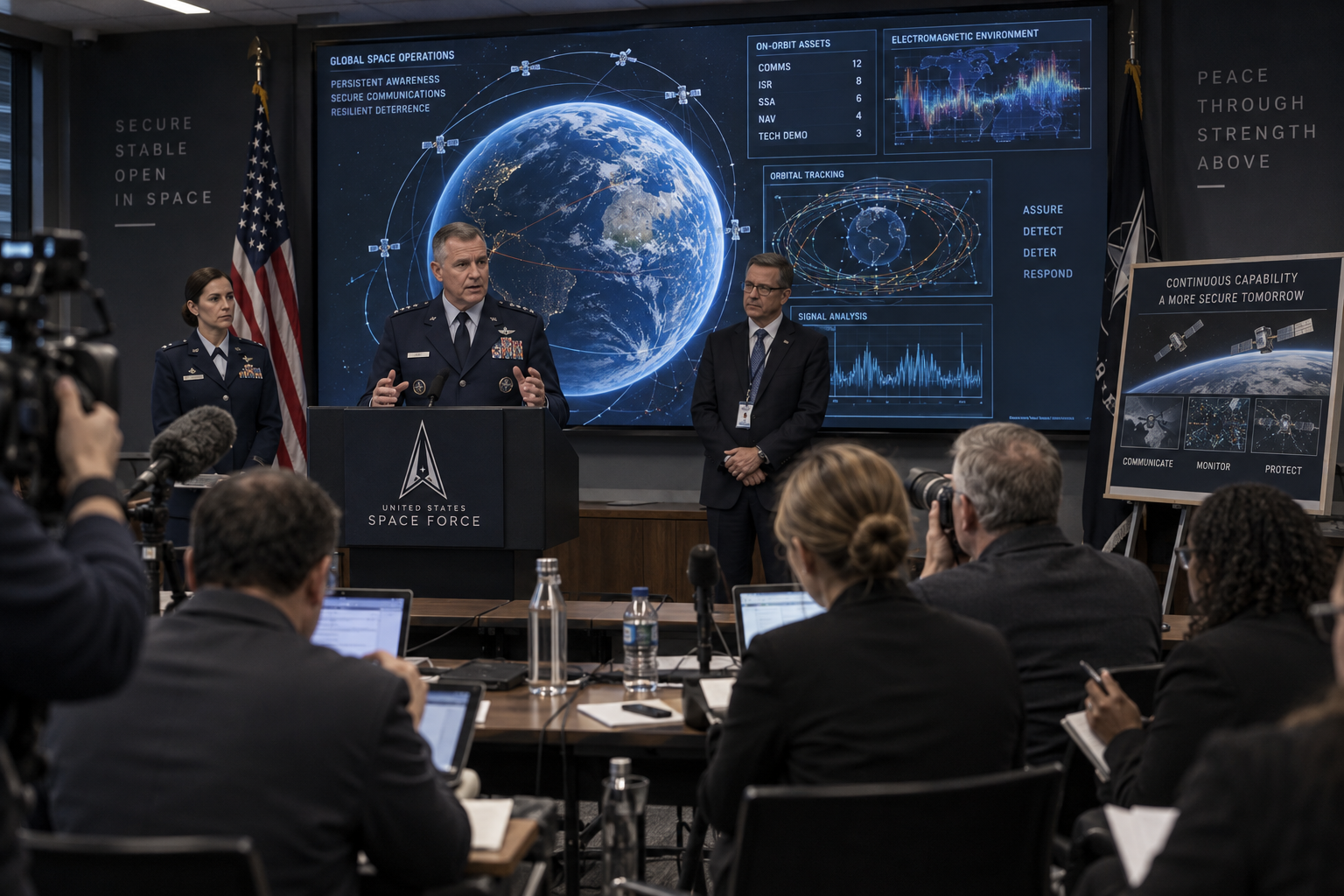
The United States has acknowledged for the first time that it has deployed a weapon in orbit with offensive capabilities. US Secretary of the Air Force Troy Meink said the “on orbit” weapon was necessary to protect American forces from hostile actions, but he did not disclose what the system can do or when it was launched.
The announcement comes as the US, China and Russia expand military programmes designed to protect their own satellites and potentially disrupt or destroy those of adversaries. A US Space Force spokesperson said space-control missions can use kinetic and non-kinetic methods, including disruption, degradation and destruction, for both offensive and defensive purposes.
Experts said the weapon could be an electronic-warfare or radio-jamming platform capable of interfering with communications. Another possibility is a kinetic system that physically destroys satellites, although RUSI expert Dr Bleddyn Bowen said this was less likely because it could create dangerous orbital debris. The lack of official information means the system’s nature remains uncertain.
China condemned the deployment and urged Washington to stop expanding its military capabilities and preparing for conflict in outer space. The development also forms part of a wider US effort to strengthen space-based defence, including the proposed “Golden Dome” missile-defence system. The US Space Force, established in 2019, has increasingly been tasked with both defending American space assets and countering foreign systems. A 1967 treaty bans weapons of mass destruction in orbit, but does not prohibit many other anti-satellite or counterspace technologies. The article notes that Russia and China have continued developing such capabilities, raising concerns about a potential arms race and the growing militarisation of space.
Entities: United States, Troy Meink, Donald Trump, China, Russia • Tone: analytical • Sentiment: negative • Intent: inform
15-09-2026
The United States has publicly acknowledged for the first time that the Space Force has deployed weapons in orbit. Air Force Secretary Troy Meink made the disclosure at the Air and Space Cyber Conference, saying the U.S. possesses “on-orbit space control weapons” capable of protecting American forces from hostile action. He did not identify the weapons or say when they were deployed.
Experts said the capability could include reversible systems, such as jamming or other forms of interference, or kinetic weapons capable of permanently destroying targets. The disclosure is significant because it officially confirms an orbital weapon capability after years of counterspace development and testing by the United States, China, and Russia. Analysts said the announcement could be intended to deter adversaries from interfering with U.S. space systems and to reinforce the Space Force’s role as a warfighting branch.
However, Victoria Samson of the Secure World Foundation described the statement as highly destabilizing. China and Russia could respond by revealing or demonstrating their own space capabilities, although experts expect an initial diplomatic response accusing Washington of militarizing space and preparing for conflict.
Meink also characterized the broader security environment as a rapidly accelerating threat driven by adversaries’ use of artificial intelligence, autonomous systems, drones, and hybrid attacks. He said the U.S. would increase combat power through large numbers of highly autonomous systems and cheaper weapons, predicting that the Air Force would look radically different by 2032. His comments reflect lessons from the war in Ukraine, which has demonstrated the growing importance of drones, AI, and autonomous warfare. The article also notes that investor interest in commercial space has increased following SpaceX’s successful public listing.
Entities: Troy Meink, Victoria Samson, Juliana Suess, U.S. Air Force, U.S. Space Force • Tone: analytical • Sentiment: negative • Intent: inform
15-09-2026
The United States has acknowledged for the first time that it has weapons deployed in orbit. The US Space Force said these are “on-orbit space control weapons” intended to defend US military forces against hostile actions by adversaries. The service did not identify the weapons or explain their capabilities in detail, but said space-control operations can use both kinetic and non-kinetic methods to disrupt or affect an opponent’s space assets. Such capabilities may be used for offensive as well as defensive purposes. US Air Force Secretary Troy Meink separately confirmed the existence of American space weapons at a military conference.
The Space Force justified the deployment by pointing to Russia and China, describing both countries as significant threats to US interests in space. It said China is developing space and counterspace systems as part of its military modernization program, while Russia considers space a battlefield and believes control of it could determine future conflicts.
China responded by urging the United States to stop expanding its military capabilities and “preparing for war” in outer space, warning that the development of such weapons could trigger an arms race. Russia likewise called for space to remain free of weapons and said it hoped for broader international cooperation toward the complete demilitarization of space.
The article places the announcement in the broader historical context of space militarization. The 1967 Outer Space Treaty prohibits the deployment of nuclear weapons in space, but it does not ban many other military activities. The United States, Russia, China and India have explored capabilities that could be used in space conflict, including attacks on satellites supporting military communications, navigation and surveillance. The US disclosure therefore highlights growing strategic competition in orbit and the limitations of existing international rules.
Entities: United States, US Space Force, Donald Trump, Troy Meink, Russia • Tone: analytical • Sentiment: neutral • Intent: inform
15-09-2026
The United States has weapons deployed in orbit, according to a Sept 14 statement from the US Space Force. The disclosure is the first official confirmation that the US possesses “on-orbit space control weapons,” although the Space Force did not identify the systems or explain where they are deployed.
A Space Force spokesperson said the weapons are capable of defending US military forces, known as the Joint Force, against hostile actions by adversaries. The agency described “space control” as operations intended to contest and control the space domain through both kinetic and non-kinetic methods. These capabilities could be used for offensive as well as defensive purposes, indicating that the systems may be intended not only to protect American satellites and military assets but also to interfere with or disable an opponent’s space capabilities.
The statement identified China and Russia as the United States’ main geopolitical rivals in space. According to the Space Force, China is developing and operating space and counterspace systems as part of its military modernization, while Russia regards space as a warfighting domain and considers space superiority potentially decisive in future conflicts.
The article places the announcement in the broader history of space militarization. Since the launch of the Soviet satellite Sputnik in 1957, the US and the Soviet Union have explored ways to arm space and destroy satellites. The 1967 Outer Space Treaty prohibits weapons of mass destruction in orbit, but it does not ban all military activity or conventional anti-satellite capabilities. Russia, the US, China and India have consequently continued developing methods to target satellites, which are essential for communications, surveillance and navigation. The disclosure highlights the growing strategic importance and risks of military competition in orbit.
Entities: United States, US Space Force, Washington, Russia, China • Tone: analytical • Sentiment: negative • Intent: inform