15-09-2026
Saudi Arabia is facing increasingly difficult security and economic choices as Iran-backed Houthi forces intensify their campaign in Yemen and threaten critical Saudi infrastructure and regional trade routes. Houthi attacks on Saudi Arabia reportedly injured 13 people on one night, bringing the number injured since the conflict escalated in July to approximately 100. The Houthis have also disrupted Saudi oil shipments through the Bab el-Mandeb Strait, while an alleged attack by Iranian proxy militias on the East-West pipeline has further endangered the kingdom’s ability to export crude. Repairs to the 1,200-kilometer pipeline could take weeks.
Experts quoted by DW say Riyadh must balance military deterrence with diplomacy. Saudi Arabia has a highly capable military but is reluctant to return to a costly intervention in Yemen, where it led a coalition supporting the internationally recognized government from 2015. Fighting eased after a UN-brokered truce in 2022, but the Houthis’ renewed attacks seek to pressure Riyadh to lift remaining air and sea blockades on Houthi-held areas. Recent Houthi gains, including the capture of port cities and Perim Island, have increased their ability to threaten global shipping and oil supplies through the Bab el-Mandeb Strait.
The crisis also exposes Saudi Arabia’s dependence on external partners. Crown Prince Mohammed bin Salman reportedly requested US military assistance from President Donald Trump but received only intelligence support, while the Mecca Joint Defense Agreement with Turkey and Pakistan remains untested. Domestically, the government faces public demands for economic progress and security as it pursues Vision 2030, Expo 2030, and the 2034 FIFA World Cup. Human rights groups also accuse authorities of suppressing criticism of the war and imposing severe sentences on peaceful dissenters. The conflict has displaced about 85,000 people, adding a humanitarian dimension to Saudi Arabia’s strategic and political pressures.
Entities: Saudi Arabia, Houthis, Yemen civil war, Mohammed bin Salman, Iran • Tone: analytical • Sentiment: negative • Intent: analyze
15-09-2026
Qatar has warned that losing access to Bab el-Mandeb, the strategic maritime gateway between the Gulf of Aden and the Red Sea, would create a global catastrophe while shipping through the Strait of Hormuz is already being disrupted. Ibrahim bin Sultan Al Hashmi, director of media and communication at Qatar’s foreign ministry, said the international community could not afford to add another blocked waterway to the existing crisis. He urged countries to prevent the disruption of international waterways from becoming the “new normal” and called for negotiations to resolve the conflicts.
The warning follows territorial gains by the Iran-backed Houthi movement in Yemen. Houthi and internationally recognised government officials said the group had captured the Greater and Lesser Hanish islands in the southern Red Sea after government-allied forces withdrew. The Houthis also control the port of Mokha and Perim Island, which lies at the entrance to Bab el-Mandeb. Saudi-backed government forces are attempting to regroup after these losses.
The Houthis have attacked Saudi oil infrastructure and Red Sea shipping after announcing a blockade on Saudi shipping in July. These attacks are adding pressure to energy supplies during the wider Iran war. Separately, US and Iranian blockades have disrupted shipping through the Strait of Hormuz.
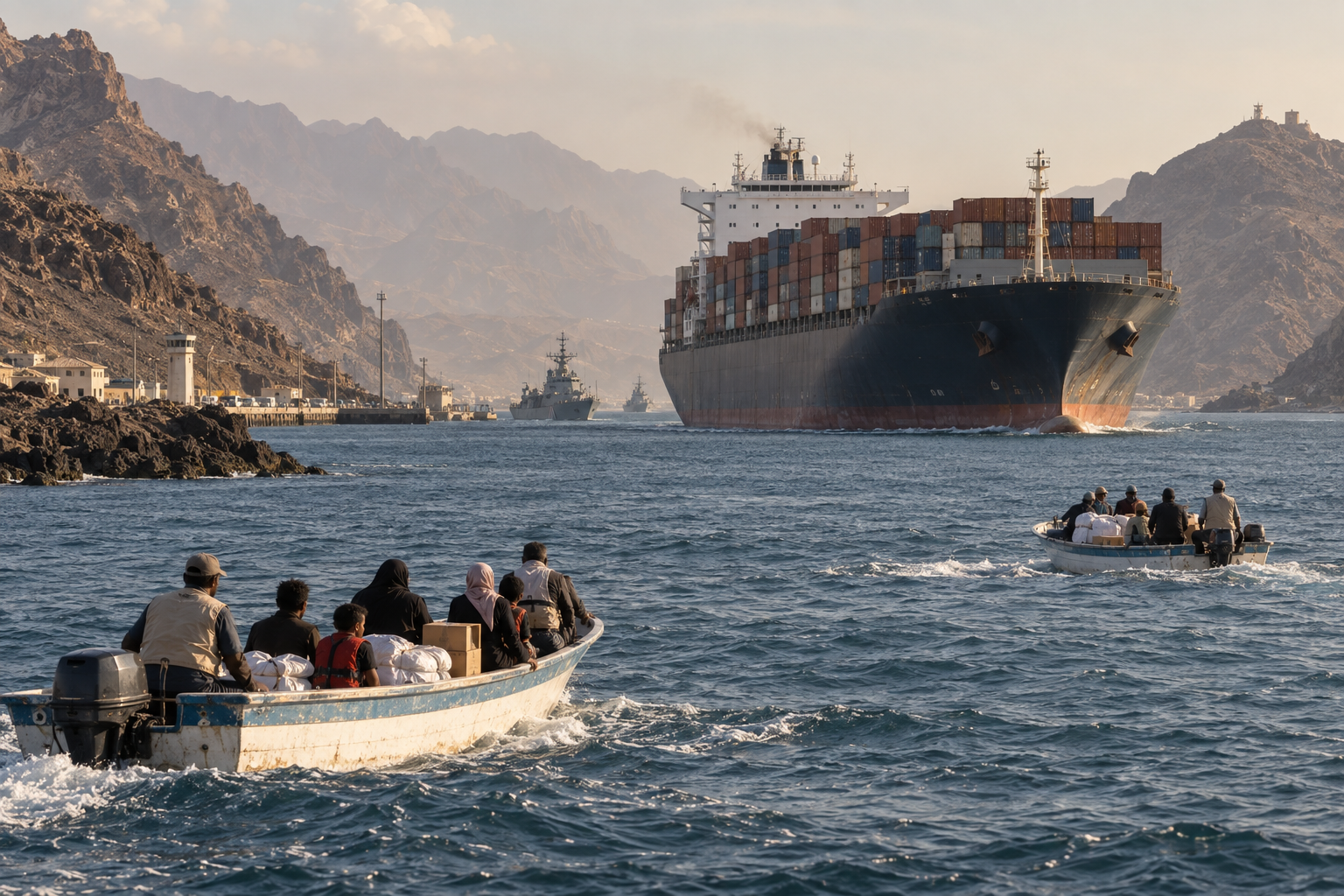
Bab el-Mandeb is vital because ships traveling between Asia and Europe via the Suez Canal must pass through the strait. Earlier Houthi attacks caused vessels to reroute around southern Africa, increasing travel times and costs. Although Saudi Arabia’s East-West pipeline can transport oil to Red Sea ports while bypassing Hormuz, tankers leaving those ports still need Bab el-Mandeb to reach global markets. Qatar says it is working with regional and international partners to support negotiations on freedom of navigation and believes diplomacy is the only viable solution.
Entities: Qatar, Ibrahim bin Sultan Al Hashmi, Houthis, Bab el-Mandeb, Strait of Hormuz • Tone: urgent • Sentiment: negative • Intent: warn
15-09-2026
The National’s editorial argues that Iran cannot simultaneously pursue improved relations with its Gulf neighbours while supporting or tolerating armed groups that threaten them. The argument comes amid Houthi advances in Yemen, new attacks claimed against Saudi Arabia, and the postponement of planned Iran-Gulf discussions in Oman. The editorial presents these developments as evidence of a contradiction in Tehran’s regional policy: diplomatic efforts to reduce tensions are being undermined by missile and drone attacks carried out by Iranian-backed groups.
The article warns that the consequences extend beyond Yemen and Saudi Arabia. Houthi expansion near the Red Sea and the Bab Al Mandeb gives Iran strategic influence over a major maritime corridor and creates additional risks for international shipping and energy supplies. The fighting has reportedly displaced about 80,000 people, while more than 2,000 Yemeni refugees have arrived in Djibouti. These developments add to the humanitarian suffering caused by Yemen’s long-running conflict.
Although the editorial insists that diplomacy should continue, it says future negotiations must address the full scope of Iran’s regional power, including its missiles, drones, support for armed proxies, and threats to maritime routes. Gulf states have strong reasons to seek stability with Tehran, but the editorial maintains that Iran has the greater need to establish constructive ties with its neighbours. It concludes that a sustainable Gulf-Iran understanding will require more than assurances of non-interference or goodwill. Tehran must demonstrate that its regional ambitions will not compromise the security of neighbouring countries; otherwise, diplomacy will remain constrained by the same power struggles it seeks to resolve.
Entities: Iran, The Houthis, Yemen, Saudi Arabia, Gulf countries • Tone: analytical • Sentiment: negative • Intent: critique
15-09-2026
The article reports that a rapid Houthi offensive along Yemen’s Red Sea coast has increased Iran’s strategic leverage in its confrontation with Washington. The Houthis are described as Iranian-backed militants, and their apparent control of territory near the Bab al-Mandab Strait gives Tehran the ability to threaten a major maritime chokepoint. The passage presents this development as part of Iran’s broader “war of economic attrition” with the United States, suggesting that pressure on commercial shipping could become an important instrument of geopolitical and economic coercion.
The article emphasizes the global significance of the Bab al-Mandab Strait, portraying it as a waterway with an even broader role in international shipping than the Strait of Hormuz. By linking the Houthi advance to the strait, the report indicates that developments in Yemen could have consequences well beyond the Middle East, potentially affecting shipping routes and the wider global economy.
The provided material is only a headline, byline, and opening paragraph; it does not include further details about the offensive, the territory captured, specific shipping threats, U.S. responses, or Iranian and Houthi statements. Therefore, the central point supported by the excerpt is that Houthi gains on Yemen’s Red Sea coast have expanded Iran’s ability to exert pressure on Washington by threatening access to a strategically important global trade route.
Entities: Iran, Tehran, Houthi militants, Yemen, Red Sea coast • Tone: analytical • Sentiment: negative • Intent: analyze