15-09-2026
The article warns that escalating conflict across the Middle East could drive Brent crude oil prices toward US$150 per barrel and significantly increase fuel costs worldwide. The Strait of Hormuz, the Red Sea and parts of Saudi Arabia are described as active war zones, threatening routes that carry a substantial share of global oil supplies.
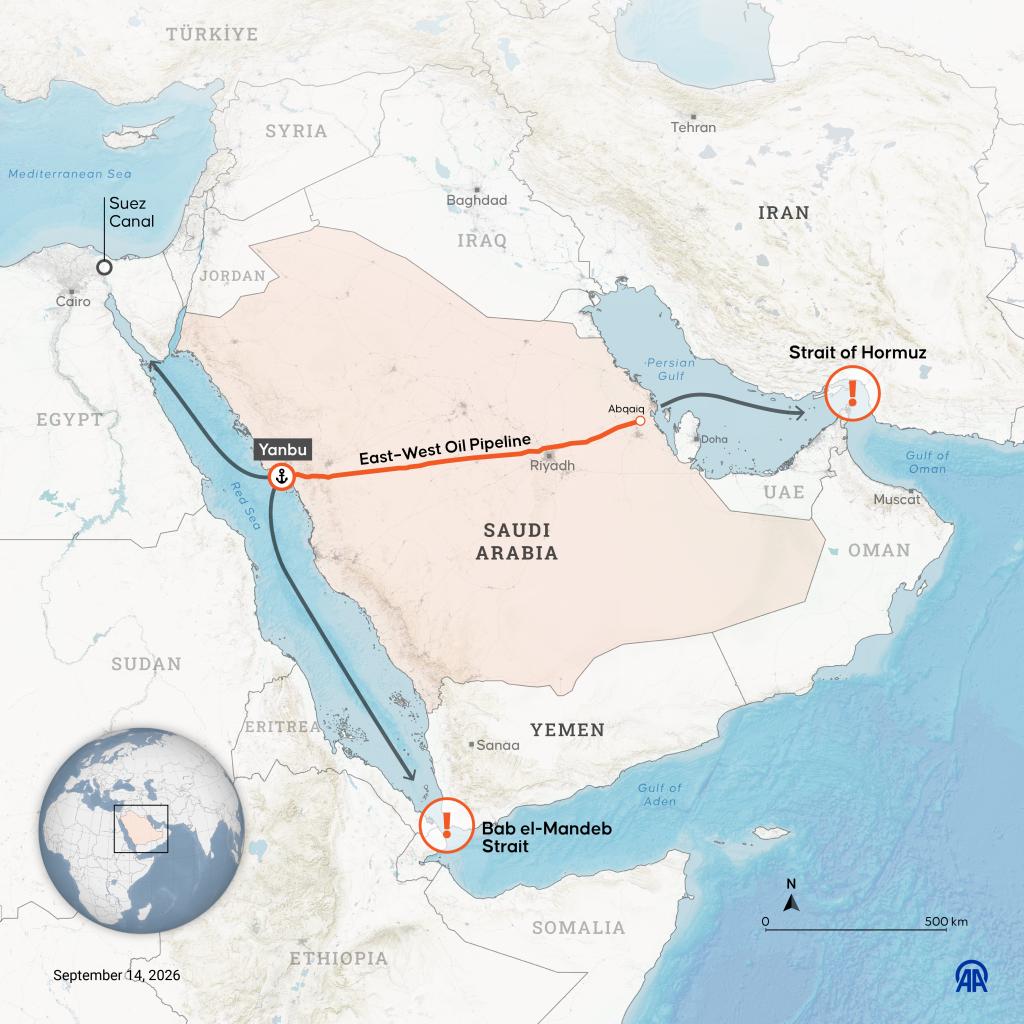
Iran-aligned Houthi forces in Yemen reportedly launched missiles and drones at a Saudi military air base, following an attack that disabled Saudi Arabia’s East-West pipeline. The pipeline had enabled tankers to bypass the Strait of Hormuz, through which roughly 20 per cent of the world’s oil normally passes. Houthi advances, including the capture of Perim Island near the Red Sea entrance, and a reported attack on another vessel have further heightened concerns about shipping and supply disruptions.
The conflict is also creating difficulties for the United States and President Donald Trump, as Washington has reportedly resisted Saudi requests for direct military intervention. Oil prices have already risen sharply: Brent crude exceeded US$107 per barrel, West Texas Intermediate reached US$103, and Australia’s Tapis benchmark climbed to US$110, up 46 per cent since July.
The increase is expected to flow through to Australian motorists. The NRMA said wholesale and retail fuel-price margins had effectively disappeared, with average unleaded petrol at $2.19 per litre and diesel at $2.68. Commonwealth Bank strategist Vivek Dhar estimates that global oil inventories could fall to critically low levels within five to 11 weeks. If supplies are depleted, Brent may need to reach about US$150 to force demand reductions in emerging Asian economies. The article concludes that Iran’s increased leverage could make it harder for the United States to end the conflict without appearing to capitulate, while households worldwide face higher energy and living costs.
Entities: Strait of Hormuz, Red Sea, Saudi Arabia, Yemen-aligned Houthi movement, Iran-US war • Tone: urgent • Sentiment: negative • Intent: inform
15-09-2026
The article reports that oil prices remain above $100 per barrel as the Iran war continues to disrupt energy markets and regional shipping. Brent crude settled at $105.68 per barrel, while U.S. crude traded near $101, more than 20% higher than a month earlier. Talks scheduled in Muscat between Oman, Iran and other regional countries about future control of the Strait of Hormuz were postponed to allow more time to build consensus.
The conflict’s effects are extending beyond the Strait of Hormuz. Iran-backed Houthi forces in Yemen intensified their offensive against Saudi-backed government forces and captured parts of Yemen’s Red Sea coast, strengthening their control over the Bab el-Mandeb Strait, a major route for Saudi oil shipments. Saudi Arabia and Egypt are coordinating diplomatically, with Crown Prince Mohammed bin Salman scheduled to meet Egyptian President Abdel Fattah al-Sisi. Egypt reportedly rejected a Houthi proposal to coordinate maritime traffic through the Red Sea.
The article also details the financial cost of the war to the United States. A Defense Department inspector general report estimated that the Pentagon had spent $33.4 billion during the conflict’s first four months, including $22.3 billion in munitions, $3.7 billion in destroyed equipment and $7.4 billion in additional operating costs. Up to 30 MQ-9 Reaper drones and four F-15E fighter jets were reportedly lost. Damage to U.S. military facilities and diplomatic posts was not fully included in the estimate, and the war has contributed to concerns about depleted munitions stockpiles and production bottlenecks.
President Trump said the United States was open to a deal with Iran and called for other countries to reimburse Washington for protecting shipping through the Strait of Hormuz. Iran, meanwhile, condemned the reported exclusion of its nuclear chief from an International Atomic Energy Agency conference as a dangerous precedent.
Entities: Iran war, Strait of Hormuz, Oman, Iran, Brent crude oil • Tone: urgent • Sentiment: negative • Intent: inform
15-09-2026
The article reports escalating consequences of the U.S.-Iran war, including its financial cost, diplomatic uncertainty, threats to shipping, and expanding conflict involving Iran-backed Houthi rebels. A Pentagon inspector general report submitted to Congress estimates that the war cost the United States $33.4 billion through mid-June, primarily for munitions. The estimate excludes hundreds of millions of dollars spent by other agencies evacuating people from the Middle East and repairing diplomatic facilities damaged by Iranian attacks.
President Donald Trump indicated that the United States might reopen direct negotiations with Iran, saying he would personally decide whether the country would engage and that the concept was under consideration. Iran rejected what a senior official described as Trump's “mixed signals,” arguing that circumstances had changed and refusing talks until Iran's conditions were met.
The article also focuses on Houthi attacks connected to the broader regional conflict. Human Rights Watch said recent Houthi attacks on commercial vessels in the Red Sea and Gulf of Aden likely constituted war crimes in at least three cases because they endangered civilian crews and targeted civilian shipping. The attacks followed the Houthis' announcement of a blockade of Saudi Arabia's Red Sea ports.
Regional tensions have also affected key maritime routes. The United Nations Security Council was expected to discuss the threat to the Bab el-Mandeb Strait, while Qatar warned that closing the waterway would be catastrophic for global energy markets. Kuwait condemned Houthi missile and drone attacks on Saudi cities, and Saudi Arabia pledged a firm response after 13 civilians were reportedly wounded. Separately, Oman's navy evacuated 23 people from an oil tanker fire in the Gulf of Oman, near the Strait of Hormuz, underscoring the dangers facing commercial shipping.
Entities: Donald Trump, Iran, United States, U.S. military inspector general, Human Rights Watch • Tone: urgent • Sentiment: negative • Intent: inform
15-09-2026
Oil prices extended their gains on Tuesday as escalating conflict involving Iran, the United States, Yemen’s Houthi movement, and Saudi Arabia raised concerns about further disruptions to global crude supplies. Brent crude futures for November delivery rose 1.28% to $107.03 per barrel, while U.S. West Texas Intermediate futures for October gained 1.50% to $102.91.
The market was already tight after Saudi Arabia closed its East-West pipeline, which normally allows oil to bypass the Strait of Hormuz. The closure followed drone damage to the pipeline attributed to launches from Iraq, increasing pressure on supplies as tensions continued across the Gulf region. The Saudi-led coalition in Yemen reportedly said that 13 civilians were injured in a wave of Houthi ballistic-missile and drone attacks on Saudi Arabia.
Iran also said its military had destroyed an advanced U.S. drone over the Strait of Hormuz, following other operations targeting American unmanned naval systems. U.S. President Donald Trump said the United States could continue its campaign against Iran and potentially take control of Iranian oil, adding to fears of a broader confrontation.
The United States and Iran also disputed the circumstances surrounding the Panama-flagged oil tanker El Gaia. Iran’s Islamic Revolutionary Guard Corps claimed that the vessel had struck a naval mine, but U.S. Central Command said the tanker had instead been hit by an Iranian missile the previous month and rendered inoperable. CENTCOM described Iran’s account as an attempt to intimidate commercial shipping.
Economist Komal Sri-Kumar warned that attacks on oil infrastructure and the closure of Saudi Arabia’s pipeline could push inflation higher. He also said an accelerating tariff war could add further upward pressure to prices and bond yields.
Entities: Brent crude, West Texas Intermediate (WTI), Saudi Arabia, East-West pipeline, Strait of Hormuz • Tone: urgent • Sentiment: negative • Intent: inform
15-09-2026
Saudi Arabia’s temporary closure of its East-West pipeline has placed more than 4 million barrels per day of crude export capacity at risk and forced additional oil toward the Strait of Hormuz, a strategically vulnerable shipping route. The pipeline normally transports crude from Abqaiq on the eastern Gulf coast to Yanbu on the Red Sea, allowing Saudi Arabia to bypass Hormuz. Although its design capacity is approximately 7 million barrels per day, analysts say the current damage to at least one pumping station may be more serious than in previous attacks.
The disruption comes as conflict involving the United States, Iran, the Iran-backed Houthis and Saudi Arabia threatens multiple regional energy and shipping routes. Analysts warn that Saudi Arabia may have only five to seven days of inventories available to cushion exports before the shutdown produces a much larger price shock. Brent crude recently traded above $106 per barrel, while West Texas Intermediate exceeded $102, with both benchmarks posting substantial monthly gains.
Global oil inventories have already declined by approximately 1 billion barrels during the broader Middle East conflict. Although analysts estimate another billion barrels may remain available before storage reaches critically low levels, the market is becoming increasingly vulnerable to further disruptions. Every additional day that the Strait of Hormuz remains constrained could tighten supply and increase upward pressure on prices.
The repair timeline is uncertain. Satellite imagery suggests extensive fire damage, and one analyst estimates that repairs could take months. Even if the East-West pipeline resumes operations, the Red Sea route and the Bab el-Mandeb strait may remain threatened by continued regional hostilities. Analysts describe the situation as a feedback loop in which attacks restrict exports, shipping disruptions delay replacement parts, and repairs become more difficult. Gulf states appear to be mobilizing diplomatically and operationally, but the article concludes that oil prices are unlikely to fall below $100 per barrel soon.
Entities: Saudi Arabia, East-West Pipeline, Strait of Hormuz, Abqaiq, Yanbu • Tone: urgent • Sentiment: negative • Intent: analyze
15-09-2026
The France 24 liveblog reports that a series of Houthi attacks using ballistic missiles and drones wounded 13 civilians in southern Saudi Arabia on September 15, 2026. The incidents occurred amid a broader escalation involving Yemen’s Houthi movement, Saudi Arabia, Iran and the United States. The Houthis are described as Iran-backed forces, while Saudi Arabia reportedly responded to attacks on military facilities in the kingdom with dozens of airstrikes in western Yemen.
The article also highlights a reported assessment by the US Department of Defense’s inspector general that the United States is experiencing an ammunition shortfall because of the costly war in Iran. The report places this development within the wider context of the ongoing Middle East conflict and the military demands associated with it.
The liveblog’s recap of the previous day includes several significant diplomatic and military developments. US President Donald Trump said he was willing to negotiate with Iran, reversing or softening his earlier position that it was too soon to pursue a deal with Tehran to end the war. Saudi Arabia also requested that a meeting between Tehran and Gulf countries on the Strait of Hormuz be postponed. The meeting had been scheduled to take place in Oman.
The available material is a brief opening update rather than a complete liveblog, and the webpage subsequently indicates that the requested content is unavailable. It does not provide further details about the casualties, the precise locations of the attacks, the extent of damage, or the US ammunition shortage. The report credits France 24 along with Reuters, the Associated Press and Agence France-Presse for its updates.
Entities: Houthi armed forces, Yemen, Saudi Arabia, Iran, United States • Tone: urgent • Sentiment: negative • Intent: inform
15-09-2026
A France 24 live update dated September 15, 2026, reports that Iran has rejected renewed talks with the United States after President Donald Trump expressed openness to resuming negotiations. Iran’s security chief criticised what he described as “mixed signals” from Trump, who had previously said it was too early to reach a deal with Tehran to end the Middle East war. The diplomatic impasse is unfolding alongside mounting military pressures, including a reported US ammunition shortfall linked to the conflict, according to the Pentagon’s inspector general.
The article recaps several major developments from the previous day. Trump indicated that he was willing to negotiate with Iran after weeks of ruling out an immediate agreement. Saudi Arabia carried out dozens of air strikes on western Yemen in response to attacks by Iran-backed Houthi rebels against military facilities in Saudi territory. The Houthi attacks reportedly wounded 13 civilians in southern Saudi Arabia, as reflected in the article’s URL and headline context. Saudi Arabia also requested that a planned meeting between Tehran and Gulf states concerning the Strait of Hormuz be postponed. The meeting was scheduled to take place in Oman.
The update presents the developments as part of a broader regional crisis involving Iran, the United States, Saudi Arabia, Yemen, and the strategic Strait of Hormuz. It highlights the gap between Washington’s stated openness to diplomacy and Tehran’s refusal to engage, while also pointing to continued military escalation and logistical strain. The supplied content appears to be only a partial liveblog entry and ends with a notice that the requested page is unavailable, so it does not provide subsequent updates or reactions from the parties involved.
Entities: Iran, United States, Donald Trump, Iranian security chief, Saudi Arabia • Tone: urgent • Sentiment: negative • Intent: inform
15-09-2026
France 24 reports that Iran has rejected renewed negotiations with the United States after President Donald Trump said he was open to resuming talks. Iran’s security chief criticised what he described as “mixed signals” from Trump, highlighting the continuing diplomatic impasse between Tehran and Washington amid the broader Middle East war. Trump had previously said it was too early to negotiate a deal with Iran, making his latest comments appear to represent a shift in position.
The report also says the US military is experiencing an ammunition shortfall linked to the conflict, according to a report from the Pentagon’s inspector general. The development adds a logistical and strategic dimension to the ongoing war, suggesting that sustained military operations may be placing pressure on American stockpiles.
The liveblog’s key developments from the previous day included Saudi Arabia carrying out dozens of air strikes on western Yemen. The strikes followed attacks by Iran-backed Houthi rebels against military facilities in Saudi Arabia. The violence underscores the regional nature of the conflict and the continuing involvement of Iran-aligned armed groups.
Saudi Arabia also reportedly asked to postpone a planned meeting between Tehran and Gulf powers concerning the Strait of Hormuz. The meeting was scheduled to take place in Oman on Monday, but its delay reflects the heightened tensions surrounding the strategically important waterway and relations between Iran and Gulf states.
The article presents these developments as part of an ongoing live update, drawing on reporting from Reuters, the Associated Press and Agence France-Presse. It focuses on stalled diplomacy, military escalation, regional proxy conflict and the potential impact of the war on US military resources and Gulf security.
Entities: Iran, United States, Donald Trump, Saudi Arabia, Houthi rebels • Tone: urgent • Sentiment: negative • Intent: inform
15-09-2026
The article warns that the Houthi rebels’ expanding control along Yemen’s western coast and over the Bab al-Mandeb Strait is creating a major new threat to Saudi Arabia’s oil infrastructure and global energy supplies. The group, backed by Iran, has reportedly captured Mokha and other strategic sites, announced a maritime blockade of Saudi ships, and threatened Saudi Arabia’s East-West Pipeline and the Abqaiq oil-processing facility.
The risks are significant because Saudi Arabia has redirected much of its crude exports through the Red Sea after Iran effectively closed the Strait of Hormuz. A Houthi-controlled Bab al-Mandeb could force oil tankers to take a much longer route around Africa, disrupting shipments and increasing costs. Saudi crude exports through its principal Red Sea port have already fallen sharply, according to the International Energy Agency. The article also cites warnings that the narrow strait would be difficult to protect with military escorts.
The 745-mile East-West Pipeline is particularly vulnerable because damage to a single section could disable the entire system. The pipeline has carried roughly 4 million barrels of crude daily during the conflict, while the Abqaiq facility processes about 7% of the world’s crude supply. Following a reported attack on the pipeline, Brent crude rose above $109 per barrel and the U.S. benchmark reached $105.
The article describes a difficult U.S. response. The Trump administration previously conducted a 53-day bombing campaign against the Houthis but has hesitated to launch further attacks despite Saudi appeals. President Trump has publicly downplayed the escalation and said negotiations could resolve the conflict, while Vice President JD Vance confirmed that Washington is holding direct talks with the Houthis. Security experts quoted in the article argue that the attacks demonstrate the broader ability of Iran’s regional network to threaten energy markets beyond the Strait of Hormuz.
Entities: Houthi rebels, Saudi Arabia, Iran, Yemen, Bab al-Mandeb Strait • Tone: urgent • Sentiment: negative • Intent: inform
15-09-2026
Saudi Arabia has warned that it will respond “firmly” to a series of Houthi missile and drone attacks that wounded 13 civilians in the kingdom’s southern regions. The Houthi movement claimed it launched a large-scale assault involving dozens of ballistic missiles and drones against the King Khalid airbase in Khamis Mushait. Saudi authorities also reported attacks on Abha and Taif, while air-raid alerts were issued in six regions. The Saudi-led coalition said it had conducted more than 50 retaliatory strikes in Yemen.
The attacks follow a major escalation in Yemen’s civil war. The Houthis have renewed fighting with Saudi-backed government forces since July, declared a maritime blockade on Saudi Arabia, and targeted shipping in the Red Sea. The group reportedly seized Yemen’s Red Sea coast and the Bab al-Mandab Strait, a strategically important waterway whose significance has increased as the wider US-Iran conflict disrupts traffic through the Strait of Hormuz. Houthi attacks on Saudi oil infrastructure have also contributed to crude prices rising above US$100 a barrel.
The conflict has caused further casualties and displacement. Eight government soldiers were reportedly killed in western Yemen, while government forces said they recaptured positions in Taiz and killed at least 10 Houthi fighters. The UN’s migration agency said renewed fighting had forced 93,864 people from their homes.
The escalation is occurring amid stalled regional diplomacy. A planned Gulf states-Iran meeting about the future of the Strait of Hormuz was postponed, with Tehran accusing Riyadh of using Yemen as a pretext. Iran says the Houthis act independently, although it has long supported them with weapons and technology. US President Donald Trump said he remained open to talks with Iran, but Iranian officials rejected negotiations until their conditions are met. Saudi Crown Prince Mohammed bin Salman also held discussions with senior Egyptian and US military officials about regional developments.
Entities: Saudi Arabia, Houthi movement, Yemen civil war, Saudi-led coalition, Khamis Mushait • Tone: urgent • Sentiment: negative • Intent: inform
15-09-2026
The supplied extract is a live-news page from The National covering the latest developments in the Iran war and its wider regional consequences. It does not include the full narrative article body; instead, it contains the headline, update summaries and related video headlines. The main development is an exchange of fire between Saudi Arabia and the Houthis. The Houthis claim to have attacked Saudi military facilities after hundreds of Saudi-led air strikes in Yemen, while another update reports that a Houthi projectile struck Saudi Arabia’s Jazan region. Saudi Arabia has reportedly shut a pipeline amid the attacks, pushing oil prices close to $108 per barrel. Satellite imagery is said to show damage to the East-West pumping station, highlighting the potential impact on energy infrastructure and global markets. The page also reports that the Saudi Crown Prince and the head of US Central Command discussed regional developments. Other updates describe Israeli strikes on a town in southern Lebanon that killed 13 people and an Israeli strike on a residential area in Gaza. The humanitarian consequences include Djibouti receiving approximately 1,400 refugees from Yemen. A separate report says an Iranian attack left a hole in a tanker off the Iraqi coast. Related videos focus on US and Gulf resilience, allegations that the Houthis may use artificial intelligence in weapons development, and comments by Donald Trump and Pete Hegseth condemning Iran. Trump is also quoted as saying he has no regrets about the Iran action and predicting that the war will end after the US midterm elections. Because the supplied material is primarily a collection of headlines, it provides limited detail about the chronology, evidence or official responses behind each development.
Entities: Iran war, Saudi Arabia, Houthis, Yemen, Saudi Crown Prince • Tone: urgent • Sentiment: negative • Intent: inform
15-09-2026
The article reports a sharp escalation in the Yemen conflict, with Iran-aligned Houthi forces claiming to have launched dozens of missiles and drones at a Saudi military airbase in Khamis Mushait, near the Yemen border. The Houthis said the attack struck aircraft hangars, radar systems, runways and ammunition depots, describing it as retaliation for hundreds of Saudi airstrikes on Yemen in recent days. Saudi authorities issued emergency alerts in several southern cities that have previously been targeted by Houthi attacks.
The latest violence follows a Houthi advance in Yemen that culminated in the seizure of an island at the entrance to the Red Sea. A separate attack, blamed by Riyadh on Iran-backed fighters in Iraq, damaged Saudi Arabia’s east-west oil pipeline. The pipeline is a major route for transporting oil while bypassing the Strait of Hormuz, and its closure reportedly pushed crude prices up by more than 3%. Traders warned that as much as 4% of global oil supply could be affected if the pipeline is not reopened quickly. Diesel prices in the United States also reached a record level.
A planned meeting between Iran and Gulf states in Oman, focused on reopening the Strait of Hormuz, was postponed. Oman cited the need for consensus, while Iran said Saudi Arabia had requested the delay. Iran separately listed 77 ships accused of violating its rules for operating in the strait and threatened restrictions on their future passage.
The conflict presents a dilemma for the United States, which faces pressure to support Saudi Arabia but is reluctant to expand the war. Washington has reportedly rejected Saudi Crown Prince Mohammed bin Salman’s requests for intervention, while President Donald Trump confirmed speaking with him. The article also highlights the humanitarian consequences for civilians near Taiz. Separately, Saudi Arabia announced the discovery of 110 million tonnes of raw materials containing uranium concentrations in Medina.
Entities: Yemen’s Houthis, Saudi Arabia, Iran, Khamis Mushait, Saudi military airbase • Tone: urgent • Sentiment: negative • Intent: inform