15-09-2026
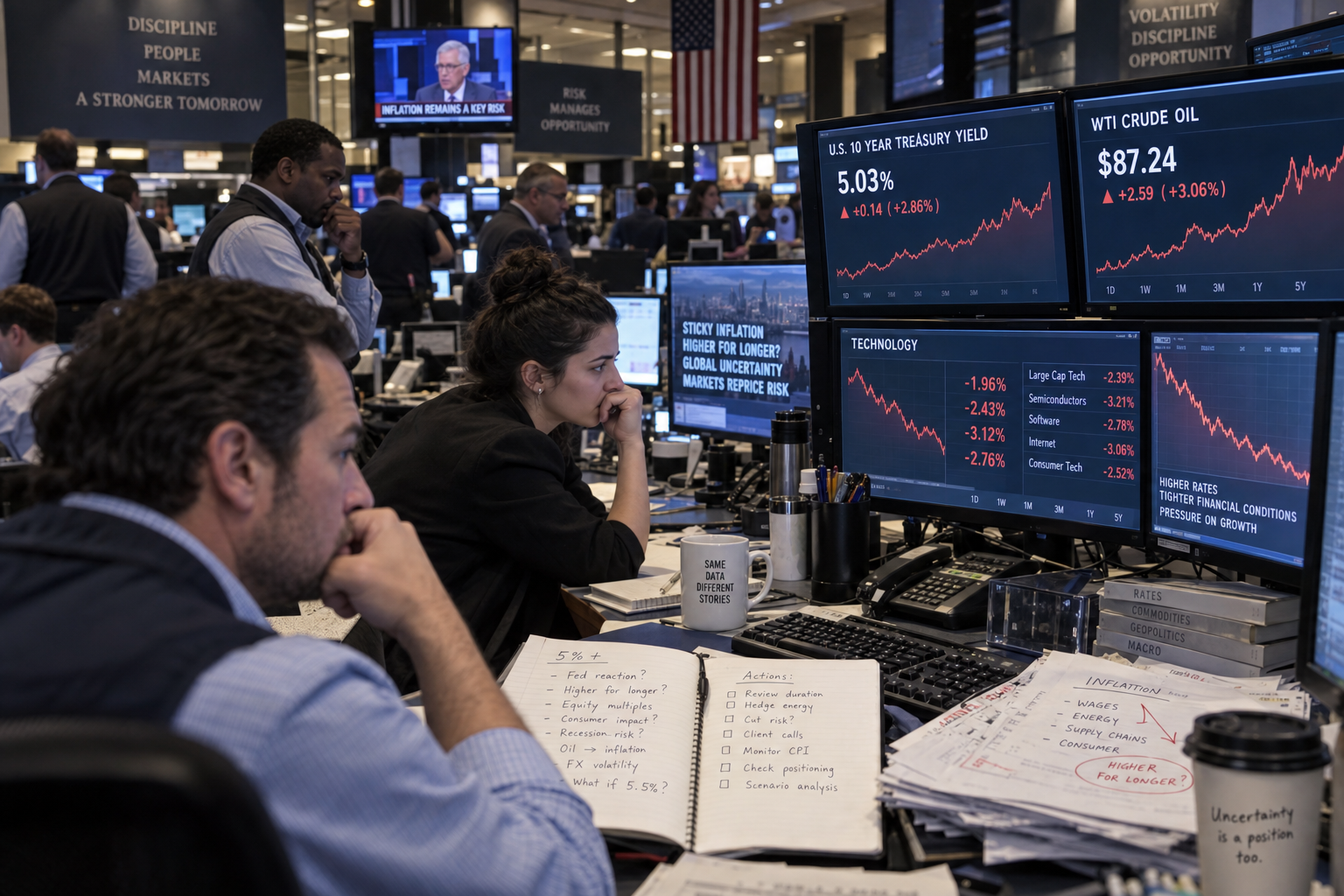
The 10-year U.S. Treasury yield briefly surpassed the psychologically important 5% threshold on Monday before retreating slightly, as investors prepared for the Federal Reserve’s upcoming interest-rate decision. The benchmark yield reached 5.014%, its highest level since October 2023, and was later up more than one basis point at 4.987%. The two-year yield also rose, reflecting expectations about near-term Fed policy, while the 30-year yield edged lower.
The market moves followed August consumer price index data that matched forecasts but remained well above the Fed’s 2% inflation target. The CME Group’s FedWatch tool showed a 92.3% probability of a quarter-point rate increase at the Fed’s meeting. Freedom Capital Markets strategist Jay Woods said a hike was largely priced into markets, while leaving rates unchanged could trigger a negative reaction because it might suggest the Fed is behind the curve.
The article examines whether a 5% 10-year yield would necessarily threaten stocks. Jason Ware of Albion Financial Group attributed the increase partly to heavy Treasury and corporate debt issuance competing for investor capital. He argued that higher yields supported by economic growth would be less concerning than increases driven by inflation, fiscal stress or dysfunction in the Treasury market. However, persistent inflation, large federal deficits, rising debt issuance and higher oil prices could increase the term premium investors demand for holding long-term bonds.
Treasury Secretary Scott Bessent’s expanded bond-buyback program may reduce selling pressure but cannot fully counter the fundamental forces pushing yields higher. Market participants also face risks from leveraged hedge-fund positions and potential forced unwinding if funding costs, margin requirements or volatility rise. Despite these concerns, equity weakness remained limited, with the S&P 500 still up more than 11% for the year.
Entities: 10-year U.S. Treasury yield, 2-year Treasury note yield, 30-year Treasury bond, Federal Reserve, August consumer price index (CPI) • Tone: analytical • Sentiment: neutral • Intent: analyze
15-09-2026
The benchmark U.S. 10-year Treasury yield climbed to 5.041% on Tuesday, its highest level since July 2007, before easing slightly to around 5%. The 30-year Treasury yield also reached a post-2007 high of 5.401%, while the two-year Treasury yield rose to 4.688%, its highest level since July 2024. Bond yields rise when prices fall.
The increase came as oil prices surged amid the continuing Iran conflict and markets anticipated a possible Federal Reserve interest-rate increase. Traders were assigning more than a 92% probability to a 25-basis-point hike at the conclusion of the Fed’s two-day meeting, following inflation data that remained above the central bank’s 2% target. Higher Treasury yields can affect consumer borrowing costs, mortgages, corporate financing and broader economic conditions.
Crude oil’s rise has intensified inflation concerns. West Texas Intermediate topped $102 per barrel as the conflict continued and the Strait of Hormuz remained effectively blocked. Diesel prices also exceeded $6 per gallon. Analysts cited a historically strong correlation between oil prices and the 10-year Treasury yield, noting that sustained energy costs could increase inflation expectations and place additional upward pressure on interest rates.
Jonathan Liang of Standard Chartered said the 10-year yield remains highly sensitive to inflation expectations. Steve Sosnick of Interactive Brokers said geopolitical tensions had made the normally modest oil-yield relationship unusually strong. However, National Economic Council Director Kevin Hassett said there were signs that inflation was cooling, presenting a possible argument against a rate increase even while acknowledging that the Fed would make the final decision.
Entities: 10-year U.S. Treasury yield, 30-year Treasury bond yield, Federal Reserve, U.S. Treasury market, Iran conflict • Tone: analytical • Sentiment: neutral • Intent: inform
15-09-2026
A new CNBC Fed Survey indicates a sharp shift in expectations for U.S. monetary policy. Among 29 economists, fund managers and strategists surveyed, 86% now expect at least one Federal Reserve rate hike over the next year, up from 46% a month earlier, while 55% anticipate more than one hike and roughly one-third foresee three or more. Respondents cite a hawkish speech by Fed Chairman Kevin Warsh, rising oil prices, and persistent inflation as major reasons for the change.
The survey suggests inflation is no longer viewed as solely an energy-price problem. About three-quarters of respondents believe price pressures have broadened, while average consumer price index forecasts have risen to nearly 3.5% for 2026 and 2.85% for 2027. Many respondents also expect the Strait of Hormuz to remain closed for at least another month and oil prices to stay elevated for more than six months. Some economists question whether interest-rate hikes can effectively address inflation driven by supply disruptions.
The Federal Open Market Committee was scheduled to announce its next rate decision after a two-day meeting. Despite the more hawkish interest-rate outlook, respondents’ growth forecasts were largely unchanged. They estimated a 29% probability of recession over the next year, projected GDP growth of about 2.25% in 2026 and 2027, and expected unemployment near 4.25%. Stock-market expectations remained optimistic, with the S&P 500 forecast to reach 8,274 by the end of 2027.
Survey participants generally viewed Warsh’s policy communication and independence favorably, although confidence in his independence declined nine percentage points from the prior survey. Inflation, the Iran war and high oil prices were identified as the leading threats to economic expansion. Respondents also cited possible market risks from legal disputes related to the midterm elections, with a plurality expecting Democrats to win the House while Republicans retain the Senate.
Entities: CNBC Fed Survey, Federal Reserve, Kevin Warsh, Christopher Waller, John Williams • Tone: analytical • Sentiment: neutral • Intent: analyze
15-09-2026
The 10-year U.S. Treasury yield rose above the closely watched 5% threshold, reaching 5.029% on Tuesday, while yields on 20- and 30-year Treasurys also climbed above 5%. The move extended a broader global bond sell-off, with government borrowing costs increasing in Japan, Germany, the United Kingdom, France and elsewhere. Because bond yields influence borrowing costs for governments, companies and consumers, the increase has raised concerns about equity valuations, corporate earnings and the outlook for global stocks.
U.S. stock futures pointed to a lower open after stocks declined in the previous session, while European and Asian markets also fell. Market strategists said the impact of higher yields depends on their cause. Rising yields associated with stronger economic growth can coincide with stock gains if improving earnings offset higher capital costs. However, yields driven by inflation, fiscal concerns, heavy government borrowing or higher term premiums can become a persistent headwind for equities.
Barclays warned that the 5% level could represent an important inflection point, particularly if yields continue materially higher. Goldman Sachs similarly emphasized that the relationship between stocks and bonds depends on the forces driving yields. BlackRock maintained a pro-risk stance and continued to favor U.S. equities and artificial intelligence-related investments, arguing that growth and earnings could offset higher rates.
Other strategists were more cautious. BMO Wealth Management’s Carol Schleif said the Federal Reserve may need to raise rates amid hot inflation, strong earnings and a resilient labor market, while elevated energy prices and geopolitical risks could keep yields high. Generali Investments’ Florian Spaete said the move above 5% signals persistent inflation, fiscal risks, heavy Treasury issuance and rising demand for capital. Overall, the article concludes that stocks may remain volatile, with AI and infrastructure spending supporting earnings but higher yields increasing the risk of a sharper market repricing.
Entities: 10-year U.S. Treasury yield, 20-year and 30-year U.S. Treasurys, U.S. equity markets, Federal Reserve, Global bond markets • Tone: analytical • Sentiment: neutral • Intent: analyze
15-09-2026
The article argues that the era of inexpensive government borrowing is ending as investors become increasingly concerned about rising debt, persistent budget deficits and intensifying competition for capital. Norway’s sovereign wealth fund reportedly plans to reduce its holdings of US government bonds by approximately $80 billion, while the US national debt has surpassed $40 trillion. The yield on 30-year US Treasury bonds has risen to nearly 5.4%, its highest level since 2007.
The pressure is not limited to the United States. Highly indebted countries such as Japan, Italy, France and the United Kingdom are facing higher borrowing costs, while Germany’s debt-to-GDP ratio is expected to rise as it finances defense and infrastructure spending. In the US, annual interest payments have exceeded $1 trillion and are now larger than military spending. The budget deficit is approaching 6% of GDP, despite Treasury Secretary Scott Bessent’s goal of reducing it by half—an objective the article presents as unrealistic given high military costs and reduced tax revenue.
The Treasury has attempted to support the bond market by increasing long-term bond buybacks, but analysts say the measure is too small to address the underlying fiscal problems. Investors are demanding greater government discipline, yet spending cuts appear politically unlikely.
Despite these concerns, economists do not see an immediate replacement for the US capital market. The dollar’s dominant role, the size of the US economy and the lack of a comparable European or emerging-market alternative mean investors are likely to continue buying US assets. However, confidence could weaken, putting downward pressure on the dollar.
The article also identifies a new source of competition: major technology companies are issuing hundreds of billions of dollars in bonds to finance artificial-intelligence infrastructure. These high-quality corporate bonds may offer investors attractive returns compared with Treasuries, further increasing the rates governments must pay to borrow.
Entities: US national debt, US Treasury bonds and 30-year Treasury yields, Norway’s sovereign wealth fund, Japan’s debt-to-GDP ratio, Italy, France and the UK • Tone: analytical • Sentiment: negative • Intent: analyze
15-09-2026
Oil prices and 10-year U.S. Treasury yields are moving in unusually close alignment, with the one-month rolling correlation between front-month West Texas Intermediate crude and the 10-year Treasury yield reaching 0.96, according to BMO Capital Markets. That is the strongest positive relationship since June 2019 and reflects a market increasingly focused on the inflationary effects of the Middle East conflict and surging energy prices.
The article explains that another rise in oil could transmit more forcefully through financial markets. Higher crude prices can lift inflation expectations, delay Federal Reserve rate cuts and push Treasury yields higher, increasing the discount rate applied to stocks and raising borrowing costs. Growth and technology shares are especially vulnerable because much of their value depends on earnings expected far in the future. Higher oil also pressures corporate profit margins, particularly for transportation- and energy-intensive businesses.
Strategists warn that consumers could face a double hit from higher gasoline and goods-transportation costs alongside more expensive mortgages, auto loans and other credit. Businesses may also find it more costly to finance inventories and capital projects, including artificial-intelligence and energy infrastructure investments.
Ed Yardeni said persistently rising oil and bond yields could increase the likelihood of additional Federal Reserve rate hikes and create a possible bond bear market. Komal Sri-Kumar favors short-duration fixed income, defensive equities and physical assets such as real estate, copper and gold. However, the strategists also caution that the 0.96 correlation may not last. If geopolitical tensions ease or concerns about economic growth become dominant, the unusually synchronized movements between oil and Treasury yields could unwind quickly.
Entities: West Texas Intermediate (WTI) crude, Brent crude, 10-year U.S. Treasury yield, Oil and Treasury yield correlation, Inflation expectations • Tone: analytical • Sentiment: negative • Intent: analyze