14-09-2026
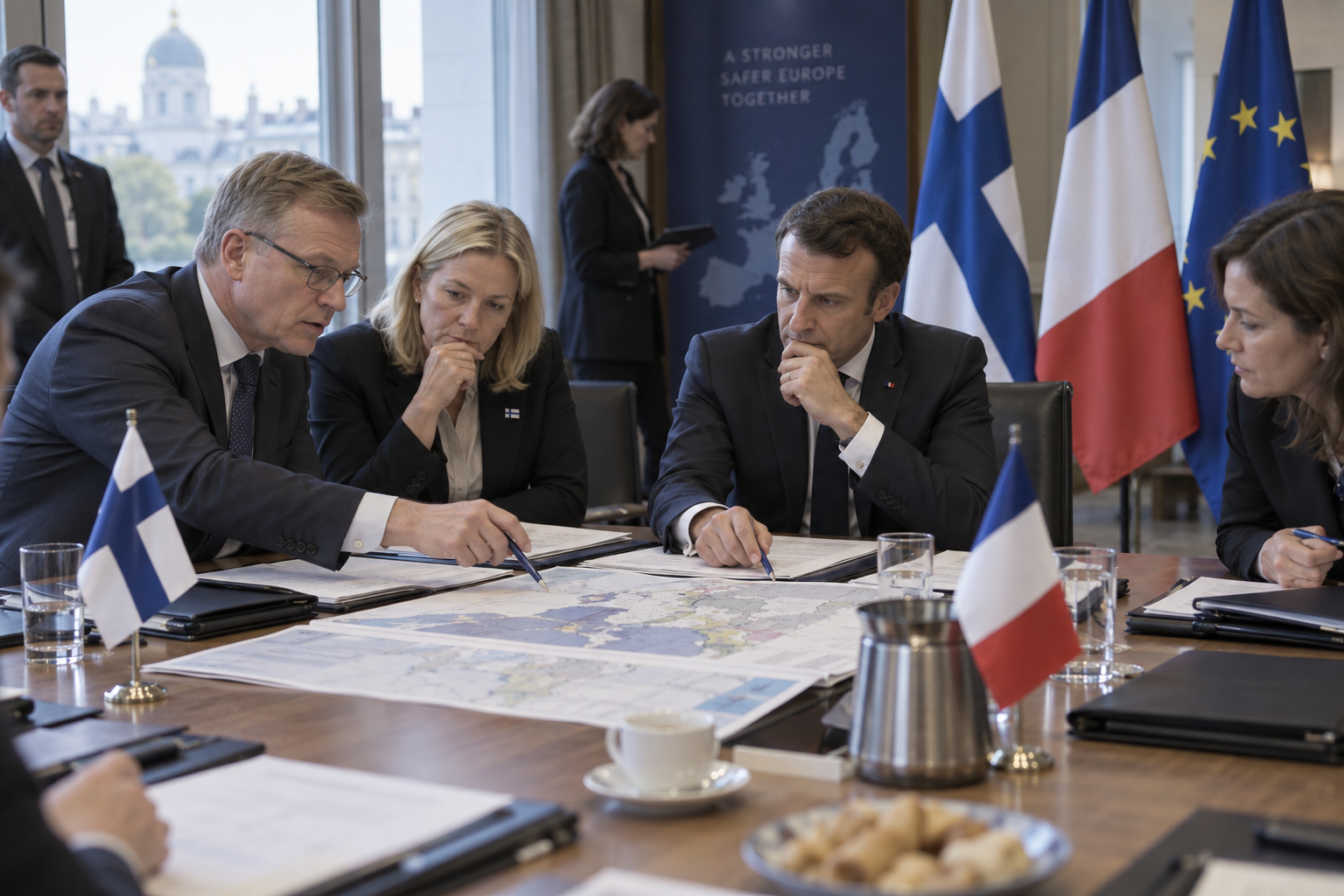
Finland and France have agreed to deepen their defence relationship by having Helsinki join France’s initiative for forward nuclear deterrence, a framework intended to strengthen European security and expand nuclear-related cooperation among European states. The agreement was described in a joint statement as an important step for both European security and bilateral ties. It is expected to create opportunities for strategic signalling and for managing escalation below the nuclear threshold. A Nuclear Steering Group will be established within the coming months to begin implementing the cooperation.
Finnish President Alexander Stubb emphasized that Finland’s primary security framework remains NATO and the European Union. He said the French initiative would not replace or overlap with NATO’s nuclear deterrence and clarified that Finland does not plan to station nuclear weapons on its territory during peacetime.
France’s initiative already includes the United Kingdom, Germany, Poland, Sweden, the Netherlands, Belgium, Greece, Denmark and Norway. The framework is designed to promote deeper cooperation through joint exercises and could allow participating countries to temporarily host French nuclear-capable aircraft. France would retain exclusive control of its nuclear arsenal, and the final decision to use it would remain with the French president.
Estonia may become the next participant. Prime Minister Kristen Michal said Tallinn was discussing possible cooperation with Paris, while noting that participation requires specific capabilities and readiness. He also stressed that Estonia is already protected by NATO’s nuclear umbrella and supported by French troops stationed in the country. France has maintained approximately 300 troops in Estonia since March 2017 as part of NATO’s enhanced forward presence in the Baltic states. The proposed cooperation reflects Europe’s effort to strengthen its own security arrangements while remaining connected to NATO’s existing deterrence structures.
Entities: Finland, France, Alexander Stubb, Kristen Michal, NATO • Tone: analytical • Sentiment: neutral • Intent: inform
14-09-2026
Finland has decided to join France’s forward nuclear deterrence initiative, according to a joint statement issued by the two countries. The move would extend France’s nuclear deterrence cooperation to Finland, which shares a long border with Russia, giving the initiative significance amid heightened European security concerns. The cooperation is intended to involve European allies through measures including joint exercises and coordination on nuclear deterrence.
France has been expanding discussions about extending its nuclear deterrent to European partners as countries reassess their security arrangements and the future of European defence cooperation. The article links this reassessment to what it describes as US President Donald Trump’s shake-up of NATO, suggesting uncertainty about the reliability or future direction of the alliance has encouraged European states to consider a greater role for their own security capabilities.
Under the agreement, Finland and France will establish a nuclear steering group in the coming months. That body will begin implementing the cooperation, although the article does not provide further details about its structure, authority, or the precise military activities involved. Finland’s participation is notable because of its geographic proximity to Russia and its position within Europe’s changing security environment.
The announcement represents a new step in France’s effort to involve other European countries in its nuclear deterrence framework. It does not state that France is transferring nuclear weapons to Finland or that Finland is acquiring its own nuclear arsenal. Instead, the initiative appears to focus on consultation, coordination, and joint preparations under France’s deterrence umbrella.
Entities: Finland, France, Russia, NATO, Europe • Tone: analytical • Sentiment: neutral • Intent: inform
14-09-2026
Finland has joined France’s Forward Nuclear Deterrence Initiative, a programme designed to deepen European cooperation on nuclear deterrence and strengthen the continent’s security. Finnish President Alexander Stubb and French officials said the initiative responds to uncertainty over the United States’ long-term commitment to European defence and to the security consequences of Russia’s war in Ukraine.
France announced the initiative in March 2026. It seeks to extend the reach and visibility of France’s nuclear deterrent through cooperation with European partners, while preserving the French president’s exclusive authority to decide whether nuclear weapons are used. This differs from NATO’s system, in which nuclear policy is coordinated through the alliance’s shared Nuclear Planning Group.
The initiative provides for joint exercises, more extensive consultations and the possible short-term deployment of nuclear-capable assets on the territory of participating allies. Finnish Defence Minister Antti Hakkanen described Finland’s decision as a natural continuation of steps taken by other Nordic countries, including Norway, Sweden and Denmark. Finland’s accession brings participation in the programme to 10 countries.
Stubb stressed that the arrangement complements rather than replaces NATO’s nuclear deterrence framework. He also said Finland does not plan to host nuclear weapons on its territory during peacetime. The initiative is therefore presented as a mechanism for reinforcing European responsibility for defence without creating a separate nuclear command structure or requiring permanent nuclear deployments in participating countries.
Entities: Finland, France, Forward Nuclear Deterrence Initiative, Alexander Stubb, Emmanuel Macron • Tone: analytical • Sentiment: neutral • Intent: inform