12-08-2026
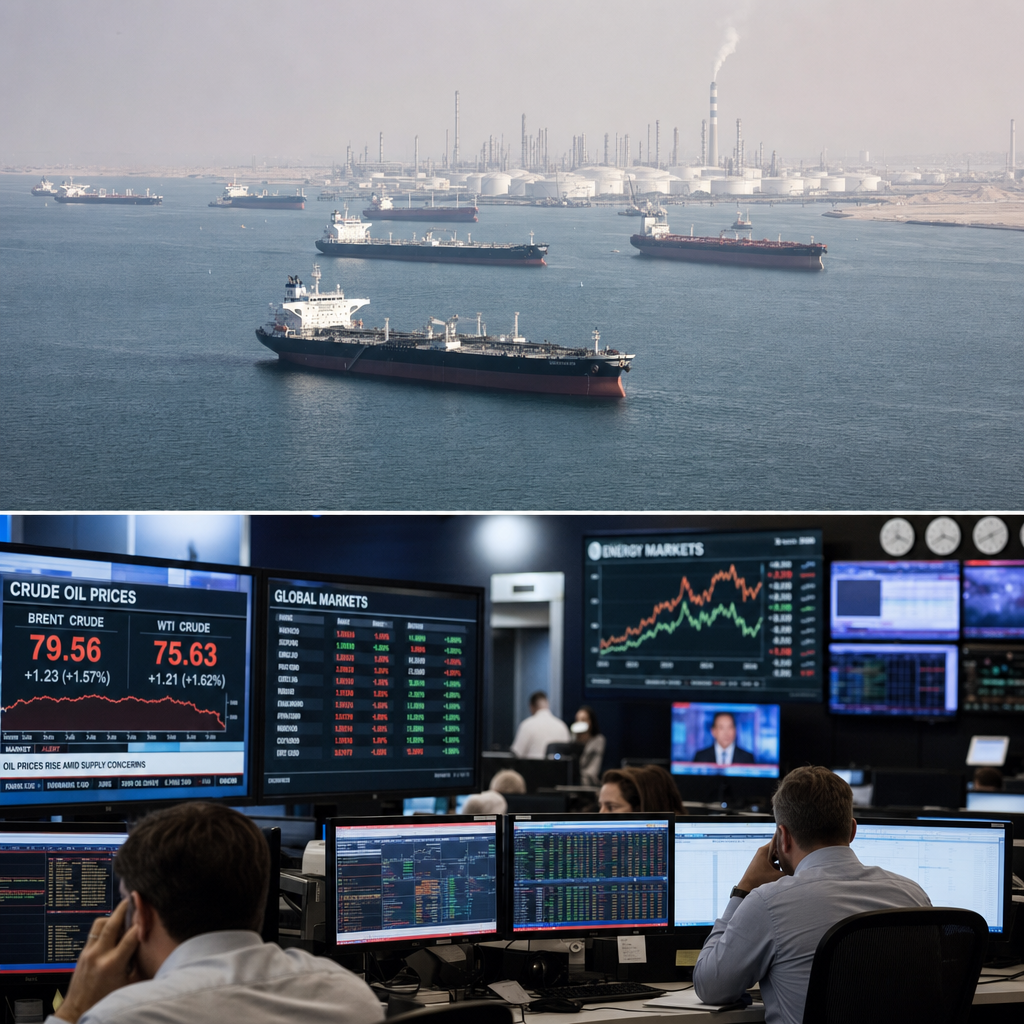
World markets traded unevenly on Wednesday as investors awaited the latest US inflation report and monitored stalled talks over the Iran war. Oil prices rose, with Brent crude gaining 0.9% to $89.67 per barrel and US crude increasing 0.9% to $83.98. Gold and silver also advanced, rising 0.8% and 1%, respectively, as geopolitical and inflation concerns supported demand for precious metals.
The market focus was intensified by continued uncertainty surrounding the conflict involving Iran. The closure of the Strait of Hormuz after US and Israeli attacks on Iran in late February has restricted the movement of oil in the region, while an attack by Iran-backed Houthi rebels on a vessel near Yemen has raised further concerns about shipping security and regional instability. Oil price volatility has contributed to higher US petrol prices, with the average cost of regular gasoline reaching $4.01 per gallon, up from below $3.14 a year earlier.
Wall Street retreated from record highs reached the previous week. The S&P 500 fell 0.3%, the Dow Jones Industrial Average declined 184 points, and the Nasdaq dropped 0.6%. Investors were watching the inflation data for clues about the Federal Reserve’s interest-rate policy. Economists expected annual inflation to ease to 3.4% in July from 3.5% in June. A softer reading could reduce pressure for further rate increases, while higher rates could restrain borrowing, economic activity, and investment valuations.
Asian markets were mostly higher. South Korea’s Kospi jumped more than 4% on renewed demand for chipmakers, with Samsung Electronics and SK Hynix making strong gains. Japan, Taiwan, and mainland China also advanced, while Hong Kong and Australia declined. The dollar strengthened slightly against the yen, while the euro weakened against the dollar.
Entities: Donald Trump, United States, Iran, Israel, Strait of Hormuz • Tone: analytical • Sentiment: neutral • Intent: inform
12-08-2026
Oil prices have risen sharply as attacks on commercial shipping in the Middle East undermine hopes that negotiations will soon restore normal traffic through the Strait of Hormuz. Brent crude climbed more than 2 percent overnight, reaching $89.61 per barrel for October delivery—about 24 percent above its level before the US-Israel war on Iran began in late February. Analysts say markets still anticipate a possible diplomatic agreement, but confidence is weakening as talks continue without visible progress and the reported demands become more complicated.
The latest escalation occurred in the Bab al-Mandeb strait, where Yemen’s internationally recognised government accused Iran-aligned Houthis of killing six people in missile attacks on a commercial vessel. Yemen’s coastguard said two of the victims were security personnel involved in a rescue mission. US Central Command also said it attacked and disabled a Panama-flagged cargo ship after it attempted to breach a US blockade of Iranian ports.
The Strait of Hormuz previously carried about one-fifth of global oil supplies, or roughly 20 million barrels of oil and petroleum products per day. Maritime traffic has since collapsed, with only 10 vessels crossing on Monday compared with approximately 130 daily transits before the war. Conflicting claims about the volume of oil moving through the waterway have added uncertainty. The US energy secretary said flows had recovered to about 9 million barrels per day, while the research firm Commodity Context estimated that the recent peak was closer to 7 million barrels per day.
Qatar said negotiations between Oman and Iran were at an advanced stage, but Tehran has maintained that reopening the strait depends on conditions including US war reparations and sanctions relief. The US Energy Information Administration expects Middle Eastern oil production to remain below pre-conflict levels until early 2027 and forecasts average Brent prices of $87 per barrel in 2026. Analysts therefore expect prices to remain supported around $85-$90 unless diplomatic talks produce renewed optimism.
Entities: Strait of Hormuz, Bab al-Mandeb strait, Brent crude oil, US-Israel war on Iran, Iran-aligned Houthis • Tone: analytical • Sentiment: negative • Intent: analyze
12-08-2026
The article reports that the United States’ Strategic Petroleum Reserve (SPR) has fallen to its lowest level in more than 40 years as the Iran war threatens global oil supplies. The reserve declined by approximately 6.1 million barrels in the latest week to 298.7 million barrels, the lowest level since January 1983. That figure is well below the reserve’s maximum authorized capacity of 727 million barrels.
The drawdown is part of a coordinated agreement involving the United States and the International Energy Agency (IEA) to release 400 million barrels in an effort to stabilize oil markets after joint U.S.-Israeli attacks on Iran. The United States has withdrawn about 172 million barrels since March. Experts warn that rebuilding the reserve will be difficult and time-consuming because global supplies are already under pressure.
The article also explains that IEA member countries must maintain emergency reserves equivalent to 90 days of net crude oil and petroleum-product imports. Canada belongs to the IEA but is the only G7 country without a government-mandated strategic stockpile, largely because it is a net crude-oil exporter.
A major source of uncertainty is the Strait of Hormuz, a vital shipping route through which roughly one-fifth of the world’s oil normally passes. Iran has declared the waterway closed and warned that unauthorized cargo vessels could be attacked. Iranian strikes against oil, energy and maritime infrastructure in neighbouring Persian Gulf countries have further disrupted market expectations. A temporary ceasefire in June collapsed as tensions returned in July, and Iran has said it will maintain the closure until the United States meets demands including financial compensation.
Oil prices have risen as traders anticipate tighter supplies and the eventual need to replenish depleted reserves. West Texas Intermediate was around US$83 per barrel, while Brent crude had recently climbed above US$85. Higher crude prices generally translate into more expensive fuel at gas stations, including in Canada.
Entities: United States Strategic Petroleum Reserve (SPR), Iran war, Iran, International Energy Agency (IEA), U.S. Department of Energy • Tone: urgent • Sentiment: negative • Intent: inform