12-08-2026
The article examines how animals respond to the sudden darkness and environmental changes caused by a total solar eclipse. While the event is exciting for people, animals experience an abrupt disruption to the cues they use to structure their daily routines. The disappearance of sunlight, along with a temporary drop in temperature, can make the middle of the day resemble nighttime and may cause confusion, disorientation, or stress. The period of unusual darkness generally lasts only a few minutes, limiting the duration of these effects.
Different species respond in different ways. Birds that normally sing during daylight often become silent when the eclipse begins, apparently interpreting the darkness as evening. Nocturnal species, including owls, may become active because they perceive conditions as dusk or night. Zoo animals and insects such as bees can also respond as though night has arrived. Elephants have reportedly moved to their nighttime enclosures, while some gorillas have charged enclosure glass and giraffes have paced or swayed, behaviors associated with stress or agitation.
Domestic animals may also react. Dogs and cats can pace, whine, or hide during totality, in ways researchers compare with their responses to fireworks or thunderstorms. However, the disruption is generally temporary. When sunlight returns, many animals quickly resume their ordinary behavior. Birds may even begin singing loudly, sometimes more intensely than at a normal dawn. Overall, the article presents eclipses as brief but powerful natural experiments that reveal how strongly animals depend on light and temperature as behavioral signals, while emphasizing that most return to normal within minutes.
Entities: Denis Loktev, Euronews, total solar eclipse, animal behaviour, dogs and cats • Tone: analytical • Sentiment: neutral • Intent: inform
12-08-2026
Portugal is preparing for two notable astronomical events on 12–13 August 2026: a total solar eclipse and the annual Perseid meteor shower. Around 19:30, observers in the Bragança region—particularly the Montesinho Natural Park—will see the Moon completely cover the Sun, briefly turning day into night. The total phase will last only about 25 seconds, although the eclipse as a whole will begin at approximately 18:33 and end around 20:23. Mainland Portugal will experience a deep partial eclipse, with coverage ranging from 92% to 99%, while the Azores and Madeira will see between 74% and 77% coverage. The article notes that the last total eclipse visible from mainland Portugal occurred in 1912.
About an hour after the eclipse ends, the Perseids will become visible. The meteor shower is active from mid-July through late August and normally peaks around 12–13 August. A nearly new Moon should provide especially dark skies. Although activity is expected to increase between midnight and 02:00, the best viewing period is from 02:00 to 05:00, when the Perseus constellation is higher in the sky. Recommended locations include Dark Sky Alqueva, Montesinho and Bragança, Serra da Estrela, Peneda-Gerês and other high, inland areas away from light pollution. Viewers are advised to avoid screens beforehand so their eyes can adapt to darkness.
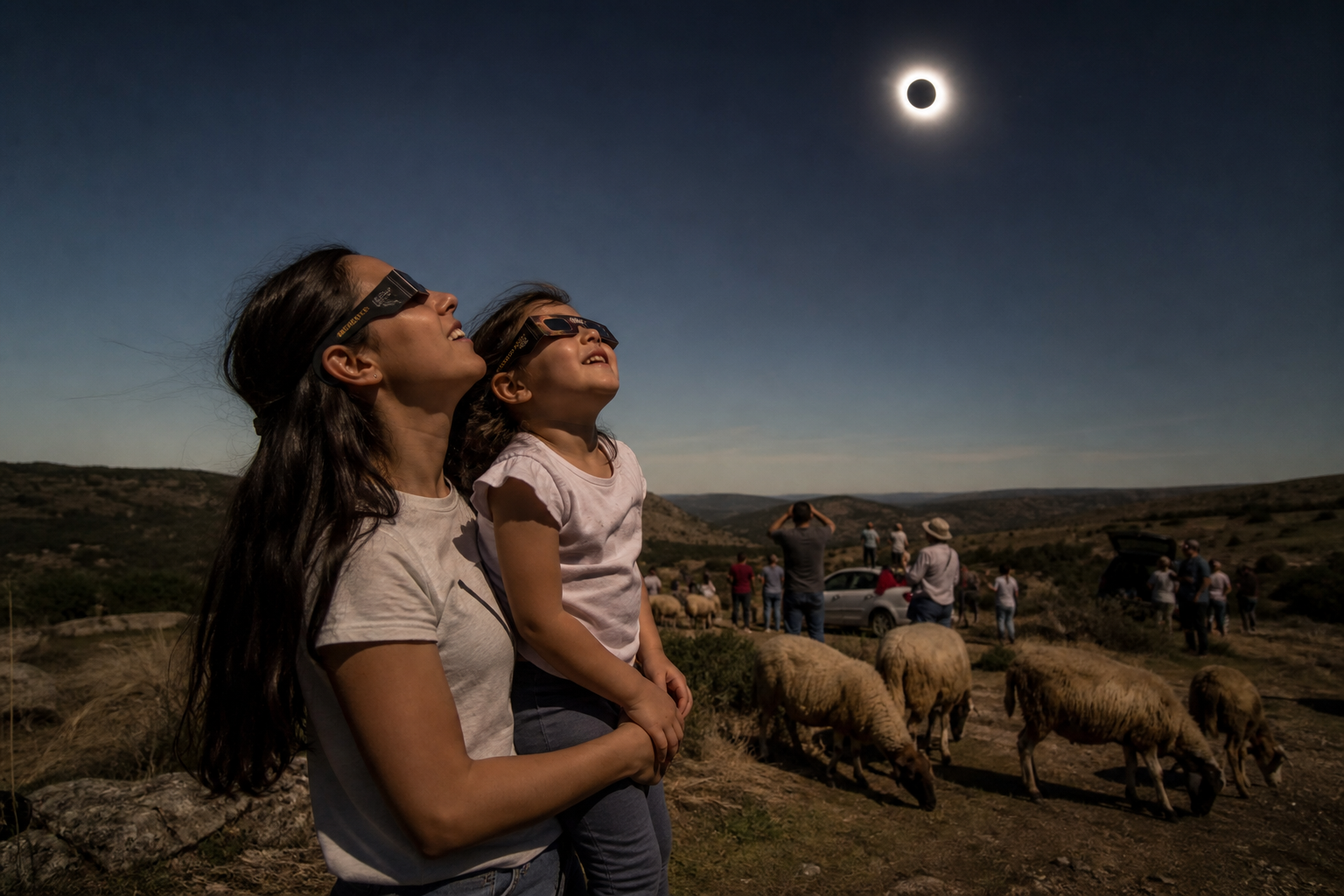
The article strongly emphasizes eclipse safety. Direct viewing is dangerous, and only certified eclipse glasses meeting ISO 12312-2 or ISO 12312-2:2015 standards and carrying the CE mark should be used. Sunglasses, telescopes and unfiltered cameras or mobile phones are unsafe. Glasses are available from pharmacies, some supermarkets and online retailers, generally costing €2.90–€3.25. Public viewing events are also being organized across Portugal, including free guided sessions in Faro and Albufeira.
Entities: Portugal, Total solar eclipse, Perseid meteor shower, Bragança, Montesinho Natural Park • Tone: analytical • Sentiment: positive • Intent: inform
12-08-2026
Euronews Culture presents a carefully sequenced playlist for a total solar eclipse, combining songs about sunlight, darkness, emotional intensity and celestial imagery. The article is framed around a major eclipse expected to affect mainland Europe, described as the first full solar eclipse visible there in two decades. It notes that opportunities to see another total eclipse will be rare in several countries: France may have to wait until 2081, the UK until 2090 and Germany until the next century, while Spain is expected to see another the following year. The writers therefore argue that the event deserves an ideal musical soundtrack.
The ten-song selection begins with Len’s “Steal My Sunshine,” a sugary 1990s pop-rock song intended to provide a bright, playful opening before the light disappears. Bill Withers’ “Ain’t No Sunshine” follows, bringing a soulful and more literal reflection on the loss of sunlight. Bonnie Tyler’s “Total Eclipse of the Heart” adds theatrical drama, while Max Richter’s “On the Nature of Daylight” introduces a poignant, cinematic mood.
The playlist then becomes darker with Soundgarden’s “Black Hole Sun,” Pink Floyd’s “Eclipse” and Leonard Cohen’s “You Want It Darker.” David Bowie’s “Blackstar” continues the celestial and elegiac atmosphere. As the eclipse ends, Bruce Springsteen’s “Dancing in the Dark” offers a more upbeat transition, followed by The Beatles’ “Here Comes the Sun” as the light returns. The article combines factual eclipse information with music criticism, cultural references and playful commentary, presenting the playlist as both practical entertainment and a dramatic way to experience a rare astronomical event.
Entities: Euronews Culture, David Mouriquand, Amber Louise Bryce, Theo Farrant, Total solar eclipse • Tone: emotional • Sentiment: positive • Intent: entertain