12-08-2026
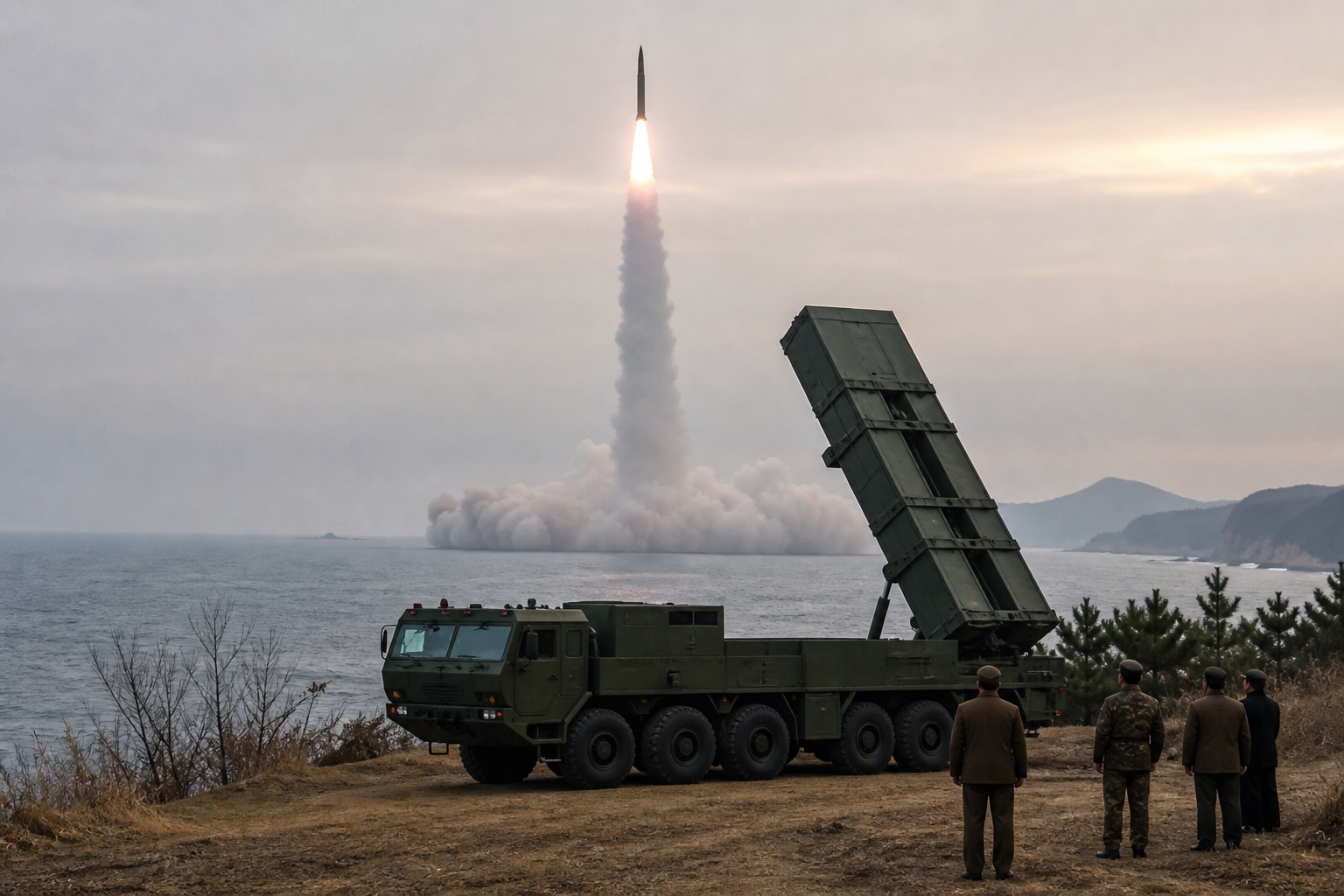
North Korea test-fired at least one ballistic missile from the Wonsan area toward the East Sea early Wednesday, according to South Korea’s Joint Chiefs of Staff. The launch occurred just days before annual US-South Korea joint military drills scheduled to begin on August 17. Pyongyang considers the exercises invasion rehearsals, while Seoul and Washington describe them as routine defensive preparations intended to coordinate responses to North Korea’s nuclear and missile capabilities.
The missile was detected at about 6:00 a.m. local time, or 2100 GMT on Tuesday. Japan, the United States and South Korea were jointly analyzing the launch, and the missile was estimated to have fallen outside Japan’s exclusive economic zone in the Sea of Japan. Japan’s Defence Minister Shinjiro Koizumi called the launch a threat to regional peace and security and said Tokyo had lodged a strong diplomatic protest through Beijing. Japan’s prime minister ordered officials to maintain a state of readiness. No damage was reported.
The launch was North Korea’s second ballistic missile test in less than a week. On August 6, the three countries detected a short-range ballistic missile launch, marking the North’s first ballistic weapons activity since late June. North Korea had not initially confirmed that test, despite usually releasing information about weapons tests a day later.
Experts said the latest launch was likely intended as a warning ahead of the military exercises. North Korea has repeatedly responded to US-South Korea drills with missile tests, and analyst Lim Eul-chul said Pyongyang was closely monitoring the upcoming exercises and could carry out further provocations if it considered them necessary. North Korean leader Kim Jong Un previously described the drills as increasingly provocative and accused Seoul and Washington of preparing to ignite a war, promising what he called proactive and overwhelming countermeasures.
Entities: North Korea, South Korea, United States, Japan, Wonsan • Tone: analytical • Sentiment: negative • Intent: inform
12-08-2026
North Korea launched another ballistic missile on Tuesday, its second reported ballistic-missile test in less than a week, according to Japan’s prime minister’s office. The launch occurred as the United States and South Korea prepare for their annual Ulchi Freedom Shield military exercises, which are generally held in the second half of August. Authorities had not immediately released details about the missile’s trajectory, range, or landing location.
The U.S. military said it was monitoring the launch and consulting with regional allies and partners. U.S. Pacific Command assessed that the incident did not pose an immediate threat to U.S. personnel, American territory, or allied countries, while reaffirming Washington’s commitment to regional defense. A North Korea expert nevertheless warned that the United States must remain focused on Kim Jong Un and his military activities.
The latest test followed an Aug. 5 launch of a short-range ballistic missile from the Wonsan area on North Korea’s eastern coast. Japan said that missile landed in waters off the North Korean coast without reaching Japanese territory. Japanese Defense Minister Shinjiro Koizumi called North Korea’s repeated launches a threat to Japan and the wider region, and Tokyo lodged a diplomatic protest through its embassy in Beijing.
South Korea increased surveillance and coordinated with the United States and Japan after the earlier launch. Seoul’s presidential National Security Council described the test as a provocation and a violation of U.N. Security Council resolutions. The upcoming Ulchi Freedom Shield exercises are designed to improve coordination among U.S., South Korean, and United Nations Command forces and strengthen the allies’ defensive capabilities. The drills include live, virtual, constructive, and field-based training.
The United States and South Korea describe the exercises as defensive, but North Korea portrays them as preparations for an invasion and frequently responds to allied drills with missile tests. The Aug. 5 launch was North Korea’s first ballistic-missile test since late June, when it tested a tactical missile carrying what state media called a “special mission” warhead. Kim Jong Un subsequently said North Korea needed to strengthen its “deadly and destructive offensive posture.”
Entities: North Korea, Kim Jong Un, United States, South Korea, Japan • Tone: urgent • Sentiment: negative • Intent: inform
12-08-2026
North Korea conducted its second ballistic missile test in less than a week on August 12, 2026, as South Korea and the United States prepare to begin their annual Ulchi Freedom Shield military exercises on August 17. South Korean and Japanese authorities detected the launch, which originated near Wonsan on North Korea’s eastern coast at about 6 a.m. South Korea’s Joint Chiefs of Staff said the missile traveled more than 700 kilometres before landing in waters outside Japan’s exclusive economic zone, between the Korean Peninsula and Japan.
The launches are widely viewed as a protest against the upcoming South Korea-US drills, which Pyongyang characterizes as preparations for an invasion. Washington and Seoul maintain that the exercises are defensive. South Korean officials described the test as an act of provocation and said their military remained prepared to respond in coordination with the United States. Japanese Defence Minister Shinjiro Koizumi said Tokyo had strongly protested the launch, calling it a serious threat to Japanese public safety.
The latest test followed an August 6 launch detected by South Korea, the United States and Japan, marking North Korea’s first reported ballistic weapons activity since late June. Experts say Pyongyang frequently uses allied military exercises as a justification for expanding its weapons testing, while also seeking to strengthen its nuclear and missile capabilities. Multiple United Nations Security Council resolutions prohibit North Korea from launching ballistic missiles.
North Korea has intensified its weapons development since diplomatic efforts with the United States collapsed in 2019. Analysts believe leader Kim Jong Un may seek to use the country’s expanded arsenal to pressure Washington into easing international sanctions. The article also notes North Korea’s closer military relationship with Russia, including support for Russia’s war in Ukraine, and its efforts to improve ties with China, whose President Xi Jinping visited Pyongyang in June.
Entities: North Korea, South Korea, United States, Japan, Wonsan • Tone: analytical • Sentiment: negative • Intent: inform
12-08-2026
North Korea fired a ballistic missile toward the sea off the Korean Peninsula’s east coast on Wednesday, according to South Korean and Japanese authorities. The launch was reportedly conducted from the Wonsan area at about 6 a.m. local time, with the missile traveling more than 700 kilometers and reaching an altitude of roughly 90 kilometers. Japan said it landed outside the country’s exclusive economic zone, in waters between the Korean Peninsula and Japan. This was North Korea’s second reported ballistic missile launch in less than a week and followed another test detected on August 6.
The launch occurred shortly before the United States and South Korea are scheduled to begin their annual Ulchi Freedom Shield military exercises on August 17. The drills, which run through August 27, are intended to improve readiness against North Korea’s nuclear and missile threats. Pyongyang has repeatedly condemned the exercises as invasion rehearsals, while Washington and Seoul describe them as defensive training.
South Korea’s National Security Council called the missile test a provocation and urged North Korea to stop activities that violate United Nations Security Council resolutions. South Korea’s military said it remained ready to respond under its combined defense posture with the United States and would respond overwhelmingly if necessary. Japan also protested diplomatically, with Defense Minister Shinjiro Koizumi calling the launch a serious threat to the safety of Japanese citizens.
The article places the test within North Korea’s broader weapons-development program, which includes short-range ballistic missiles, artillery rockets and other tactical systems. Experts say Pyongyang often increases weapons testing around US-South Korean exercises and may use its expanding arsenal to strengthen its negotiating position in future talks with Washington, particularly over sanctions. The report also notes North Korea’s closer ties with Russia and China, including support for Russia’s war in Ukraine and Chinese President Xi Jinping’s June visit to Pyongyang.
Entities: North Korea, South Korea, Japan, United States, Wonsan • Tone: analytical • Sentiment: negative • Intent: inform