09-09-2026
Al Jazeera reports that Jordanian air-defence systems intercepted a barrage of ballistic missiles launched from Iran. According to Jordanian authorities, 18 of the 20 missiles were intercepted, and no injuries were reported. Witnesses recorded the interceptions, and the events were visible from across the border in Syria’s Daraa province. The report is presented as a short video news item focused on the air-defence response and the visible activity along the Jordan-Syria border. It does not provide details about the intended targets, the missiles that were not intercepted, any damage, or the circumstances surrounding the Iranian launch. The incident highlights the regional security risks posed by missile exchanges and the role of Jordanian air defences in responding to threats originating beyond its borders. The article was published on 9 September 2026 and relies on Jordan’s official account of the interceptions, along with witness-recorded footage. Although the report concerns an armed confrontation involving ballistic missiles, its wording remains concise and factual. The lack of reported injuries is the only stated impact, while no further assessment of casualties or property damage is included. The report’s primary purpose is to inform viewers about the interception, the number of missiles involved, and where the event could be observed.
Entities: Jordanian air-defence systems, Jordan, Iran, Iranian missile barrage, Ballistic missiles • Tone: neutral • Sentiment: neutral • Intent: inform
09-09-2026
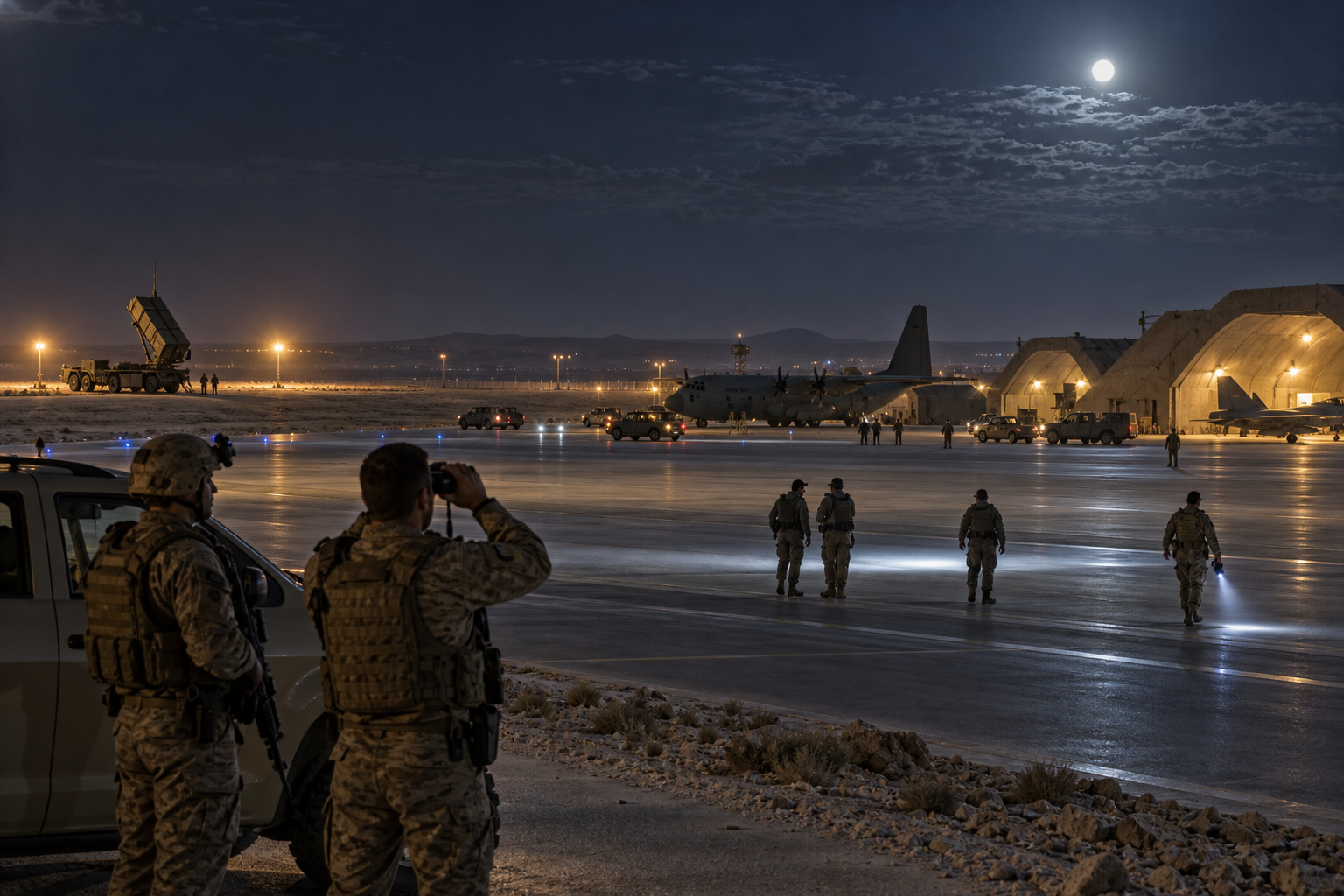
The article examines Iran’s repeated missile attacks on Jordan’s Muwaffaq Salti Air Base, commonly known as Al-Azraq, which hosts US military personnel and aircraft. The latest barrage occurred as the United States and Iran exchanged strikes connected to the Strait of Hormuz. Iran’s Islamic Revolutionary Guard Corps (IRGC) said it targeted facilities used to maintain, prepare, deploy, and shelter US F-35, F-16, and F-15 fighter jets. Jordanian authorities said 18 of 20 ballistic missiles were intercepted and destroyed, while two landed in open areas. No casualties were reported in the latest attack, according to Jordanian and US officials.
Iran has expanded its targeting of Jordan during a broader escalation that began with US attacks on Iranian rocket launchers on Larak Island. Tehran has claimed more than 10 attacks on Al-Azraq between March and September, although Jordan and other affected governments have frequently said that incoming projectiles were intercepted. Iran also claimed a July attack destroyed aircraft and other assets; US Central Command later confirmed that two US service members were killed, one was missing, and four were injured.
Located about 100km northeast of Amman, Al-Azraq is strategically important because of its size, two runways, aircraft shelters, and distance from Iran. A 2021 US-Jordan defence agreement gives US forces access to multiple Jordanian installations. Experts describe Al-Azraq as a major logistics hub for C-17 transport aircraft and approximately 60 combat aircraft, as well as a base for intelligence, surveillance, reconnaissance, and operations in Syria and Iraq. Jordan’s geographic position provides the US with greater strategic depth than bases in nearby Gulf states, which are closer to Iran’s missiles and drones. The article also explains the base’s history, its namesake Jordanian pilot Muwaffaq Salti, and the US-funded expansion that increased its capacity.
Entities: Al-Azraq Air Base / Muwaffaq Salti Air Base, Jordan, Iran, United States, Islamic Revolutionary Guard Corps (IRGC) • Tone: analytical • Sentiment: negative • Intent: analyze
09-09-2026
Iran launched a barrage of missiles toward the U.S. air base at Al-Azraq in Jordan overnight, according to the article, marking the latest escalation in an expanding conflict. The Islamic Revolutionary Guard Corps (IRGC) described the attack as a “punitive operation” directed at the American base and said the confrontation would continue. The statement was carried by Iranian state media and reflects increasingly aggressive rhetoric from Iranian leaders in recent days.
Jordan’s military said its air defenses intercepted 18 of the 20 missiles. The remaining two missiles reportedly landed in unpopulated areas, according to the military’s account. The article does not report casualties, damage, or the U.S. response to the attack. It does, however, state that Jordan has faced repeated attacks in recent weeks, placing the missile barrage within a broader pattern of violence affecting the country and U.S. military positions in the region.
The report presents the incident as another significant development in a rapidly intensifying conflict. Its focus is on the immediate attack, the competing official descriptions of the event, and the Iranian warning that further military action is likely. The language attributed to the IRGC emphasizes retaliation and continued fighting, while Jordan’s interception figures suggest an effort to limit the attack’s impact. Overall, the article conveys a situation marked by heightened regional tensions, recurring missile attacks, and the prospect of additional escalation without providing further operational or political context.
Entities: Iran, United States, Jordan, Al-Azraq U.S. air base, Islamic Revolutionary Guard Corps (IRGC) • Tone: urgent • Sentiment: negative • Intent: inform