09-09-2026
German Chancellor Friedrich Merz confronted Alternative for Germany (AfD) leader Alice Weidel in the Bundestag after the far-right party’s major victory in Saxony-Anhalt. The AfD won almost 44% of the vote in the eastern state, while Merz’s conservative Christian Democrats saw their support fall to 17.2%, roughly half its previous level. The result left the AfD three seats short of an outright majority and raised the possibility that it could seek coalition support from another party, potentially the left-wing populist BSW. No far-right party has governed one of Germany’s 16 states since World War Two.
Weidel described Merz’s coalition with the Social Democrats as a failure and accused his government of pushing Germany towards bankruptcy. Merz responded that the AfD had harmed German interests through its support for Russia and that its deportation and “remigration” policies would undermine the country’s workforce. He argued that one in six skilled workers has a migration background and said the AfD’s proposals could amount to “ethnic cleansing” based on skin colour and origin. Weidel, meanwhile, linked migration to knife attacks and violence on public transport.
The parliamentary debate became highly confrontational, with AfD MPs repeatedly heckling Merz and Bundestag President Julia Klöckner threatening to expel disruptive members. Merz said the AfD’s policies could leave care homes, hospitals and restaurants unable to function because of labour shortages. The party’s regional branch has been classified as right-wing extremist by German domestic intelligence.
The result has been welcomed by US President Donald Trump, who attributed the AfD’s success to Germany’s immigration policies. A planned phone call between Trump and Merz was postponed without explanation. The election has also renewed debate over Germany’s “firewall” preventing mainstream parties from cooperating with the far right, with an AfD official suggesting that the CDU could work with the party if it abandoned that policy.
Entities: Friedrich Merz, Alice Weidel, Alternative for Germany (AfD), German Bundestag, Saxony-Anhalt • Tone: analytical • Sentiment: negative • Intent: inform
09-09-2026
US President Donald Trump attributed the far-right Alternative for Germany (AfD)’s strong performance in Saxony-Anhalt’s state election to what he described as Germany’s “horrible” immigration rules and regulations. The AfD finished first in the Sept 6 election with 44 per cent of the vote, marking the party’s biggest electoral victory and the first time since World War II that a far-right party has come close to gaining power at the state level in Germany.
Trump, writing on Truth Social, said German voters had become frustrated with immigration policies that he claimed had harmed the country. His comments echoed his longstanding criticism of European governments for failing to control their borders after large numbers of migrants and asylum seekers arrived, particularly from the Middle East and Afghanistan, over the past decade.
AfD candidate Ulrich Siegmund, who hopes to become Saxony-Anhalt’s premier, has promised to begin deporting illegal immigrants “from the first minute,” reflecting Trump’s own emphasis on deportations. The result represents a major setback for Chancellor Friedrich Merz’s conservative party, which returned to national power more than a year ago.
German government spokesman Stefan Kornelius declined to respond directly to Trump’s post, but said Mr Merz had previously made clear that foreign intervention or commentary on German domestic politics and elections was unacceptable. Kornelius also announced that Germany had postponed a planned phone call between Merz and Trump commemorating the 25th anniversary of the Sept 11 attacks, without providing a reason.
The report places the election result within broader strains in traditionally close US-German relations. Since Trump returned to office, the allies have disagreed over tariffs, the US-Israeli war on Iran and support for Ukraine. Kornelius nevertheless said Germany remained committed to the shared values of freedom, democracy and respect.
Entities: Donald Trump, Alternative for Germany (AfD), Saxony-Anhalt, Germany, United States • Tone: analytical • Sentiment: neutral • Intent: inform
09-09-2026
The article reports that US President Donald Trump celebrated the Alternative for Germany (AfD)’s strong performance in Saxony-Anhalt’s state elections, describing the result as a “really big” victory for Germany’s populist movement. In a Sept 8 post on Truth Social, Trump criticized Germany’s immigration rules, saying voters had become frustrated with regulations that he claimed had harmed the country. Although Trump did not explicitly name the AfD in the post, his comments followed the party’s emergence as the largest political force in the eastern German state.
The AfD won nearly 44 per cent of the vote. The party is described as anti-immigration, Russia-friendly and supportive of Trump. It has pledged a “remigration and deportation offensive” targeting migrants. Its success has raised the possibility that a far-right party could lead a German state for the first time since World War II, a prospect that has alarmed migrant and minority communities.
The article also highlights the AfD’s controversial status. Germany’s domestic intelligence agency classifies the Saxony-Anhalt branch as a “right-wing extremist” group. The party’s lead candidate, Ulrich Siegmund, has staff members who were formerly part of a banned neo-Nazi organization. Despite these concerns, Trump-aligned figures welcomed the result. Former US ambassador to Germany Richard Grenell called it “a new day in Germany,” while technology billionaire Elon Musk congratulated the party. Trump later used “MGGA”—a German variation of his “Make America Great Again” slogan—to celebrate the AfD’s rise.
Entities: Donald Trump, Alternative for Germany (AfD), Saxony-Anhalt, Germany, Richard Grenell • Tone: analytical • Sentiment: negative • Intent: inform
09-09-2026
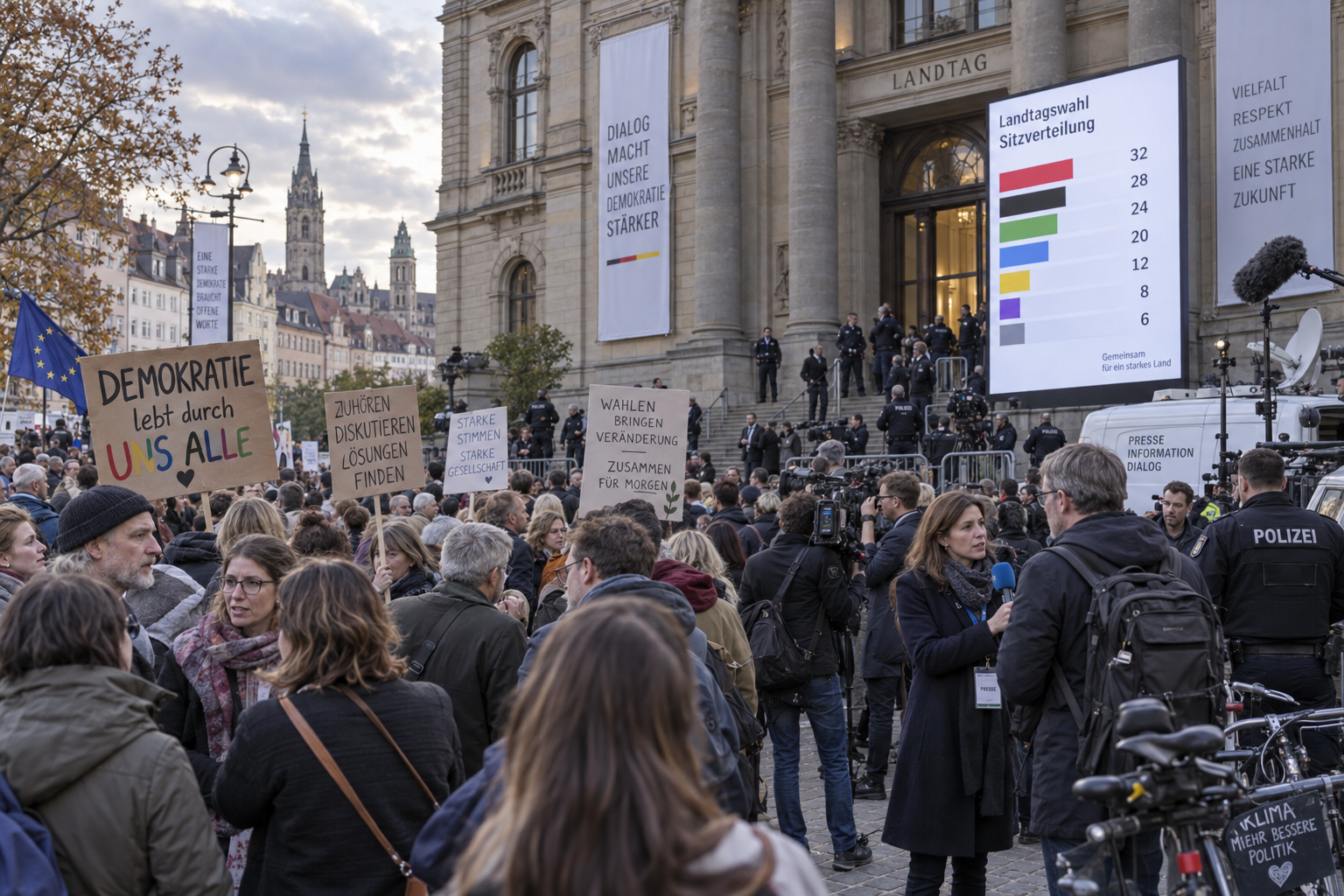
Thousands of people demonstrated across Germany after the far-right Alternative for Germany (AfD) achieved its strongest-ever result in a state election. In Saxony-Anhalt, the party won nearly 44% of the vote and secured 39 of the state legislature’s 83 seats. Although it lacks the majority required to govern alone, the AfD is seeking support from legislators in other parties. If successful, it would lead Germany’s first far-right state government since the Nazi Party ruled the country.
The largest protest took place in Berlin, where demonstrators gathered near the Brandenburg Gate for a pro-democracy rally. Police estimated attendance at about 5,000, while organisers claimed more than 14,000 participants. Other demonstrations were held in cities including Potsdam, Münster, Göttingen, Dresden, Aachen, Bamberg, Darmstadt and Halberstadt. Protesters condemned racism and fascism, while speakers warned against accepting the AfD’s electoral progress as inevitable. Jens-Christian Wagner, director of the Buchenwald memorial, called the election result a disgrace.
The outcome has increased pressure on Chancellor Friedrich Merz and his Christian Democratic Union (CDU). Merz rejected cooperation with the AfD but admitted that the result had shaken his party. He also dismissed calls for his resignation and said he would continue his reform programme.
The AfD’s prospects are being closely monitored ahead of elections in Mecklenburg-Western Pomerania and Berlin. It is leading polls in Mecklenburg-Western Pomerania, while Berlin’s race remains fragmented. Germany’s traditional political firewall against cooperation with the AfD is also under renewed scrutiny, particularly after the populist-left BSW suggested it might work with the party on migration and Russia policy.
The AfD has been classified as right-wing extremist by Saxony-Anhalt’s domestic intelligence agency, a designation it rejects. Its co-leader Alice Weidel described the result as a breakthrough and said the party would target at least 40% in the 2029 national election. French Finance Minister Roland Lescure called the result a worrying signal for Europe, amid broader concern about the rise of populist and nationalist movements.
Entities: Alternative for Germany (AfD), Saxony-Anhalt state election, Germany, Berlin, Mecklenburg-Western Pomerania • Tone: analytical • Sentiment: negative • Intent: inform
09-09-2026
The article reports on a protest in Cologne against the Alternative for Germany (AfD), a German far-right political party. Thousands of people reportedly gathered in the city after the AfD won nearly 44 percent of the vote in the state election in Saxony-Anhalt. The result is presented as a significant electoral success for the party and the immediate context for the demonstration.
The report identifies the protesters as anti-AfD demonstrators but provides no further information about the organizers, the size or character of the rally beyond the description of “thousands” participating, or the protesters’ specific demands. It also does not include reactions from AfD representatives, German government officials, election authorities, or other political parties. No details are provided about whether the protest was peaceful, whether there were arrests or disruptions, or how the election result could affect the state’s government.
The article is a brief Al Jazeera Newsfeed report published on September 9, 2026. Its central focus is the connection between the AfD’s strong performance in Saxony-Anhalt and the public opposition expressed at a rally in Cologne. The report frames the event as a response to the rise of a far-right party, while remaining concise and factual. Because the supplied content consists only of a headline and a short summary, it does not offer broader electoral analysis, historical context, polling data, or detailed accounts from people at the demonstration.
Entities: Anti-AfD protesters, AfD (Alternative for Germany), Cologne, Saxony-Anhalt, Germany • Tone: neutral • Sentiment: negative • Intent: inform