09-09-2026
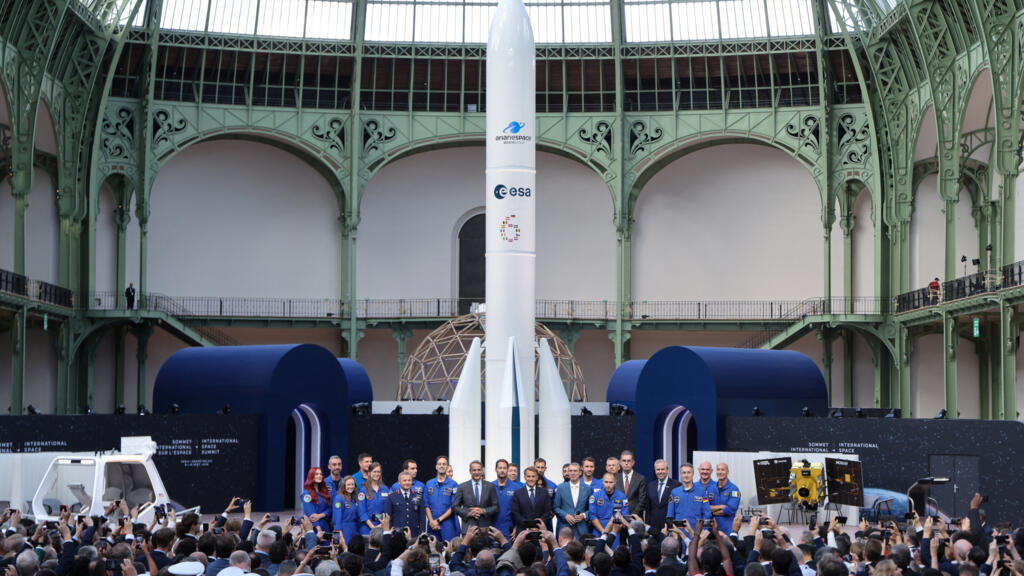
France and Germany are co-hosting a major international space summit in Paris as Europe seeks to strengthen its strategic autonomy and reduce dependence on the United States, China and Russia. French President Emmanuel Macron said more than 50 projects are expected to be signed during the two-day event and emphasized the importance of European cooperation, space research and international partnerships. He also announced the European Space Agency’s planned 2027 PAM-6 private astronaut mission to the International Space Station, which is expected to carry Greek astronaut Adrianos Golemis, and highlighted a deal giving Amazon Leo six additional launches with Arianespace.
The summit is taking place amid tensions with the United States. SpaceX, Blue Origin, Stoke Space and Starcloud reportedly withdrew after a White House official warned that participation could be interpreted as support for European Union policy positions. The withdrawals underscore the political sensitivity surrounding Europe’s effort to develop independent launch, communications and security capabilities.
France and Germany are also divided over the future direction of European space and defence policy. German Chancellor Friedrich Merz skipped the summit because of domestic commitments, while ministers represented Germany. Paris has promoted European-built systems such as Ariane 6 and broader strategic autonomy, whereas Berlin has shown more openness to cheaper US providers including SpaceX. The two countries also abandoned the Future Combat Air System project after years of disagreement.
Despite these difficulties, Europe is increasing its investment in space. The ESA approved a record €22.3 billion budget for 2026–2028, while broader European spending on space, security and defence is expected to reach €35 billion. The recent orbital launch by German startup Isar Aerospace and the development of the IRIS² secure satellite network demonstrate Europe’s push for independent access to space and resilient communications. Experts cited in the article say space is becoming increasingly important to both civilian life and modern warfare, particularly as the war in Ukraine has highlighted the strategic value of satellite services such as Starlink.
Entities: France, Germany, Emmanuel Macron, Friedrich Merz, European Space Agency (ESA) • Tone: analytical • Sentiment: neutral • Intent: inform
09-09-2026
European space officials, astronauts, researchers and industry leaders from around 120 countries gathered in Paris for a two-day International Space Summit focused on strengthening Europe’s position in a space sector dominated by the United States. French President Emmanuel Macron used the summit to argue that Europe should reduce its dependence on US technology and develop greater strategic autonomy in areas including satellite communications, reconnaissance and launch services.
European Space Agency Director General Josef Aschbacher called for a €10 billion investment over the next decade—approximately €1 billion annually—to build independent European capabilities. He warned that without such funding, Europe would remain reliant on foreign providers. Purchasing flights for European astronauts from overseas companies could cost around €5 billion over 10 years, he said, while investing in European infrastructure could create jobs, strengthen autonomy and improve Europe’s leverage in international negotiations. ESA member states are expected to consider the proposal at a ministerial meeting in December.
The article places Europe’s debate in the context of intensified global competition and recent geopolitical events. Russia’s invasion of Ukraine demonstrated both the importance and vulnerability of Elon Musk’s Starlink satellite network. In response, the European Union is developing Iris2, a sovereign satellite constellation intended to provide secure communications, though it is not expected to be fully operational until 2030. The article also notes that US satellite-imaging companies withheld imagery during the recent Iran conflict, reinforcing concerns about dependence on foreign commercial providers.
The United States remains the industry leader through NASA’s Artemis lunar program, SpaceX’s reusable rockets and Amazon’s planned broadband satellite network. SpaceX and Blue Origin did not attend the Paris summit, reportedly after a White House warning that participation could appear to endorse EU policies. European officials nevertheless say the continent has strong universities, laboratories, companies and space agencies, but must invest more quickly if it wants to become an independent participant rather than a customer of other powers.
Entities: European Space Agency (ESA), Josef Aschbacher, Emmanuel Macron, Thomas Pesquet, International Space Summit • Tone: analytical • Sentiment: neutral • Intent: inform
09-09-2026
The France 24 debate examines the rapidly intensifying competition to control space infrastructure, satellite networks and launch capacity. It frames the issue as part of a broader strategic race for resources and technological power, comparing the United States’ increasingly dominant position with Europe’s slower progress. Donald Trump has set an ambition of 1,000 rocket launches per year, while SpaceX’s reusable launch systems have helped the United States move far ahead of competitors. Elon Musk’s Starlink network is presented as an example of the strategic leverage created by private satellite constellations, including Ukraine’s dependence on Musk’s cooperation for military operations against Russia.
Europe is portrayed as struggling to keep pace. Its Ariane rocket is expected to conduct only nine to 11 launches the following year, although the programme is part of a wider European effort to maintain independent access to space. The programme also refers to Norway’s first private launch of a German satellite and asks whether commercial space activity can expand safely in increasingly crowded orbits.
A central concern is the lack of effective governance. The discussion questions whether space requires urgent regulation, particularly as orbital debris grows and more governments and private companies compete for limited orbital resources. The article expresses skepticism about prospects for international cooperation: Germany reportedly withdrew from co-hosting the Paris International Space Summit, while the White House allegedly pressured American aerospace leaders not to attend. The summit itself brought together nearly 120 delegations to discuss global space governance, but the political divisions surrounding it suggest that coordinating rules may be difficult. Overall, the programme presents space as a rapidly militarized and commercialized domain in which the United States currently sets the pace, Europe is attempting to catch up, and global regulation remains uncertain.
Entities: Donald Trump, Elon Musk, Emmanuel Macron, Thomas Pesquet, Kyriakos, Greece’s prime minister • Tone: analytical • Sentiment: negative • Intent: analyze
09-09-2026
UAE astronaut and Minister of State for Youth Affairs Sultan Al Neyadi is attending the two-day International Space Summit in Paris, where he is the only Arab astronaut among about 15 participants. His presence highlights the UAE’s expanding role in the global space sector. Al Neyadi joined a UAE delegation that includes Space Agency chairman Dr Ahmad Al Falasi and Fatima Al Shamsi, the agency’s acting director of space policy and international relations.
Speaking on a panel with international astronauts, Al Neyadi attributed the rapid development of the UAE’s roughly two-decade-old space programme to international partnerships. He cited cooperation with Russia, the United States, Japan and South Korea, and said the UAE remained open to further collaboration and knowledge transfer.
French President Emmanuel Macron convened the summit to begin discussions on global space governance and strengthen Europe’s position in an industry increasingly shaped by US-China competition. China, India, Japan, Vietnam and South Korea are participating, while international statements and commercial agreements are expected. However, the event has exposed divisions within Europe: German Chancellor Friedrich Merz and Italian Prime Minister Giorgia Meloni are absent, and US technology companies withdrew after pressure from the White House, which regarded the summit as overly pro-European.
The meeting also reflects growing commercial ties between France and the UAE. Orbitworks acting chief executive Hamdullah Mohib is among business leaders attending a closed-door meeting with Macron. Orbitworks, based in Abu Dhabi, is a partnership between US-based Loft Orbital and Marlan Space, a subsidiary of Abu Dhabi-based Marlan Holding. The company recently signed an agreement with France and plans to launch its Altair-1 satellite with SpaceX in October.
The article also outlines Al Neyadi’s credentials. In 2023, he spent six months aboard the International Space Station and became the first Arab astronaut to conduct a spacewalk. He completed NASA geology training in New Mexico with Hazza Al Mansouri in June as the UAE prepares for future missions, including destinations such as the Moon.
Entities: Sultan Al Neyadi, United Arab Emirates, International Space Summit, Paris, France, Emmanuel Macron • Tone: analytical • Sentiment: neutral • Intent: inform