09-09-2026
Al Jazeera reports that Saudi-backed Yemeni government forces are intensifying a counteroffensive against the Houthis along Yemen’s western coast. The operation is presented as part of a broader escalation in Yemen, where fighting is spreading across the country. The report links the renewed offensive to recent Houthi attacks on four Saudi Arabian cities, which reportedly injured 73 people. In response to those attacks, Riyadh pledged retaliation, increasing the likelihood of further military action and widening regional tensions.
The article’s headline identifies the western coast as the immediate location of the strikes, while the accompanying text places the offensive within the larger conflict between Yemen’s Saudi-backed government forces and the Houthi movement. It does not provide details about the specific towns or military targets hit, the timing or scale of the strikes, casualties among the Houthis or government forces, or the nature of the injuries in Saudi Arabia. It also does not include statements from Houthi officials, Saudi authorities, or independent observers.
Overall, the brief NewsFeed item informs readers about a new phase of fighting and emphasizes the connection between cross-border attacks and the Saudi-backed response. The reported retaliation pledge and the spread of hostilities suggest a potentially escalating conflict involving Yemen and Saudi Arabia, but the limited report offers no further assessment of the political or humanitarian consequences.
Entities: Yemen, Saudi-backed Yemeni government forces, Houthis, Saudi Arabia, Riyadh • Tone: urgent • Sentiment: negative • Intent: inform
09-09-2026
The article reports a new escalation involving Yemen’s Houthi movement and Saudi Arabia, centered on the strategically important Bab al-Mandab Strait, the maritime gateway between the Red Sea and the Gulf of Aden. On September 9, 2026, the Saudi-led coalition said that the Iran-backed Houthis had launched fresh attacks against southern Saudi Arabia. The statement came after the Houthis began an offensive aimed at gaining control of the Bab al-Mandab passage.
The strait is a vital route for international shipping and energy supplies. Disruption there could affect vessels traveling through the Red Sea and potentially limit access to the Suez Canal, creating broader consequences for global trade and oil and gas markets. The article links the Houthi offensive to wider regional tensions involving maritime security and Iran’s relationships with allied armed groups.
Speaking to FRANCE 24’s Mark Owen, Adam Baron of the New America Foundation said that the ability of both relevant groups to disrupt shipping in the Red Sea and the Gulf could provide “tremendous” leverage. According to Baron, such pressure could be used to push the parties toward a political resolution, although the comment also underscores the serious risks to commercial shipping and regional stability.
The report does not provide details about casualties, damage, or the specific targets of the latest attacks. Instead, it focuses on the strategic significance of Bab al-Mandab and the possibility that coordinated or simultaneous maritime disruption could intensify pressure on governments involved in the conflict. The accompanying image caption also describes concerns that Iran could use its Houthi allies to threaten closure of the strait.
Entities: Houthi movement, Bab al-Mandab Strait, Saudi-led coalition, Saudi Arabia, Yemen • Tone: analytical • Sentiment: negative • Intent: inform
09-09-2026
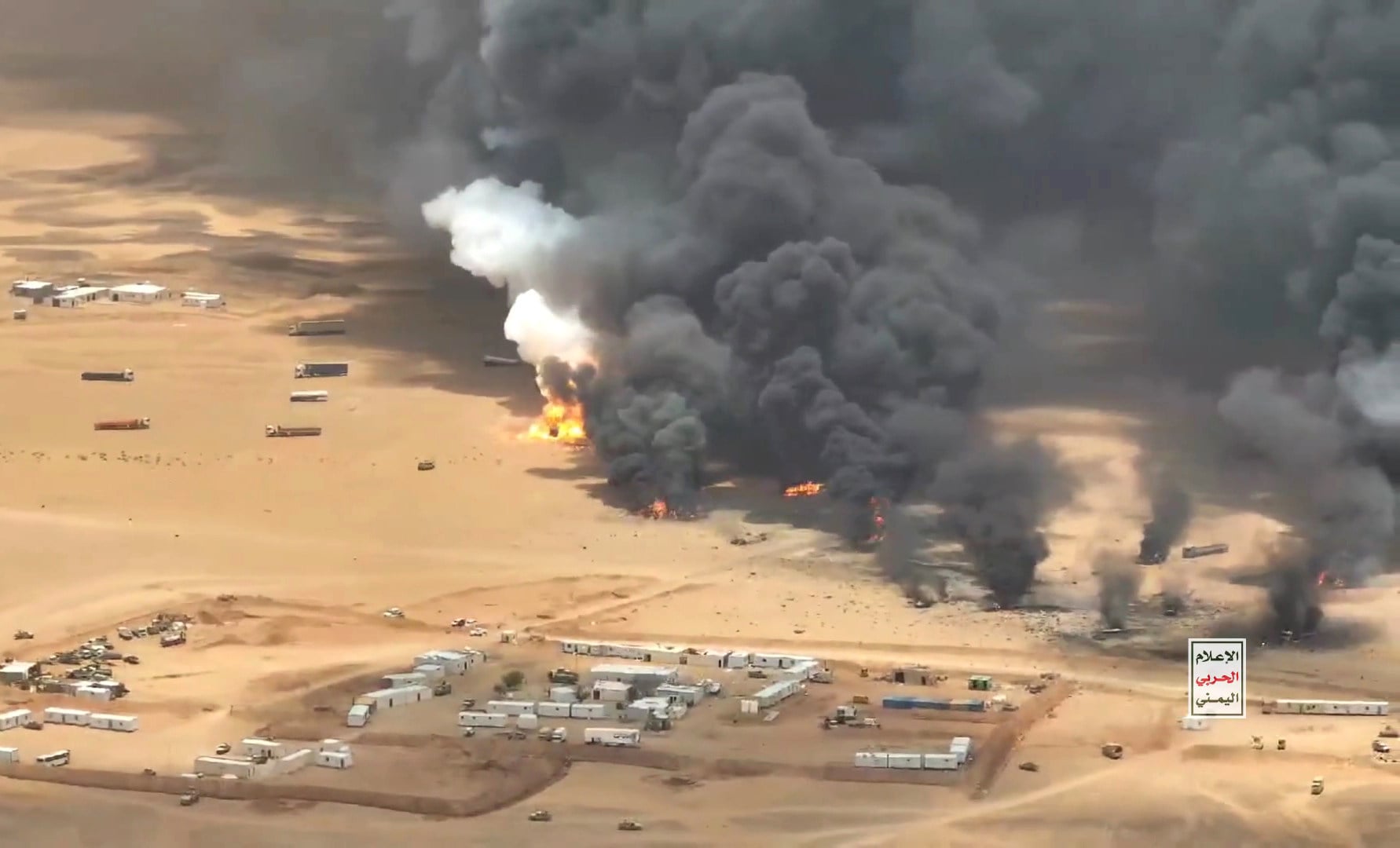
France 24 reports that Yemen’s Houthi movement said Saudi Arabia carried out retaliatory strikes on Tuesday after the Houthis targeted Saudi oil facilities. According to the report, the attacks set oil sites ablaze and wounded dozens of people. The exchanges represent a renewed escalation in Yemen, where deadly fighting has resumed following a Houthi offensive directed toward Bab al-Mandab, the Red Sea chokepoint.
The report describes a rapid sequence of strikes and counter-strikes between the Houthis and Saudi Arabia, which supports Yemen’s internationally backed government. The latest violence follows the breakdown of a four-year truce between the Houthis and the Saudi-backed government in July. That ceasefire had temporarily reduced the intensity of the conflict, but its collapse has reopened the possibility of broader hostilities and increased risks around a critical maritime passage.
The article presents the Houthis’ account of the Saudi response and does not provide further details about the scale of the reprisals, the precise locations of the strikes, or independent confirmation of the reported casualties. Its focus is on the immediate cycle of attack and retaliation and on the wider deterioration of Yemen’s security situation. The report places the developments within the context of the renewed conflict over the Red Sea’s Bab al-Mandab chokepoint, emphasizing that the violence is not an isolated incident but part of a broader escalation after the truce unraveled.
Entities: Houthis, Saudi Arabia, Yemen, Saudi-backed government, Red Sea • Tone: neutral • Sentiment: negative • Intent: inform
09-09-2026
The France 24 video interview examines Yemen’s transition from a prolonged, unresolved civil war toward a renewed phase of regional confrontation. Hosted by Oliver Farry, the segment features Jules Grange Gastinel, a researcher at the Institute for Research and Studies on the Arab and Muslim World (IREMAM). Gastinel argues that the relative calm Yemen experienced after 2022 should not be interpreted as a lasting peace or political settlement. Instead, the country remains deeply divided among rival political, financial and military institutions, leaving it vulnerable to renewed escalation and outside influence.
The framing suggests that Yemen’s internal fragmentation is closely connected to wider Middle Eastern tensions, including the strategic rivalry involving Iran and Saudi Arabia and security concerns surrounding the Red Sea. The title presents the escalation as a development that is alarming not only for Yemen but for governments and populations across the region. The discussion therefore places Yemen’s conflict within a broader regional security environment rather than treating it solely as a domestic civil war.
The available article text is an introduction to a video interview and does not provide details about the immediate trigger for the latest escalation, specific military operations, casualties or diplomatic responses. Its central argument is analytical: a period of reduced violence after 2022 concealed unresolved political and institutional divisions. Those divisions, combined with regional rivalries, mean that Yemen’s apparent stability was fragile and that renewed confrontation could have consequences beyond the country’s borders.
Entities: Yemen, Jules Grange Gastinel, Oliver Farry, Institute for Research and Studies on the Arab and Muslim World (IREMAM), Iran • Tone: analytical • Sentiment: negative • Intent: analyze
09-09-2026
The article warns that a renewed Houthi offensive in Yemen could trigger another major crisis for shipping in the Red Sea. Iran-aligned Houthi rebels launched an operation on Friday to seize coastal plains overlooking the Bab el-Mandeb Strait, confronting Saudi-backed government forces and intensifying fighting in the strategically important Taiz and Hodeidah governorates.
The conflict escalated further when Houthi forces launched missile and drone attacks against four cities in southern Saudi Arabia early Tuesday. The strikes injured 73 civilians and, according to analysts, could mark a turning point by widening the war beyond Yemen’s borders. The attacks are occurring alongside an escalating US-Iran confrontation over the Strait of Hormuz, raising concerns that both major maritime chokepoints could be threatened simultaneously.
The Bab el-Mandeb links the Indian Ocean with Europe through the Suez Canal, making it vital to global trade and energy shipments. The Houthis imposed an embargo on Saudi shipping using the strait in July, forcing Saudi Arabia to reroute oil exports from Red Sea ports to Asia around Africa. That diversion adds thousands of kilometres and significant costs to tanker journeys.
Yemen analyst Adam Baron says the latest developments suggest a return to Houthi cross-border attacks on Saudi Arabia and renewed efforts to disrupt Red Sea shipping. The article presents the fighting as a potential parallel to the crisis around Hormuz, with the conflict threatening to choke maritime traffic, increase transport costs and undermine four years of relative peace in Yemen.
Entities: Houthi rebels, Saudi-backed government forces, Saudi Arabia, Bab el-Mandeb Strait, Red Sea shipping • Tone: urgent • Sentiment: negative • Intent: warn
09-09-2026
The editorial argues that recent attacks by Iran-backed Houthi rebels on several Saudi cities represent a serious escalation that could draw Yemen back into large-scale conflict. The attacks reportedly wounded dozens of civilians, disrupted energy operations in southern Saudi Arabia and included threats to block the Bab Al Mandeb strait, a vital global shipping route. The National warns that Yemen is becoming a regional pressure point at a time when the Middle East cannot afford another open-ended war.
The article recalls a warning from UN Yemen envoy Hans Grundberg that Yemen faces its greatest risk of returning to major fighting since the 2022 truce. Although the truce has brought relative calm and some relief to Yemen’s suffering population, it has not resolved the political issues underlying the conflict. The editorial contends that the Houthis are guided by ideological objectives rather than a genuine commitment to improving the lives of Yemenis, and may be using regional instability to increase their leverage over neighbouring states and the international economy.
The potential consequences extend beyond Yemen and Saudi Arabia. The Houthis have developed networks around the Red Sea and in the Horn of Africa, with reports alleging cooperation with Somalia’s Al Shabab involving weapons and technical expertise. Their networks have also reached Sudan and other parts of the region, raising fears that a conflict beginning in Yemen could spread across borders.
The editorial says Saudi Arabia’s response and restraint will be crucial, but emphasizes that a truce is not the same as peace. It calls for an urgent long-term political solution and the reinstatement of an internationally recognized Yemeni government capable of serving its people and acting as a stable regional neighbour.
Entities: Houthi movement, Yemen, Saudi Arabia, Iran, Yahya Sarea • Tone: urgent • Sentiment: negative • Intent: warn
09-09-2026
Al Jazeera reports that a cameraman recorded the moment Yemeni government forces came under attack in what is described as a suspected Houthi roadside ambush. The incident occurred as a convoy travelled through Yemen’s Hodeidah governorate. According to the brief report, gunmen opened fire on the convoy, killing one person and wounding several others.
The report presents the footage and the immediate consequences of the attack but provides limited additional context. It does not identify the deceased or wounded, specify their affiliations beyond describing the convoy as belonging to Yemeni government forces, or explain which Houthi faction or unit may have been responsible. The wording “suspected-Houthi” indicates that responsibility had not been definitively established in the information provided.
The incident took place in Hodeidah, a strategically important area of Yemen that has been affected by the country’s ongoing armed conflict. The article does not state when the ambush occurred, describe the weapons used, or provide details about the condition of those wounded. It also does not include comments from Yemeni government officials, Houthi representatives, witnesses, or independent investigators.
The central focus is the cameraman’s footage, which allegedly captures the attack as it happened. The report is primarily factual and immediate, emphasizing the ambush, the movement of the convoy, the suspected perpetrators, and the casualties. Its presentation conveys the danger faced by government forces and the continuing volatility of the conflict, while avoiding broader political analysis or claims beyond the reported incident.
Entities: Yemeni government forces, Houthi movement, Hodeidah governorate, Yemen, Al Jazeera • Tone: urgent • Sentiment: negative • Intent: inform