09-09-2026
The European Central Bank is widely expected to raise its deposit rate by 0.25 percentage points on Thursday, from 2.25% to 2.5%, after eurozone inflation accelerated to 3.3% in August. Investors see the move as nearly certain, but the article argues that the justification is far less straightforward than the headline figures suggest.
The increase in inflation is being driven overwhelmingly by energy costs, which rose 14.3% year on year, largely because of geopolitical tensions and the energy shock linked to the Iran war. By contrast, core inflation fell from 2.5% to 2.4%, while services inflation declined from 3.3% to 3%. These measures suggest that higher energy prices have not yet generated broad-based wage or demand pressures, known as second-round effects. An ECB research paper estimated that adverse energy-supply factors accounted for about 90% of the rise in energy inflation between January and May.
The situation also differs from the 2021–22 inflation surge, when both supply and demand pressures were strong and justified aggressive monetary tightening. Inflation varies considerably across member states, reaching 4.5% in Spain compared with 2.9% in Germany and 2.7% in France. Meanwhile, eurozone growth has been more resilient than expected, partly because of fiscal support and economic developments elsewhere.
ING describes the expected move as an “insurance” or “dovish” hike because the deposit rate would remain within the ECB’s estimated neutral range. The ECB’s decision is further complicated by possible moves from the Federal Reserve and Bank of Japan. A stronger dollar could weaken the euro, making European exports more competitive but raising the cost of dollar-priced oil and gas. The article concludes that the hike is effectively settled, but it will not resolve the ECB’s dilemma of containing inflation it cannot directly control while avoiding unnecessary pressure on a still-fragile economy.
Entities: European Central Bank (ECB), Christine Lagarde, Federal Reserve, Kevin Warsh, Bank of Japan • Tone: analytical • Sentiment: neutral • Intent: analyze
09-09-2026
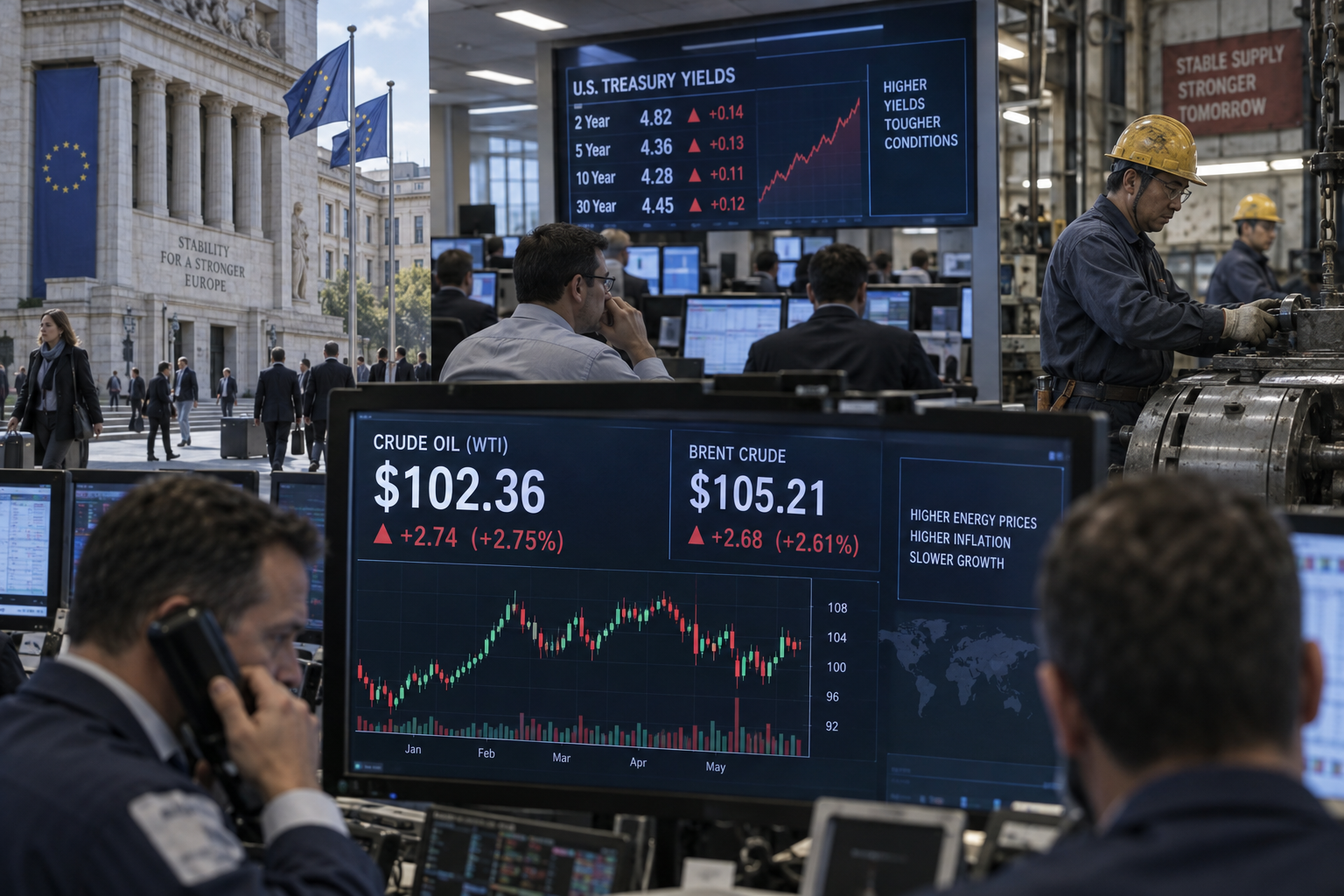
U.S. Treasury yields moved higher on Wednesday as oil prices climbed above $100 per barrel, intensifying concerns that energy costs could fuel inflation. The 2-year Treasury yield, which is particularly sensitive to expectations for near-term Federal Reserve policy, rose more than 2 basis points to 4.423%. The benchmark 10-year yield increased by less than 1 basis point to 4.808%, while the 30-year Treasury yield declined by more than 1 basis point to 5.251%. Because bond prices move inversely to yields, the changes indicated modest selling pressure in shorter- and intermediate-term Treasurys, with longer-term bonds performing somewhat better.
Brent crude futures rose above $100 per barrel for the first time since late July. U.S. West Texas Intermediate crude also gained more than 2%, trading at approximately $95 per barrel. The oil rally was linked to escalating Middle East tensions and continuing conflict between the United States and Iran. Tehran said its forces had attacked two U.S. vessels and eight oil tankers in the Gulf, describing the action as retaliation for the U.S. destruction of five Iranian crude oil tankers.
Marc Ostwald, chief economist and global strategist at London-based ADM Investor Services, said markets were confronting the dual risks of higher energy prices increasing inflation and weakening economic growth through reduced demand. Investors are awaiting economic data that could clarify how resilient the U.S. economy remains amid the conflict and energy-supply constraints. Producer price index data for August is scheduled for Thursday, followed by the August consumer price index report on Friday. The figures could influence expectations for monetary policy and the direction of Treasury yields.
Entities: U.S. 2-year Treasury yield, U.S. 10-year Treasury note, U.S. 30-year Treasury bond, Brent crude futures, West Texas Intermediate crude • Tone: analytical • Sentiment: negative • Intent: inform
09-09-2026
China’s factory-gate inflation accelerated in August, with the producer price index (PPI) rising 3.8 per cent year on year, up from 3.5 per cent in July. The increase exceeded the 3.6 per cent median forecast from economists surveyed by financial data provider Wind. The article attributes the stronger producer-price growth to volatile international energy and commodity markets, particularly higher crude oil and non-ferrous metal prices associated with the US-Israel war on Iran.
Consumer inflation also strengthened. China’s consumer price index (CPI) rose 0.8 per cent year on year in August, compared with 0.5 per cent in July and following two months of slower growth. The result was broadly consistent with Wind’s 0.78 per cent projection. The CPI is described as a key measure of inflation and a gauge of consumer-price trends.
Dong Lijuan, a senior statistician at China’s National Bureau of Statistics, said rising international prices for crude oil and non-ferrous metals had pushed up prices in related domestic industries. Coal-mining prices increased 26.6 per cent year on year in August, while prices in non-ferrous-metal processing rose 20.8 per cent. Oil and gas extraction prices climbed 10.5 per cent.
The figures indicate that imported commodity-cost pressures are feeding into China’s industrial economy, even as domestic demand remains weak. The report presents the data as an early indication that geopolitical conflict and energy-market volatility are complicating China’s inflation outlook. It does not provide a broader policy response or a detailed forecast beyond the August figures.
Entities: China, Beijing, Xinyi Wu, Dong Lijuan, National Bureau of Statistics (NBS) • Tone: analytical • Sentiment: neutral • Intent: inform