07-10-2026
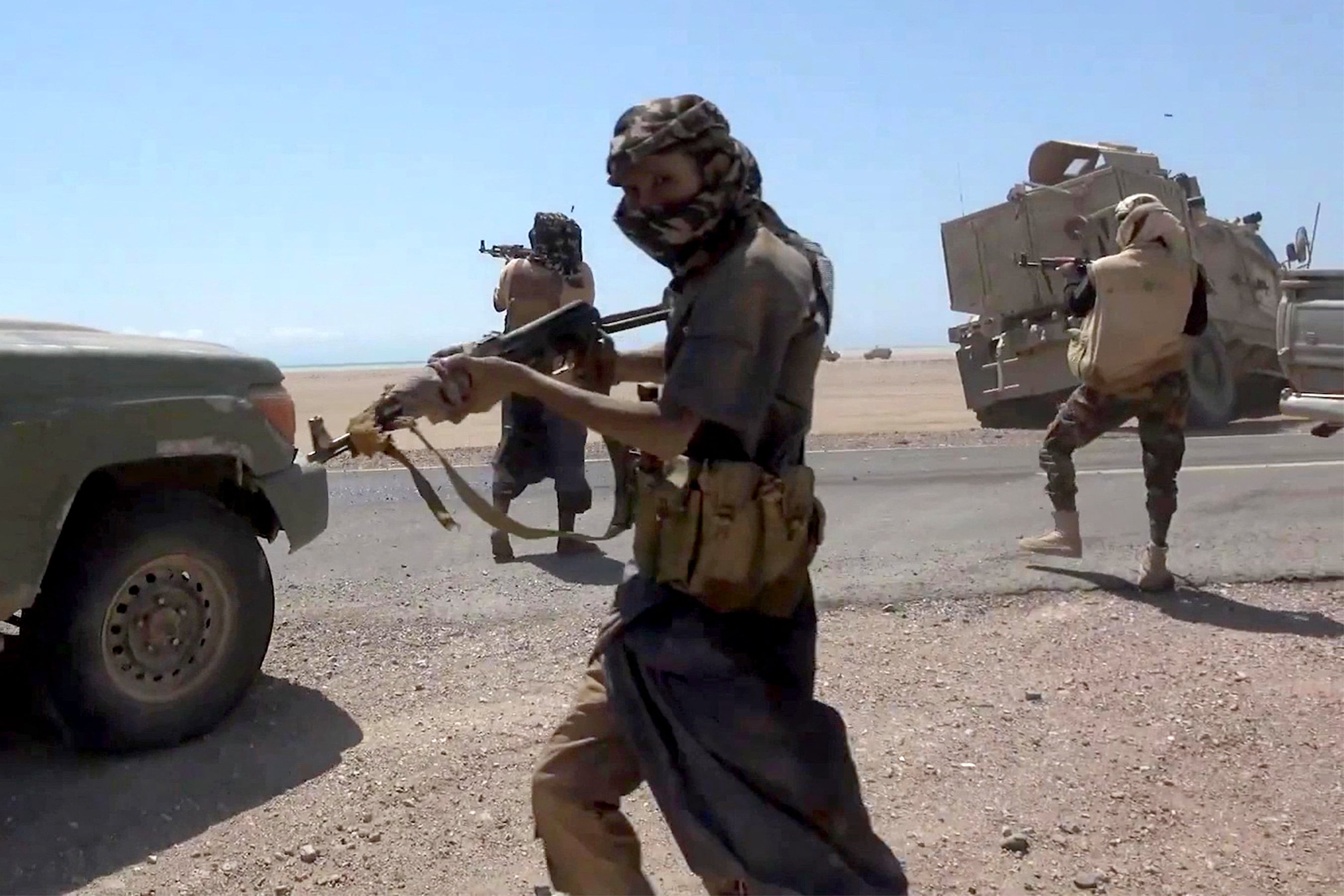
The live news roundup reports continued fighting in Yemen as Iran-backed Houthi forces and the Saudi-backed Yemeni government dispute control of strategic areas along the Red Sea coast. The Houthis denied government claims that they had lost key positions, saying they retained their gains. They also claimed attacks on Saudi sites had killed or wounded 200 security personnel; Saudi officials confirmed attacks on two airports but reported only three minor injuries. Brent crude fell below $100 a barrel despite the conflict, which is unfolding near the Bab el-Mandeb Strait, a critical route for global energy shipments.
In the latest update, the Houthis said they targeted Riyadh’s King Khalid International Airport with a ballistic missile and claimed the strike disrupted air traffic. They also said they targeted military supplies near Aden. The claims came after the Saudi-led coalition said it intercepted a missile north of Riyadh. Reports of territorial changes remain difficult to verify independently, and fighting was reported around Dhubab, a strategic town near the southern Red Sea.
Other updates describe Iran-related developments beyond Yemen. A U.S. official said RAF Fairford in England had faced threats linked to Iran, prompting the United States to remove its bombers from the base. British police arrested a seventh person in connection with a suspected plot. Iran also summoned France’s ambassador over the French police response to school-condition protests, amid already strained relations.
The roundup further reports that most families of six U.S. soldiers killed in a March drone attack in Kuwait planned to skip a White House Gold Star family event. Some relatives questioned the administration’s transparency and handling of the event, while others expressed appreciation for its recognition of their family members. The article says the war has killed 19 U.S. troops and wounded more than 800.
Entities: Iran-backed Houthis, Yemen, Saudi Arabia, Bab el-Mandeb Strait, Red Sea • Tone: analytical • Sentiment: negative • Intent: inform
07-10-2026
Yemen’s Houthi rebels claimed attacks on airports in Aden, Riyadh, Abha and nearby Khamis Mushait as fighting intensified between the Houthis and Saudi-backed Yemeni government forces. Yemen’s Transport Ministry said ballistic missiles and explosive-laden drones struck Aden International Airport, the country’s main international gateway outside Houthi control. A missile reportedly landed near its runway shortly before a flight from Cairo was due to arrive, prompting the plane to divert to Jeddah. Two aircraft on the runway were moved as a precaution. Houthi military spokesman Yahya Saree separately claimed that drones targeted King Khalid International Airport in Riyadh, though Saudi authorities had not confirmed an attack there. The Saudi-led coalition said it intercepted and destroyed another ballistic missile north of Riyadh, tracing its launch to Houthi-controlled Sanaa. Saree also said the Houthis targeted Abha International Airport and an air base in Khamis Mushait; those claims were not immediately confirmed by Saudi authorities, and it was unclear whether they were connected to a missile intercepted near Khamis Mushait. The attacks took place amid a government counteroffensive along Yemen’s Red Sea coast. Saudi-backed forces, supported by coalition air power, said they had driven the Houthis from areas around the Bab el-Mandeb Strait and the city of Mocha, which the rebels had captured the previous month. The article also reports a sharp rise in displacement. The International Organization for Migration said more than 200,000 people had been displaced by Wednesday, up from about 76,000 in mid-September after fighting erupted. The escalation is described as Yemen’s most serious since a UN-brokered truce largely halted cross-border attacks in 2022.
Entities: Yemen, Houthi rebels, Yahya Saree, Aden International Airport, King Khalid International Airport • Tone: neutral • Sentiment: negative • Intent: inform
07-10-2026
Yemen’s transport ministry said the Houthis attacked Aden’s international airport on Wednesday using ballistic missiles and explosive-laden drones. The reported strike comes as fighting between the Iran-aligned Houthi movement and Saudi-backed government forces intensifies. In recent days, clashes have centered on areas near the Bab el-Mandeb Strait, a strategically important shipping route. The article notes that the strait has become more significant for energy exports after conflict between the United States and Iran restricted trade through the Strait of Hormuz.
This week, Yemeni government forces, supported by air power from the Saudi-led coalition, began a counteroffensive aimed at retaking strategic territory near the Bab el-Mandeb Strait and around the town of Mocha. The Houthis had captured those areas in September. The report says it remains unclear whether the government forces’ advance will hold, leaving the outcome of the counteroffensive uncertain.
The article presents the airport attack as part of a broader escalation in Yemen, where control of territory near vital maritime routes is a key focus of the fighting. It does not provide details about damage or casualties from the attack, nor does it report a response from the Houthis. Its account is attributed to Yemen’s transport ministry and Reuters, and emphasizes the strategic importance of the area rather than offering a broader assessment of the conflict.
Entities: Houthis, Aden, Aden International Airport, Yemen, Yemen’s transport ministry • Tone: neutral • Sentiment: negative • Intent: inform
07-10-2026
Yemen’s Houthi rebels claimed they launched coordinated drone and ballistic-missile attacks at dawn on Wednesday against airports and military positions in Saudi Arabia and Yemen. The claims included attacks on Riyadh’s King Khalid International Airport, Abha International Airport and a military base in Khamis Mushait, as well as strikes on Saudi military camps in Jizan and Asir. Saudi authorities did not immediately confirm all the reported airport targets. They did, however, report attacks across several locations, and Saudi state television said the Saudi-led coalition intercepted a ballistic missile headed for Khamis Mushait.
The attack with the most immediate aviation impact was in Aden, where Yemen’s Transport Ministry said two ballistic missiles and several explosive-laden drones targeted the international airport. One missile landed near the runway shortly before Yemenia Airways flight 603, travelling from Cairo, was due to land. The plane diverted to Jeddah. Airport staff evacuated passengers and workers and moved two aircraft away from danger. No casualties were reported. Online videos and local reports described explosions near the airport, although accounts of damage and the reported missile launch locations were not independently verified.
Houthi military spokesman Brig Gen Yahya Saree said attacks on Saudi camps killed and wounded dozens of soldiers and officers and set fire to weapons depots; those claims could not be independently verified. The coalition said it was continuing operations against Houthi missile launch sites and weapons facilities. Its spokesman, Maj Gen Turki Al Malki, said coalition forces had destroyed a missile launch platform in Sanaa and a storage facility in Saada.
The exchanges come amid renewed fighting following Houthi advances along Yemen’s Red Sea coast and a Saudi-backed government counteroffensive supported by coalition air strikes. The article also reports earlier attacks near airports in Jizan and Najran, temporary holds on flights to and from Riyadh, and Houthi-affiliated reports of Saudi strikes in Ibb and Taiz. The escalation raises concerns for civilian aviation and other infrastructure.
Entities: Yemen’s Houthi rebels, Saudi Arabia, Yemen, Aden International Airport, King Khalid International Airport • Tone: analytical • Sentiment: negative • Intent: inform
07-10-2026
Al Jazeera reports that two missiles fired by Houthi forces targeted Yemen’s Aden International Airport on 7 October 2026. The report says video shows explosions near the airport. Yemen’s Saudi-backed government said the missiles were fired by Houthi forces, and the article reports that no casualties were recorded. The available text does not provide further details about damage, the missiles’ impact or intended targets, the circumstances of the launch, or any official response beyond the government’s statement. It also does not describe the video in detail or independently establish who fired the missiles; the attribution is presented as the government’s account. The article is a brief video-news item focused on the reported attack and its immediate human toll, rather than a broader account of the conflict or its political context. Its central facts are the two missiles, the airport near which explosions were shown, the government’s attribution to the Houthis, and the absence of reported casualties. No additional consequences or subsequent developments are stated in the supplied article text.
Entities: Aden International Airport, Yemen, Houthi forces, Saudi-backed government of Yemen, Two missiles • Tone: neutral • Sentiment: negative • Intent: inform
07-10-2026
Yemeni forces aligned with the internationally recognised government have launched an offensive to retake al-Waziiya, a strategic mountainous district in Taiz governorate held by the Houthis. The operation is part of the government’s wider “Dawn of Yemen” campaign, announced by Presidential Leadership Council chairman Rashad al-Alimi, to regain Houthi-held territory, including Sanaa, which the group has controlled since 2014. Yemen’s army said the Homeland Shield Forces had begun a large-scale operation and secured hills overlooking al-Mansoura, while claiming that Houthi fighters were retreating. The Houthis disputed that account, saying they had repelled the advance.
Al-Waziiya lies west of Taiz and east of the Red Sea port of Mocha. Its terrain is considered strategically important to any government effort to retake Mocha and areas near the Bab al-Mandeb Strait, a key maritime corridor. Al Jazeera reporter Yousef Mawry said the Houthis had taken the mountains before capturing Mocha last month, and argued that government forces would need to control the district to retake the port.
The ground operation coincided with escalating attacks involving Saudi Arabia. The Saudi-led coalition said it intercepted and destroyed a Houthi ballistic missile aimed at Khamis Mushait, and its spokesperson said missile threats originated from Houthi-held Sanaa, Saada and Amran. Saudi aviation authorities separately reported attacks on King Abdullah bin Abdulaziz Airport in Jazan and Najran Airport, near Yemen’s border, that caused injuries to three people and material damage. The Houthis said they had targeted sites in southern Saudi Arabia, including airports and military locations.
The coalition confirmed it was supporting the government offensive, stating that 100 fighter jets were providing air support. Pakistan and Turkiye also agreed to activate deterrence measures under their mutual defence pact with Saudi Arabia and rapidly deploy forces to the kingdom in response to Houthi attacks.
Entities: Yemen, al-Waziiya, Taiz governorate, Houthis, Rashad al-Alimi • Tone: analytical • Sentiment: neutral • Intent: inform
07-10-2026
Oil prices rose Wednesday as renewed geopolitical concerns in the Middle East outweighed signs that crude supply was recovering. Brent crude for December delivery gained 83 cents to $101.41 a barrel, while U.S. West Texas Intermediate for November rose 38 cents to $89.82, as of 8:22 a.m. ET.
Saudi Energy Minister Prince Abdulaziz bin Salman said oil pumped through the East-West Pipeline had reached 5.8 million barrels by Tuesday morning, indicating a recovery in physical supply. However, traders remained concerned that renewed attacks could disrupt flows. Saudi authorities reportedly said airports in Jazan and Najran had been targeted in two attacks, amid escalating hostilities between Saudi Arabia and Yemen’s Iran-backed Houthis. Separately, Iran’s increased attacks on tankers transiting the Strait of Hormuz raised fears that the fragile rebound in oil exports through the strategic waterway could be interrupted.
Market analysts described the oil market as caught between improving supply and continuing geopolitical risk. Naeem Aslam of Zaye Capital Markets said those opposing forces were shaping prices. Samer Hasn of XS.com warned that the Houthis’ ability to strike oil facilities far from Yemen’s border kept the risk of a major supply disruption high. He added that the danger could increase if the group sought to apply more pressure in response to losing territory. Overall, the article presents oil’s price rise as a reaction to the possibility of further disruptions, despite recent progress in restoring supply.
Entities: Brent crude, West Texas Intermediate (WTI), Saudi Arabia, Yemen, Iran-backed Houthis • Tone: analytical • Sentiment: negative • Intent: inform
07-10-2026
Turkey is providing Saudi Arabia with mainly defensive and technical military support as the kingdom confronts attacks by Yemen’s Iran-aligned Houthis, according to Turkish and US officials cited by Reuters. The assistance reportedly includes military equipment, weapons systems, intelligence sharing, drone operators, strategic planning, logistics, and support refining defensive measures. No Turkish troop deployment has taken place under the alliance so far.
The support follows the August signing of the Mecca Joint Defence Agreement by Turkey, Pakistan, and Saudi Arabia. The pact says an armed attack on one member constitutes an attack on all. After holding political and military meetings in response to Houthi attacks, the three countries said on Monday that they would move immediately to implement their collective-defence commitments and ensure the rapid deployment of forces and capabilities in Saudi Arabia.
For now, Turkish assistance is largely being provided bilaterally, officials said, because Turkey’s parliament has not formally ratified the agreement. Officials expect the scale and nature of support to increase after ratification. Turkish Foreign Minister Hakan Fidan said defence and military leaders had contributed views on operational and technical matters at a meeting of the alliance in Riyadh.
The developments come amid fighting in Yemen and concern over the security of Red Sea shipping. Yemeni government forces, backed by Saudi-led coalition air support, have launched a counter-offensive to retake territory near the Bab el-Mandeb Strait, a key route for energy exports and other trade. Reuters previously reported that Saudi Arabia was considering options for a broader offensive against the Houthis, including a coastal push to protect shipping or attacks on multiple fronts.
Entities: Turkey, Saudi Arabia, Pakistan, Yemen, Houthi movement • Tone: analytical • Sentiment: neutral • Intent: inform
07-10-2026
The article reports that Saudi Arabia, Pakistan and Turkey have begun putting their Mecca Joint Defense Agreement into practical effect amid escalating fighting between Saudi-backed Yemeni government forces and the Iran-backed Houthi movement. Signed by Saudi Crown Prince Mohammed bin Salman, Turkish President Recep Tayyip Erdogan and Pakistani Prime Minister Shehbaz Sharif, the pact states that an armed attack on one signatory should be treated as an attack on all three. After an emergency meeting in Riyadh, the countries said Turkey and Pakistan would provide military forces and capabilities for rapid deployment in Saudi Arabia. Retired Pakistani Lieutenant General Nauman Mahmood was named the alliance’s first secretary-general. The exact forces, capabilities and missions remain undisclosed, however, and analysts caution that the agreement’s operational significance is not yet clear.
The activation comes as Saudi Arabia intercepts Houthi missiles and supports a Yemeni government offensive to retake territory along the Red Sea coast near the strategic Bab el-Mandeb Strait and Mokha. Turkey’s possible role is uncertain. Its NATO membership could widen the implications of any deployment, and Turkey’s foreign minister says peaceful dialogue remains an option. Turkish opposition figures question whether the agreement can be implemented without parliamentary approval, while a retired admiral warns that Turkish forces and commercial vessels could become Houthi targets.
Pakistan faces a different dilemma. Its defense relationship with Saudi Arabia is longstanding, but direct participation against the Houthis could harm Pakistan’s perceived neutrality in the US-Iran conflict and strain relations with Iran. Pakistani officials describe the role as supportive, including reconnaissance, while Saudi forces conduct combat operations. A Yemeni analyst warns that foreign troops on the ground could strengthen Houthi narratives, local alliances and recruitment. Overall, the article presents the pact as a consequential but politically sensitive response to the Houthi threat, with its actual military scope and strategic effects still uncertain.
Entities: Saudi Arabia, Pakistan, Turkey, Mecca Joint Defense Agreement, Yemen • Tone: analytical • Sentiment: neutral • Intent: analyze