07-10-2026
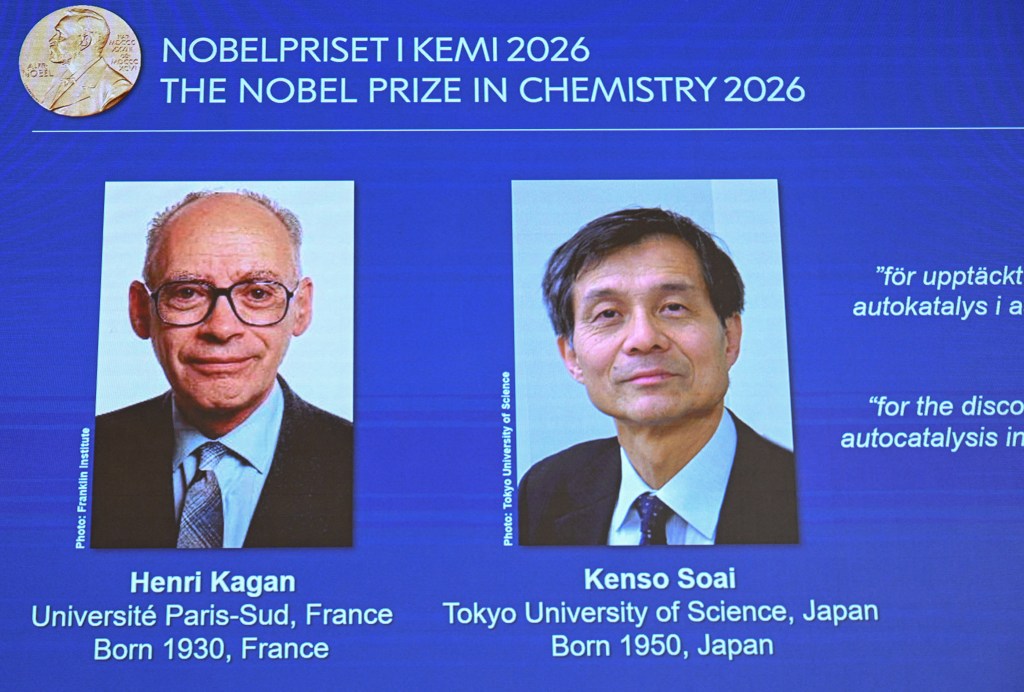
Henri B. Kagan and Kenso Soai have been awarded the 2026 Nobel Prize in Chemistry for discovering non-linear effects and autocatalysis in asymmetric organic synthesis. Their work addressed a longstanding question: how molecules with one particular handedness, or mirror-image form, can emerge spontaneously. Nobel Committee for Chemistry chair Heiner Linke called the chemical reactions developed by the scientists “spectacular.”
The research is important to pharmaceutical chemistry because many molecules exist in two mirror-image forms that can have different effects. The article illustrates this with carvone: one form smells like mint, while the other smells like caraway. When developing medicines, scientists need to control which form they produce, since different versions of a molecule may have different effects. Kagan and Soai found ways to direct chemical reactions toward a desired mirror-image form. One experiment is known as the “Soai reaction.”
Kagan was born in France and is affiliated with Université Paris-Sud in Orsay. Soai was born in Japan and is affiliated with the Tokyo University of Science. The Nobel committee said their research has been decisive for chemists designing reactions to manufacture pharmaceuticals.
The article places the chemistry award within the wider 2026 Nobel announcements. The medicine prize went to three scientists for work leading to a light-based tool for studying the brain, while the physics award recognized research on neutrinos. The literature prize was scheduled for Thursday, the peace prize for Friday, and the economics prize for Monday. This year’s prize money is 12 million Swedish kronor, approximately $1.71 million, for an individual, group of laureates, or organization. The article also notes that the previous year’s chemistry prize recognized the development of molecular structures capable of trapping large amounts of gas, with potential applications including greenhouse-gas removal and moisture harvesting in deserts.
Entities: Henri B. Kagan, Kenso Soai, Heiner Linke, Nobel Prize in Chemistry, Royal Swedish Academy of Sciences • Tone: neutral • Sentiment: positive • Intent: inform
07-10-2026
French scientist Henri B. Kagan and Japanese scientist Kenso Soai have been awarded the Nobel Prize in Chemistry for research addressing the chemical origins of life’s asymmetry. The article explains that molecules such as amino acids can occur in two forms that are mirror images of one another, much like a person’s left and right hands. Yet only one of those forms is found in the body’s cells. How nature produces one version rather than the other has long puzzled researchers. According to the article, the Nobel jury said the scientists’ discoveries enabled chemists to drive chemical reactions toward particular outcomes. The report links this work to the development of pharmaceuticals, although the sentence describing the jury’s statement is incomplete in the supplied text. The award is presented as part of the sequence of Nobel announcements: it followed the physics prize and came before the highly anticipated Peace Prize, scheduled for Friday. Overall, the article provides a brief account of the laureates, the central scientific problem their work addresses, and its potential relevance to chemistry and medicine. It does not provide further details about the specific experiments, the scientists’ institutions, or the exact wording of the jury’s full explanation. The report’s emphasis is on the significance of controlling molecular handedness and on the prize announcement itself.
Entities: Henri B. Kagan, Kenso Soai, France, Japan, Nobel Prize in Chemistry • Tone: neutral • Sentiment: positive • Intent: inform
07-10-2026
Henri Kagan, a 95-year-old French scientist, and Kenso Soai, a 76-year-old Japanese scientist, have won the 2026 Nobel Prize in Chemistry for research into asymmetric organic synthesis. The Royal Swedish Academy of Sciences recognized their discovery of nonlinear effects and autocatalysis, which showed how chemical reactions can favor one of two molecular forms that are mirror images of each other. The work addresses a longstanding question about how a single form can become dominant—a phenomenon known as homochirality—and has important applications in designing chemical reactions for pharmaceutical manufacturing.
Many molecules occur in left- and right-handed forms, but living organisms overwhelmingly use only one version. The distinction can matter in medicine: the two forms of a drug may have different effects. Nobel Committee member Peter Somfai said the laureates’ findings provide powerful tools for selectively preparing a desired form. Committee chair Heiner Linke described their work as a solution to a chemical mystery more than a century old: how homochirality can emerge spontaneously.
Soai said during a phone call to the Nobel Prize news conference that he was shopping when he heard the news, and called it the most exciting day of his life. He also expressed pleasure at sharing the prize with Kagan.
The article places the award within Nobel week, noting that the chemistry prize follows the medicine and physics awards, with literature and peace prizes still to be announced. It also recalls that the previous year’s chemistry prize went to Susumu Kitagawa, Richard Robson and Omar Yaghi for developing metal-organic frameworks. The Nobel prizes in science, literature and peace have been awarded since 1901, with interruptions mainly during the world wars; the economics prize was added later and is funded by Sweden’s central bank.
Entities: Henri Kagan, Kenso Soai, Royal Swedish Academy of Sciences, Nobel Prize in Chemistry, Stockholm, Sweden • Tone: analytical • Sentiment: positive • Intent: inform
07-10-2026
The 2026 Nobel Prize in Chemistry has been awarded to French scientist Henri B. Kagan and Japanese scientist Kenso Soai for research into chirality—the property by which molecules can exist in two forms that are mirror images of one another. Although laboratory reactions often produce an approximately equal mix of both forms, living organisms generally use only one. The laureates’ work helped explain how this selectivity, known as homochirality, can arise and how chemists can design reactions to produce more of a desired molecular form.
The distinction matters especially in medicine because mirror-image versions of a molecule can have very different effects in the body. The article cites thalidomide, prescribed to pregnant women in the 1950s for morning sickness. The drug was a mixture of two chiral forms; one was an effective treatment, while the other was toxic. The body can convert between the forms, and use of the drug was associated with severe disabilities in thousands of children.
Kagan’s work in 1986 showed a new way to manipulate reactions to create a greater excess of one mirror form. Soai advanced the research with a 1995 paper describing a reaction with the potential to produce a single desired form, and in 2003 he succeeded in controlling a reaction so that only one of the two forms was created. The Nobel Committee said no one had previously achieved this outside life itself.
Researchers quoted in the article describe the work as important both for understanding chemistry and for addressing practical challenges such as developing effective medicines. The research may also help scientists investigate why life became “one-handed” billions of years ago. Chirality is reflected in living organisms and structures, from the position of human hearts to the direction in which snail shells coil.
Entities: Henri B. Kagan, Kenso Soai, Nobel Prize in Chemistry, Chirality, Homochirality • Tone: analytical • Sentiment: neutral • Intent: inform
07-10-2026
Henri B. Kagan and Kenso Soai have been awarded the Nobel Prize in Chemistry for their discoveries concerning non-linear effects and autocatalysis in asymmetric organic synthesis. The Royal Swedish Academy of Sciences announced the award in Stockholm. Kagan, 95, was born in France and is affiliated with Université Paris-Sud; Soai, 76, was born in Japan and is based at the Tokyo University of Science.
The article explains that their work addresses the longstanding mystery of homochirality, a feature of life in which certain molecules, including amino acids, occur in two mirror-image forms but living organisms use only one. The Nobel Committee recognized the scientists’ discoveries for showing how homochirality can emerge spontaneously and for enabling chemists to guide reactions toward it. Committee chair Heiner Linke said their work solved a chemical mystery more than a century old and described the reactions they developed as spectacular. The discoveries have also been important to chemists designing reactions to manufacture pharmaceuticals.
The article provides context about other Nobel announcements. The previous year’s chemistry prize went to Susumu Kitagawa, Richard Robson and Omar Yaghi for developing molecular structures capable of trapping large quantities of gas, with possible applications to problems such as climate change. This year’s medicine prize recognized Karl Deisseroth, Peter Hegemann and Georg Nagel for pioneering optogenetics, while the physics prize went to Francis Halzen for work involving neutrinos and astronomy. The literature and peace prizes were scheduled for Thursday and Friday, respectively, followed by the economics prize on Monday. The article also notes that Nobel laureates receive a diploma, a medal and a document specifying their cash award; this year’s award is 12 million Swedish kronor, equivalent to just over €1 million or $1.2 million.
Entities: Henri B. Kagan, Kenso Soai, Nobel Prize in Chemistry, Royal Swedish Academy of Sciences, Université Paris-Sud • Tone: neutral • Sentiment: neutral • Intent: inform
07-10-2026
Henri B. Kagan and Kenso Soai have been awarded the Nobel Prize in Chemistry for work that helped scientists control the “handedness,” or chirality, of molecules. Many molecules exist in two mirror-image forms that are similar but can behave differently. The article illustrates this with carvone: one form smells like mint, while the other smells like caraway. In medicine, selecting the appropriate molecular form can be crucial to producing a desired effect and avoiding an undesirable one.
Kagan’s work in the 1980s suggested that chemical reactions could be designed to favour one mirror image over another. Years later, Soai achieved a major step toward that goal by creating the first chemical reaction to produce only one of a molecule’s mirror images, now known as the “Soai reaction.” The Nobel Committee for Chemistry said the laureates’ discoveries advanced understanding of how molecular chirality is created, amplified and transmitted. Committee member Peter Somfai described the work as a landmark experiment in organic chemistry.
Scientists quoted in the article emphasized the broad impact of this chemistry on modern medicine. Somfai said it is difficult to identify medicines that have not benefited from the knowledge and tools the work provided, while American Chemical Society president Rigoberto Hernandez said today’s medicines would not be possible without it.
Kagan, 95, was born in France and is affiliated with Université Paris-Sud in Orsay. Soai, born in Japan in 1950, is affiliated with the Tokyo University of Science. Soai said he was shopping near his home when he learned of the award and called it one of the most exciting days of his life.
The Royal Swedish Academy of Sciences announced the prize in Stockholm. The article also places the chemistry award within the week’s Nobel announcements: medicine and physics prizes had already been awarded, with literature, peace and economics prizes still to come. This year’s prize money is 12 million Swedish kronor, approximately $1.2 million, regardless of whether the award goes to an individual, group or organization.
Entities: Henri B. Kagan, Kenso Soai, Peter Somfai, Rigoberto Hernandez, Nobel Prize in Chemistry • Tone: analytical • Sentiment: positive • Intent: inform
07-10-2026
Henri B. Kagan, a French chemist, and Kenso Soai, a Japanese chemist, received the 2026 Nobel Prize in Chemistry for work that made it possible to control which mirror-image form of a molecule a chemical reaction produces. Molecules can exist in forms that resemble a person’s left and right hands but are not interchangeable: the two versions may smell different or interact differently with other chemicals. This distinction is especially important in medicine, where one form may help treat a disease while another could be ineffective or harmful.
Kagan’s research in the 1980s showed that reactions could be designed to favor one molecular form. Soai later advanced the work by creating the first chemical reaction that efficiently produced only one mirror image, now called the Soai reaction. The Nobel Committee described the achievement as something previously accomplished only by living systems. Chemists say the underlying methods and understanding have contributed broadly to modern drug development, as well as to other fields such as perfume chemistry and research into life’s chemical origins.
The article illustrates molecular handedness with carvone, whose mirror-image forms smell like mint and caraway, and with biology: DNA twists to the right, while proteins in human bodies are made mostly from left-handed building blocks. Kagan, 95, is affiliated with Université Paris-Sud in Orsay; Soai, 76, with Tokyo University of Science. Soai learned the news while shopping and later said the award was one of the most exciting days of his life. French President Emmanuel Macron and the French Academy of Sciences congratulated Kagan. In Japan, newspapers printed an extra edition celebrating Soai, which quickly sold out.
The article also places the chemistry award among the week’s Nobel announcements. The 2026 prizes began with medicine and physics, with literature, peace and economics awards still to come. The chemistry prize is worth 12 million Swedish kronor, about $1.2 million. The story notes a correction to Kagan’s age and clarifies that NPR does not accept payment for coverage or interviews.
Entities: Henri B. Kagan, Kenso Soai, 2026 Nobel Prize in Chemistry, Soai reaction, molecular chirality (mirror-image molecules) • Tone: analytical • Sentiment: positive • Intent: inform
07-10-2026
Henri B. Kagan and Kenso Soai have been awarded the 2026 Nobel Prize in Chemistry for research addressing how homochirality—the predominance of one mirror-image form of a molecule—can emerge spontaneously. Nobel Committee for Chemistry chair Heiner Linke described the question as a chemical mystery more than a century old and called the laureates’ reactions “spectacular.” Kagan, 95, was born in France and is affiliated with Université Paris-Sud in Orsay. Soai, who was born in Japan, is affiliated with the Tokyo University of Science. Soai said he was shopping near his home when the Nobel committee contacted him. The Royal Swedish Academy of Sciences announced the award in Stockholm. The article places the chemistry award within the wider 2026 Nobel Prize schedule. The medicine prize, announced Monday, went to three scientists for work that led to a light-based tool for studying the brain. Tuesday’s physics award recognized research concerning a rare group of neutrinos. The literature prize was scheduled for Thursday, the peace prize for Friday, and the Nobel Memorial Prize in Economic Sciences for the following Monday. The article also recalls the previous year’s chemistry Nobel, awarded to three scientists who developed molecular structures capable of trapping large quantities of gas. Their work could potentially support efforts to remove greenhouse gases from the atmosphere or collect moisture in desert environments. This year’s prize carries 12 million Swedish kronor, approximately $1.2 million, whether awarded to an individual, a small group of laureates, or an organization.
Entities: Henri B. Kagan, Kenso Soai, Heiner Linke, Nobel Prize in Chemistry, homochirality • Tone: neutral • Sentiment: neutral • Intent: inform
07-10-2026
Henri Kagan, a French chemist, and Kenso Soai, a Japanese chemist, have won the 2026 Nobel Prize in Chemistry for work on non-linear effects and autocatalysis in asymmetric organic synthesis. The Nobel award-giving body said their discovery solved a longstanding puzzle involving asymmetric “mirror image” molecules. The research is important to pharmaceutical manufacturing, where controlling which mirror-image form of a molecule is produced can matter. Their work built on research by 19th-century French chemist Louis Pasteur.
Soai, 76, learned of the award while shopping and spoke by phone to the Nobel Prize press conference. He described the news as the most exciting day of his life and said he was very glad to share the prize with Kagan. At the time of the report, the Nobel committee was still trying to reach Kagan, who is 95. The article notes that Kagan is the third-oldest person to receive a Nobel Prize. The report presents the award, its scientific basis and potential relevance to pharmaceutical production, alongside Soai’s reaction and the committee’s effort to notify his co-laureate.
Entities: Henri Kagan, Kenso Soai, Louis Pasteur, Nobel Prize in Chemistry, Nobel committee • Tone: neutral • Sentiment: neutral • Intent: inform