07-10-2026
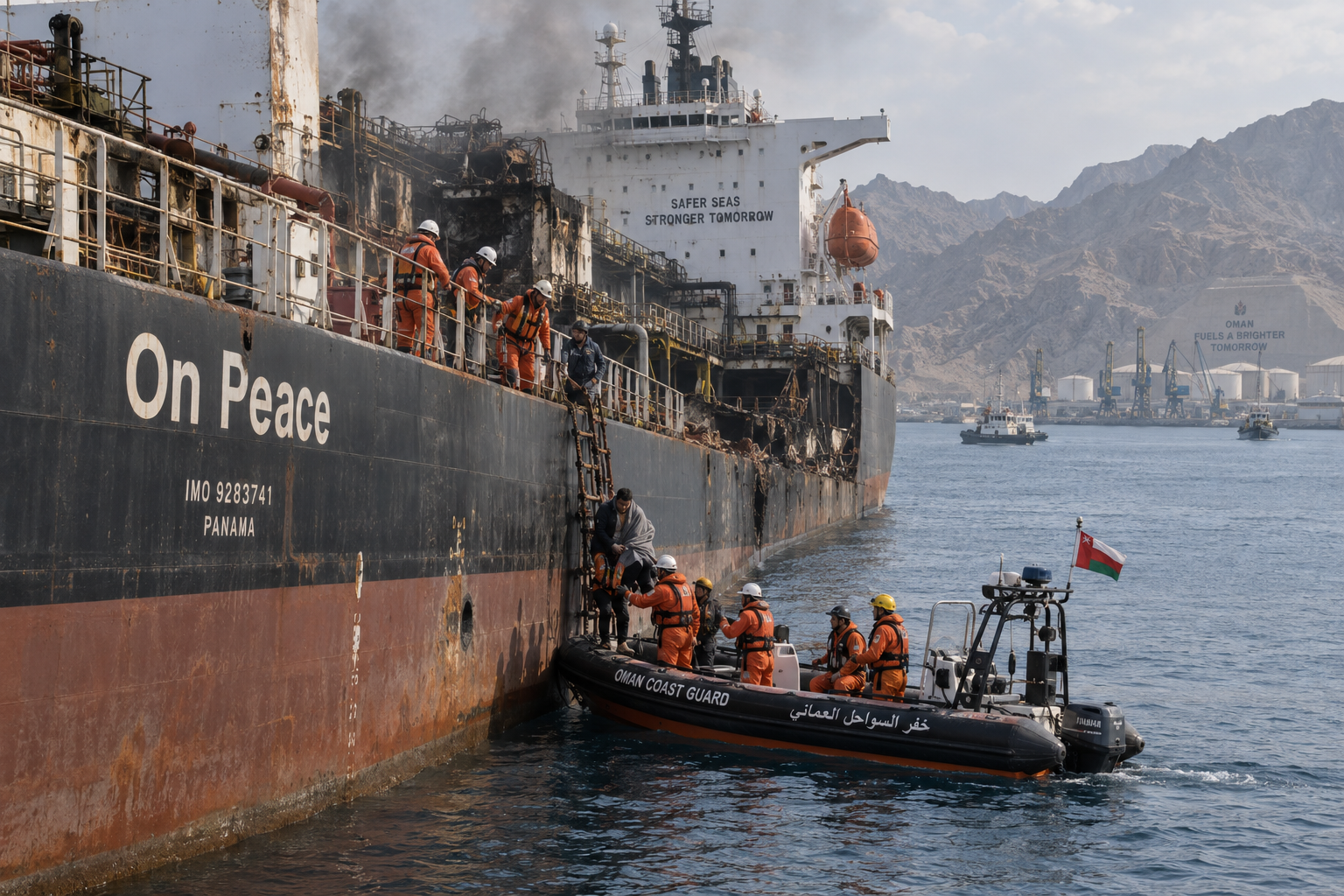
Oman’s air force evacuated 10 crew members from the Panamanian-flagged tanker On Peace after it was attacked in the Strait of Hormuz on Tuesday. The vessel was struck about 9 nautical miles (17km) off Limah, an Omani port city, and caught fire. The injured sailors were taken to Khasab hospital in the Musandam governorate for treatment, according to Oman’s Ministry of Defence. No group had claimed responsibility at the time of publication.
India’s Ministry of External Affairs said at least 12 of the tanker’s 19 crew members were injured. Seventeen crew members were Indian nationals, including 11 of those injured. India expressed deep concern about continued attacks on shipping and called for them to stop immediately. The article notes that India supplies many sailors to merchant shipping and that its government reported at least 10 Indian seafarers killed since the US-Israel war on Iran began in late February. An Indian sailor was also killed in a September attack on a cargo ship in the strait.
The attack occurred amid deteriorating maritime security. The article says Iran effectively closed the Strait of Hormuz after the war began on February 28, has frequently attacked commercial vessels that do not follow its designated route, and has said it wants to charge ships for passage. Shipping intelligence service Marisks reported at least seven other tanker-related incidents in the preceding week.
Despite the incidents, Middle Eastern oil exports had returned to pre-war levels in recent weeks: Kpler data put the seven-day average at 18.3 million barrels per day on September 30, compared with a pre-war average of about 18 million. Oil prices nevertheless remained elevated. Brent crude futures reached $101.51 per barrel on Tuesday, compared with $72.48 on the day before the war began.
Entities: Oman, Strait of Hormuz, On Peace tanker, Limah, Khasab hospital • Tone: analytical • Sentiment: negative • Intent: inform
07-10-2026
The Iran war has created significant trading opportunities in global energy markets, according to Vitol, the world’s largest independent oil trader. Tom Baker, Vitol’s managing director for Bahrain, said that disrupted trade routes have lengthened oil voyages and pushed the global tanker fleet to full utilisation, making shipping especially attractive. Restrictions affecting the Strait of Hormuz and Bab Al Mandeb have increased voyage distances and ship-to-ship transfers, while very large crude carrier spot earnings approached $642,000 per day in late September, according to Clarksons Research. Vitol has also redirected barrels from Western and European refineries towards eastern markets.
Refining capacity has been another source of disruption. Baker said about two million barrels per day of Russian refining capacity had been knocked out, with comparable outages in the Middle East and reduced capacity in China. Middle East capacity, however, is recovering rapidly. S&P Global Energy forecast that regional refinery runs would average about eight million barrels per day this year—1.6 million below 2025—contributing to tighter supplies of petrol, diesel and jet fuel.
The uncertainty has influenced Vitol’s infrastructure investment priorities. Baker said the company favours assets, such as ships, that can deliver returns immediately, while longer-term projects like pipelines must be weighed against the risk of further unexpected events and may be justified by national strategic goals. He added that Vitol increasingly sees a need to participate directly in energy infrastructure, rather than only trading third-party oil.
Vitol also sees stronger energy connections between the Middle East and East Africa. During the crisis, it helped landlocked Uganda diversify fuel imports by routing supplies through Tanzania’s port of Tanga instead of relying solely on Kenya’s pipeline system. Uganda is expected to begin exporting around 230,000 barrels per day of crude through a heated pipeline to Tanga next year. Baker said those exports should find buyers in Europe, the Middle East or Asia.
Entities: Vitol Group, Tom Baker, Iran war, Fujairah, Strait of Hormuz • Tone: analytical • Sentiment: neutral • Intent: inform
07-10-2026
CNBC’s Daily Open highlights concerns that renewed Iranian attacks on ships could derail a fragile recovery in oil exports through the Strait of Hormuz. The Joint Maritime Information Center reported nearly 20 commercial vessels attacked in the past month while traveling through the Strait, the Persian Gulf, or waters off Oman. Without a negotiated settlement or Iran’s capitulation, traders remain uncertain whether the export rebound can last.
In the United States, President Donald Trump temporarily expanded access to red-dyed diesel, a lower-cost fuel generally reserved for agricultural use, to help ease record-high fuel costs ahead of the midterm elections. Because the fuel is exempt from highway taxes, the White House said truckers could save more than $100 per fill-up. The article also notes that the U.S. trade deficit reached $105.6 billion, its steepest level since March 2025, shortly before Trump announced reciprocal tariffs.
U.S. stocks advanced Tuesday: the S&P 500 rose 0.58% to a record close of 7,818.93, supported by lower Treasury yields and technology stocks. The Dow gained 0.49%, and the Nasdaq reached a new intraday high. Asian markets were mostly higher, with gains in Japan and Australia offset by a decline in South Korea; mainland Chinese markets were closed for a holiday.
In technology, Anthropic is expanding its Claude Startups program, which offers eligible young or recently funded companies access to Claude products and credits. The initiative is intended to strengthen the company’s relationships with startups and founders. Finally, Amazon’s Prime Video will become the exclusive global home of the Emmy Awards beginning in 2027 under a six-year agreement. The ceremony will be available free to audiences in more than 240 countries and territories, including viewers who do not subscribe to Prime Video.
Entities: Justina Lee, Donald Trump, Iran, Strait of Hormuz, Joint Maritime Information Center • Tone: analytical • Sentiment: neutral • Intent: inform
07-10-2026
Singapore Foreign Minister Vivian Balakrishnan said U.S. President Donald Trump is not “completely wrong” that Asian economies have a major stake in keeping the Strait of Hormuz open, since they are among the largest customers for energy shipped through the waterway. Trump has argued that Asian countries should take on more responsibility for protecting the strait rather than depending mainly on the United States. Balakrishnan, speaking to CNBC at the Milken Institute’s Asia Summit in Singapore, said the issue is not simply about which countries buy the oil: freedom of navigation through international waterways is a fundamental principle and, for Singapore, an existential concern. He cited the United Nations Convention on the Law of the Sea and its protections for transit passage and navigation.
Balakrishnan said Iran’s efforts to assert control over traffic through Hormuz could have implications beyond collecting tolls or fees. If Tehran could decide which vessels may pass, it could gain what he called a “veto right” over the waterway—and potentially significant leverage. He does not expect the United States or Gulf states to accept such a situation. Although oil may continue to flow, he anticipates continued friction and sees no quick diplomatic resolution to the conflict.
The article also recalls Balakrishnan’s warning that a U.S.-China conflict in the Pacific could make the Hormuz disruption look like a “dry run,” highlighting the vulnerability of global trade at maritime chokepoints. Singapore, he has said, will not choose between Washington and Beijing, but will act according to its own long-term interests. It also supports freedom of navigation through the Strait of Malacca and would not join efforts to close, interdict, or impose tolls on that waterway.
Entities: Vivian Balakrishnan, Donald Trump, Singapore, Strait of Hormuz, Iran • Tone: analytical • Sentiment: neutral • Intent: inform