06-10-2026
The article reports that renewed fighting between Ethiopia’s federal forces and the Tigray People’s Liberation Front (TPLF) is raising fears of a broader conflict, including a possible war involving Eritrea. Clashes began on September 23, and federal forces have since pushed back the rebel offensive and taken Mekelle, Tigray’s capital, after TPLF leaders and fighters left the city. Magnus Taylor of the International Crisis Group says the TPLF’s inability to sustain its offensive was surprising, and suggests its retreat may indicate a shift toward insurgency rather than another direct campaign against the federal government.
Taylor warns that worsening relations between Ethiopia and Eritrea could cause the conflict to spread beyond Tigray, describing wider regional escalation as a worst-case scenario. Tensions have risen for months, with Eritrea accusing landlocked Ethiopia of intending to invade and seize access to the coast. Ethiopia, in turn, has accused Eritrea of directly supporting the TPLF, alongside Sudan and Egypt; all three countries deny the allegations.
Regional diplomacy adds to the tense backdrop. The presidents of Egypt, Somalia, Sudan and Eritrea—countries described as having difficult relations with Ethiopia—met in El-Alamein, Egypt. Ethiopia and Egypt also remain in a long-running dispute over the Grand Ethiopian Renaissance Dam, which Cairo fears could affect its share of Nile waters. Before the meeting, Egyptian President Abdel Fattah al-Sisi called for cooperation and dialogue on cross-border issues, including natural resources and transboundary rivers. The leaders’ statement urged peaceful resolution of disputes, respect for international law, and non-interference in the internal affairs of Horn of Africa states.
Entities: Tigray, Ethiopia, Eritrea, Tigray People’s Liberation Front (TPLF), Mekelle • Tone: analytical • Sentiment: negative • Intent: analyze
06-10-2026
The Al Jazeera Newsfeed item introduces renewed fighting in northern Ethiopia, noting that it is occurring roughly four years after the devastating Tigray war ended. It frames the new violence as a potential regional concern rather than an isolated domestic clash: Ethiopia’s tensions with neighboring Eritrea are rising, while broader rivalries involving Egypt and Sudan add to the uncertainty. The central question is whether the conflict could spread beyond Ethiopia’s borders. Al Jazeera’s Lina-Serene is identified as the explainer, but the supplied article text does not include her detailed account, specific causes of the fighting, named groups, casualty figures, or evidence of cross-border escalation. The item is therefore a brief introduction to a video report, not a full account of developments. Its focus is on the possibility that renewed conflict could interact with existing regional tensions and widen, while leaving the likelihood and mechanisms of such a spread unresolved.
Entities: Ethiopia, Northern Ethiopia, Tigray war, Eritrea, Egypt • Tone: analytical • Sentiment: negative • Intent: inform
06-10-2026
Ethiopian Prime Minister Abiy Ahmed has begun a new five-year term amid renewed fighting in Tigray and growing regional tensions. After his swearing-in, Abiy repeated that Ethiopia would pursue access to the Red Sea, a goal that has heightened concerns in Eritrea because Ethiopia is interested in the strategically important port of Assab. A DW correspondent says Abiy’s renewed mandate gives him more political authority, but that Ethiopia’s internal conflicts and strained relations with neighboring states could make stability difficult. A recent meeting in Cairo among Egypt, Eritrea, Somalia and Sudan—without Ethiopia—illustrated its regional isolation.
Analyst Abdurahman Sayed argues that Eritrea faces a risk of being drawn into the Tigray war. He links the danger to Ethiopia’s campaign to secure Assab and notes that the port overlooks the Bab el-Mandeb Strait. Ethiopia has severed diplomatic ties with Eritrea and Egypt. Meanwhile, Ethiopian forces reportedly took Mekelle, Tigray’s capital, and pro-government media said troops were moving toward the Eritrean border as Tigray People’s Liberation Front (TPLF) forces retreated near Adigrat. Sayed warns that fighting could spread across the border, while suggesting Ethiopia might use unsubstantiated claims of Eritrean involvement to justify an attack.
The article also highlights calls for renewed diplomacy and the importance of Ethiopia’s trade route through Djibouti. Conflict in Afar could threaten that route, which the TPLF has sought to control in past fighting. Analyst Jalale Getachew Birru says regional diplomacy has become more complicated, including as Djibouti tries to maintain neutrality. Both Ethiopia and Djibouti have economic reasons to keep trade flowing, but shortages and hyperinflation could increase pressure on Abiy’s government. Djibouti’s strategic location and its hosting of several countries’ military bases may give international actors leverage. The article concludes that disruption of Ethiopia’s trade route could prompt stronger international pressure to end the conflict.
Entities: Abiy Ahmed, Ethiopia, Tigray conflict, Eritrea, Port of Assab • Tone: analytical • Sentiment: negative • Intent: analyze
06-10-2026
The National’s editorial argues that diplomacy is urgently needed to prevent further conflict in the Horn of Africa, a region whose instability could also affect the Middle East. It describes a volatile landscape shaped by long-standing rivalries, shifting alliances, non-state armed groups and unresolved disputes. Ethiopia’s renewed fighting with a rebel alliance has revived regional tensions four years after the 2022 Pretoria Agreement helped end the devastating Tigray war. Addis Ababa has accused Egypt, Sudan and Eritrea of supporting armed groups, though those countries deny the allegations. Meanwhile, Sudan is in the fourth year of a destructive civil war between two rival generals accused of war crimes, and Somalia continues to face armed radicals and weak state institutions.
The editorial warns that armed factions can become tools in broader geopolitical contests, weaken national institutions and carry instability across borders. It points to the expansion of Yemen’s Iran-backed Houthi rebels as an example of how conflict can spill beyond a single country. Beyond its human consequences, persistent rivalry diverts money and attention from development, including infrastructure, education, health care, trade and employment. This is especially costly because the Horn of Africa occupies a strategically important position along major maritime routes and has significant economic potential.
Peace, the editorial contends, can support investment, trade, jobs and reconstruction while allowing governments to reduce military spending. A four-way summit in Alamein involving Egypt, Eritrea, Somalia and Sudan signals recognition of the crisis, but the piece stresses that diplomacy is most effective when opposing parties are included. Egypt and Ethiopia remain divided over the Nile and the Grand Ethiopian Renaissance Dam, and regional governments have competing security interests. The editorial concludes that mediation and serious diplomatic efforts are essential to lower tensions and avert further bloodshed and lost opportunity across the region and the wider Middle East.
Entities: The National, Horn of Africa, Middle East, Ethiopia, Tigray • Tone: analytical • Sentiment: negative • Intent: persuade
06-10-2026
The article reports renewed fighting in Ethiopia’s Tigray region and its severe impact on civilians, particularly children. Clashes between Ethiopian federal forces and Tigrayan rebels began on September 23, and reports describe deaths and injuries across the region. In a Tigrayan hospital, children were being treated for leg wounds and lost limbs following heavy shelling. A drone strike on a displacement camp in western Tigray on Sunday killed eight people, including a child, according to an aid worker and a witness who spoke to AFP; at least six more people were seriously injured. Separately, shelling of Maychew and Alamata between September 26 and 28 critically injured at least 44 civilians, including 33 children, a medical source said. A health worker described some victims as blinded or having limbs amputated.
The military situation has also shifted: federal forces pushed back the rebel offensive and seized Mekelle, Tigray’s capital, over the weekend after Tigray People’s Liberation Front leaders and troops left the city. Ethiopian National Defense Force members were stationed at Mekelle’s Alula Aba Nega International Airport on Tuesday. The renewed violence has intensified concern that the region could face another humanitarian crisis and a return to large-scale civil war. The article places those fears in the context of the 2020–2022 war, in which an estimated 600,000 people were killed. It emphasizes the civilian toll and the vulnerability of children while outlining the latest battlefield developments.
Entities: Tigray, Ethiopia, Mekelle, Maychew, Alamata • Tone: urgent • Sentiment: negative • Intent: inform
06-10-2026
Government-allied forces are conducting drone strikes in Ethiopia’s Tigray region as fighting intensifies, according to Ermiyas Ababu, a Tigray Peace Force commander in the Mekelle zone. Ababu said the strikes were being carried out with federal government cooperation and would continue until the state was free of opposing forces. The clashes have renewed pressure on the peace agreement signed in 2022, which ended the two-year Tigray war.
The latest escalation follows Tigray fighters’ seizure of Mekelle’s airport on September 23. Federal forces have reportedly retaken the facility, and Prime Minister Abiy Ahmed has vowed to crush the insurgency.
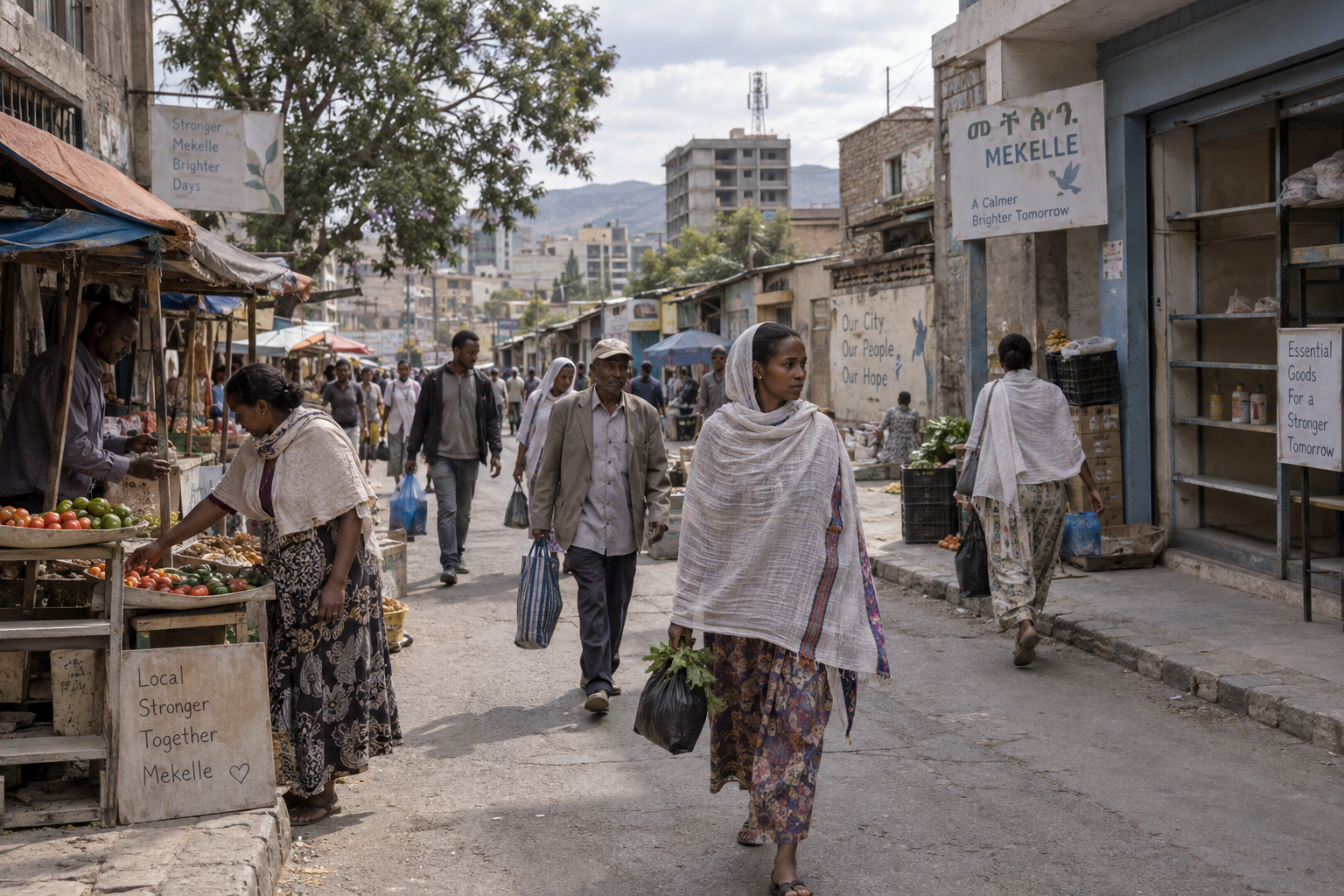
Despite the ongoing conflict, everyday life in Mekelle is gradually recovering from several days of disruption. Markets have reopened, though resident Ahmedin Mehammed said they were not yet operating fully and offered only a limited selection of essential goods. He said that all markets would need to reopen before people could regain confidence. Motorized auto-rickshaws have also returned to the streets, and residents have welcomed their affordable fares.
Resident Birhanu Araya said business remained constrained by a shortage of cash, although conditions were better than they had been two or three days earlier. The article presents these developments as tentative signs of normality for Mekelle’s residents, while emphasizing that fighting continues elsewhere in the region and the political and security situation remains fragile.
Entities: Ethiopia, Tigray, Mekelle, Ermiyas Ababu, Tigray Peace Force • Tone: analytical • Sentiment: neutral • Intent: inform