01-09-2026
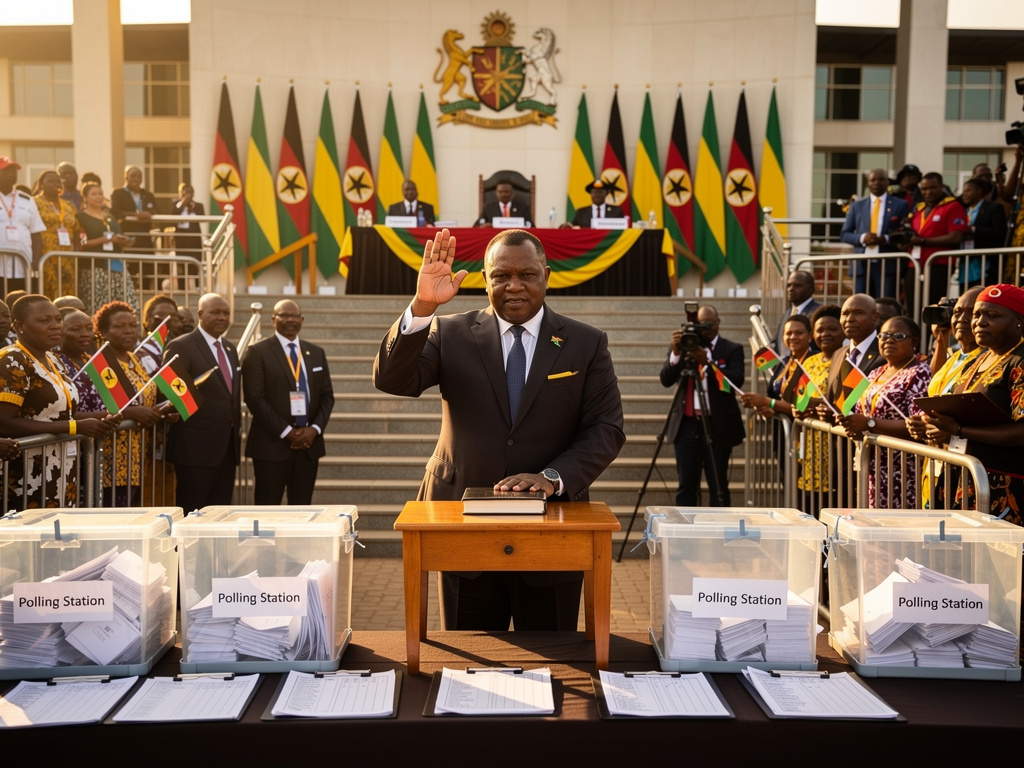
Zambia’s President Hakainde Hichilema has been sworn in for a second five-year term after winning the August 13 presidential election with 60 percent of the vote. His main challenger, Brian Mundubile, received 38 percent but was jailed on treason charges along with his running mate, Makebi Zulu. The charges follow a security operation at Mundubile’s home, where authorities said they were targeting a suspected militia. Mundubile’s alliance rejected the allegations, and both candidates deny the treason accusations.
The election and its aftermath have raised concerns about Zambia’s democratic record. Observers and opposition figures criticized alleged intimidation, pro-government bias, restrictions on political activity, the arrest of opposition supporters, and a pause in vote counting. A former cabinet minister was killed during the security operation, while 11 people linked to Mundubile’s camp were arrested. International observers have also questioned the broader treatment of the opposition.
Hichilema’s first term was marked by market-oriented reforms, the abolition of the death penalty, free primary and secondary education, and what supporters describe as a major economic turnaround. However, critics argue that economic growth has not improved conditions for many citizens. More than 70 percent of Zambia’s 22 million people live on less than three dollars a day, according to the World Bank, while rising prices continue to pressure households.
The article also places the political conflict in historical context. Mundubile and Zulu are associated with the Patriot Front, the party of Hichilema’s predecessor, Edgar Lungu. Hichilema himself was previously jailed for four months on treason charges after the 2016 election, though those charges were later dropped. Copper remains central to Zambia’s economy, accounting for about 70 percent of export earnings, with China serving as a major investor and creditor. Despite current tensions, Zambia has traditionally been regarded as one of southern Africa’s more stable democracies.
Entities: Hakainde Hichilema, Brian Mundubile, Makebi Zulu, Edgar Lungu, Kenneth Kaunda • Tone: analytical • Sentiment: negative • Intent: inform
01-09-2026
Zambia’s President Hakainde Hichilema has been sworn in for a second five-year term after winning the August 13 presidential election with 60 percent of the vote. His main challenger, Brian Mundubile, received 38 percent but was jailed on treason charges along with his running mate, Makebi Zulu. The charges follow a security operation at Mundubile’s home, where authorities said they were targeting a suspected militia. Mundubile’s alliance rejected the allegations, and both candidates deny the treason accusations.
The election and its aftermath have raised concerns about Zambia’s democratic record. Observers and opposition figures criticized alleged intimidation, pro-government bias, restrictions on political activity, the arrest of opposition supporters, and a pause in vote counting. A former cabinet minister was killed during the security operation, while 11 people linked to Mundubile’s camp were arrested. International observers have also questioned the broader treatment of the opposition.
Hichilema’s first term was marked by market-oriented reforms, the abolition of the death penalty, free primary and secondary education, and what supporters describe as a major economic turnaround. However, critics argue that economic growth has not improved conditions for many citizens. More than 70 percent of Zambia’s 22 million people live on less than three dollars a day, according to the World Bank, while rising prices continue to pressure households.
The article also places the political conflict in historical context. Mundubile and Zulu are associated with the Patriot Front, the party of Hichilema’s predecessor, Edgar Lungu. Hichilema himself was previously jailed for four months on treason charges after the 2016 election, though those charges were later dropped. Copper remains central to Zambia’s economy, accounting for about 70 percent of export earnings, with China serving as a major investor and creditor. Despite current tensions, Zambia has traditionally been regarded as one of southern Africa’s more stable democracies.
Entities: Hakainde Hichilema, Brian Mundubile, Makebi Zulu, Edgar Lungu, Kenneth Kaunda • Tone: analytical • Sentiment: negative • Intent: inform
01-09-2026
Zambia’s President Hakainde Hichilema has been sworn in for a second five-year term after winning the 13 August election with 60% of the official vote. His main challenger, Brian Mundubile, received 38% and alleged that the result had been manipulated. Mundubile was unable to file a legal challenge after courts were reportedly sealed on the final day for submitting a petition.
The election was largely peaceful on polling day, but observers, including the European Union, questioned the vote-counting process. They reported that officials often failed to record results promptly on tally sheets, verification between digital and paper records was weak, and counting was repeatedly paused while local officials awaited instructions from headquarters.
Political tensions intensified after security forces raided a property in Lusaka linked to Mundubile. A former cabinet minister was killed and several opposition politicians were arrested. Authorities accused the opposition of planning an armed insurrection, a claim they denied. Mundubile and his running mate, Makebi Zulu, later went into hiding before being detained and charged with treason.
Hichilema did not directly address his opponent’s detention during his inauguration speech. Instead, he called for political disagreement to remain peaceful and invited the opposition to cooperate with his government. He was inaugurated before thousands of supporters at Lusaka’s National Heroes Stadium, alongside Vice-President Mutale Nalumango, with several African leaders in attendance.
Hichilema highlighted his administration’s economic record. Zambia had defaulted on international debt and faced inflation above 24% when he took office in 2021. His government negotiated debt restructuring and improved relations with creditors, while inflation has fallen. However, the cost of living remains difficult for many citizens. With copper prices rising, investors remain confident despite concerns about the post-election political climate. Hichilema said his second term would focus on moving Zambia from economic stabilisation to growth and prosperity.
Entities: Hakainde Hichilema, Zambia, Brian Mundubile, Makebi Zulu, Mutale Nalumango • Tone: analytical • Sentiment: neutral • Intent: inform
01-09-2026
Zambia's President Hakainde Hichilema was sworn in for a second term on September 1, but the ceremony was overshadowed by allegations that the August 13 election was marred by serious irregularities. His main rival, Brian Mundubile, was imprisoned on treason charges, along with his running mate Makebi Zulu and roughly a dozen other opposition members. Authorities have offered few details or supporting evidence for the charges, citing alleged national security threats and possession of weapons.
International and domestic observers reported possible manipulation of vote tallies, the suspension of vote counting, the deployment of soldiers at polling stations and counting centers, the arrest of opposition lawmakers, and the closure of courts during the period when an electoral challenge could have been filed. Observers nevertheless concluded that Hichilema would have won even without the alleged additions to his tally. The Electoral Commission of Zambia said any discrepancies should be examined by the courts, but authorities subsequently restricted access to the courts and said no complaint had been submitted.
The developments have raised concerns that Zambia, which has held regular but imperfect elections since the 1990s, could establish a precedent enabling future leaders to consolidate power. Historian Euston Chiputa said the country's democratic reputation was at risk. Zambia's strategic importance as a major copper producer has also drawn interest from China and the United States, both of which congratulated Hichilema and sent representatives to his inauguration.
Financial markets have largely looked past the political turmoil. Zambia's eurobonds outperformed the broader African market after the election, Citi upgraded the country's international bonds and foreign investors returned. Hichilema's first-term debt restructuring and economic recovery have made him attractive to investors seeking policy continuity. However, Chatham House analyst Christopher Vandome warned that this confidence could be short-sighted and that the political developments do not represent the institutional strengthening needed for sustainable investment.
Entities: Zambia, Lusaka, Hakainde Hichilema, Brian Mundubile, Makebi Zulu • Tone: analytical • Sentiment: negative • Intent: analyze