01-09-2026
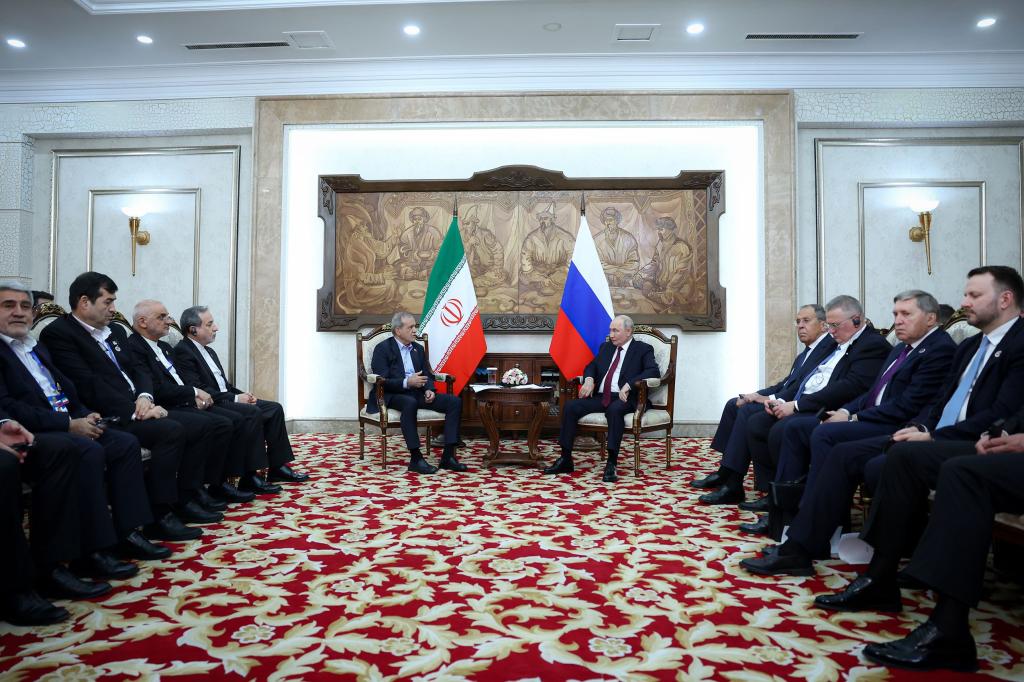
Iranian President Masoud Pezeshkian has urged the United States to resume its obligations under a memorandum of understanding (MoU) reached in June, saying Iran would immediately reciprocate if Washington did so. He made the statement at a Shanghai Cooperation Organisation summit in Bishkek, Kyrgyzstan, one day after the first direct exchange of fire between Iran and the United States in nearly a month.
According to the report, US forces attacked Larak Island, prompting Iran to retaliate against two US-used airbases in Jordan. The June MoU, brokered by Pakistan and Qatar, was intended to extend a ceasefire and establish a 60-day period of negotiations aimed at ending the war, which began with US and Israeli strikes on Tehran on February 28. Under the agreement, Iran was to clear mines from the Strait of Hormuz and allow commercial shipping to pass. In return, the United States was to end its naval blockade, ease sanctions, issue waivers for Iranian oil exports and begin work on a reconstruction package.
The ceasefire broke down within weeks as the two sides resumed attacks, amid Iranian strikes on commercial shipping in the strait. The MoU subsequently lapsed. Pezeshkian accused Washington of honoring the agreement for less than two weeks before making excessive demands and abandoning its commitments. Iranian Foreign Ministry spokesman Esmaeil Baghaei likewise said the US had broken its promises.
Pakistan’s Foreign Minister Ishaq Dar called sincere implementation of the MoU the only way forward, while Qatar warned that renewed escalation served no one’s interests. Qatar said it was working with international partners to find a peaceful solution and reopen the Strait of Hormuz. Pakistani, Qatari and Omani officials had visited Tehran the previous week as part of a renewed diplomatic effort, before the latest military confrontation.
Entities: Masoud Pezeshkian, Iran, United States, Memorandum of understanding (MoU), Shanghai Cooperation Organisation (SCO) • Tone: analytical • Sentiment: negative • Intent: inform
01-09-2026
The supplied material does not contain the body of the Al Jazeera liveblog. Instead, it consists almost entirely of advertising and interface text, including “Advertisement,” “20 Updates,” and a prompt to receive alerts. The only substantive information available is the headline: “Iran war live: Trump vows to strike Iran ‘hard’ after first clash in month.”
Based on that headline alone, the live coverage appears to concern a renewed or escalating confrontation involving Iran and Donald Trump. It indicates that Trump made a forceful threat to conduct further strikes against Iran following what the headline describes as the first clash in a month. The wording suggests a significant military or geopolitical development, but the provided excerpt does not identify the parties involved in the clash, explain what happened, state whether there were casualties or material damage, or clarify whether Trump was speaking as a current US president, candidate, or political figure in the article’s timeline. It also provides no statements from Iranian officials, US authorities, military sources, or independent observers.
Because the article body is missing, no reliable account can be given of the chronology, causes, diplomatic context, or consequences of the reported clash. The headline supports an assessment of urgent, conflict-focused coverage with a predominantly negative subject matter and an informational live-news intent. All extracted entities and passages below are limited to the headline and publication identification; they do not represent details that are absent from the supplied content.
Entities: Iran, Donald Trump, Al Jazeera, Iran war, First clash in a month • Tone: urgent • Sentiment: negative • Intent: inform
01-09-2026
The article examines the main outcomes of the Shanghai Cooperation Organisation (SCO) summit in Bishkek, Kyrgyzstan, where member-state leaders adopted the Bishkek Declaration. The declaration condemned US and Israeli military attacks on Iran, which SCO members said violated international law and the UN Charter, caused civilian casualties and damaged Iran’s economy. The grouping also expressed condolences following the reported death of Iran’s Supreme Leader Seyyed Ali Khamenei, reaffirmed support for Iran’s sovereignty and territorial integrity, and called for a diplomatic resolution to the conflict. It criticized Israel’s attacks on Palestine and said a comprehensive settlement of the Palestinian issue was necessary for peace in the Middle East.
The SCO also rejected unilateral coercive measures, including sanctions that members said could harm the global economy. Leaders supported Iran’s rights under the Nuclear Non-Proliferation Treaty to develop peaceful nuclear energy, including uranium enrichment, research and civilian nuclear facilities. This position directly conflicts with the Trump administration’s demand that Iran abandon its domestic nuclear programme following US and Israeli military action.
Economic and energy cooperation was another major theme. The member states pledged to strengthen multilateral trade, financial cooperation and energy collaboration amid disruptions to maritime routes, global supply chains and energy markets caused by the conflict around Iran and the Strait of Hormuz. They also endorsed strategies for economic and energy cooperation through 2030.
The summit featured a renewed dispute between India and Pakistan over terrorism. Indian Prime Minister Narendra Modi called for an end to terrorist financing, recruitment, radicalisation and safe havens, comments widely viewed as directed at Pakistan. Pakistan’s Prime Minister Shehbaz Sharif said his country was itself a victim of terrorism. The final declaration nevertheless committed SCO members to fighting terrorism, separatism and extremism.
Entities: Shanghai Cooperation Organisation (SCO), Bishkek Declaration, Bishkek, Kyrgyzstan, Xi Jinping, Vladimir Putin • Tone: analytical • Sentiment: negative • Intent: inform
01-09-2026
The article argues that China is unlikely to comply with the latest US sanctions against Iran because Beijing has both the capacity and the economic and strategic incentives to resist Washington’s pressure. At the Shanghai Cooperation Organization summit in Bishkek, China, Russia, India and Iran signaled support for financial institutions independent of countries that “weaponize” economic tools, highlighting the limits of US efforts to isolate Tehran.
According to the article, China purchases approximately 90 percent of Iran’s oil exports, allowing the Iranian economy to survive despite sanctions. Chinese firms reportedly evade restrictions through “dark fleets,” small private “teapot” refineries, renminbi transactions, barter and shell companies. These arrangements reduce their exposure to US jurisdiction and force Washington into a costly effort to replace sanctioned entities. The article argues that imposing sanctions on major Chinese banks and companies without direct Iranian ties could provoke retaliation from Beijing, at a time when the US economy is already under pressure from the war and approaching midterm elections.
China’s support for Iran is also presented as a matter of geopolitical self-interest. Beijing fears that an Iranian defeat would restore US dominance in the Middle East, weaken China’s regional influence, restrict cooperation in areas such as 5G, artificial intelligence and defense, and put China’s Gulf energy supplies at risk. A US victory could also encourage further regime-change efforts against governments aligned with Beijing.
However, China is not portrayed as an ally of Iran. Beijing worries that a total Iranian victory could increase Tehran’s regional dominance and damage China’s relations with Gulf states. It is therefore maintaining a carefully calibrated distance, refusing to arm Iran and avoiding a close political embrace. At the same time, China considers stabilizing relations with the US a priority. The article concludes that Washington should abandon its hegemonic approach and return to negotiations, arguing that continued coercion will prolong suffering for both the US and the wider world.
Entities: China, Iran, United States, Yang Xiaotong, Horizon Insights Centre • Tone: analytical • Sentiment: negative • Intent: analyze
01-09-2026
The supplied content does not include the body of the AP News article. It consists almost entirely of AP’s website navigation, section labels, newsletter promotions, and headlines for unrelated or related stories. The only direct article information is the headline: “Iran war latest: US military says it's striking targets in Iran.” Based on that headline, the report concerns an active military confrontation involving the United States and Iran, with the U.S. military stating that it is conducting strikes against targets inside Iran.
Several nearby navigation headlines provide limited context but should not be treated as the article’s full reporting. They refer to the U.S. military completing additional strikes against Iran, President Donald Trump warning of further action, and the United States and Iran exchanging fire after a month without military action. These snippets suggest an escalation or resumption of hostilities, but the supplied material does not explain when the strikes occurred, what targets were hit, why the attacks were launched, or how Iran responded.
No article text is provided about casualties, damage, civilian effects, military objectives, official statements, diplomatic efforts, regional reactions, or the potential impact on Israel, the Palestinians, or shipping through the Strait of Hormuz. The material also does not establish whether the headline refers to a single operation or a broader campaign. Therefore, a complete summary of the AP report cannot be produced from the supplied extract. The available information supports only the conclusion that the article concerns reported U.S. military strikes in Iran amid a serious and ongoing U.S.-Iran conflict.
Entities: Iran, United States military, AP News, U.S.-Iran military conflict, Military strikes • Tone: urgent • Sentiment: negative • Intent: inform
01-09-2026
The supplied material does not include the body of the Associated Press article. Instead, it consists almost entirely of AP News navigation menus, section labels, newsletter promotions, unrelated headlines, and links to other coverage. The only identifiable article-specific information is the headline: “US military completes latest strikes against Iran, while Trump vows more for Tehran's retaliation.”
Based on that headline alone, the article appears to report that the United States has concluded another round of military strikes against Iran and that President Donald Trump has threatened additional action in response to Iranian retaliation. The wording suggests an escalating confrontation involving the U.S. military, Iran, and Tehran, but the supplied text provides no information about the targets, locations, timing, casualties, stated justifications, Iranian actions, or reactions from other governments. It also does not provide quotations, official statements, eyewitness accounts, background, or the article’s conclusion.
Because the article body is missing, it is not possible to produce a reliable comprehensive account of the reported events or distinguish confirmed facts from details that would ordinarily be supplied by AP’s reporting. The tone, sentiment, and intent classifications below are therefore based only on the headline and the limited article-specific text available. The headline has an urgent, conflict-focused framing and conveys a negative sentiment because it describes military strikes and threatened retaliation. Its apparent primary purpose is to inform readers about a developing military confrontation, although the headline’s emphasis on escalation also functions as a warning about the potential for further conflict.
Entities: United States military, Iran, Tehran, Donald Trump, U.S.-Iran conflict • Tone: urgent • Sentiment: negative • Intent: inform
01-09-2026
The supplied material identifies an Associated Press report titled “US military strikes targets in Iran,” but it does not contain the article’s full body. Instead, it consists primarily of AP News navigation menus, section labels, newsletter promotions, and related-story headlines. Based on the available text, the central event is a U.S. military operation targeting locations in Iran. A related AP headline states that the U.S. military had completed its latest strikes against Iran, while President Donald Trump warned of additional action in response to retaliation from Tehran. Another live-news headline reports that the United States and Iran were exchanging fire after an abrupt end to a month without military action, framing the strikes as a significant escalation in a broader Iran conflict. The page also presents the situation under AP’s “Iran war” and Middle East coverage. However, the supplied excerpt does not provide details about the specific targets, the timing or scale of the strikes, the weapons used, casualties, damage, the stated U.S. rationale, or the precise nature of Iran’s response. It also does not include direct quotations, statements from Iranian officials, or independent assessments of the military operation. Consequently, the available text supports only a limited summary: U.S. forces conducted strikes in Iran, Iran and the United States exchanged fire, and Trump indicated that further action could follow. The article’s apparent live-update format and conflict-focused headlines give the report an urgent framing, while the subject matter conveys a clearly negative emotional context associated with military escalation and possible retaliation.
Entities: United States military, Iran, Donald Trump, Tehran, AP News • Tone: urgent • Sentiment: negative • Intent: inform
01-09-2026
Two supertankers carrying Saudi crude were reportedly struck by unknown projectiles within minutes of each other while leaving the Strait of Hormuz near Oman. The Saudi-flagged very large crude carrier Sidr was hit northeast of Khasab at approximately 3:52 p.m. ET, according to shipping intelligence firm Marisks. Shortly afterward, the Liberian-flagged Senegal Prosperity was reportedly hit by three projectiles farther east of Khasab. The United Kingdom Maritime Trade Operations agency reported three projectiles striking a tanker in the same area. All crew members were reported safe, while the vessels’ operators had not immediately commented.
The tankers had each loaded approximately two million barrels of Saudi crude at the Juaymah terminal the previous week. The incidents have heightened concerns about maritime security and the potential for further disruption in the Strait of Hormuz, a critical energy corridor that carried roughly one-fifth of global oil supplies before the conflict escalated.
Oil prices rose after U.S. President Donald Trump threatened additional strikes against Iran. The incidents followed a U.S. attack on Iran’s Larak Island and Iranian missile launches against two U.S. air bases in Jordan. Both Washington and Tehran have described the recent exchanges as limited, but each has threatened to respond to further attacks, raising fears that an economic confrontation involving sanctions and blockades could again become a wider war.
Mediation efforts by Qatar and Oman to reopen the strait have so far failed. Iran has said navigation will remain unrestricted only if the United States honors a June interim agreement, while Washington has increased economic pressure and threatened secondary sanctions. Iranian officials have sought to reassure markets by saying the country has sufficient foreign-currency reserves and could inject up to $2 billion into its currency market. Analysts nevertheless warn that the conflict could continue indefinitely and cause major oil-supply disruptions.
Entities: Strait of Hormuz, Sidr oil tanker, Senegal Prosperity oil tanker, Khasab, Oman, Saudi Arabia • Tone: analytical • Sentiment: negative • Intent: inform
01-09-2026
The article describes the most serious escalation in the U.S.-Iran conflict in several weeks after Washington launched fresh airstrikes against Iranian targets and Tehran responded with missile and drone attacks on U.S. facilities and allies across the Middle East. The U.S. strikes followed a weekend exchange of fire—the first since July—and accusations that Iran was preparing to deploy sea mines in the Strait of Hormuz. Two tankers were also hit while leaving the strait, a critical waterway that carried roughly one-fifth of global oil supplies before the conflict. Iran has effectively restricted tanker traffic through the strait, pushing global oil prices more than $4 US per barrel higher on Tuesday, to a five-week high.
Iranian officials threatened to further close the waterway, arguing that if Iran could not export oil from the Persian Gulf, no other country would be able to do so. Tehran claimed attacks on U.S. assets in Jordan, Bahrain and northern Iraq. Jordan said its air defences intercepted 10 of 13 ballistic missiles entering its airspace, while U.S. officials said there were initially no reported casualties from the attack on facilities in Jordan. Iranian claims of damage and U.S. casualties in Iraq had not been independently confirmed.
The escalation also caused civilian casualties in Iran. The Iranian Red Crescent reported that five people were killed and 50 wounded at a wedding near Sirik, including a four-year-old child, although the article does not establish whether the incident was directly connected to the attacks.
U.S. President Donald Trump threatened further strikes at a “much harder and higher level” and expressed doubt that another ceasefire could succeed. A June memorandum of understanding had temporarily halted fighting, but negotiations broke down after a 60-day period without agreement on major issues, including Iranian control of the Strait of Hormuz. Iran accused Washington of treating negotiations as demands rather than diplomacy. Mediation efforts by Qatar and Oman to reopen the strait remained inconclusive, while Treasury Secretary Scott Bessent indicated that new U.S. sanctions were likely.
Entities: United States, Iran, Strait of Hormuz, Donald Trump, Islamic Revolutionary Guard Corps (IRGC) • Tone: urgent • Sentiment: negative • Intent: inform
01-09-2026
The article reports a renewed escalation in the six-month U.S.-Iran war, centered on the strategically vital Strait of Hormuz. Two oil tankers—one Saudi and one South Korean-owned—were hit by projectiles Monday night as Washington and Tehran resumed hostilities. The attacks have raised concerns about the security of global energy shipments and pushed oil prices higher.
President Donald Trump said he could order additional strikes against Iran, despite recently announcing a shift toward “economic warfare.” He characterized the conflict as a “relatively little war,” while Vice President JD Vance described Iran’s leadership as irrational and willing to disrupt the flow of oil and gas. Vance said the United States was focused on maintaining freedom of commerce through the strait.
Iranian President Masoud Pezeshkian thanked Russian President Vladimir Putin for Moscow’s support and described the relationship between Iran and Russia as strategic. Before meeting Putin at a Shanghai Cooperation Organization summit, Pezeshkian said Iran would immediately reciprocate if the United States returned to the terms of a June memorandum intended to establish a ceasefire and begin peace negotiations. He also warned that renewed U.S. pressure and threats could undermine diplomacy.
Qatar urged both sides to exercise restraint and return to negotiations, saying it would intensify mediation efforts with Pakistan and Oman. However, the Trump administration said there were no active direct talks with Iran. Separately, Iran praised its air defenses and said international flights through its airspace were gradually increasing after repairs to damaged navigation equipment. Despite Tehran’s assurances, U.S. and European aviation authorities continued warning airlines to avoid Iranian and nearby Gulf airspace because of the ongoing war.
Entities: U.S.-Iran war, Strait of Hormuz, Oil tanker attacks, Larak Island, Donald Trump • Tone: urgent • Sentiment: negative • Intent: inform
01-09-2026
The article reports renewed military and economic tensions between the United States and Iran, centered on escalating incidents around the Strait of Hormuz. A tanker traveling near Oman was hit by three unidentified projectiles, although no casualties were reported. Iran also said it intercepted a U.S. MQ-9 drone over the eastern Strait. The incidents followed a sequence of retaliatory strikes: Iran attacked two U.S. bases in Jordan after American forces struck Iranian rocket launchers on Larak Island, which Washington said were preparing to launch rockets carrying sea mines into the strategic waterway.
The clashes marked the first direct exchange of U.S. and Iranian strikes in more than a month. President Donald Trump threatened that the United States would respond forcefully, while analysts said the attack on Larak Island appeared designed to punish a specific Iranian capability rather than expand U.S. war aims. Tehran, meanwhile, signaled conditional openness to diplomacy. Iranian President Masoud Pezeshkian said Iran would immediately reciprocate if Washington returned to its commitments under an interim agreement reached in June.
The confrontation has also intensified economic pressure on Iran. The United States is using secondary sanctions to penalize countries and companies that purchase Iranian crude, while Treasury Secretary Scott Bessent said Iran was responding militarily because the sanctions were damaging its economy. Oil prices rose as traders assessed the risk that further conflict could disrupt energy shipments through Hormuz, with Brent crude moving above $90 per barrel.
Analysts characterized the conflict as an endurance contest. Washington appears focused on degrading Iran’s ability to mine or restrict the Strait while applying economic pressure, but the article warns that Iran could respond more aggressively as sanctions deepen. The war has now lasted seven months, disrupting global energy supplies and unsettling financial markets.
Entities: Donald Trump, Masoud Pezeshkian, Scott Bessent, Ali Vaez, Jason Brodsky • Tone: analytical • Sentiment: negative • Intent: inform
01-09-2026
Iranian President Masoud Pezeshkian said Tehran would immediately reciprocate if the United States returned to its commitments under a collapsed interim ceasefire memorandum. Speaking on the sidelines of the Shanghai Cooperation Organisation summit in Bishkek, Kyrgyzstan, Pezeshkian accused Washington of abandoning its obligations under the agreement, which broke down in June after both countries blamed each other for violating its terms.
The agreement’s collapse followed US strikes on Iranian targets after Washington accused Iran of continued aggression against commercial shipping in the Strait of Hormuz. An Iranian drone had struck a Panama-flagged tanker. Iran has repeatedly said it will permit free navigation through the strategic waterway, but only under conditions set by Tehran.
Pezeshkian’s comments came soon after the United States and Iran exchanged fire for the first time in more than a month. The US said it attacked Iranian minelaying forces on Larak Island, while Iran targeted US forces elsewhere in the Middle East. President Donald Trump said the US would respond but maintained that the latest attacks did not constitute a return to full-scale war. Despite Pezeshkian’s offer, a diplomatic settlement remains uncertain.
During the summit, Pezeshkian also met Russian President Vladimir Putin, who expressed solidarity with Iran and reaffirmed bilateral economic and trade ties. Pezeshkian thanked Russia for opposing sanctions and criticized the US for imposing sanctions on other countries. Putin separately met Chinese President Xi Jinping, who said China-Russia relations had become stronger, while Putin described cooperation as developing across all areas.
The Shanghai Cooperation Organisation, promoted by Russia and China as an alternative to Western influence, includes 10 members such as India and Pakistan and 15 dialogue partners, including Turkey and Qatar.
Entities: Masoud Pezeshkian, Donald Trump, Vladimir Putin, Xi Jinping, Iran • Tone: neutral • Sentiment: negative • Intent: inform
01-09-2026
Iranian President Masoud Pezeshkian said Iran would immediately reciprocate if the United States returned to its commitments under a collapsed interim ceasefire memorandum. Speaking on the sidelines of the Shanghai Cooperation Organisation summit in Bishkek, Kyrgyzstan, Pezeshkian accused Washington of reneging on the agreement, which broke down in June after both countries accused each other of violating its terms.
The announcement follows a new exchange of attacks between the United States and Iran, the first direct exchange of fire between them in more than a month. Washington said it had struck Iranian minelaying forces on Larak Island in the Strait of Hormuz. Iran subsequently targeted US forces elsewhere in the Middle East. US President Donald Trump said the attacks would prompt a response but insisted they did not signal a return to full-scale war.
The article notes that tensions remain focused on the Strait of Hormuz, a critical commercial shipping route. Iran has repeatedly said it will permit free navigation, but only on conditions set by Tehran. Despite Pezeshkian’s call for reciprocal steps, a diplomatic settlement remains out of reach.
During the SCO summit, Pezeshkian also met Russian President Vladimir Putin, who expressed solidarity with Iran and affirmed that Russian-Iranian economic and trade ties would continue despite political tensions. Pezeshkian thanked Putin for Russia’s position on sanctions and criticized the United States’ authority to impose sanctions on other countries.
Putin also met Chinese President Xi Jinping, who said the China-Russia partnership had become stronger and would have brighter prospects. Putin described bilateral cooperation as developing successfully across all areas. The SCO, promoted by Russia and China as an alternative to Western-led influence, includes 10 members, among them India and Pakistan, as well as 15 dialogue partners such as Turkey and Qatar.
Entities: Masoud Pezeshkian, Donald Trump, Vladimir Putin, Xi Jinping, Iran • Tone: neutral • Sentiment: negative • Intent: inform
01-09-2026
The article reports a renewed military escalation between the United States and Iran, centered on the strategically important Strait of Hormuz. The United States launched fresh strikes against Iranian targets in and around the waterway after what US Central Command described as attempted attacks by Iran’s Islamic Revolutionary Guard Corps against commercial shipping and American service members. Iranian state media reported explosions in Bandar Abbas, Qeshm Island, Lavan Island and at Jiroft airport. Oil prices rose sharply after the attacks, with US crude increasing by as much as 5%.
Entities: Iran, United States, Strait of Hormuz, Donald Trump, Masoud Pezeshkian • Tone: urgent • Sentiment: negative • Intent: inform
01-09-2026
Iranian President Masoud Pezeshkian said Iran is prepared to return to a ceasefire framework agreed with the United States in June, provided Washington also resumes compliance with its commitments. He made the statement at the Shanghai Cooperation Organisation summit in Bishkek, Kyrgyzstan, shortly after Iran and the US exchanged fire over the weekend, marking a renewed escalation after a month-long lull.
According to Iranian state media, Pezeshkian said that if the US returned to the commitments outlined in the memorandum of understanding, Iran would immediately reciprocate. The June agreement called for an immediate ceasefire and a 60-day period of negotiations toward a broader peace settlement. Under the framework, Iran was to clear mines from the Strait of Hormuz and permit maritime traffic, while the US was expected to end its naval blockade, ease sanctions, authorize Iranian oil exports and begin work on a reconstruction package.
The agreement quickly collapsed, although active fighting temporarily subsided. The situation deteriorated again when the US targeted two Iranian launchers on Larak Island near Hormuz, followed by Iran’s pledge to respond firmly to aggression. Pezeshkian said Iran does not seek war but would not remain passive in the face of attacks.
The article notes that Pezeshkian and Foreign Minister Abbas Araghchi support a negotiated settlement, but Iran’s powerful Islamic Revolutionary Guard Corps is demanding additional concessions, including Iranian control of the Strait of Hormuz and financial compensation for war losses. Those demands are described as conditions Washington would be unlikely to accept. Araghchi separately called on the US to honor the original framework, saying this could provide a way out of the current crisis. Overall, the article depicts simultaneous diplomatic overtures and renewed military tension, with significant obstacles remaining before a ceasefire could be restored.
Entities: Iran, United States, Masoud Pezeshkian, Abbas Araghchi, Islamic Revolutionary Guard Corps (IRGC) • Tone: analytical • Sentiment: negative • Intent: inform
01-09-2026
The United States launched sustained strikes against Iranian Revolutionary Guard Corps (IRGC) military targets along Iran’s southern coast, saying the operation followed attempted attacks on commercial shipping in the Strait of Hormuz and on US personnel stationed in the region. The strikes reportedly targeted radar installations that Iran had been rebuilding after earlier US-Israeli attacks during a six-month war. US President Donald Trump said Gulf allies were notified in advance and warned that Iran would face a more severe attack if it retaliated.
Iran responded with missile and drone strikes against what it described as military installations in Jordan, Bahrain and Kuwait. Jordan said it intercepted 13 ballistic missiles that entered its airspace, while Kuwait issued emergency alerts over what it called Iranian aggression. Explosions were reported near Jordan’s southern city of Aqaba, and sirens sounded in Mafraq. The IRGC said the US actions had tightened control over the Strait of Hormuz and warned Washington that it would regret the strikes.
Iranian authorities disputed the US account, claiming that American forces attacked civilian locations and a civilian airport along Iran’s southern coast. Iranian media reported explosions in several areas, including Bandar Abbas, Qeshm Island, Jask and Asaluyeh. Tehran also said at least four people, including a child, were killed when a strike hit a home where a wedding was taking place in Kuhestak. Ayatollah Mojtaba Khamenei threatened to deliver “unforgettable lessons” to the United States.
The escalation came despite Iranian President Masoud Pezeshkian saying earlier that Tehran was prepared to return to a US-brokered June ceasefire if Washington would honor the agreement. The competing accounts and threats indicate a sharp deterioration in regional security, particularly around the strategically important Strait of Hormuz.
Entities: United States military, Iranian Revolutionary Guard Corps (IRGC), Iran, Strait of Hormuz, Jordan • Tone: urgent • Sentiment: negative • Intent: inform
01-09-2026
Multiple U.S. embassies in the Middle East warned Americans on Tuesday to exercise heightened caution because of the possibility of an unforeseen escalation in the conflict between the United States and Iran. The advisories, posted by U.S. embassies in Jerusalem, Jordan and Qatar, told Americans to prepare for flight cancellations, temporary airspace closures and other travel disruptions. They also warned that U.S. diplomatic facilities, businesses and institutions could become targets in the region and elsewhere.
The warnings followed the announcement by U.S. Central Command that American forces had begun striking targets linked to Iran’s Islamic Revolutionary Guard Corps. CENTCOM said the strikes were retaliation for attempted Iranian attacks on commercial shipping in the Strait of Hormuz and on U.S. personnel in the region. According to the report, Iranian forces had been preparing to launch rockets carrying sea mines into the waterway when U.S. forces struck two rocket launchers on Larak Island.
Iran subsequently fired eight ballistic missiles at U.S. military bases in Jordan. U.S. officials said all the missiles were successfully intercepted. President Donald Trump described the new U.S. strikes as “large and powerful” and warned that Iran would face an even more severe response if it retaliated. He said a potentially larger attack was “waiting in the wings” and threatened that little of the Islamic Republic might remain afterward.
The embassy notices characterized the regional security environment as complex and fluid, citing Iran’s recent attacks without warning and its expansion of operations into areas not previously targeted, including Egypt. Americans were urged to remain vigilant because the absence of previous attacks in a particular country did not guarantee the safety of U.S. interests there. The article also notes that U.S. military aircraft were patrolling the region as the military enforced a blockade of Iranian ports.
Entities: United States, Iran, U.S. embassies in Jerusalem, Jordan and Qatar, U.S. Central Command (CENTCOM), Islamic Revolutionary Guard Corps (IRGC) • Tone: urgent • Sentiment: negative • Intent: inform
01-09-2026
The article examines Iran’s worsening economic and military position amid a renewed confrontation with the United States. President Donald Trump declared on Truth Social that Iran is a “Failed Nation,” claiming the country has lost much of its military capability, is suffering from extreme inflation, and has leadership in disarray. The article contrasts Trump’s claims with Iranian and international economic data, including Iranian-reported annual inflation of 66% in July and an International Monetary Fund projection of 68.9% inflation for 2026. The IMF also expects Iran’s economy to contract by 5.4% this year.
The escalation intensified after U.S. forces struck two Iranian launchers on Larak Island, reportedly after observing Islamic Revolutionary Guard Corps preparations to launch rockets and sea mines into the Strait of Hormuz. Iran responded with ballistic-missile launches toward U.S. bases in Jordan, while Jordan said it intercepted eight missiles that entered its airspace.
Alongside military pressure, Washington is expanding sanctions. Treasury Secretary Scott Bessent said the administration could impose additional secondary sanctions as often as weekly, targeting banks and financial institutions that facilitate Iranian transactions outside the U.S. dollar system. Iranian President Masoud Pezeshkian has acknowledged that sanctions and a naval blockade reduced the country’s imports and exports by almost 35%.
Miad Maleki of the Foundation for Defense of Democracies argues that Iran may be approaching an economic breaking point. He says Tehran’s central weakness is its declining ability to convert oil exports into usable revenue. According to figures cited in the article, Chinese imports of Iranian crude fell from an average of 1.4 million barrels per day in 2025 to a provisional 534,000 barrels per day in August. Maleki estimates Iran needs roughly 1 million barrels per day to sustain itself, 1.5 million to avoid hyperinflation, and about 2 million to support development. The supplied excerpt ends as he begins discussing Iran’s increasing reliance on money creation.
Entities: Donald Trump, Iran, Miad Maleki, Masoud Pezeshkian, Scott Bessent • Tone: analytical • Sentiment: negative • Intent: analyze
01-09-2026
The article describes escalating U.S.-Iran tensions and argues that Iran is facing severe economic and military pressure. President Donald Trump called Iran a “Failed Nation” and claimed that its military, currency and government were collapsing. His statements came after U.S. forces struck two Iranian launchers on Larak Island, reportedly after Islamic Revolutionary Guard Corps personnel were seen preparing to launch rockets and sea mines into the Strait of Hormuz. Iran responded with ballistic missile launches toward U.S. bases in Jordan, while Jordan said it intercepted eight missiles that entered its airspace.
The article emphasizes that Washington is combining military action with an intensified sanctions campaign. Treasury Secretary Scott Bessent said the administration could impose additional secondary sanctions as often as weekly, targeting banks and financial institutions that facilitate Iranian transactions and potentially excluding them from the U.S. dollar-based financial system.
Iranian officials and economic data cited in the article indicate mounting strain. President Masoud Pezeshkian reportedly said that Iranian imports and exports had declined by nearly 35% because of sanctions and the naval blockade. Reuters cited Iranian data showing annual inflation at 66% in July, while the International Monetary Fund projected average inflation of 68.9% for 2026 and a 5.4% contraction in the Iranian economy. These figures differ from Trump’s claim that inflation had reached 300%.
Miad Maleki of the Foundation for Defense of Democracies said Iran may be approaching an economic breaking point, particularly because it is struggling to convert oil exports into usable revenue. He estimated that Tehran needs about 1 million barrels per day to sustain itself, 1.5 million to avoid hyperinflation and roughly 2 million to support economic development. Data cited from Kpler showed Chinese imports of Iranian crude falling sharply, from 1.4 million barrels per day in 2025 to a provisional 534,000 barrels per day in August. The supplied article ends while discussing Iran’s increasing reliance on money creation.
Entities: Donald Trump, Iran, United States, Islamic Revolutionary Guard Corps (IRGC), Strait of Hormuz • Tone: urgent • Sentiment: negative • Intent: inform
01-09-2026
Russian President Vladimir Putin pledged continued support for Iran and opposition to U.S. sanctions during the Shanghai Cooperation Organization summit in Kyrgyzstan, a gathering presented as a counterweight to American global influence. Speaking to Iranian President Masoud Pezeshkian, Putin said Russia was providing Tehran with necessary assistance and essential goods during its conflict with the United States.
Pezeshkian condemned the sanctions imposed on Iran, comparing them with penalties placed on Russia after its invasion of Ukraine. He argued that the United States had no right to impose sanctions unilaterally, violate international law, or commit acts of aggression. He urged closer Russian-Iranian cooperation to challenge what he called U.S. unilateralism and unjust sanctions.
The article says Russia has supported Iran during the conflict, including through satellite targeting assistance for Iranian retaliatory strikes against U.S. military bases in the Middle East. Moscow has also been accused of supplying Iran with components for drones, missiles, and explosives. Iran previously supplied Russia with Shahed suicide drones used in the war in Ukraine.
Putin’s comments came as U.S. Treasury Secretary Scott Bessent threatened to intensify economic pressure on Tehran, saying he wanted to “asphyxiate” the Iranian government until it reached an agreement with President Trump. Bessent also threatened to seize offshore bank accounts and luxury properties allegedly connected to Iran’s Islamic Revolutionary Guard Corps, including a reported London property portfolio linked to Supreme Leader Mojtaba Khamenei.
Despite his call for cooperation with Moscow against sanctions, Pezeshkian said Iran remained willing to resume negotiations with Washington. He said Tehran would immediately take reciprocal action if the United States returned to the terms of a memorandum of understanding reached in June.
Entities: Vladimir Putin, Masoud Pezeshkian, Russia, Iran, United States • Tone: urgent • Sentiment: negative • Intent: inform
01-09-2026
Two supertankers carrying Saudi crude were struck by projectiles while attempting to transit the Strait of Hormuz overnight, according to maritime analysts and tracking firms Kpler and Marist. The Saudi-flagged Very Large Crude Carrier (VLCC) Sidr was reportedly hit first, followed minutes later by the Liberian-flagged VLCC Senegal Prosperity, which was struck by three projectiles. Both ships were carrying approximately 2 million barrels of oil from Saudi Arabia’s Juaymah terminal, and all crew members were reported safe.
The vessels were traveling near the Omani coast, a route used by tankers attempting to avoid Iran’s claimed authority over the strait. Ships have reportedly been using this corridor nightly under American escort, while Iran has repeatedly attacked vessels with missiles and drones. Marist described the near-simultaneous strikes as a further escalation in the security threat facing shipping in the Omani corridor.
The incidents caused crude oil prices to rise by more than 2%, with Brent crude reaching $92 per barrel. The attacks occurred amid continuing tensions and tit-for-tat strikes between Iran, the United States, and US allies in the region.
At the same time, Iranian President Masoud Pezeshkian said Tehran was prepared to return to negotiations with Washington and restore the terms of a June memorandum of understanding. Speaking at the Shanghai Cooperation Organization Summit, Pezeshkian said Iran would take reciprocal action immediately if the United States agreed to return to those terms. President Trump rejected that proposal, instead supporting continued economic pressure intended to force Iran to surrender. Trump also warned that the US would respond forcefully to the attacks in the Strait of Hormuz and against American allies. The article presents the tanker strikes and Pezeshkian’s diplomatic overture as developments occurring simultaneously within a broader regional confrontation.
Entities: Strait of Hormuz, Sidr, Senegal Prosperity, Iran, Saudi Arabia • Tone: urgent • Sentiment: negative • Intent: inform
01-09-2026
Iran has urged the United States to honour a June memorandum of understanding intended to halt their conflict, saying Tehran will immediately reciprocate if Washington resumes compliance. Iranian President Masoud Pezeshkian made the statement at a Shanghai Cooperation Organisation summit in Bishkek, while also saying that war serves no one’s interests and that Iran remains open to negotiations. However, no diplomatic breakthrough has emerged since a 60-day negotiation period under the agreement expired.
Tensions have intensified after the United States attacked Iran’s Larak island on Aug 30 and Iran responded with overnight missile strikes against two US air bases in Jordan. US President Donald Trump threatened to respond “hard”, although he separately said the strikes did not represent a return to full-scale war. An Iranian official described the exchanges as limited and contained but warned of a severe response to any further US attack. The article highlights the risk that the conflict, increasingly conducted through sanctions, blockades and economic pressure, could again escalate militarily.
Iran has also linked the reopening of the Strait of Hormuz to Washington’s implementation of the June agreement. The renewed confrontation has raised fears of disruptions to global oil supplies, sending Brent crude futures up 1.3 per cent. Two Saudi oil supertankers were reportedly hit by unknown projectiles while leaving the strait.
The conflict, which began with US and Israeli strikes on Iran on Feb 28, has killed thousands, mainly in Iran and Lebanon. Washington is expanding sanctions, including possible secondary sanctions against banks and other entities doing business with Iran. Meanwhile, Iran faces severe economic strain: its currency fell below two million rials to the US dollar in August and annual inflation reached 66 per cent in July. Central bank governor Abdolnaser Hemmati said Iran has adequate reserves and could inject up to US$2 billion into foreign-exchange markets to stabilise the currency.
Entities: Iran, United States, Donald Trump, Masoud Pezeshkian, Strait of Hormuz • Tone: urgent • Sentiment: negative • Intent: inform
01-09-2026
The United States and Iran exchanged military strikes as tensions intensified and fears grew that an uneasy, weeks-long lull in their conflict had ended. Iranian media reported strikes near Bandar Abbas, close to the Strait of Hormuz, early Wednesday. Local officials also said a strike in Sirik killed at least four people, including a child, at a wedding. The report did not establish who carried out the Sirik attack, and US Central Command did not comment on it.
US Central Command said American forces were striking targets linked to Iran’s Islamic Revolutionary Guard Corps (IRGC). According to the command, the operation followed recent attempted IRGC attacks against commercial shipping in the Strait of Hormuz and against US service members stationed in the region. US President Donald Trump said the strikes were retaliation for Iran’s alleged attempt to place sea mines in the strait and for eight missiles fired at a US military base in Jordan, all of which he said were intercepted.
Trump issued a further warning that Iran would face a stronger response if it retaliated, threatening what he called the “biggest attack of them all,” which he said could leave very little of the Islamic republic remaining. Iran’s semi-official Mehr news agency described the IRGC’s response as “regrettable,” while the IRGC released footage it said showed ballistic missiles being launched at US military positions in Jordan.
The strikes followed an uneasy stalemate, including intermittent discussions about reopening the Strait of Hormuz. The US had also been applying economic pressure through a new series of sanctions against Iran, with additional measures reportedly under consideration.
Entities: United States, Iran, Donald Trump, Ayatollah Mojtaba Khamenei, US Central Command (Centcom) • Tone: urgent • Sentiment: negative • Intent: inform
01-09-2026
The supplied excerpt reports on a joint appearance involving Russian President Vladimir Putin and Iranian President Masoud Pezeshkian at a regional security meeting. Pezeshkian thanked Putin for Russia’s support of Iran during wartime and called for closer cooperation between the two countries in opposing U.S. sanctions. The headline characterizes Putin’s role more broadly, saying that he pledged support to Iran and encouraged other leaders to challenge the United States.
The passage presents the meeting as part of a wider effort by Russia and Iran to coordinate politically against Washington. It highlights two central themes: bilateral support during conflict and resistance to U.S. economic and political pressure. The excerpt does not specify which war or wartime circumstances Pezeshkian referenced, identify the regional security organization hosting the meeting, or detail the form of Putin’s promised support. It also does not provide statements from U.S. officials, other leaders, or independent assessments of the meeting’s significance.
Based on the available text, the article’s focus is diplomatic and geopolitical rather than operational. It portrays the Russian-Iranian relationship as cooperative and increasingly oriented toward challenging U.S. sanctions and influence. However, because only the headline, byline, and opening sentence are provided, the broader arguments, context, and reactions that may appear in the full Washington Post article cannot be assessed. The excerpt’s primary function is to inform readers about the leaders’ public statements and the meeting’s apparent emphasis on coordinated opposition to U.S. policy.
Entities: Vladimir Putin, Masoud Pezeshkian, Russia, Iran, United States • Tone: neutral • Sentiment: neutral • Intent: inform
01-09-2026
The article reports that U.S. forces launched a new series of military strikes inside Iran, according to American military officials. The operation represents an expansion of hostilities after attacks between the two countries had recently resumed following several weeks of an unstable ceasefire. U.S. Central Command, which directs American military operations in the Middle East, said the strikes were conducted in response to attempted Iranian attacks against commercial shipping in the Strait of Hormuz and against U.S. service members stationed in the region.
According to Central Command, the targets included Iranian air-defense sites, radar installations, equipment used to distribute naval mines, and other related military systems. The reported targets suggest that the operation was intended both to degrade Iran’s ability to detect and respond to U.S. aircraft and to disrupt capabilities that could threaten shipping through the strategically important Strait of Hormuz. The article does not provide details about the number of strikes, casualties, damage, or the specific locations within Iran that were hit.
The report places the strikes within a broader deterioration of regional security. A ceasefire had temporarily reduced fighting, but the resumption of attacks and the alleged threats to maritime traffic and U.S. personnel have created new conditions for escalation. By attributing the explanation to military officials and Central Command, the article presents the U.S. rationale for the operation while emphasizing that the strikes mark a significant development in the ongoing confrontation between Washington and Tehran.
Entities: U.S. forces, Iran, Alex Horton, U.S. Central Command, Strait of Hormuz • Tone: urgent • Sentiment: negative • Intent: inform
01-09-2026
This brief Al Jazeera video report focuses on the annual summit of the Shanghai Cooperation Organisation (SCO), taking place in Kyrgyzstan on 1 September 2026. It states that leaders of SCO member states are meeting at a significant geopolitical moment, following what the article describes in the headline as a “US war on Iran” and in the body as the “US-Israel war on Iran.” The report presents the summit as occurring amid the international community’s efforts to deal with the consequences of that conflict.
The article provides only a short introduction to the video and does not identify the leaders attending, specify the Kyrgyzstani venue, describe the conflict’s consequences, or report any statements, agreements, or decisions made at the summit. It also does not provide background on the SCO, explain the organization’s position on the war, or detail how the meeting may affect regional or international diplomacy. Its central focus is therefore the timing and context of the gathering rather than a comprehensive account of the summit.
The wording is factual and concise, while the reference to the aftermath of the war frames the meeting as part of a broader international response to a major conflict. The report’s primary purpose is to inform viewers that SCO leaders are convening in Kyrgyzstan and that their meeting is taking place against the backdrop of the US-Israel war on Iran and its aftermath. Because the supplied text contains no further video transcript or reporting, conclusions about the summit’s outcomes or the leaders’ positions cannot be drawn from this article alone.
Entities: Shanghai Cooperation Organisation (SCO), SCO summit, Kyrgyzstan, United States, Israel • Tone: neutral • Sentiment: negative • Intent: inform
01-09-2026
NPR examines whether the Trump administration can persuade other countries, particularly China, to join a campaign of economic pressure against Iran. In an interview with Leila Fadel, former Biden administration principal deputy national security adviser Jon Finer argues that China’s position is decisive because it purchases more than 90% of Iran’s oil, the country’s largest source of government revenue. Without Chinese participation or at least acquiescence, he says, sanctions are unlikely to significantly affect Iran’s economy or behavior.
The administration has threatened sanctions against countries that continue doing business with Iran, but Finer warns that applying this strategy to China is far more difficult than pressuring smaller countries. China views itself as a peer competitor to the United States and can retaliate, as it did when it restricted rare-earth mineral exports during a previous period of U.S. economic pressure. Such escalation could endanger the current U.S.-China trade relationship and broader diplomatic stability.
Finer says European countries will probably support the pressure campaign, but their backing will have limited practical effect because they are not responsible for most of Iran’s economic activity. He contrasts the current situation with the negotiations that produced the 2015 Joint Comprehensive Plan of Action, when China, Russia, Europe and other countries broadly supported coordinated sanctions through the United Nations.
Although Iran is experiencing severe inflation and reduced economic growth because of the war and sanctions, Finer doubts that additional pressure will force Tehran to accept the Trump administration’s demands. He says Iran has shown a willingness to endure economic pain and impose that pain on its population. Finer ultimately recommends returning to negotiations, using existing pressure to seek the best available agreement, and ending a war he believes the United States should never have entered and which is straining military readiness elsewhere.
Entities: United States, Iran, China, Trump administration, Jon Finer • Tone: analytical • Sentiment: negative • Intent: analyze
01-09-2026
This NPR Morning Edition segment examines the U.S. effort to persuade other countries to participate in an economic pressure campaign against Iran. The central question, reflected in the headline, is whether the United States can build sufficient international support for measures intended to economically isolate and pressure the Iranian government.
NPR correspondent Leila Fadel interviews Jon Finer, a former deputy national security adviser, about the diplomatic and strategic challenges involved in cultivating global backing. The segment focuses on the U.S. desire to expand participation beyond its own policies, suggesting that the effectiveness of economic pressure may depend on whether other governments are willing to coordinate with Washington.
The available article text provides a short description of the audio report rather than a written transcript. It does not specify which countries the United States is approaching, what particular sanctions or economic measures are under consideration, how Iran has responded, or whether foreign governments have agreed to participate. As a result, the report’s framing is primarily about the international political challenge of building a coalition, rather than a detailed account of specific policy actions.
The segment is presented as a current-affairs analysis within NPR’s “World” coverage and was broadcast on Morning Edition on September 1, 2026. Its tone is measured and analytical, treating international cooperation as an open question rather than assuming that the campaign will succeed. The interview format also indicates that the report relies on expert interpretation from Finer to assess the United States’ efforts and the prospects for broader global support.
Entities: United States, Iran, NPR, Leila Fadel, Jon Finer • Tone: analytical • Sentiment: neutral • Intent: analyze
01-09-2026
The article argues that US threats to impose additional sanctions on China over Beijing’s relationship with Iran are not credible because the United States is more financially vulnerable to a major shock than China. The author contends that removing major Chinese institutions from SWIFT, the global messaging system for dollar-based payments, would damage the US economy and accelerate the international adoption of China’s yuan-based Cross-border Interbank Payment System (CIPS).
The article places the sanctions threat in the context of the United States’ limited options against Iran. After decades of sanctions, Washington is now considering secondary sanctions against Iran’s trading partners. Because China is Iran’s main trading partner, the author views this policy as an indirect attempt to target Beijing.
The author compares the economic positions of China and the US since Donald Trump began the trade and technology conflict during his first term. China previously faced a property bubble and an oversized shadow-banking sector, but managed to deflate both without causing a major downturn. Although Chinese growth is now slower, the article describes the economy as resilient and capable of absorbing further shocks.
By contrast, the United States is portrayed as facing an artificial-intelligence and stock-market bubble, rapidly growing public debt, rising bond yields, and substantial refinancing needs. With public debt exceeding US$40 trillion, the author argues that a financial shock could trigger a severe collapse. A sanctions-driven financial conflict with China, therefore, would threaten America’s own markets. The article concludes that, in a “game of chicken,” US financial fragility means Washington would ultimately back down, while China has little incentive to respond because it has already absorbed previous US trade and technology restrictions.
Entities: Andy Xie, United States, China, Iran, Donald Trump • Tone: analytical • Sentiment: negative • Intent: analyze
01-09-2026
Andy Xie argues that US threats to impose sanctions on China over Beijing’s relationship with Iran lack credibility because the United States is more financially vulnerable to a major shock than China. Washington has already sanctioned Iran for decades and is now considering secondary sanctions against countries that trade with Tehran. Since China is Iran’s principal trading partner, Xie contends that the policy would effectively target Chinese institutions and potentially restrict their access to SWIFT, the global messaging system used for dollar-based cross-border payments.
The article’s central argument is that such a move would cause significant self-inflicted damage to the US financial system while accelerating the international use of China’s yuan and its Cross-border Interbank Payment System (CIPS). Xie says China has already endured US trade and technology restrictions without entering recession. Although Chinese growth has slowed, he portrays the country as resilient and capable of absorbing additional shocks. He contrasts this with what he describes as an increasingly fragile US economy, characterized by an artificial intelligence and stock-market bubble, a large fiscal deficit, rising bond yields, and more than US$40 trillion in public debt.
Xie highlights the US government’s need to refinance US$9 trillion in bonds and issue another US$2.1 trillion to cover the fiscal deficit. In his view, a financial shock caused by economic conflict with China could trigger a broader market collapse. This imbalance, he argues, makes it unlikely that Washington would actually take steps capable of destabilizing its own financial system. He frames the confrontation as a game of chicken in which the United States would ultimately back down first. China, meanwhile, has little incentive to respond aggressively because it is already accustomed to US pressure and has continued to withstand it. The article concludes that China remains in Washington’s crosshairs regardless of the Iran issue, reducing the incentive for Beijing to react to additional sanctions threats.
Entities: Andy Xie, United States, China, Iran, Donald Trump • Tone: analytical • Sentiment: negative • Intent: analyze