28-09-2026
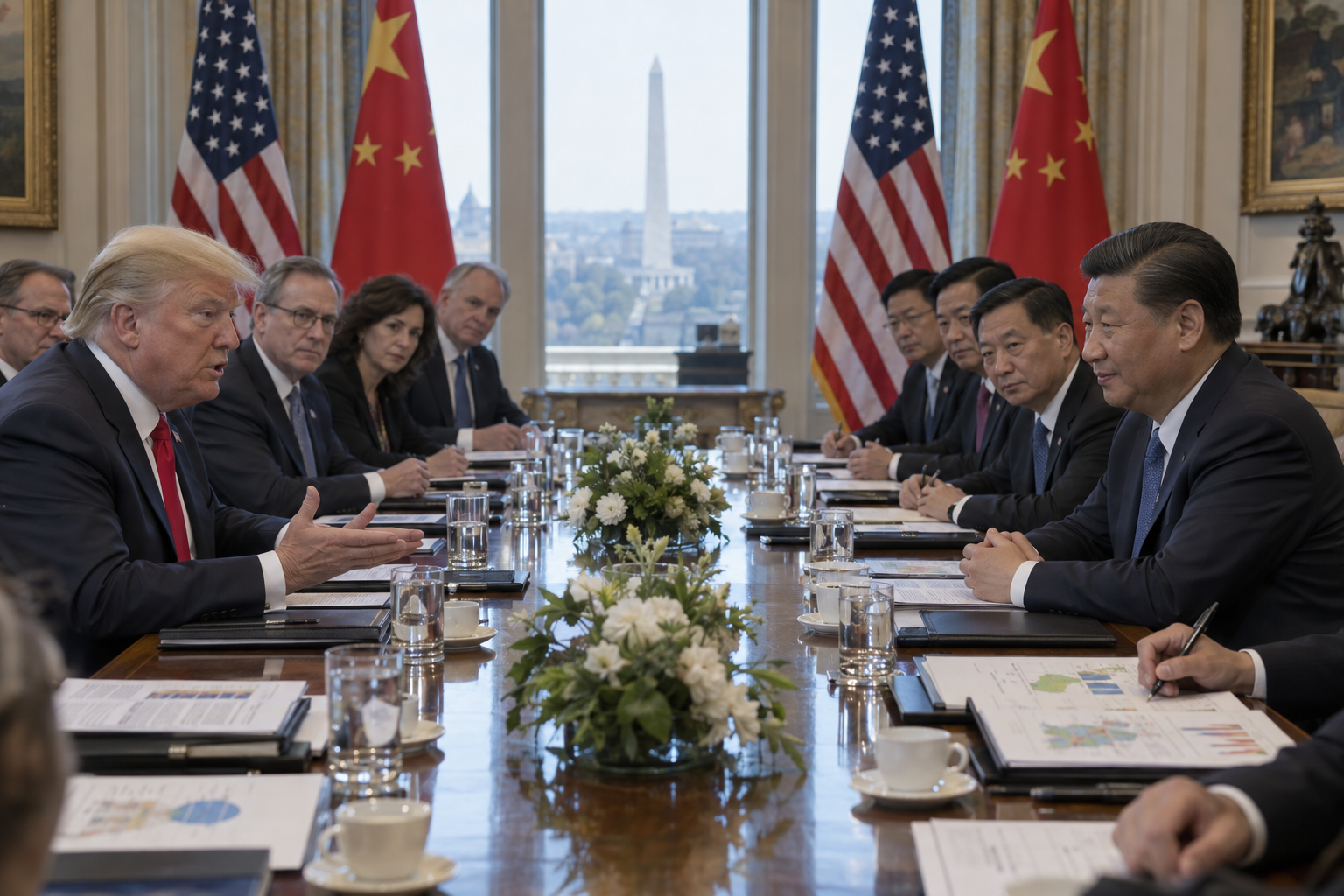
The article examines what emerged—and what remained unclear—after talks between US President Donald Trump and Chinese President Xi Jinping. Although China later disclosed several outcomes, the summit produced no joint statement and few major breakthroughs, with each government issuing its own account of the meeting. The article reads this as evidence that the two countries remain cautious despite efforts to present a warmer relationship.
The leaders agreed to launch an artificial-intelligence dialogue and create a communication channel for AI-related incidents, with further talks expected in November. The measures could help prevent misunderstandings as both countries develop increasingly powerful AI systems. On trade, the existing truce was extended only until 10 January, a shorter period than Beijing had hoped for. China secured lower US tariffs on $30bn of goods, while the Trump administration said China would buy at least 10 million metric tons of US coal annually in 2027 and 2028. The accounts did not mention increased Chinese rare-earth exports or relaxed US semiconductor restrictions.
Taiwan was absent from the White House factsheet but prominent in Beijing’s account. Xi reportedly urged Trump to oppose Taiwanese independence. Trump offered little detail publicly, and uncertainty persisted over a proposed US arms package for Taiwan. The article also notes China’s stated willingness to let more foreign financial firms apply to operate there, while stressing that Chinese regulations will still determine access. Discussions about additional flights have likewise yielded no clear plan, and Americans remain excluded from China’s visa-free entry offer.
Overall, the summit produced more dialogue than policy change. Contentious issues—including advanced technology and Taiwan—remain unresolved. The article concludes that communication and limited economic concessions appear easier for both governments than making substantial compromises.
Entities: Donald Trump, Xi Jinping, Laura Bicker, United States, China • Tone: analytical • Sentiment: neutral • Intent: analyze
28-09-2026
CNBC’s Daily Open describes a tense start to the trading week, with investors weighing an inconclusive U.S.-China summit against the risk of renewed conflict between the United States and Iran. Chinese President Xi Jinping’s Washington visit produced tariff reductions covering $30 billion in goods and a new U.S.-China dialogue on artificial intelligence, but no specific purchase commitments. The two countries extended their trade truce by only two months, less than some analysts had expected. Commentators cautioned that the fragile detente may not last without more substantial results or progress on underlying strategic disputes.
The Iran standoff remains a major market concern. Xi and President Donald Trump agreed that Iran should not develop nuclear weapons and that international waterways should not be subject to transit tolls. Iranian Foreign Minister Abbas Araghchi said Tehran was prepared for a “doomsday” war while continuing to pursue diplomacy. Trump reportedly rejected Iran’s peace terms, pushing oil prices higher: Brent crude topped $107 per barrel, while U.S. crude futures reached $94.14. The conflict’s disruption to oil supplies has also contributed to inflation concerns. Police in Britain separately arrested five men near an air base used in U.S. strikes on Iran on suspicion of terrorism and explosives offenses.
Markets reflected the uncertainty: stock futures slipped after a winning week as Treasury yields reached their highest levels since 2007, raising financing costs for large-scale AI infrastructure projects. The article also reports that Chinese industrial profits grew 4.2% year over year in August, their weakest pace of the year. In corporate news, Northern Star Resources rejected Gold Fields’ A$38.7 billion takeover approach, calling it opportunistic; Northern Star shares rose more than 10%. Meta’s Muse AI agent can help users identify and cancel recurring subscriptions. Finally, SpaceX planned Starship’s first genuine orbital attempt, carrying 26 next-generation Starlink V3 satellites, with another launch opportunity possible before an FAA restriction expires.
Entities: Anniek Bao, Xi Jinping, Donald Trump, Abbas Araghchi, United States–China trade truce • Tone: analytical • Sentiment: neutral • Intent: inform
28-09-2026
CNBC’s Daily Open examines the limited results of Chinese President Xi Jinping’s visit to Washington and the market implications of rising geopolitical and borrowing-cost pressures. The U.S. and China agreed to reduce tariffs on $30 billion of goods and begin an artificial-intelligence dialogue, but made no specific purchase commitments; their trade-truce extension also fell short of expectations. The leaders discussed Iran, nuclear weapons and international waterways, while Iranian Foreign Minister Abbas Araghchi warned that Tehran was prepared for a “doomsday” war even as he said he remained open to diplomacy. The conflict and the risk to oil shipments through the Strait of Hormuz have contributed to constrained global supply and inflation concerns. Separately, British police arrested five men near an air base used in U.S. strikes on Iran, on suspicion of terrorism and explosives offenses.
Markets opened the week cautiously: stock futures slipped, Treasury yields reached their highest levels since 2007, and oil prices rose after President Donald Trump rejected Iran’s ceasefire conditions. Higher borrowing costs could make the already enormous AI infrastructure buildout more expensive to finance. On technology and U.S.-China relations, Beijing may allow ByteDance and Alibaba to purchase Nvidia’s RTX PRO 5500 chips, according to a report cited by CNBC—an indication of a possible, limited easing in restrictions. Anthropic CEO Dario Amodei, who missed the state dinner for Xi, was instead due to have a private dinner with Trump.
The article also notes China’s upcoming report on industrial profits, which are under pressure from higher commodity costs and weak domestic demand. In a final item, it describes South Korean President Lee Jae Myung’s renewed push to discuss transferring wartime operational control of allied forces to South Korea, amid concerns about military readiness after Trump curtailed a joint exercise.
Entities: Xi Jinping, Donald Trump, Abbas Araghchi, Anniek Bao, Lee Jae Myung • Tone: analytical • Sentiment: neutral • Intent: inform
28-09-2026
The Trump-Xi summit in Washington ended with limited concrete results despite high-profile gestures, including Trump greeting Xi at the airport and a state dinner attended by more than 100 people. The presidents agreed to continue discussions, but extended the trade truce by only two months, less than many had expected. Analysts warned that the fragile détente may not last unless it produces tangible outcomes or addresses deeper strategic tensions. The countries issued separate statements rather than a joint communiqué, which one analyst interpreted as evidence that both are still competing to shape the relationship and manage escalation.
The readouts identified several areas of overlap. Trump and Xi plan to attend the APEC meeting in Shenzhen in November and the G20 summit in Miami in December. They also agreed to hold an AI dialogue within two months and create a communication channel for AI-related incidents, though the countries used different terminology for the technology. Both statements invoked U.S.-Chinese cooperation against Japan during World War II. Analysts saw the historical references as a possible signal of cooperation, while a Chinese social-media account connected them to current tensions involving Japan and Taiwan. Xi urged the United States to oppose Taiwan independence, but Taiwan was not mentioned in either official readout.
The two sides also signaled some alignment on limiting Iran’s nuclear capabilities and opposing tolls on international waterways. Trade arrangements include plans for boards on trade and investment, tariff reductions on $30 billion in goods, Chinese coal purchases, and a working group on agricultural trade. However, the details and scale of several commitments remain uncertain, and businesses will be watching implementation. Analysts characterized the trade, investment, rare-earth, refined-oil, and AI deliverables as limited and tentative. China also mentioned increasing flights and opening its financial sector to businesses from all countries, without providing details. Separately, Zoo Atlanta announced the arrival of two giant pandas from China.
Entities: Donald Trump, Xi Jinping, Daniel Kritenbrink, Peter Alexander, Scott Kennedy • Tone: analytical • Sentiment: neutral • Intent: analyze
28-09-2026
The United States and China announced plans to reduce tariffs on $30 billion worth of goods from each country, following a summit between President Donald Trump and President Xi Jinping in Washington. The announcement gives product lists but does not clarify when the lower tariffs will take effect or how much duties will be reduced. Last year, the countries imposed effective tariffs exceeding 40% and 30%, respectively, on one another’s goods. They had since limited further increases under a one-year truce, which U.S. Treasury Secretary Scott Bessent said negotiators agreed to extend through January.
The U.S. list covers 77 categories of Chinese imports, including toys, sports equipment, household goods, and Christmas decorations. China’s list is much longer, covering 1,619 categories of U.S. imports. Agricultural products feature prominently, including livestock, meat, soybeans, peanuts, apples, and whiskey. The United States has sought to reduce its trade deficit with China, which exceeded $202 billion in goods last year.
Business representatives described potential benefits if the tariff reductions are implemented. WPIC CEO Jacob Cooke said cuts before the holiday season could support U.S. consumption and retailers, while noting that Chinese competitors are strong in categories such as hair care and packaged pet food. Jiangsu Green Willow Textile director Ryan Zhao forecast second-half sales growth of 30% year over year if the cuts take effect. The governments also said a bilateral “Board of Trade” would include officials from both sides, meet at least quarterly, and allow senior officials to meet as needed.
Entities: United States, China, Donald Trump, Xi Jinping, Scott Bessent • Tone: analytical • Sentiment: neutral • Intent: inform
28-09-2026
The United States and China announced reciprocal tariff-reduction lists covering roughly US$30 billion in goods from each country. The announcement followed a three-day Washington summit and a meeting between U.S. President Donald Trump and Chinese President Xi Jinping, their first state visit to the United States since 2015. The agreement is expected to support bilateral trade, amid an easing of tensions after U.S. tariffs on Chinese goods had reached as high as 145 per cent last year.
China’s list covers 1,619 categories of U.S. goods, including agricultural products, hair and personal-care items, timber, medical equipment and coal. The U.S. list includes 77 categories of Chinese exports, such as fireworks, tableware, toys, glass and wooden Christmas ornaments, and soccer balls. China said tariff rates on more than 90 per cent of the listed products would move to most-favored-nation levels—the standard rates applied under World Trade Organization rules—effectively removing country-specific tariffs on those items.
U.S. Trade Representative Jamieson Greer described the products as nonsensitive goods that could benefit from more favorable treatment. He said the deal could improve market access for U.S. farmers, manufacturers, businesses and workers, while giving American consumers access to Chinese household goods and toys. The two governments said they may adjust the lists as needed, though changes are expected to be limited to no more than once a year. China also said the countries would cooperate further on agriculture through a group under the Board of Trade established in May. The supplied article ends as it begins to mention strategic sectors such as chips, electric vehicles and batteries.
Entities: United States, China, Donald Trump, Xi Jinping, Jamieson Greer • Tone: analytical • Sentiment: neutral • Intent: inform
28-09-2026
US Ambassador to China David Perdue said President Donald Trump had asked Chinese President Xi Jinping whether China wanted to buy US weapons during Xi’s recent visit to Washington. Perdue described Trump as noting that the United States sells arms to countries around the world, but offered no details about Xi’s response. The White House and State Department subsequently said the US had no plans to sell arms to China; the State Department added that US law prohibits such sales.
The reported offer is striking because US policymakers across party lines generally regard China as the country’s principal military, economic and diplomatic rival. The article also describes growing concern over China’s military expansion, its support for US adversaries, and the possibility of conflict in the Asia-Pacific, especially over Taiwan and disputed maritime areas. Meanwhile, US military influence in the region is facing pressure as resources are redirected and the American defence industry struggles to produce weapons at the pace officials say is needed.
The report places Perdue’s comments alongside Trump’s delay of a US$14 billion arms package for Taiwan. The sale was assembled by State Department officials and approved by congressional leaders, but has not advanced despite bipartisan calls for action. Legislators have also urged the administration to release previously approved funding for Taiwan’s defence. Trump has described the arms sale as a negotiating chip with China, and the article notes that discussions with Xi about arms sales to Taiwan conflict with a 1982 US assurance that Washington would not consult Beijing on those sales. A former US diplomat said Perdue’s disclosure could unsettle US partners such as Japan, the Philippines and Taiwan.
Entities: Donald Trump, Xi Jinping, David Perdue, Ryan Hass, Mitch McConnell • Tone: analytical • Sentiment: negative • Intent: inform
28-09-2026
US Ambassador to China David Perdue said the United States’ policy toward Taiwan has not changed following Chinese President Xi Jinping’s state visit to Washington. Perdue said the US opposes both Taiwanese independence and coercion, responding to concerns that President Donald Trump might reduce support for Taiwan to accommodate Beijing. He said the administration had approved US$11 billion in arms sales to Taiwan and that discussions about additional sales were continuing. Perdue also recounted that Trump had jokingly asked Xi whether China wanted to buy some weapons.
During the visit, Xi pressed Trump to explicitly oppose Taiwan independence, a more direct public appeal than Beijing’s usual calls for Washington to respect its position. China regards Taiwan as its territory and has threatened to bring the island under its control by force if necessary. Trump said on Sept 26 that Taiwan did not occupy much of his discussion with Xi, who, Trump said, understood his views on the issue.
The article notes that the US position rejects Taiwanese independence and opposes unilateral changes to the status quo by either Beijing or Taipei. Trump had delayed a planned US$14 billion arms package for Taiwan for months and previously described it as a negotiating chip after meeting Xi in Beijing. Taiwan’s representative to the US, Alexander Yui, argued that Taiwan’s importance as a supplier of chips—particularly amid growing artificial-intelligence demand—creates a “symbiotic relationship” with the US and is a reason the island should be protected. Yui said the US is Taiwan’s main weapons supplier and expressed hope that arms would arrive soon. The report presents the policy and competing pressures without suggesting that US support has been formally altered.
Entities: David Perdue, Donald Trump, Xi Jinping, Alexander Yui, United States • Tone: neutral • Sentiment: neutral • Intent: inform
28-09-2026
The United States and China have published lists of goods that could receive reduced tariffs under an arrangement covering about US$30 billion of imports from each country. The US list contains 77 product entries, including fireworks, household goods, sporting equipment and toys. China’s list includes 1,619 goods, such as meat, seafood, dairy products, grains, coal, timber and medical equipment. The proposed relief covers US$60 billion in bilateral trade, a small share of the US$415 billion in goods traded between the countries in 2025. About 90 per cent of the products covered are expected to have tariffs reduced to most-favoured-nation rates.
The announcement followed Chinese President Xi Jinping’s state visit to Washington and was described as one of its most concrete outcomes. The countries also extended their trade truce until January as they pursue a broader agreement and anticipate further meetings between Xi and US President Donald Trump in 2026. With disputes over export controls and Taiwan unresolved, the article presents less-sensitive trade as an area where progress is more achievable.
US Trade Representative Jamieson Greer said the selected products could improve access for US agricultural goods and medical devices while lowering barriers for Chinese household products and toys. China said the tariff reductions would take effect simultaneously after required domestic procedures. Beijing also said US coal was included, supporting planned purchases in 2027 and 2028. Wheat, corn and sorghum are among the US agricultural exports that could benefit, potentially helping China reach a US$17 billion annual purchasing goal through 2028, alongside its soybean commitment. Progress towards the agricultural target has been slow.
The two governments will establish an Agricultural Working Group, with its first meeting expected by the end of 2026. The arrangement is intended to support trade relations and create conditions for increased agricultural purchases, while market reactions included gains for some Chinese appliance makers.
Entities: United States, China, Donald Trump, Xi Jinping, Jamieson Greer • Tone: analytical • Sentiment: neutral • Intent: inform
28-09-2026
US ambassador to China David Perdue said Donald Trump asked Xi Jinping during the Chinese leader’s recent visit to Washington whether China wanted to buy US weapons. Perdue made the remark in a television interview while discussing US policy toward Taiwan. The comments drew attention because Taiwan is awaiting approval of a proposed $14bn US arms-sales package, which Trump has previously described as a negotiating chip in dealings with Beijing. The White House and State Department subsequently said the United States had no plan or offer to sell weapons to China; the State Department added that US law prohibits such sales.
The article places the reported exchange within the broader dispute over Taiwan. Washington is required under the Taiwan Relations Act to provide the self-governed island with defensive equipment, though it maintains strategic ambiguity about whether it would defend Taiwan in an invasion. Beijing opposes US arms sales to Taiwan, considers the island part of China, and has not ruled out using force to take it. During the Washington summit, Xi urged Trump to oppose Taiwan independence. Trump has since said Xi understands his position, while Perdue separately stated that US Taiwan policy had not changed.
Taiwanese officials described a serious military threat from China, noting that Beijing continues to expand its military capacity despite economic decline. The article also reports a dispute over a White House account of the countries’ history in the second world war: a Taiwanese official objected to language suggesting the Chinese Communist party and the US fought as allies. China’s wartime government was the Republic of China, led by Chiang Kai-shek; his government later retreated to Taiwan after losing the civil war to the communists. The article notes that China is now a net arms exporter and that its arms imports have fallen sharply, partly as its domestic weapons industry has advanced.
Entities: Donald Trump, Xi Jinping, David Perdue, Taiwan, China • Tone: analytical • Sentiment: neutral • Intent: inform
28-09-2026
The article reports that US President Donald Trump sought to downplay a pending arms sale to Taiwan during discussions with Chinese President Xi Jinping. US ambassador to China David Perdue said Trump had told Xi that the United States sells weapons around the world and had even asked whether China wanted to buy some. Perdue did not say when the exchange took place or provide more details. He rejected suggestions that Washington was delaying Taiwan’s weapons orders to avoid upsetting Beijing, describing Trump as strongly supportive of Taiwan and saying there had been no change in US policy.
Taiwan has been waiting for months for approval of a proposed arms package worth about $14 billion, following an $11 billion deal announced in December. The proposed package was put on hold after Trump met Xi in Beijing in May, and Trump has not said whether it will proceed after their latest summit. Trump has previously called arms sales a “very good negotiating chip” in dealings with China. He also said Taiwan was not a major topic in his latest talks with Xi, who, according to China’s Xinhua news agency, urged Trump to handle the issue prudently and oppose Taiwan independence. The White House had not released its own account of that discussion.
Taiwanese deputy foreign minister Chen Ming-chi said Washington understands Taiwan’s defence needs and the military pressure it faces from China, and that Taiwan has received assurances that US policy remains unchanged. The article places the dispute within the broader effort by Washington and Beijing to stabilise relations after tensions over trade, technology and other geopolitical issues. Their summit extended a trade truce, but differences over Taiwan, artificial intelligence and Iran remained. US law requires Washington to provide Taiwan with defensive means, although the United States does not formally recognise it as an independent country and has not clearly stated whether it would intervene militarily in a Chinese attack. Beijing claims Taiwan as its territory; Taiwan rejects that claim.
Entities: Donald Trump, Xi Jinping, David Perdue, Taiwan, Beijing • Tone: neutral • Sentiment: neutral • Intent: inform