28-09-2026
A powerful nor’easter continued to batter the northeastern United States for a second day on Sunday, bringing coastal flooding, strong winds, heavy rain and widespread power outages. Tidal surges inundated low-lying New Jersey neighbourhoods, while gusts on New York’s Long Island toppled trees, damaged homes and brought down utility poles. Streets in the Howard Beach neighbourhood of Queens, New York City, were also flooded. The storm had killed a New York City housing authority worker on Saturday when a tree fell, and forecasters expected hazardous weather to persist through Sunday, extending into New England.
Some areas of New Jersey had received more than 10cm (4 inches) of rain since Friday. The combination of heavy rainfall and a surging ocean caused flooding that residents said had not been seen in nearly a decade in some communities accustomed to high water. The storm brought back memories of Hurricane Sandy, which caused more than $60bn in damage across the eastern United States in 2012, although the current storm’s impact was far smaller. The article notes that an El Niño climate pattern could contribute to several more East Coast storms during the fall.
Coastal waves crashing over sea walls and beaches raised concerns about erosion. More than 100,000 electricity customers across the Northeast and mid-Atlantic were without power at times on Sunday, with the broadest outages in coastal counties from New Jersey to Connecticut. Flights were cancelled or delayed along the coast; Boston Logan International Airport had recorded more than 250 cancellations by late Sunday morning as wind gusts reached 64km/hour (40 mph).
The heaviest remaining rainfall was forecast from northern New Jersey into southern New England. Although the storm was gradually weakening, National Weather Service forecaster Bob Oravec warned that tidal flooding would continue through Sunday night’s high-tide cycles.
Entities: Nor’easter, Northeastern United States, New Jersey, Long Island, Howard Beach, Queens • Tone: neutral • Sentiment: negative • Intent: inform
28-09-2026
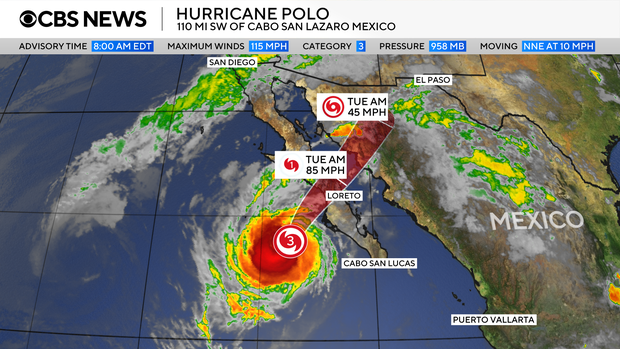
Mexico’s Pacific coast is preparing for Hurricane Polo, a Category 3 storm forecast to reach Baja California Sur late Monday or early Tuesday. The area includes Los Cabos, a major tourist destination. Polo has maximum sustained winds of about 115 mph (185 km/h), and meteorologists at the US-based National Hurricane Center have warned that heavy rain could cause life-threatening flooding and mudslides, particularly in steep areas. The storm may also bring a dangerous surge with large, destructive waves.
As Polo approached, residents stocked up on essentials including food and drinking water. Authorities in Cabo San Lucas restricted access to beaches, and some restaurants closed. The town is known for its natural rock arch and as a base for sport fishing and whale watching. Lifeguards raised red flags on beaches to warn visitors about hazardous sea conditions.
Baja California Sur’s regional government ordered schools closed on Monday as a precaution. Governor Víctor Manuel Castro Cosío said temporary shelters were available for residents who might need to evacuate. Federal authorities deployed thousands of navy and army personnel, along with specialised machinery, to support the response.
The report says Polo has been moving slowly toward Mexico’s coastline. Meteorologists attributed the storm’s strength in part to exceptionally warm ocean waters associated with the El Niño climate phenomenon.
Entities: Hurricane Polo, Baja California Sur, Los Cabos, Cabo San Lucas, Víctor Manuel Castro Cosío • Tone: urgent • Sentiment: negative • Intent: inform
28-09-2026
Hurricane Polo was forecast to bring dangerous winds, heavy rain, flash flooding and mudslides to Mexico’s Baja California Sur and Sonora as it approached the Pacific coast. The National Hurricane Center expected the storm to reach Baja California Sur late Monday, then move into southern Sonora late Monday night or early Tuesday. Although Polo was expected to weaken inland, forecasters anticipated it would still be a hurricane when it made landfall. In its early Monday update, the storm had maximum sustained winds of 115 mph, with hurricane-force winds extending up to 40 miles from its center. Warnings and watches were in effect for parts of the peninsula and mainland coast.
Rainfall forecasts included 6 to 12 inches in parts of Baja California Sur, 4 to 6 inches in parts of Sonora, and as much as 8 inches elsewhere in Mexico. The hurricane center warned that the rain could trigger life-threatening flooding and mudslides, particularly in steep terrain. Mexican authorities ordered evacuations, opened shelters and deployed military personnel in potentially affected areas. Acapulco suspended classes, while state and local officials coordinated preparations and kept shelters open.
The article also describes Polo’s unusually rapid intensification. Between Sept. 21 and 22, its winds increased from 45 mph to 150 mph, meeting the definition of extreme rapid intensification and prompting the hurricane center to call the transformation “truly remarkable.” Winds later reached 180 mph, above the Category 5 threshold. Polo’s central pressure made it the second-strongest hurricane on record in the Eastern Pacific, behind Hurricane Patricia; its peak winds tied Hurricane Rick as the region’s third-strongest. The article attributes heightened Pacific cyclone activity in part to unusually strong El Niño conditions, which bring warmer waters, moist air and reduced wind shear. It also briefly notes that Hurricane Nolo passed Hawaii’s Big Island over the weekend, bringing rain and wind.
Entities: Hurricane Polo, Baja California Sur, Sonora, U.S. National Hurricane Center, Hurricane Nolo • Tone: urgent • Sentiment: negative • Intent: warn
28-09-2026
Hurricane Nolo was moving away from Hawaii on Sunday, but officials warned that heavy rain, flash flooding, mudslides and strong winds remained a danger. The storm was about 365 miles south-south-west of Honolulu, with maximum sustained winds of 115mph, and was expected to strengthen before turning north-west. Forecasters said its center should stay south and south-west of the islands, but outer rain bands could bring as much as 20 inches of rain to parts of the Big Island. Advisories remained in effect, and officials urged people to avoid dangerous conditions. Rain had already flooded part of a major Big Island highway, prompting partial closures. More than 120 National Guard members were activated on the island, and about 400 statewide. Hawaii was still recovering from Hurricane Lala, while utility crews responding to damage from Hurricane Lowell were redirected to prepare for Nolo. Governor-approved federal emergency assistance was also authorized. Residents and business owners took precautions, though some hoped the islands would avoid the strongest winds.
Meanwhile, Hurricane Polo, a separate and powerful storm, was approaching Mexico’s Baja California peninsula after bringing rain and strong winds to the country’s south-west coast. The Category 3 hurricane had sustained winds of 125mph and was forecast to make landfall Monday. Mexico issued a hurricane warning for part of its mainland coast, and the navy positioned personnel, aid and vessels to help communities that might be isolated. In San Juanico, residents were concerned that flooding could cut off roads and access to medical care; the army prepared a shelter and electrical crews made preparations. The article also reports that Tropical Storm Rachel formed offshore, but no coastal watches or warnings were in effect.
Entities: Hurricane Nolo, Hurricane Polo, Tropical Storm Rachel, Hawaii, Big Island • Tone: urgent • Sentiment: negative • Intent: inform
28-09-2026
A powerful nor’easter brought dangerous conditions to the northeastern United States over the weekend, affecting tens of millions of people from Virginia to Maine. The storm caused coastal flooding, strong winds, heavy rain, power outages and widespread travel disruption. New York and New Jersey declared states of emergency, while the National Weather Service warned of significant inundation in low-lying areas near the shore, including roads, homes and businesses.
In Brooklyn, a falling tree killed Leighton Brown, a 56-year-old New York City Housing Authority employee. Brown was reportedly working an extra shift when the incident occurred. New York City’s public advocate paid tribute to him, describing him as a dedicated employee with a warm personality.
The storm cut electricity to more than 160,000 households, according to PowerOutage. FlightAware reported that more than 2,400 flights were delayed and 1,199 were grounded on Saturday. A full moon was expected to make coastal flooding worse, and streets and homes were inundated in New Jersey communities including Surf City and Manasquan. New York officials warned of wind gusts reaching 55mph (86km/h), with the risk of falling trees and power lines. Mayor Zohran Mamdani urged residents to avoid unnecessary travel and warned them not to drive or walk through floodwater.
The weather also disrupted sporting and entertainment events. The Boston Red Sox moved a game against the Chicago Cubs to Florida, while a professional football match between Red Bull New York and St Louis City SC was cancelled. New York’s Global Citizen Festival, featuring Lauryn Hill, Wyclef Jean and John Legend, was called off, as was Ed Sheeran’s concert at Gillette Stadium near Boston. The venue said the decision was made for safety reasons.
Entities: Nor’easter, Leighton Brown, New York City Housing Authority (NYCHA), New York City, New Jersey • Tone: neutral • Sentiment: negative • Intent: inform