28-09-2026
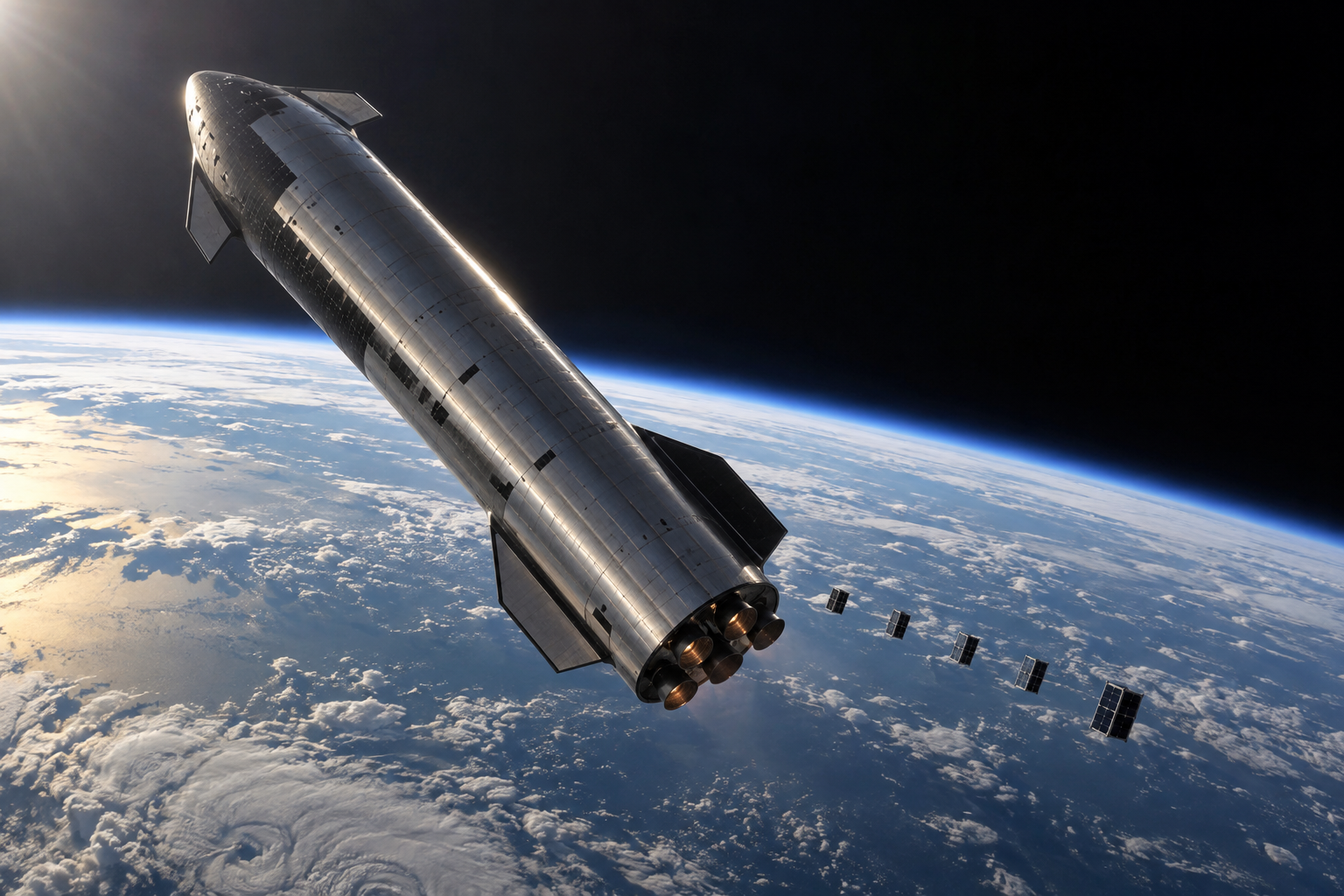
SpaceX completed Starship’s 14th test flight on September 28, 2026, reaching orbit for the first time and deploying 26 Starlink V3 satellites. The launch took place from Starbase, Texas, where employees cheered as the vehicle reached orbit. The booster made what the company described as a soft splashdown off the coast, while the spacecraft continued upward; the article also notes that one vacuum engine went out during its sub-orbital trajectory. The flight marks a major step for a rocket whose earlier 13 test flights were not intended to reach orbit.
Starship is central to SpaceX’s plans to expand Starlink, which the article describes as the company’s largest and only profitable business segment in the second quarter. SpaceX says a Starship can carry 60 of its new V3 satellites—about 20 times the capacity of a Falcon 9 launch. The company operates about 11,000 active satellites, compared with roughly 650 for competitor Eutelsat OneWeb. The V3 satellites are larger, have solar arrays that generate twice as much power as earlier versions, and can transmit data more rapidly.
SpaceX designed Starship and its Super Heavy booster to be fully reusable and to carry more cargo at lower cost than previous spacecraft. The company is preparing the vehicle for a NASA test flight next year and aims to use it to return U.S. astronauts to the Moon. It also plans to launch AI-computing satellites in 2027. The article reports that SpaceX went public in June in what it calls the largest IPO on record and is valued at about $2 trillion. CEO Elon Musk has said Starlink could eventually provide internet access to a majority of the world, where the company is permitted to operate.
Entities: SpaceX, Starship, Starship Super Heavy, Elon Musk, Gwynne Shotwell • Tone: analytical • Sentiment: positive • Intent: inform
28-09-2026
SpaceX’s Starship rocket lifted off from the company’s Starbase facility in Texas on September 28, 2026, and reached orbit for the first time, despite an engine shutting down earlier than planned. The uncrewed, 40-story vehicle consists of a Super Heavy booster and the Starship upper stage. Its mission was an important test of the rocket’s ability to carry payloads into space and potentially deploy its first batch of Starlink satellites.
During the company’s live broadcast, SpaceX spokesperson Dan Huot initially said the vehicle could not reach orbit after the engine issue. He corrected that assessment minutes later, following an update from engineers confirming Starship could still attempt a crucial engine firing to reach orbit. The craft was expected to make six Earth orbits over a 10-hour flight—the longest Starship voyage to date—before splashing down in the Pacific Ocean west of Chile.
Reaching orbit marks a major milestone for a rocket intended to launch Starlink satellites more frequently and eventually carry NASA missions to the moon. The achievement had been delayed: Elon Musk had previously forecast an orbital flight in 2022 and satellite deployments in 2023, but all 13 earlier Starship test flights since 2023 had remained suborbital. The article reports that the nearly decade-long development program has cost SpaceX more than $15 billion. Musk has described a future in which the company launches hundreds or thousands of Starships annually, a pace without precedent in the space industry. The flight therefore represented both progress toward Starship’s planned roles and a test of its performance under an engine problem.
Entities: SpaceX, Starship, Super Heavy, Starlink, Elon Musk • Tone: analytical • Sentiment: neutral • Intent: inform
28-09-2026
SpaceX’s Starship reached Earth orbit for the first time during a test flight launched from the company’s site in southern Texas, marking a major milestone in the rocket’s development. The 407-foot (124-metre), two-stage vehicle lifted off near Brownsville at 7:46 a.m. Central Time. Its uncrewed mission was planned to last nearly 10 hours, with six trips around Earth at an altitude of about 170 miles (275 km), followed by a splashdown in the Pacific Ocean west of Chile.
The rocket consists of a Super Heavy booster topped by the Starship spacecraft. It carried 26 of SpaceX’s latest Starlink satellites, which were intended for deployment to supplement a network of more than 11,000 satellites already providing internet service. Reaching orbit is an essential capability for rockets intended to carry payloads, but Starship had not previously achieved it despite years of development. Musk had earlier forecast orbital flight in 2022 and satellite deployments in 2023. The article reports that all 13 previous test flights since 2023 remained suborbital, after nearly a decade of development and estimated spending exceeding $15 billion.
SpaceX aims to use Starship to deploy Starlink satellites more frequently and eventually transport astronauts and cargo for NASA’s Moon missions. Musk has also proposed scaling up production to launch hundreds or even thousands of Starships annually—an unprecedented level of activity for the space industry. The article presents the orbital milestone alongside the substantial technical and operational ambitions that remain.
Entities: SpaceX, Starship, Elon Musk, Super Heavy booster, Starlink satellites • Tone: analytical • Sentiment: neutral • Intent: inform