24-09-2026
Pope Leo XIV is scheduled to spend four days in France, visiting Paris, Lourdes and Metz. The trip has generated unusually high interest in a country shaped by a strong tradition of secularism: public events have sold out, and organizers expect large crowds for an open-air mass in Paris. Political scientist Olivier Roy says Leo’s popularity extends beyond Catholics, in part because his dispute with US President Donald Trump has given him broader moral standing. The visit also arrives shortly before France’s presidential election, making the state’s role in welcoming the pope and the visibility of Catholicism politically sensitive. The left is described as appreciating Leo personally while questioning government involvement; far-right groups support Catholic visibility but object to an interfaith event in Metz.
The article places Leo’s visit in the context of earlier papal trips and differing views of Europe within the Catholic Church. Roy suggests Leo may take a middle position between John Paul II’s European emphasis and Francis’s focus on the Global South. Church historian Jörg Ernesti notes that Europe remains an important political reference point even as Catholics have become more geographically dispersed: Europeans now make up about 20% of Catholics and 39% of the College of Cardinals.
The anticipated high point is Leo’s final-day speech in Metz, titled “To the roots of Europe for peace and unity.” The city’s history and its connection to Robert Schuman, an advocate of Franco-German reconciliation and European unity, provide a symbolic setting for a message against nationalism. Roy will watch whether Leo directly addresses populism and nationalist Catholicism. The pope is also scheduled to meet seven survivors of abuse by members of the French Catholic Church. The survivors have publicly stressed that meeting the pope does not mean abandoning their demands, underlining the Church’s continuing struggle to confront abuse.
Entities: Pope Leo XIV, Olivier Roy, Jörg Ernesti, Emmanuel Macron, Robert Schuman • Tone: analytical • Sentiment: neutral • Intent: analyze
24-09-2026
Pope Leo XIV is scheduled to visit Paris over two days, drawing an anticipated large crowd of both Catholic faithful and other visitors. The France 24 report says hundreds of thousands are expected in the French capital during the weekend visit. It describes the event as the first papal visit to France since 2008 and says the country is making extensive preparations to welcome the pontiff. A major part of those preparations is a large security deployment: approximately 14,000 police officers, gendarmes, and soldiers are being mobilized across Paris to provide what the report characterizes as maximum protection. The article focuses on the scale of the operation and the expected attendance, rather than providing details about specific security measures, the Pope’s itinerary, or possible disruptions. It also offers no further explanation of the visit’s agenda or its significance beyond noting that it is the first such visit in 18 years. The report is a brief video item issued on September 24, 2026. Its central message is that the anticipated crowds and high-profile papal visit have prompted an extensive security response across the capital.
Entities: Pope Leo XIV, Paris, France, French capital, papal visit • Tone: neutral • Sentiment: neutral • Intent: inform
24-09-2026
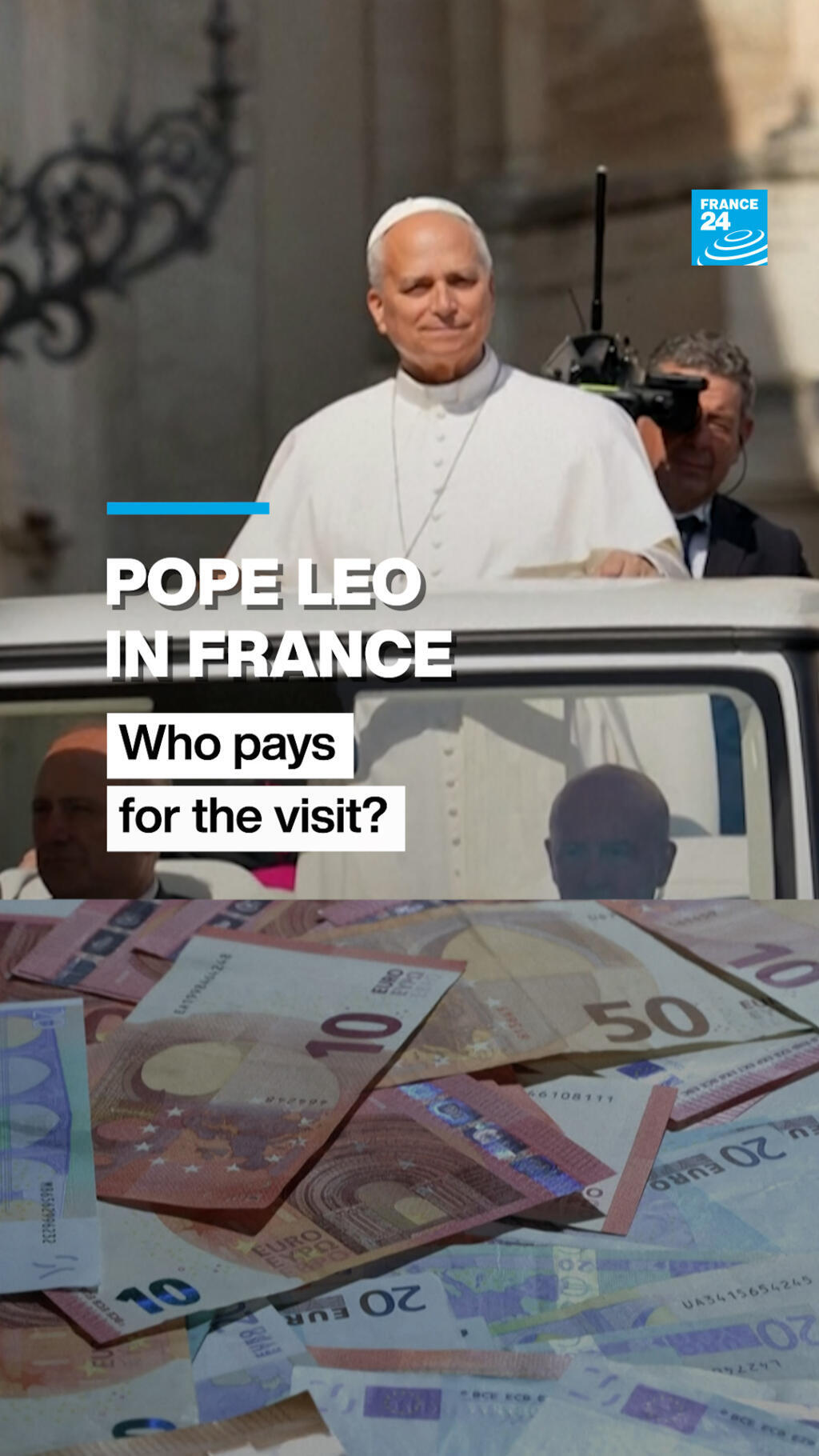
The France 24 item asks who will pay for Pope Leo XIV’s visit to France, a question made more pressing by the rising projected cost of the trip. The supplied description says the visit was initially expected to cost €12 million, but the estimate has since increased to €27 million amid what it describes as immense public excitement. It frames the funding issue in the context of France’s firm commitment to secularism: if the state and religion are formally separate, which parties will cover the costs associated with the papal visit? France 24 journalist Sam Ball is identified as explaining the issue in a video lasting 2 minutes and 47 seconds. The supplied page does not include the video’s transcript or any further details about the funding arrangements, so it does not establish who will ultimately pay, how the costs are divided, or what expenses account for the increase. The article’s central focus is therefore the tension between the substantial cost of a high-profile religious visit and the funding questions raised by France’s secular character. The available material presents the question and the revised estimate but leaves the answer to the video itself.
Entities: Pope Leo XIV, France, Sam Ball, France 24, Pope Leo XIV’s visit to France • Tone: analytical • Sentiment: neutral • Intent: inform
24-09-2026
Pope Leo XIV’s first visit to France since becoming pope will include a visit to Notre-Dame Cathedral in Paris, where he is expected to pray in a chapel dedicated to Eastern Christian churches and meet representatives of those communities. The chapel, redesigned during Notre-Dame’s restoration and opened at the cathedral’s December 2024 reopening, contains eight icons representing Eastern churches and their historic centers, including Jerusalem, Baghdad, Armenia, Ethiopia and India. The visit is expected to draw attention to the historical and continuing presence of Christians in the Middle East and other parts of the Arab world.
Monsignor Hugues de Woillemont, director of the Christian association L’Oeuvre d’Orient, described the papal visit to the chapel as significant. He stressed that Christians who remain in the region contribute to their countries’ histories, warning that their disappearance would mean the loss of an important chapter. L’Oeuvre d’Orient was founded in 1858 to support Christian schools in Lebanon and has since expanded its work across the region. It rebuilt two churches destroyed by ISIS in Mosul last year.
Pope Leo’s itinerary also includes a meeting with French President Emmanuel Macron, a visit to UNESCO headquarters and a drive through Paris in the Popemobile. An open-air Mass on the Champs-Elysees and Place de la Concorde is expected to attract about 600,000 people. The pope will then travel to Lourdes and, on the final day, to Metz, where he is scheduled to speak about world peace in the presence of European leaders.
The visit is an apostolic visit rather than a state visit, despite a speech at the Elysee Palace. The article also notes France’s stated support for protecting Middle Eastern Christians and the relationship between Macron and the pope, which has been shaped by international crises and issues including Ukraine, the Middle East, artificial intelligence and climate change.
Entities: Pope Leo XIV, Emmanuel Macron, Notre-Dame Cathedral, L'Oeuvre d'Orient, Monsignor Hugues de Woillemont • Tone: neutral • Sentiment: neutral • Intent: inform