24-09-2026
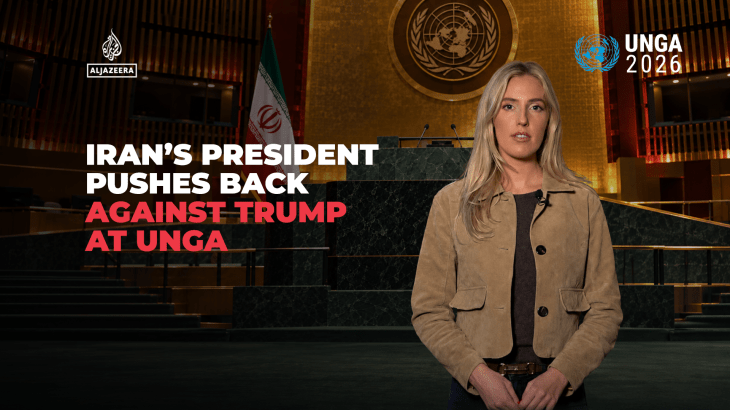
The Al Jazeera video report focuses on Iran’s president addressing the United Nations General Assembly one day after US President Donald Trump threatened to “annihilate” Iran. The headline characterizes the Iranian president as presenting evidence of US strikes on civilians, though the supplied description does not identify the evidence or provide details about the strikes. It says Iran is open to talks but will not negotiate while under threat, setting out Tehran’s stated position amid the war. The report poses the central question of whether the United States and Iran can find a way to end the conflict. Al Jazeera correspondent Emma Withrow is identified as explaining the situation. The item is dated September 24, 2026. Because the supplied article text is only a brief video description, it does not give the president’s name, quote his full UN address, describe the civilian casualties, or report any response from the US. Its focus is therefore the contrast between Trump’s threat and Iran’s conditional openness to negotiations, with the possibility of ending the war left unresolved.
Entities: Iran, Iran’s president, Donald Trump, United States, United Nations General Assembly (UNGA) • Tone: analytical • Sentiment: negative • Intent: analyze
24-09-2026
US Secretary of State Marco Rubio warned that Iraq could face “Balkanisation” if its armed factions are not brought under state control. Speaking in New York after meeting Iraqi Prime Minister Ali al-Zaidi, Rubio said several groups had disarmed or joined the government, while at least one had been less cooperative. The article explains that, in this context, the warning is less about an imminent territorial breakup than about Iraq’s difficulty establishing a stable central government free from parallel armed, political and economic networks linked to Iran.
Experts differ over the weight and purpose of Rubio’s warning. RUSI researcher Burcu Ozcelik describes the factions as a structural challenge that has operated with near impunity. Analyst Zeidon Alkinani suggests Rubio’s statement may be intended to pressure Baghdad, or may reflect limited understanding of Iraq; he argues the country has survived more severe threats, including the 2003 US invasion, sectarian violence, the war against ISIL and the Kurdish independence referendum.
The disarmament effort is politically sensitive and behind schedule. Al-Zaidi had previously said factions would have no justification after September 30, but later extended the process to June 30, 2027. Many Iraqis support bringing armed groups under state authority, yet implementation is difficult. Most factions are associated with the Popular Mobilisation Forces (PMF), whose members were formally incorporated into security forces but often retain separate command structures and ties to Iran. Some groups have reached understandings with Baghdad, while powerful factions such as Kataib Hezbollah and Harakat al-Nujaba refuse to surrender what they call “resistance weapons.”
The meetings took place shortly before the remaining US troops were due to leave Iraq, with Rubio saying there had been no discussion of extending the deadline. The article also notes that Iran-aligned Iraqi factions have targeted US forces and Gulf states, and may have been involved in attacks on regional energy infrastructure. Its final section begins to address US sanctions affecting Iranian flights to Iraq, but the supplied text cuts off before the explanation is complete.
Entities: Marco Rubio, Ali al-Zaidi, Donald Trump, Iraq, United States • Tone: analytical • Sentiment: neutral • Intent: inform
24-09-2026
The article examines the contrast between confrontational public statements and possible behind-the-scenes diplomacy between U.S. President Donald Trump and Iranian President Masoud Pezeshkian during the U.N. General Assembly in New York. Foreign policy expert Behnam Ben Taleblu of the Foundation for Defense of Democracies said Pezeshkian’s criticism of Washington would likely have elicited little more than a smirk from Trump, who, in Taleblu’s view, believes he has the advantage. Pezeshkian accused the United States and Israel of attacking Iran and described Iranians as victims, while insisting that Iran had only defended itself. Trump, meanwhile, defended the U.S. conflict with Iran and warned Tehran it must choose between a deal and further destruction.
Taleblu characterized both leaders’ speeches as predictable given the countries’ current relationship and foreign-policy positions. He also described Pezeshkian’s address as an effort to present Iran as a victim through anti-American, anti-Israeli and anti-imperialist themes, arguing instead that the Iranian people have suffered from their government’s policies.
Despite the public hostility, diplomatic contacts may be continuing. Trump said his special envoy Steve Witkoff and Jared Kushner spoke with Iranian officials for about three hours on the sidelines of the General Assembly, calling the talks productive. Witkoff said mediators carried messages between the delegations, and reports identified Iranian Foreign Minister Abbas Araghchi as representing Tehran. Taleblu said both sides are trying to use time to their advantage and place the choice between escalation and engagement on the other. The article presents these parallel tracks—public confrontation and exploratory diplomacy—as evidence of unresolved tensions and a possible search for a way to end the conflict. The supplied article text cuts off before its final thought is complete.
Entities: Donald Trump, Masoud Pezeshkian, Behnam Ben Taleblu, Steve Witkoff, Jared Kushner • Tone: analytical • Sentiment: neutral • Intent: analyze
24-09-2026
In this France 24 Spotlight segment, host François Picard speaks with journalist and author Scott Anderson about the US war with Iran and the risks of misunderstanding the country. Anderson draws a parallel between 1979 and 2026, arguing that Washington has repeatedly misread Iran. He points to US intelligence and military exercises that, he says, anticipated Iran would close or seize the Strait of Hormuz in a conflict, and questions why the Trump administration did not adequately account for that possibility when starting the war.
The discussion takes place nearly seven months into the war. Iranian President Masoud Pezeshkian has accused the United States of “terrorism” at the UN General Assembly, following President Donald Trump’s threat to “annihilate” the Islamic Republic if no deal is reached. Pezeshkian has also expressed willingness to negotiate, while rejecting coercion and emphasizing that Iran would not submit to force.
Anderson’s argument extends beyond an alleged intelligence failure. He describes the 1979 revolution as an uncertain struggle among liberal, leftist, nationalist and religious groups, rather than an inevitable path to the Islamic Republic. Ayatollah Khomeini, he says, proved more politically capable than many expected. In contrast, today’s Islamic Republic is an established system supported by institutions and constituencies, not one reliant on a single revolutionary leader.
The segment’s central warning is that history does not simply repeat itself, but misjudging Iran’s internal politics, resilience and capacity for resistance can have far-reaching consequences. The outcome of the current conflict may differ from that of 1979, yet the costs of misunderstanding Iran could be comparable in scale.
Entities: Scott Anderson, François Picard, Donald Trump, Masoud Pezeshkian, Ayatollah Khomeini • Tone: analytical • Sentiment: neutral • Intent: analyze
24-09-2026
On the second day of the U.N. General Assembly, Iran and Ukraine dominated discussions as diplomats considered ways to contain two wars with consequences for global stability. Iranian President Masoud Pezeshkian addressed the assembly a day after President Trump threatened that the U.S. could annihilate Iran if it did not reach a deal. Pezeshkian portrayed Iran as a victim of the U.S.-Israeli war, displayed images of the supreme leader and schoolgirls killed in strikes, and rejected the accusation that Iran is a terrorist state. He warned against a world governed by military might rather than diplomacy.
U.S. Secretary of State Marco Rubio countered that Iran had no standing to lecture others on human rights, citing its crackdown on protesters and support for armed groups. Rubio said Trump wanted a deal to end Iran’s nuclear ambitions. U.S. and Iranian negotiators were reportedly holding talks through mediators on the sidelines, though Rubio offered few details.
The report also focused on the war in Ukraine. After meeting Russian Foreign Minister Sergey Lavrov, Rubio said both sides had shown interest in a limited ceasefire involving grain and energy. Ukraine had offered to pause attacks on Russian oil and gas infrastructure if Russia stopped striking Ukraine’s energy grid ahead of winter. Lavrov, however, said Russia would not pause its military operation. Ukraine’s foreign minister accused Russia of widening the conflict by recruiting mercenaries from 37 African countries; U.S. Ambassador Mike Waltz also cited Cuban mercenaries and raised concerns about Russian violations of NATO airspace.
Waltz warned that the conflict’s spread was dangerous and said global food and energy markets were at stake. The report concludes that, as in the Persian Gulf, the U.S. has yet to outline a clear endgame.
Entities: Masoud Pezeshkian, Donald Trump, Marco Rubio, Sergey Lavrov, Mike Waltz • Tone: analytical • Sentiment: neutral • Intent: inform
24-09-2026
Ukrainian Foreign Minister Andrii Sybiha said he met with Iranian Foreign Minister Abbas Araqchi on the sidelines of the United Nations General Assembly in New York to discuss preventing further escalation between their countries. Sybiha described the meeting as a follow-up to a telephone conversation in July and said the ministers agreed to keep existing communication channels open. Their discussion also covered the situations in the Middle East and Europe and ongoing peace efforts. Sybiha reiterated Ukraine’s support for restoring peace and stability in both regions as soon as possible.
The meeting took place amid strained relations. During more than four and a half years of war with Russia, Ukraine has faced attacks involving Iranian-designed drones. Ukraine has since developed technology to counter drone threats and offered assistance to Middle Eastern countries facing strikes by Tehran. The article does not report any new agreement on those matters, but recalls that Sybiha and Araqchi spoke by phone in July after a Ukrainian drone strike on an Iranian ship killed one sailor and injured another. Iran condemned that attack and threatened retaliation. In their earlier conversation, Sybiha said he urged Araqchi to avoid escalation and end any support for Russia’s war against Ukraine. The latest meeting was presented as a diplomatic effort to keep tensions in check despite these unresolved disagreements.
Entities: Andrii Sybiha, Abbas Araqchi, Ukraine, Iran, Russia • Tone: analytical • Sentiment: neutral • Intent: inform
24-09-2026
A UN-backed plan to let fertiliser vessels pass through the Strait of Hormuz is stalled because the United States and Iran have not approved it, according to Jorge Moreira da Silva, head of the UN Office for Project Services (UNOPS). Da Silva says the delay is diplomatic rather than technical: neither side has raised concerns about how the mechanism is designed, but both appear focused on negotiating a broader peace agreement. He urged them to allow the interim operation to proceed while those talks continue.
The strait carried an estimated 20 to 30 per cent of global fertiliser exports before the conflict began in late February. Shipments subsequently fell to less than 5 per cent of their pre-war level. The UN warns that the disruption could leave almost 45 million people facing acute food insecurity.
With political approval, the mechanism could be operating within about seven days. It would register vessels, coordinate safe passage through a joint centre in Salalah, provide routes and GPS coordinates, and monitor and verify cargo at ports and during voyages. Da Silva described the operation as relatively straightforward, citing similar UN work in Gaza, Yemen and the Black Sea. He said the main difficulty is securing diplomatic agreement before implementation can begin.
The article situates the delay amid a fragile US-Iran framework agreement and renewed retaliatory attacks. Although the two countries met in New York during the UN General Assembly week, the meeting produced no tangible results, and the sides returned to threats and hostile rhetoric. Da Silva acknowledged that negotiations over a comprehensive deal could take time and argued that humanitarian measures should not have to wait. He expressed hope that the week might bring a breakthrough.
Entities: Jorge Moreira da Silva, Mohamad Ali Harisi, United Nations Office for Project Services (UNOPS), United States, Iran • Tone: analytical • Sentiment: negative • Intent: inform
24-09-2026
The National’s editorial argues that the UN General Assembly’s value lies not only in formal debate but also in bringing adversaries together. It points to a three-hour meeting in New York between US and Iranian officials, brokered by Qatar and Pakistan amid months of Middle East conflict, as a timely example of the practical work of diplomacy. The editorial cites Norwegian Foreign Minister Espen Barth Eide’s observation about “seeing the limitations of warfare” to make the case that military force rarely resolves modern conflicts on its own. Even when force can destroy targets and disrupt economies, its effects must eventually be translated into a political arrangement both sides can accept. Negotiation, the editorial says, is not capitulation but the mechanism through which conflicts—often lacking a decisive battlefield winner—can end. The piece emphasizes that achieving a settlement is difficult and that post-conflict recovery in the Gulf, including rebuilding institutions, restoring trade routes and rebuilding trust among neighbours, could take a generation. It presents the UAE’s continued commitment to dialogue, despite repeated attacks by Iran, as a clear-eyed response to the costs of continued conflict, citing Minister of State Lana Nusseibeh’s focus on de-escalation. The editorial acknowledges that mediation may stall, spoilers can undermine progress, and leaders’ public rhetoric can damage delicate diplomatic efforts. Nevertheless, it concludes that the alternative to diplomacy is not victory but continued escalation and greater costs for all sides. Even limited signs of talks between Washington and Tehran during UN General Assembly week would therefore be worthwhile, and all parties should recognize that escalation has limits.
Entities: United Nations General Assembly (UNGA), The National, New York, United States, Iran • Tone: analytical • Sentiment: neutral • Intent: analyze
24-09-2026
Japanese Prime Minister Sanae Takaichi said discussions aimed at ending restrictions on shipping through the Strait of Hormuz should involve regional countries, nations that rely on the waterway, and the International Maritime Organization (IMO). Speaking to The National at an event on the sidelines of the UN General Assembly in New York, she called for free and safe navigation to be restored without additional charges. The issue is especially important to Japan: in normal circumstances, tankers using the strait carry about 93 per cent of the country’s crude oil imports, according to Japan’s Economy Ministry.
The article describes renewed diplomatic efforts between the United States and Iran amid the conflict and disruption to the route. Iranian President Masoud Pezeshkian said Tehran was ready for dialogue and negotiations, but not under what he called the “language of force.” US Secretary of State Marco Rubio said President Donald Trump had several options, including military ones. Middle East sources told The National that Iran had proposed a road map involving a regionwide ceasefire, a gradual reopening of the strait, and an end to the US blockade of Iranian ports. US and Iranian officials had also held talks on the sidelines of the UN General Assembly.
Before the conflict, about 20 million barrels of crude oil and petroleum products travelled through the strait each day, making it a major global energy route. Interruptions have strained energy supplies. Japan has pursued diplomatic engagement while seeking alternative oil supplies, and has supported international discussions on freedom of navigation. It has also proposed safe maritime corridors at the IMO for ships and crews in the Arabian Gulf. Takaichi said Japan would continue direct engagement with Iran and other countries, including through calls and meetings between leaders.
Entities: Sanae Takaichi, Masoud Pezeshkian, Donald Trump, Marco Rubio, Japan • Tone: analytical • Sentiment: neutral • Intent: inform
24-09-2026
The National’s September 24, 2026 edition of its “Trending Middle East” podcast presents a concise roundup of five regional developments. First, Iran has reportedly given the United States a proposed road map to end the war. According to sources cited by The National, the proposal includes a region-wide ceasefire lasting up to 60 days, the gradual reopening of the Strait of Hormuz, and an end to the US blockade of Iran. Second, the US-backed Board of Peace has proposed a six-month plan worth $2.45 billion to begin rebuilding Gaza and restoring basic services. Third, the UAE Central Bank has barred Bank Melli Iran from conducting financial transactions between its branches in the Emirates and Iran, following investigations that found the lender had not complied with UAE anti-money-laundering regulations. Fourth, tourism in Syria is recovering: visitor numbers in the first half of the year more than doubled compared with the same period in 2025. Finally, the Emirates Foundation and the Responsible AI Future Foundation have partnered to apply artificial intelligence for social good in the UAE and internationally. The podcast notes that it is AI-assisted, drawing on original reporting published by The National and curated and edited by humans. Overall, the item is a factual, compact news briefing rather than an extended analysis of any one development.
Entities: Iran, United States, Strait of Hormuz, Gaza, Board of Peace • Tone: neutral • Sentiment: neutral • Intent: inform