23-09-2026
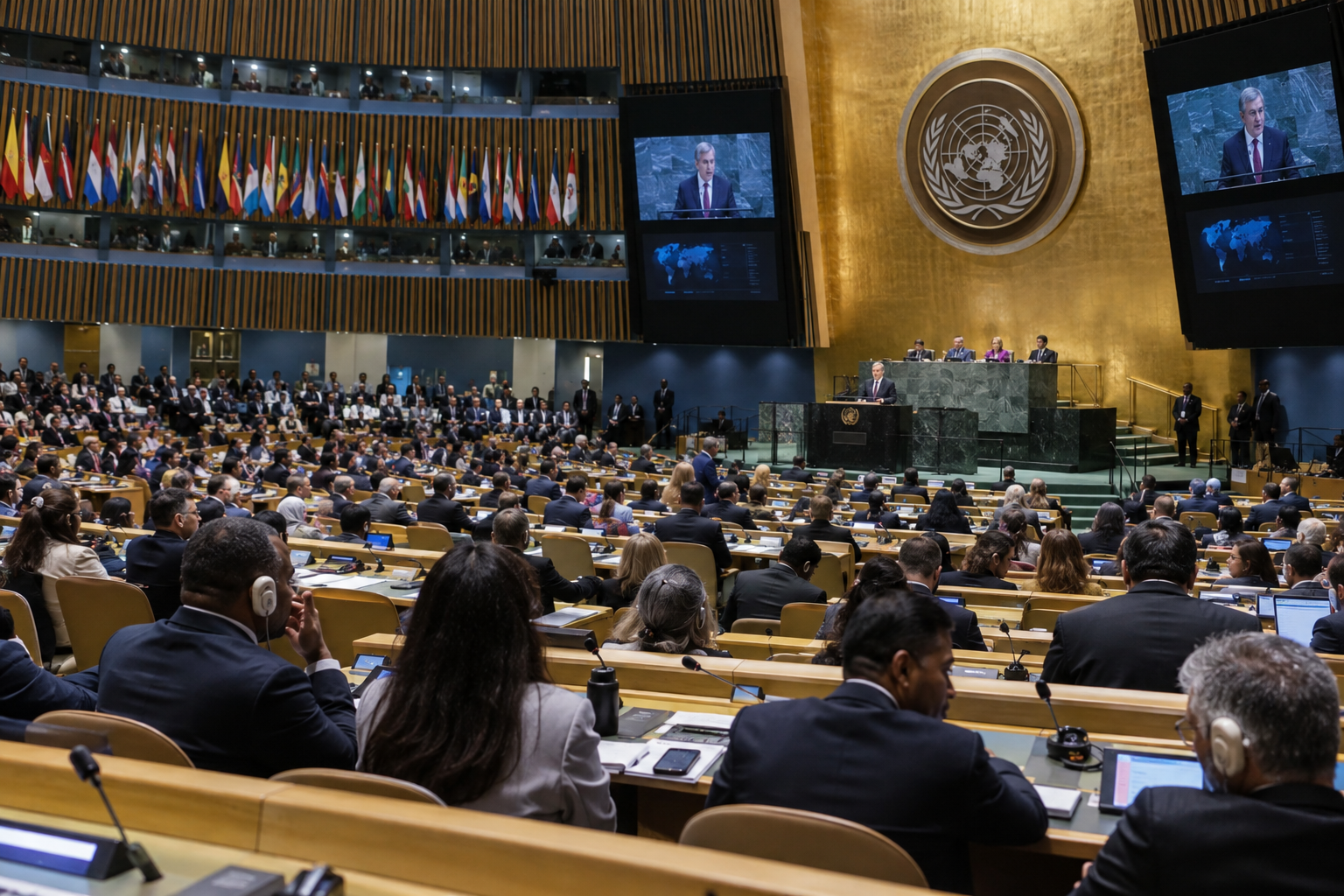
The first day of the UN General Assembly summit featured cooperation and confrontation, with US President Donald Trump dominating headlines through his remarks on Iran and opposition to global AI controls. The article highlights four other developments. First, numerous leaders condemned Israel over its actions in Gaza, settlement expansion and violence in the West Bank, and its operations in southern Lebanon. UN Secretary-General António Guterres warned that West Bank settlements were undermining peace, while Jordan’s King Abdullah II called for sanctions. French President Emmanuel Macron challenged claims that peace had been achieved in Gaza. Netanyahu’s office responded to the criticism with an apparently AI-generated video of parrots repeating “blame Israel.” Despite the speeches, the article says no immediate UN action appears likely, in part because Israel’s ally, the United States, has Security Council veto power.
Second, Australian Prime Minister Anthony Albanese continued advocating international safeguards for AI after Trump rejected what he called a “globalist scheme” and argued regulation would stifle growth. UK Prime Minister Andy Burnham said the industrial revolution brought suffering and exploitation and called for global AI standards. Albanese also helped launch a roadmap focused on risks to children, including chatbot safety, AI-generated sexual abuse material, deepfakes and AI literacy.
Third, Ukrainian President Volodymyr Zelenskyy told the Wall Street Journal he had asked Trump for a winter weapons package, including Patriot systems, and expected Trump to seek an energy ceasefire. The US is continuing earlier commitments to Ukraine but has asked NATO allies to fund new assistance.
Finally, Trump said Cuba was a failed state that “will fall,” while also saying Secretary of State Marco Rubio was negotiating with the Cuban government. Cuba’s delegation walked out during Trump’s remarks. President Miguel Díaz-Canel said Cuba would continue defending its sovereignty and working for peace.
Entities: United Nations General Assembly, Donald Trump, Israel-Gaza war, Benjamin Netanyahu, António Guterres • Tone: analytical • Sentiment: neutral • Intent: inform
23-09-2026
France, the United Kingdom and Canada voiced support for Palestinian statehood at the United Nations General Assembly, while French President Emmanuel Macron condemned Israel’s restrictions on aid to Gaza and called the lack of international action a “shame.” His remarks came as the article reported that Israeli forces had killed at least three Palestinians in Gaza City despite a U.S.-brokered ceasefire. It also cited a death toll of more than 73,900 Palestinians since the war began in October 2023, including 1,399 since the ceasefire took effect.
Macron said the ceasefire had not restored humanitarian routes and criticised Israel’s actions in the occupied West Bank. He warned that violating the sovereignty of neighbouring countries would ultimately weaken Israel’s security. Macron joined UK Prime Minister Andy Burnham, Canadian Prime Minister Mike Carney and Saudi Foreign Minister Prince Faisal bin Farhan Al Saud in chairing a UN meeting on Palestinian statehood.
Burnham warned that failing to pursue a two-state solution would further undermine public trust in political and diplomatic institutions. He cited the UK’s ban on trade with illegal Israeli settlements in the West Bank and described the E1 settlement project as an effort to obstruct a Palestinian state. The project would divide the occupied West Bank and separate it from East Jerusalem.
Carney announced 100 million Canadian dollars in aid for Palestinians, with 80 percent allocated to direct humanitarian assistance and the remainder to peace and security initiatives, including training Palestinian police. He acknowledged severe Palestinian suffering as well as security threats facing Israelis from Hamas, Iran and its allies. Canada also plans restrictions on goods made in settlements in occupied territory and has pledged more than 600 million Canadian dollars in aid to Palestinian civilians since the war began.
Entities: France, Emmanuel Macron, Gaza, Israel, United Nations General Assembly (UNGA) • Tone: analytical • Sentiment: negative • Intent: inform
23-09-2026
The liveblog reports diplomatic, political and humanitarian developments related to the US-Israel war on Iran and the wider conflict involving Palestinians. US President Donald Trump said American officials had a “very good” meeting with an Iranian delegation on the sidelines of the UN General Assembly. Earlier, he told the assembly Iran must choose between a deal and further military action, while predicting that an agreement could come after the US midterm elections. US Special Envoy Steve Witkoff also described lengthy talks with the Iranian delegation. Iran said it had conveyed conditions for ending the war on all fronts through Qatari mediation.
French President Emmanuel Macron said France was ready to become more engaged to help ensure transit through the Strait of Hormuz, a vital route amid an escalating energy crisis. He criticized the US decision to start the war and argued that regime change through bombing is not feasible. Oil prices edged lower, with Brent crude reported at $99.18 a barrel.
The liveblog also covered international support for a two-state solution. Canadian Prime Minister Mark Carney announced 100 million Canadian dollars in assistance for Palestinians, mostly for humanitarian aid, with some funding for peace and security initiatives, including training Palestinian police. The UK, France, Canada and Saudi Arabia were among those engaging at the UN on conditions for lasting peace. Angola’s president condemned violence, displacement and settlement expansion affecting Palestinians.
On the ground in the occupied West Bank, Israeli forces raided villages near Jerusalem and Ramallah and made arrests, while settlers reportedly vandalized property and burned a vehicle. The roundup also included criticism of Israeli Prime Minister Benjamin Netanyahu by US Senator Chris Van Hollen, who cited an arrest warrant related to alleged crimes in Gaza, and Senator Bernie Sanders’s condemnation of Trump’s threat to “annihilate” Iran. Sanders called the conflict illegal and unconstitutional and urged Congress to act to end it.
Entities: Donald Trump, Emmanuel Macron, Chris Van Hollen, Bernie Sanders, Mark Carney • Tone: analytical • Sentiment: neutral • Intent: inform
23-09-2026
The article reports that UK Prime Minister Andy Burnham used an address to the United Nations General Assembly to condemn what he described as Russian electoral interference. Burnham accused Russia of conducting information warfare and attempting to interfere in the 2019 UK election, calling the alleged interference “repulsive.” The report presents these claims as the central subject of his remarks; it does not provide further evidence, detail specific actions attributed to Russia, or include a response from the Russian government.
Burnham also announced the creation of a National Centre for Information Defence. According to the article, the centre is intended to counter hostile information attacks by state actors. The announcement frames the issue not only as a dispute over past election interference but also as a security challenge that the UK plans to address through a dedicated national institution.
The item is a brief Al Jazeera video-news report published on 23 September 2026. Its focus is limited to Burnham’s statements at the UN and the proposed centre. It does not describe the centre’s structure, powers, launch timeline, or specific measures, nor does it elaborate on how the alleged interference was carried out. Overall, the report informs readers of the prime minister’s accusation and policy announcement, while conveying the seriousness of the UK government’s stated concerns about foreign information operations and electoral integrity.
Entities: Andy Burnham, United Kingdom, Russia, United Nations General Assembly, 2019 election • Tone: analytical • Sentiment: negative • Intent: inform
23-09-2026
The supplied Al Jazeera Newsfeed item reports on remarks attributed to UK Prime Minister Andy Burnham during his address to the United Nations General Assembly. According to the description, Burnham condemned Israel’s military campaign in Gaza, characterizing it as a “genocidal war,” and said the United Kingdom would not “stand by” while Palestinians suffer. The item also connects continued Israeli military action to a UK policy response: sanctions imposed on Israeli settlements in Palestinian territory that the article describes as illegal. Its central focus is therefore the prime minister’s public condemnation of the war and the sanctions cited as a consequence of ongoing military action. The content provided is a short video-page description rather than a full transcript or extended news report. It does not give the exact wording of Burnham’s complete UN address, identify the specific settlements or sanctions, or provide reactions from Israel, Palestinians, or other governments. Accordingly, the article supports a concise account of the stated remarks and policy position, but not further conclusions about the sanctions’ scope, implementation, or broader diplomatic effects. The page is dated September 23, 2026. The headline frames the remarks as a refusal to remain passive in the face of Palestinian suffering, while the description emphasizes condemnation of the war and action targeting settlements. Overall, the item informs readers about the reported speech and associated UK measure, without supplying detailed background or multiple perspectives in the text provided.
Entities: Andy Burnham, United Kingdom, Israel, Gaza, Palestinians • Tone: neutral • Sentiment: negative • Intent: inform
23-09-2026
Britain plans to establish a National Centre for Information Defence to respond to disinformation and other hostile information operations, particularly those attributed to Russia and potentially amplified by artificial intelligence. Prime Minister Andy Burnham announced the initiative in a speech to the United Nations General Assembly on Sept 22, describing what he called an “industrial-scale assault” on the information environment in Britain and among its allies.
Burnham accused Russian agencies of spreading lies, exploiting public fears and interfering in British politics. He repeated allegations of Russian involvement in the 2019 general election and referred to suspected meddling in the 2016 Brexit referendum. The article notes that the previous Conservative government was criticised for not investigating the referendum allegations. Burnham also said Moscow had amplified far-right narratives and heightened tensions and unrest after horrific events.
The centre is intended to detect, attribute and disrupt hostile state information attacks. Defence Secretary Wes Streeting said that a public unable to distinguish fact from propaganda would pose a danger to democracy, and described plans to mobilise trusted voices across civil society. Burnham warned that AI could intensify both disinformation and cyberattacks as governments face growing pressure to regulate the technology.
Alongside the new centre, Burnham said Britain would take a leading role in developing global standards for AI. He also announced a defence partnership with the United States focused on detecting cyberattacks against critical infrastructure. The article places these measures in the context of approaching elections in Europe and the broader challenge governments face in protecting democratic debate, public trust and essential systems from information and cyber threats.
Entities: Andy Burnham, Wes Streeting, United Kingdom, Russia, United States (Washington) • Tone: analytical • Sentiment: neutral • Intent: inform
23-09-2026
Benjamin Netanyahu is due to address the UN General Assembly as Israel faces growing international criticism and approaches a general election. The article says a meeting with US President Donald Trump has not been scheduled, a notable setback for Netanyahu, who has long presented his access to American presidents as a political strength. Trump has already met with leaders from Gulf and Arab states, as well as the leaders of Ukraine, Britain and Japan, to discuss issues including the Iran war. The article highlights a contrast between earlier US-Israeli military coordination and Trump’s recent lack of public support for Israel during a discussion with British Prime Minister Andy Burnham about sanctions on settlements in the occupied West Bank.
Polling cited in the report points to declining US support for Israel’s government: a Pew Research Centre survey found that 62 per cent of US adults viewed it unfavourably in July, up from 43 per cent in 2022. A CNN poll also found that nearly two-thirds of Americans did not think the US was winning the Iran war. Meanwhile, Israeli officials have publicly criticised several foreign leaders, including British Foreign Secretary Ed Miliband, Austria’s President Alexander Van der Bellen, Jordan’s King Abdullah and French President Emmanuel Macron, over their remarks on Israel and the Palestinians.
The article describes criticism of Israel’s conduct in Gaza and the West Bank as another challenge for Netanyahu. It also notes reported plans by Trump’s Board of Peace to present a $2.45 billion Gaza recovery proposal, which Israeli leaders have increasingly opposed. Netanyahu is portrayed as relying on his experience at the UN, where his past speeches—especially on Iran—remain well known, to make Israel’s case amid what the article characterizes as unprecedented international isolation.
Entities: Benjamin Netanyahu, Donald Trump, United Nations General Assembly (UNGA), Israel, Palestinians • Tone: analytical • Sentiment: negative • Intent: analyze
23-09-2026
One year after France and 11 other Western countries recognised Palestinian statehood, Palestinian ambassador to France Hala Abou Hassira says the diplomatic step must not be dismissed, even as conditions in the occupied Palestinian territories worsen. Speaking to The National after French President Emmanuel Macron’s final address to the UN General Assembly, she argued that recognition should be followed by stronger pressure on Israel to end its occupation and negotiate peace. She called for political, economic and arms-related sanctions until Israel complies with international law.
Macron accused Israel of using Hamas as a pretext for violations in the West Bank, where, he said, Hamas has never operated in the same way as in Gaza. Israeli Prime Minister Benjamin Netanyahu rejected Macron’s remarks and cited the killing of French-Israeli settler Netanel Shukrun in a shooting attack. France described the killing as a terrorist attack; Israeli forces later raided the suspected attacker’s hometown, Biddu. The article also notes Hamas has an underground presence in the Fatah-run West Bank.
At the UN, Jordan’s King Abdullah II called the West Bank situation “extraordinarily dangerous” and criticised the international community’s reluctance to sanction Israel. The Israeli Foreign Ministry countered by accusing Jordan of having violated international law in 1988. The United States again denied visas to Palestinian leaders seeking to attend the General Assembly, saying the Palestinian Authority had not implemented reforms.
Abou Hassira said international speeches had accurately described the long-term abandonment of Palestinians and alleged that Israeli settlers’ violence is supported or protected by Israeli authorities. UN figures cited in the article record about 50 Israeli civilians and military personnel killed in the West Bank since 2023, compared with more than 1,100 Palestinians killed by Israeli forces or settlers. While France has joined Britain in banning trade with illegal settlements, Abou Hassira said broader restrictions on dealings with Israel’s settlement enterprise—and sanctions against Israel—are needed.
Entities: Hala Abou Hassira, Emmanuel Macron, Benjamin Netanyahu, King Abdullah II of Jordan, Netanel Shukrun • Tone: analytical • Sentiment: negative • Intent: inform