20-10-2026
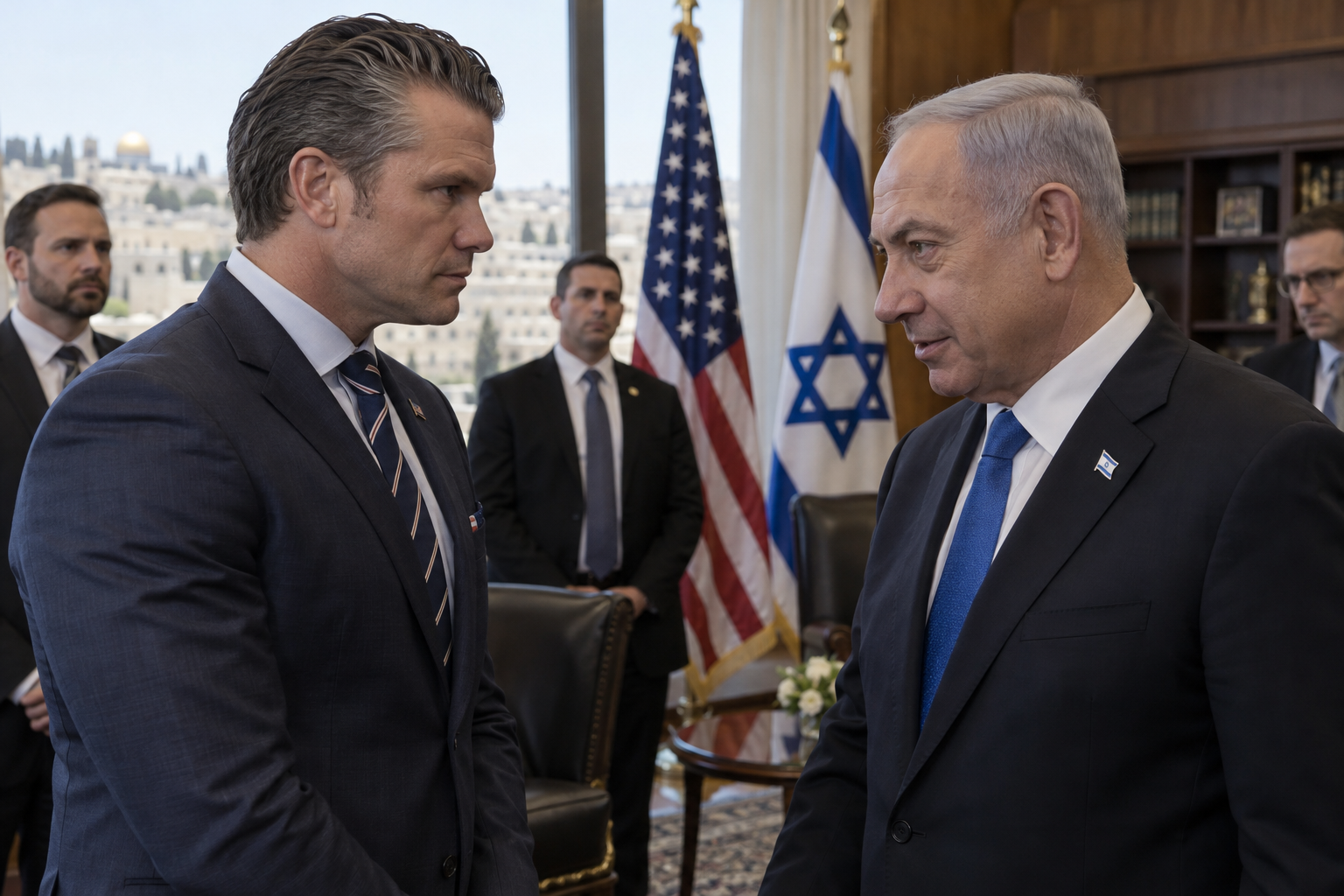
US Defense Secretary Pete Hegseth met Israeli Prime Minister Benjamin Netanyahu during an undisclosed visit to Israel, according to a report by Axios. The meeting reportedly took place on Monday. Axios cited two people familiar with the matter, while Reuters said it could not immediately confirm the visit. The Pentagon and Israel’s embassy in Washington did not respond immediately to requests for comment, and the article said there was no immediate information about what the two leaders discussed.
The reported visit came shortly before Israel’s parliamentary election, which the article describes as the first since the Hamas-led attacks of October 7, 2023, and the start of Israel’s military campaign in Gaza. US President Donald Trump endorsed Netanyahu on Truth Social on Sunday, praising him as an ally in the US war on Iran and declaring his “Complete and Total Endorsement.” Trump also wrote, “BIBI NETANYAHU WILL NEVER LET YOU DOWN!”
Opinion polls suggest Netanyahu’s religious-nationalist coalition could lose its governing majority, though opposition parties may also have difficulty forming a government. In contrast to Trump, US Vice President JD Vance declined to endorse Netanyahu when asked in an interview on Monday. Vance said he was not involving himself in Israeli elections and was focused on American candidates and the US midterm elections. The article also notes that Vance had endorsed Hungarian Prime Minister Viktor Orban during Hungarian elections earlier that year.
Entities: Pete Hegseth, Benjamin Netanyahu, Donald Trump, JD Vance, Viktor Orban • Tone: neutral • Sentiment: neutral • Intent: inform
20-10-2026
U.S. Defense Secretary Pete Hegseth made an unannounced visit to Israel on Monday and met with Prime Minister Benjamin Netanyahu, according to a senior U.S. military official and a separate Israeli source. Hegseth confirmed the visit to reporters the following day, saying he visited U.S. troops and spoke with Netanyahu, but declined to discuss the substance of their conversations. The Pentagon declined to comment, and CBS News requested comment from the Israeli government.
The visit took place shortly before elections in Israel and amid uncertainty over whether the United States might resume military action against Iran. President Donald Trump has said he is weighing either a deal with Iran’s leadership or a far more forceful response, with a decision potentially coming after the U.S. midterm elections. U.S. and Israeli forces conducted joint strikes against Iran in late February, while the United States previously struck three Iranian nuclear sites in June 2025. The two countries have largely avoided striking each other in recent weeks.
Netanyahu’s right-wing Likud-led coalition is seeking to stay in power against several more centrist challengers, including a party led by former Israel Defense Forces chief of staff Gadi Eisenkot. Netanyahu has said he does not plan to renew strikes against Iran before Israel’s Oct. 27 elections. Trump publicly endorsed him, praising him as a partner in confronting Iran.
The report also describes areas of friction and cooperation between the Trump administration and Netanyahu’s government. Washington has pressed Israel to reduce strikes in Lebanon, address settler violence in the West Bank, and reach a longer-term arrangement with Hamas in Gaza. Trump envoy Jared Kushner suggested that Israel’s election period may have slowed progress on Gaza.
Entities: Pete Hegseth, Benjamin Netanyahu, Donald Trump, Jared Kushner, Gadi Eisenkot • Tone: neutral • Sentiment: neutral • Intent: inform
20-10-2026
The live updates describe widening military and diplomatic developments connected to the war involving Iran. Iran’s foreign minister said Tehran’s relationship with Russia had never been closer, contradicting President Trump’s assertion that Moscow was doing little to help Iran. Russian Foreign Minister Sergey Lavrov, visiting Tehran for the first time since the war began, condemned U.S. and Israeli attacks as illegal and said his visit aimed to prevent a return to large-scale war. Israeli Prime Minister Benjamin Netanyahu was shown discussing with Trump the possibility of further joint strikes, while U.S. Defense Secretary Pete Hegseth made an unannounced visit to Israel.
Diplomatic efforts continue alongside the military escalation. Qatar says Iran and the United States remain engaged in negotiations, though it provided no details about recent direct contacts or whether talks are mediated. Qatari official Majed al-Ansari warned that unchecked escalation could spread the conflict beyond the region. Pakistan’s army chief Asim Munir, who has played a role in mediation, was expected in Tehran; Iranian officials described his discussions as focused mainly on bilateral ties and cooperation.
Iran’s military claimed it destroyed another U.S. MQ-9 Reaper drone and that sea mines struck two oil tankers attempting to cross the Strait of Hormuz without Iran’s permission. The report notes that these claims challenge U.S. assertions that the strait is open and cleared of mines. Separately, Yemen’s Houthis claimed responsibility for a missile strike on a government military training camp in Shabwa, where the reported death toll rose to 73. Saudi forces also said they intercepted a ballistic missile targeting Riyadh. In response to Houthi attacks, the United Kingdom announced defensive Royal Air Force patrols over Saudi Arabia, along with a transport plane and military advisers; it said British aircraft would not strike Houthi targets in Yemen.
Entities: Iran, Russia, United States, Donald Trump, Sergey Lavrov • Tone: analytical • Sentiment: negative • Intent: inform
20-10-2026
U.S. Vice President JD Vance declined to endorse Israeli Prime Minister Benjamin Netanyahu ahead of Israel’s election next week, despite President Donald Trump’s public support for Netanyahu’s reelection. In an interview with Mark Halperin on 2WAY Tonight, Vance said he endorses American candidates and is concentrating on the U.S. midterm elections. He characterized his position as neither opposing nor supporting Netanyahu and said he would not get involved in Israeli elections. Vance also praised Trump’s influence as an endorser, calling it historically effective.
Trump, by contrast, praised Netanyahu on Truth Social as a “Great Warrior Prime Minister” and a partner in efforts to counter Iran. Netanyahu thanked Trump for his support and their cooperation. Vance’s stance differs from his previous involvement in foreign politics: he traveled to Budapest in April to campaign for then-Prime Minister Viktor Orban, who was subsequently voted out after 16 years in power. Vance also met Alice Weidel, leader of Germany’s far-right Alternative for Germany party, during a security conference in Munich last year; Elon Musk was also promoting the party at the time.
The upcoming Israeli vote will be the country’s first national election since Hamas attacked Israel in late 2023. Vance’s remarks come amid a sharp decline in U.S. public support for Israel, which had historically been strong among both major parties, and vigorous debate in the United States over the Netanyahu government’s response to the Hamas attack. The article also notes that Vance said in June that Israel had almost no friends left in the world and should think carefully before turning against the one it had.
Entities: JD Vance, Benjamin Netanyahu, Donald Trump, United States midterm elections, Israeli national election • Tone: analytical • Sentiment: neutral • Intent: inform
20-10-2026
The supplied page capture is a live-news page whose headline says that US Defence Secretary Pete Hegseth made a surprise visit to Israel, while Israeli Prime Minister Benjamin Netanyahu told US President Donald Trump, “we have job to finish.” The capture does not include the article’s live-update reporting or any supporting details, so it is not possible to establish when the visit occurred, what the leaders discussed, or what “job” Netanyahu meant. The remaining editorial material consists of a list of related headlines, rather than full articles. Those headlines report that Pakistan’s army chief is expected to visit Tehran for Iran-US mediation efforts; that a Saudi-led coalition accused the Houthis of using traditional fishing boats to smuggle weapons; and that the United States is allowing “dark fleet” oil tankers to ship crude, according to an energy chief. Other listed developments include Egypt’s Parliament postponing a vote on Saudi military assistance, Saudi Arabia postponing an investment conference in Riyadh after Houthi attacks, and more than 50 recruits being killed in a Houthi attack on a military training centre in Yemen. These are presented as teasers, without further verification or context in the supplied text. The page is dated October 20, 2026, and its displayed update time is 5:04 a.m. Overall, the capture indicates a regional news agenda shaped by the Iran war, mediation efforts, Houthi attacks and allegations, and associated security and energy issues. It does not provide enough article text to assess the headline’s claims in depth or reconstruct the full live coverage. Website navigation, social-sharing controls, video links, print settings, and subscription prompts make up most of the rest of the captured content.
Entities: Pete Hegseth, Benjamin Netanyahu, Donald Trump, Israel, Iran war • Tone: urgent • Sentiment: negative • Intent: inform
20-10-2026
US Vice President JD Vance declined to endorse Israeli Prime Minister Benjamin Netanyahu’s re-election, saying he would focus on American candidates and the upcoming US midterm elections. His comments came one day after President Donald Trump publicly backed Netanyahu. In an interview with journalist Mark Halperin, Vance noted the influence of Trump’s endorsement but drew a boundary around his own involvement in Israeli politics while travelling to campaign for Republican Senate nominee Michael Whatley in North Carolina.
The article notes that Vance has previously supported a foreign politician: he travelled to Hungary last spring to campaign for then-prime minister Viktor Orban, whose party subsequently lost the parliamentary election. Vance’s decision not to echo Trump on Netanyahu comes amid heightened concern about antisemitism and continuing debate over US-Israel relations ahead of the American midterms. Republicans have portrayed some Democrats, including Michigan Senate nominee Abdul El-Sayed, as hostile to Jews and Israel, although divisions also exist within the Republican Party.
Vance has faced questions from Jewish Republicans about his support for Jewish Americans and the US alliance with Israel. At a recent Republican Jewish Coalition event in Las Vegas, he reportedly left a positive impression, but did not distance himself from conservative podcast host Tucker Carlson, who was criticized for interviewing antisemite Nick Fuentes.
The report also describes Vance’s criticism of aspects of Netanyahu’s government over the war with Iran. He criticized Israeli officials who opposed Trump’s efforts to resolve the conflict and later alleged that some officials were trying to influence American public opinion to prevent negotiations from ending the war. The article presents Vance’s refusal to endorse Netanyahu as a political distinction from Trump, set against tensions over Israel, antisemitism, and the Iran conflict.
Entities: JD Vance, Benjamin Netanyahu, Donald Trump, Mark Halperin, Michael Whatley • Tone: analytical • Sentiment: neutral • Intent: inform