20-10-2026
With Israel’s election one week away, opinion polls show no clear path to a parliamentary majority for either Prime Minister Benjamin Netanyahu’s bloc or the opposition led by Gadi Eisenkot. The average of three recent surveys from mainstream pollsters gives Eisenkot’s bloc 52 seats, one more than Netanyahu’s, while 17 seats remain unaligned. The result could therefore hinge on coalition negotiations, which may take months; failure to reach an agreement could lead to another election, as has occurred repeatedly in recent Israeli political history.
The polling picture is not uniform. Surveys from some right-wing news channels are more favourable to Netanyahu, with Channel 14 projecting a one-seat majority for his bloc, although it too shows his coalition losing support over recent weeks. Netanyahu’s political skill, the possibility of renewed fighting with Iran, and US President Donald Trump’s endorsement could all affect voters’ decisions and potentially help the incumbent.
The article identifies Arab parties as a possible route to victory for the opposition. Palestinian citizens make up about 20 per cent of Israel’s population, and polls suggest their turnout may rise significantly. Yet many opposition parties, including Eisenkot’s, have ruled out forming a government with parties that represent Palestinian citizens. An arrangement in which Arab parties support an opposition government from outside could be more feasible, but would carry political risks: the far right might denounce Eisenkot as a traitor, and some of his current partners could leave the bloc.
Against a backdrop of regional tension and a deeply divided electorate, the persistent polling stalemate is contributing to uncertainty about both the election result and what will follow it.
Entities: Benjamin Netanyahu, Gadi Eisenkot, Donald Trump, Israel, Jerusalem • Tone: analytical • Sentiment: neutral • Intent: analyze
20-10-2026
Israeli Prime Minister Benjamin Netanyahu has argued that Israel should prepare for the possibility of a future US president who is hostile toward the country. Speaking on Sunday, nine days before Israel’s October 27 election, he presented a security doctrine focused partly on strengthening relationships with other countries. His comments came hours before US President Donald Trump endorsed his re-election bid.
Netanyahu said Israel should make the most of the remaining years of Trump’s presidency while preparing for changes in US policy. He called for expanding Israel’s international alliances, naming India as an important partner and pointing to potential diplomatic openings in Latin America, including Brazil. He also said Israel should develop capabilities that make it valuable to other countries. Netanyahu has previously highlighted his relationship with Indian Prime Minister Narendra Modi and described India-Israel ties as “unique,” citing strong public support for Israel in India.
The article places Netanyahu’s remarks against concerns in Israel about declining support among US Democrats. Analysts have connected some of the strain to Netanyahu’s difficult relationships with Democratic presidents Barack Obama and Joe Biden. Netanyahu has portrayed his readiness to challenge US presidents as evidence that he will defend Israeli interests, a political stance analysts say has benefited him.
Gadi Eisenkot, Netanyahu’s main election challenger and a former Israel Defence Forces chief, sharply criticized the doctrine. He called it a political exercise lacking substance, arguing that it did not address the country’s security challenges while multiple war fronts remained open. Eisenkot said the presentation exposed a strategic vacuum and accused Netanyahu of using fear and political messaging to influence voters. The article thus presents the proposed alliance-building as both a response to uncertainty in US-Israel relations and a contested election message.
Entities: Benjamin Netanyahu, Narendra Modi, Donald Trump, Gadi Eisenkot, Barack Obama • Tone: analytical • Sentiment: neutral • Intent: inform
20-10-2026
The article examines an increase in Israelis considering emigration amid political upheaval, war and the approach of Israel’s October 27 legislative elections. It focuses on research by Itai Ater, an economist at Tel Aviv University, whose team reported that around 50,000 Israeli graduates have been leaving annually since 2023, with 150,000 having left by the time of the article. Many are highly paid doctors and engineers under 40. Ater argues the sharp rise began after the government’s judicial overhaul, rather than being driven mainly by economic conditions or public-service cuts. He warns that Israel’s economy depends heavily on skilled human capital and says political developments, wars and international academic boycotts are worsening the problem.
The article presents the experiences of Tamar*, a 32-year-old AI product manager who says she may leave with her husband and young son if Netanyahu’s governing coalition is re-elected. She describes exhaustion with the continuing wars, her husband’s more than 400 days of reserve duty, and what she sees as unequal military obligations for ultra-Orthodox Jews. Although her family has deep roots in Jerusalem and she loves Israel, she is exploring employment options in Europe and the United States. She fears raising her son in a country where, in her view, liberal values are being eroded and religious hardliners hold too much influence.
The report also depicts a society fractured by the trauma of Hamas’s October 7, 2023 attacks and the continuing dispute over the government’s handling of the hostage crisis. It recounts a controversy in which Channel 14 journalist Yinon Magal berated relatives of former hostages who had criticized Netanyahu. Overall, the article portrays skilled, liberal Israelis weighing departure not simply as a personal choice, but as a response to political division, security fears and concern about the country’s democratic direction.
Entities: Itai Ater, Benjamin Netanyahu, Tamar*, Itamar Ben-Gvir, Yinon Magal • Tone: analytical • Sentiment: negative • Intent: inform
20-10-2026
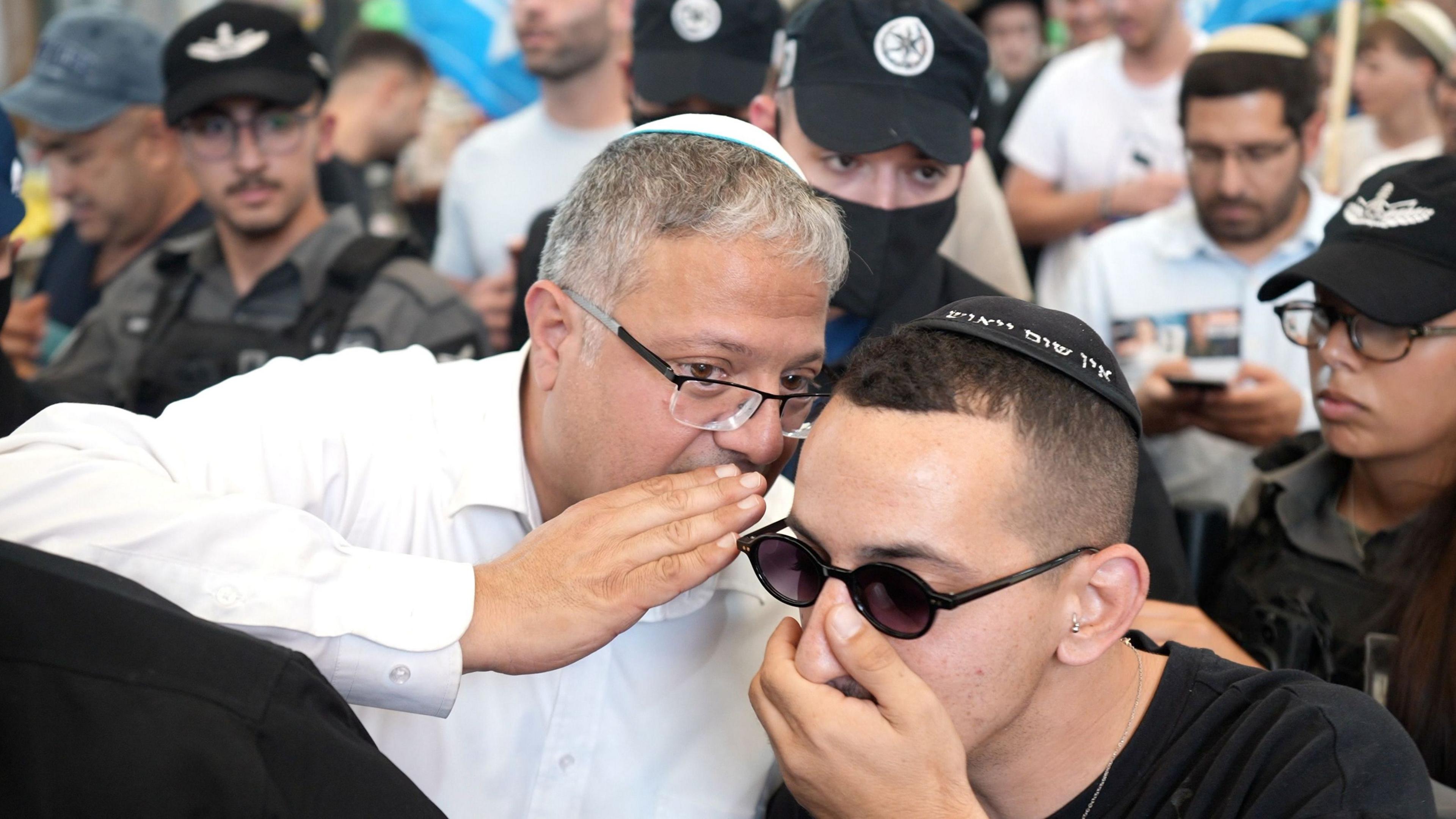
The article examines the growing appeal of far-right Israeli politician Itamar Ben-Gvir among first-time voters ahead of a closely contested general election. More than half a million young people are eligible to vote, and polls indicate that over 16% may support far-right parties, while nearly three-quarters identify as right or centre-right. Young supporters interviewed in Ramle say Ben-Gvir makes them feel secure and represents a stronger expression of Israeli identity. Some connect their political views to the Hamas-led 7 October 2023 attacks and the ensuing Gaza war, arguing that the events shaped their understanding of security and peace.
Ben-Gvir’s positions—including annexing the occupied West Bank, settling Gaza and encouraging Palestinians to leave—are strongly condemned by liberal Israelis. A Ramle shopkeeper says his rhetoric sows discord, while political analyst Dahlia Scheindlin says young Israeli Jews have been moving right for roughly two decades. She attributes this in part to growing up amid wars without personal experience of peace efforts, and to the normalization of more extreme political ideas in public debate.
The article also describes young voters’ relationship with politics and media. Surveys suggest they are motivated to vote but more sceptical of democratic institutions and less involved in protests or petitions. Opposition candidate Yonatan Shalev argues that Ben-Gvir gained an advantage by using TikTok and Instagram earlier than liberal politicians; opposition parties are now trying to reach younger voters through social media and younger candidates. The race remains divided between pro-government and anti-government blocs, and turnout among new voters could be decisive. The article concludes that young Israelis may be shifting right but remain divided, though the supplied text cuts off before completing its final thought.
Entities: Itamar Ben-Gvir, Bezalel Smotrich, Benjamin Netanyahu, Dahlia Scheindlin, Yonatan Shalev • Tone: analytical • Sentiment: neutral • Intent: inform