20-10-2026
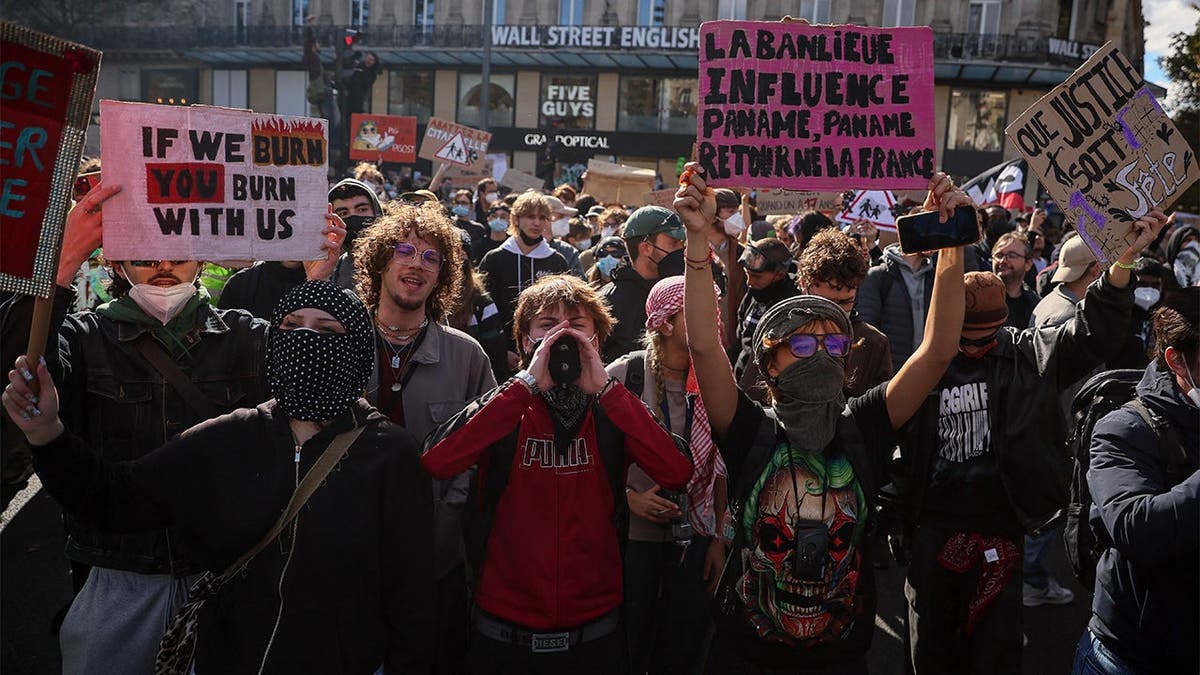
French authorities imposed local curfews and restricted gatherings on Monday after a weekend of nationwide protests escalated into riots, leaving historic buildings damaged, vehicles burned and more than 2,500 people arrested. Curfews were announced for parts of Paris, Nice and Lyon; Marseille banned large gatherings. The unrest began with high school students protesting poor school conditions, including overcrowded classrooms and teacher shortages, then broadened into demonstrations over the cost of living, wages failing to match inflation and declining public services. More than 500,000 people reportedly took to the streets on Saturday.
The violence caused extensive damage in several cities. Limoges’ historic 19th-century town hall was destroyed by fire, Lyon’s tourist office was set alight, and Marseille’s 17th-century city hall was vandalized. In Paris, residents awoke to debris and burned vehicles. Hundreds later gathered outside the Louvre in support of the student movement.
President Emmanuel Macron said those who sought to undermine the republic would be held accountable. Prime Minister Sébastien Lecornu blamed some of the violence on an alleged ultra-left movement seeking to create disorder ahead of the April presidential election. He said police had lost control during the unrest, urged localized curfews to protect businesses, and warned that the government could declare a national state of emergency if necessary. Lecornu also acknowledged that student concerns were legitimate, while arguing that violence was undermining the right to demonstrate. The U.S. State Department advised Americans to avoid protest areas. The article notes that French officials had not linked the unrest to immigration, despite former President Donald Trump making that claim on social media.
Entities: Emmanuel Macron, Sébastien Lecornu, Donald Trump, Paris, Marseille • Tone: urgent • Sentiment: negative • Intent: inform
20-10-2026
Damage from France’s weekend riots has reached at least 3,000 shops, double the number reported the previous day, but insurers have not yet estimated the total cost or the number of claims. France Assureurs says its members are mobilised to help policyholders. Carrefour had reported damage at 50 stores, including 20 looted, while its chief executive previously estimated industry losses in the hundreds of millions of euros. French shares, insurance stocks and government bonds fell or came under pressure as markets responded to the unrest.
The 2023 riots offer a comparison: insurers paid €793 million for about 17,000 claims, with two-thirds of insured losses involving shops and business premises. A Senate inquiry later put property damage closer to €1 billion, noting that some destruction was uninsured, undeclared or only partly covered. This weekend’s reported count of affected businesses already exceeds the roughly 2,500 vandalised businesses recorded during the 2023 unrest.
A new insurance scheme created by France’s 2026 budget law is intended to make riot cover compulsory in certain property policies and establish a national fund to help insurers meet major losses. It is not yet in effect, pending European Commission approval and a government decree. For now, compensation depends on existing contracts. Policies commonly cover physical damage such as fire, theft and vandalism, but compensation for lost trade generally requires optional business-interruption cover and usually applies only when insured physical damage forces a closure. Policyholders typically have five days to notify insurers, and some claims require a police complaint.
Prime Minister Sébastien Lecornu said affected businesses could use the state-funded furlough scheme and announced targeted curfews, with a state of emergency possible if needed. President Emmanuel Macron declined to accept Interior Minister Laurent Nuñez’s resignation as arrests passed 2,400. The eventual public cost remains uncertain, against a backdrop of a projected 5.4% budget deficit and public debt at 119% of GDP. The article concludes that the financial impact will extend beyond the directly attacked shops.
Entities: France, Piero Cingari, France Assureurs, Carrefour, Alexandre Bompard • Tone: analytical • Sentiment: negative • Intent: inform
20-10-2026
The article reports that French President Emmanuel Macron attributed part of the anger behind protests and riots in France to higher fuel and living costs, which he linked to the U.S.-Iran conflict and disruption to energy markets. In a televised address, Macron said France was not involved in the conflict but was suffering its consequences. He said he understood demonstrators’ concerns, described steps he had taken to secure fuel and gas, and announced a trip to Gulf countries to discuss the energy crisis. He also warned that people seeking to undermine the republic would be held accountable.
The report places Macron’s remarks alongside criticism from experts who question whether fuel prices adequately explain the scale and character of the unrest. Iran expert Lisa Daftari argued that Iran’s closure of the Strait of Hormuz contributed to expensive fuel, but said arson, looting and mass arrests point to organized lawlessness rather than an ordinary cost-of-living protest. The article says nearly 2,400 people were arrested in a single day. French Prime Minister Sébastien Lecornu blamed the ultra-left for orchestrating disorder ahead of the presidential election.
The story also includes comments from Barak Seener of the Henry Jackson Society, who links immigration and pro-Palestinian slogans to threats to Western civilization. Those claims are presented as his views, not as independently established facts. U.S. President Donald Trump criticized Macron’s border policies, saying he had warned the French leader that they would damage the country. The article thus frames the unrest as a dispute over its causes: economic hardship and energy shocks, versus domestic political movements, crime and migration. Its language and selection of critical commentators give the piece a strongly skeptical view of Macron’s explanation, while emphasizing the violence and political controversy surrounding the protests.
Entities: Emmanuel Macron, Donald Trump, Sébastien Lecornu, Lisa Daftari, Barak Seener • Tone: analytical • Sentiment: negative • Intent: analyze
20-10-2026
The article reports that curfews took effect in several French cities as police sought to contain rioting and looting during protests. The listed locations include parts of Paris, Bordeaux, Nice and Lyon. The protests were described as being driven by rising living costs and high school students’ demands for education funding, and had escalated into violent clashes. The article says law enforcement officers and protesters were wounded, public buildings were set ablaze and businesses were looted.
In Paris, authorities imposed a curfew around Place de la République and the streets near Les Halles, running from 11 p.m. Monday to 6 a.m. Tuesday. Interior Minister Laurent Nunez acknowledged that police had “lost control” of protests in several cities over the weekend. The article also reports that the Yellow Vest movement called for another round of protests on Saturday.
Prime Minister Sébastien Lecornu said that declaring a state of emergency had not been ruled out. The page presents itself as a liveblog, but the supplied text contains only a brief overview and a list of the previous day’s key developments; the remainder is unavailable. It does not provide further updates or detail the scale of the disturbances, the number of people injured, or what actions authorities took beyond the curfews.
Entities: Sébastien Lecornu, Laurent Nunez, France, Paris, Bordeaux • Tone: urgent • Sentiment: negative • Intent: inform
20-10-2026
Paris police imposed an overnight curfew on Monday in two central areas after a weekend of severe rioting across France. The restrictions cover the Place de la République, where violence occurred Saturday, and the Les Halles shopping district, which was looted. They run from 11 p.m. Monday to 6 a.m. Tuesday; demonstrations and gatherings are also prohibited from 8 p.m. Other local authorities introduced curfews for minors, including in Lille and Nice, while Marseille banned protests and gatherings for part of Monday.
The unrest followed nationwide protests over rising living costs and poor conditions in schools. Authorities reported at least 2,400 arrests and estimated that 3,000 businesses had been damaged or looted. Groups also targeted public buildings, and a fire severely damaged the 19th-century City Hall in Limoges. The violence recalled earlier unrest after a fatal police shooting in 2023 and during the yellow vest movement that began in 2018.
Prime Minister Sébastien Lecornu called for limited, localized curfews and defended the police response, noting that no one had been killed. Interior Minister Laurent Nuñez offered to resign, accepting responsibility for the events, but President Emmanuel Macron rejected the resignation. Macron called for transparency about failures in planning and intelligence-gathering and for new policing tactics. Nuñez acknowledged that authorities had lost control in some major cities and said police needed to adapt to highly mobile groups.
Shopkeepers described looting and criticized the police response. Ouri Zagoury, who owns a video game shop near Place de la République, said he watched looters enter his store on surveillance cameras after police told him not to intervene but did not arrive. Jordan Bardella, leader of the far-right National Rally, blamed the government and urged voters to use their electoral power. He is campaigning with Marine Le Pen, whose polling has made her a leading contender in the next presidential election.
Entities: Paris Police, Paris, Place de la République, Les Halles, Sébastien Lecornu • Tone: analytical • Sentiment: negative • Intent: inform
20-10-2026
France announced partial overnight curfews in four northern cities, including Lille, after weekend demonstrations over the cost of living escalated into severe violence and looting. The restrictions were set to run from 8 p.m. to 6 a.m. on Monday and Tuesday, with officials saying they were intended to protect businesses. Prime Minister Sebastien Lecornu said he was determined to restore public order and did not rule out declaring a state of emergency. Organisers were already calling for another round of protests the following Saturday.
The unrest prompted an admission of shortcomings from President Emmanuel Macron, despite the deployment of approximately 60,000 law-enforcement personnel on Saturday. Interior Minister Laurent Nunez offered to resign, saying the measures had not been proportionate to the scale of the participants and failed to contain rioters, looters and far-left activists. Macron declined to accept the resignation. More than 2,330 people were taken into police custody over the weekend, and officials said at least 3,000 shops were affected, with damage estimated in the hundreds of millions of euros.
The government also moved to address the online resale of looted property. Digital Minister Anne Le Henanff asked platforms to remove listings for stolen goods and summoned representatives of companies including Vinted and eBay; representatives of Amazon, Leboncoin, Meta and TikTok were also invited.
The demonstrations come six months before France is due to elect a successor to Macron. Similar protests over rising prices have occurred elsewhere in Europe, with clashes reported in Milan and Belgium and demonstrations continuing in Spain, Portugal and Albania. The European Union condemned the violence while stressing that peaceful protest must be protected. Germany updated its travel advice, warning that further demonstrations and outbreaks of violence could not be ruled out.
Entities: France, Sebastien Lecornu, Emmanuel Macron, Laurent Nunez, Anne Le Henanff • Tone: analytical • Sentiment: negative • Intent: inform