17-09-2026
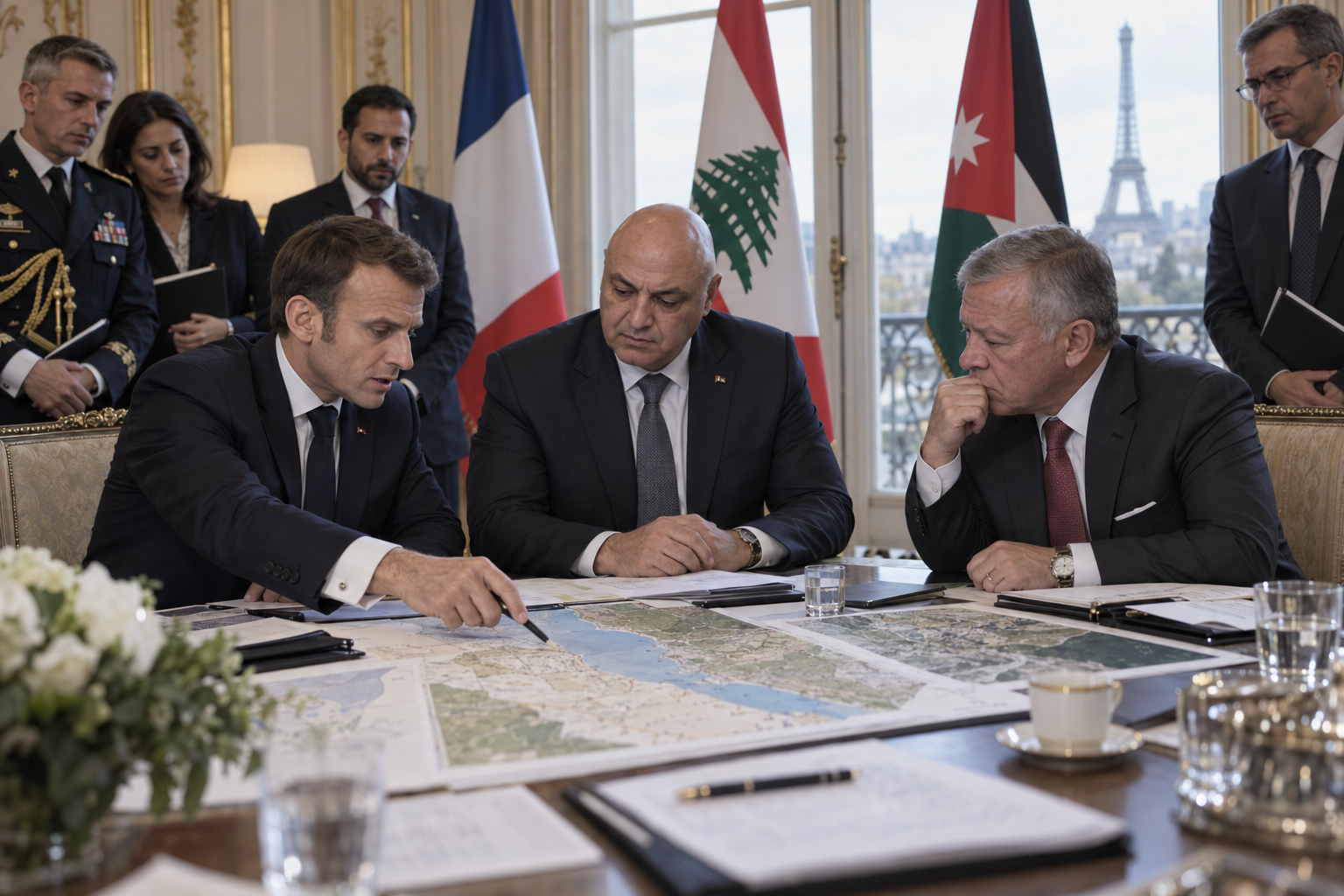
French President Emmanuel Macron is due to host Jordan’s King Abdullah II and Lebanese President Joseph Aoun in Paris to discuss international support for the Lebanese Armed Forces (LAF). The meeting, linked to Jordan’s Aqaba Process, will bring together officials and military experts from France, Britain, Jordan, Lebanon and the United States. Discussions will focus on the LAF’s possible deployment in southern Lebanon and the assistance it may need, including funding, equipment, intelligence and operational guidance.
The talks take place ahead of the planned end of the UN Interim Force in Lebanon (UNIFIL) mandate on 31 December 2026, followed by a year-long withdrawal. Lebanon is seeking to prevent a security vacuum, while France, Italy and several EU countries are exploring a new civilian and military coalition to support the Lebanese state. Aoun has said that any replacement force should be temporary and that extending UNIFIL’s mandate remains the best option.
The situation is complicated by continued hostilities between Israel and Hezbollah. Israeli strikes and military operations have displaced residents in southern Lebanon, while Hezbollah has continued attacks against northern Israel. Israel has linked a full withdrawal from Lebanon to Hezbollah’s disarmament, but Hezbollah has rejected such demands. Aoun nevertheless insists that Lebanon’s decision to establish a state monopoly on weapons is not negotiable.
The article also examines France’s historical and diplomatic role in Lebanon. Analyst Karim Émile Bitar argues that the LAF faces an exceptionally difficult mission because it lacks resources and must confront a powerful militia with significant political and community support. He says Lebanon’s territorial integrity, sovereignty and internal unity are all under pressure, while France’s exclusion from earlier ceasefire negotiations weakened Beirut’s position. Overall, the meeting is presented as an effort to build international backing for Lebanon while addressing the unresolved conflict with Israel and Hezbollah.
Entities: Emmanuel Macron, King Abdullah II of Jordan, Joseph Aoun, Lebanese Armed Forces (LAF), Lebanon • Tone: analytical • Sentiment: negative • Intent: inform
17-09-2026
This France 24 video report examines the planned withdrawal of the United Nations Interim Force in Lebanon (UNIFIL) and its central role in diplomatic talks in Paris. French President Emmanuel Macron is hosting Lebanese President Joseph Aoun and Jordanian King Abdullah II to discuss Lebanon’s security situation and international assistance for the Lebanese army.
The talks are taking place as France seeks to prevent a security vacuum before UNIFIL’s scheduled departure at the end of 2026. The peacekeeping mission’s withdrawal raises questions about who will assume responsibility for monitoring and securing Lebanon’s southern border. These concerns are heightened by continued Israeli strikes in southern Lebanon, which contribute to regional instability and create additional pressure on the Lebanese state and its armed forces.
France is presented as attempting to coordinate international support for Lebanon while addressing the possible security consequences of UNIFIL’s departure. The meeting also reflects the broader regional dimension of Lebanon’s security challenges, with Jordan participating alongside France and Lebanon. The report identifies support for the Lebanese army as a key part of the discussions, suggesting that strengthening national security institutions could help reduce the risks associated with the peacekeeping force’s withdrawal.
The supplied article is primarily a short video introduction rather than a full transcript. It establishes the diplomatic context, identifies the main participants, and highlights the key concern: preventing a dangerous gap in security along the Lebanese-Israeli border as UNIFIL prepares to leave. The report is presented by France 24 journalist Luke Shrago and was issued on September 17, 2026.
Entities: Lebanon, United Nations Interim Force in Lebanon (UNIFIL), Paris talks, Emmanuel Macron, Joseph Aoun • Tone: urgent • Sentiment: negative • Intent: inform
17-09-2026
Lebanese President Joseph Aoun visited Paris for talks with French President Emmanuel Macron and Jordan’s King Abdullah II on creating an international military and civilian mission to replace the UN Interim Force in Lebanon (Unifil), which is scheduled to withdraw from southern Lebanon later in 2026 after roughly five decades. France and Italy are leading efforts to establish the successor framework, with more than 10 European Union countries reportedly prepared to contribute personnel to advise and train the Lebanese Armed Forces.
The discussions took place under the Aqaba framework, a regional security initiative launched by King Abdullah in 2015. Army chiefs from Lebanon, Jordan, the United Kingdom and France were expected to participate in the wider military gathering in Paris. France and Jordan also signed a separate defence agreement during the visit, although details were not disclosed.
The future of southern Lebanon’s security is being discussed amid growing concern that a June ceasefire between Israel and Lebanon could collapse. The article says Israel has taken a harder position ahead of October elections, while US-brokered diplomatic negotiations involving Lebanon and Israel have stalled. A key issue is Israel’s continued occupation of parts of southern Lebanon and efforts to end what Beirut describes as Israeli aggression.
Unifil, based in an area where Hezbollah has significant influence, has monitored security breaches and supported the Lebanese Armed Forces. Israel has accused the mission of failing to disarm Hezbollah, although the article notes that Unifil’s mandate was limited. Lebanon’s relatively weak military and political authorities have historically resisted forcibly disarming Hezbollah because of the group’s military strength and role in Lebanon’s sectarian political system.
Aoun said Lebanon was open to any force capable of replacing Unifil in order to prevent a security “vacuum.” He also said Lebanon wanted a security agreement with Israel to formally end decades of hostilities dating to the 1948 Arab-Israeli War. Further discussions involving Israeli and US representatives are expected at the UN General Assembly in New York.
Entities: Joseph Aoun, Emmanuel Macron, King Abdullah II, Lebanon, France • Tone: analytical • Sentiment: neutral • Intent: inform