17-08-2026
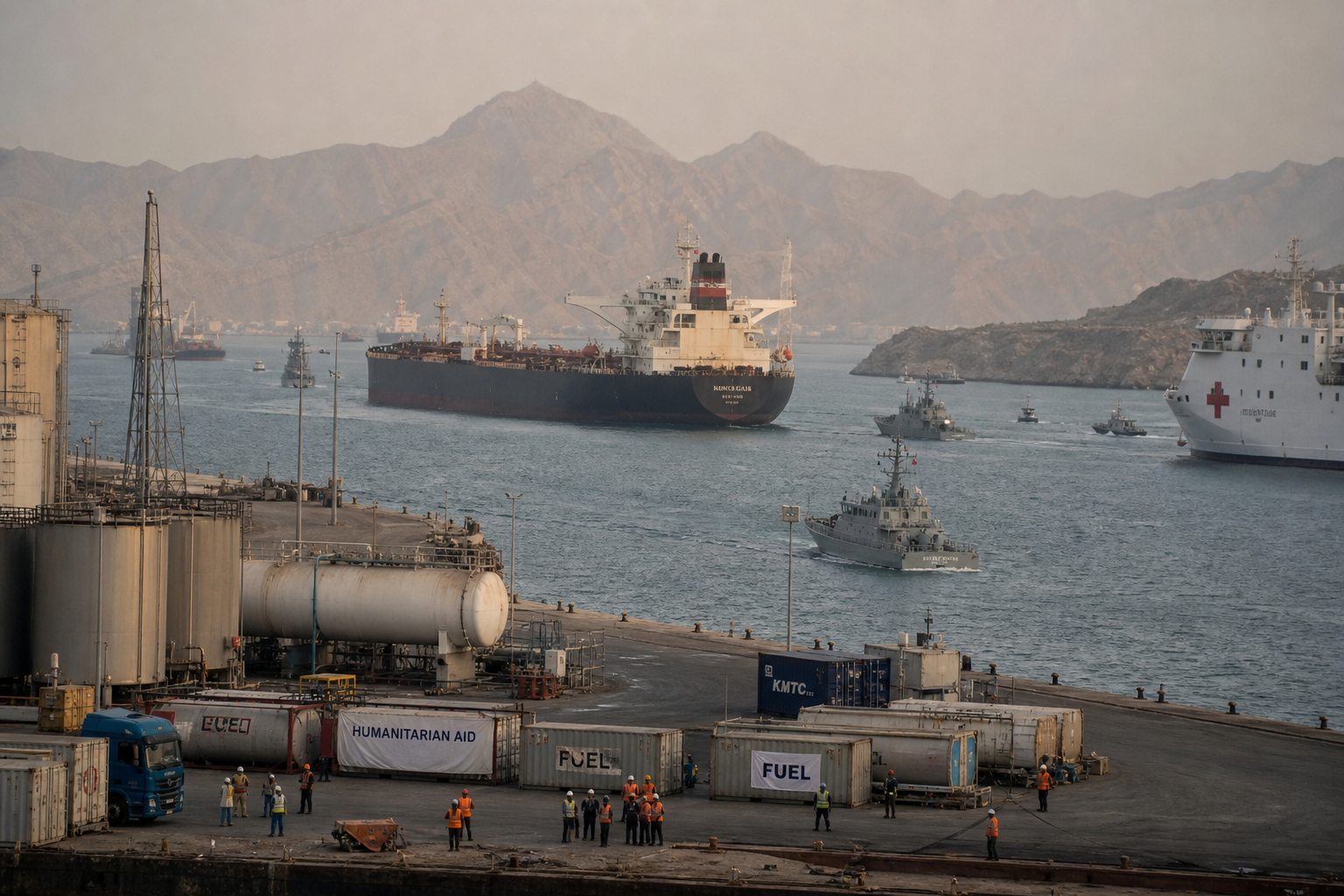
The Al Jazeera liveblog reports on the widening consequences of the US-Israel war on Iran, covering military, humanitarian, political and economic developments across the region. Yemen’s internationally recognised government says it carried out artillery and drone attacks against Iran-backed Houthi positions in al-Jawf and Marib, while the United Nations warns Yemen faces its greatest risk of returning to full-scale war since the 2022 truce. The update also references a Houthi attack that caused an explosion and fire at Yemen’s Mokha port.
In the occupied West Bank, Israeli forces reportedly detained nine Palestinians after settlers surrounded their family home near Nablus. Three other Palestinian families remain trapped in their homes in Qusra, where settlers have cut off supplies and Israeli forces have declared the area a closed military zone. A UNICEF convoy delivered food and medical supplies but was reportedly prevented from delivering water.
The liveblog highlights the humanitarian crisis in Gaza through a doctor’s account of amputating a five-year-old girl’s leg without anaesthesia. It also reports that Israel released 35 Palestinian prisoners into Gaza, amid allegations by rights groups of abuse in Israeli detention.
In the United States, 15 Democratic senators demanded answers from Defense Secretary Pete Hegseth about alleged poor conditions aboard the USS Abraham Lincoln, including food, sanitation, medical care and the ship’s indefinite deployment. Senator Chris Van Hollen separately criticised former President Donald Trump and Hegseth, arguing that the war was not making the United States safer.
Iranian officials defended Supreme Leader Mojtaba Khamenei’s appointment of senior military commanders, saying the changes would strengthen Iran’s wartime capabilities. Oil prices remained elevated after attacks on tankers and refineries, reflecting renewed geopolitical risk around the Strait of Hormuz. The headline also points to an expiring Tehran-US memorandum of understanding and a meeting between Hamas’s Khalil al-Hayya and Jared Kushner, though those developments are not covered in the supplied excerpt.
Entities: Tehran-US memorandum of understanding, Hamas, Khalil al-Hayya, Jared Kushner, US-Israel war on Iran • Tone: urgent • Sentiment: negative • Intent: inform
17-08-2026
CNBC’s Daily Open surveys geopolitical, economic and corporate developments dominated by the prolonged Middle East conflict and its wider consequences. The conflict, described in different parts of the article as being in its fifth or sixth month, is reportedly affecting the mental health and morale of U.S. service members aboard the USS Abraham Lincoln, which has been deployed in the region for more than eight months. U.S. Central Command acknowledged the challenges after reports that a sailor went overboard.
President Donald Trump has continued to make expansive claims about the conflict, including saying that the Strait of Hormuz could soon become U.S. territory. Iran rejected that claim, while negotiations concerning access to the strategically important waterway reportedly stalled. The article also warns that rapidly releasing oil from the U.S. Strategic Petroleum Reserve could damage the underground caverns used to store it, as inventories approach a four-decade low.
Diplomatic efforts related to Trump’s Gaza peace plan are also continuing, with U.S. envoys reportedly meeting Egyptian, Qatari and Turkish mediators in Cairo. Separately, Trump directed the Pentagon to reduce planned joint military exercises with South Korea, criticizing Seoul for allegedly declining to assist with efforts to denuclearize Iran.
In Asia, China’s State Taxation Administration is reportedly preparing training for local officials on taxing offshore trusts, following confusion among wealthy taxpayers. Investors are also awaiting Chinese retail sales and investment data. In markets, Anthropic’s revenue reportedly increased more than fourteenfold year over year in the second quarter ahead of a possible IPO, while Alphabet became Berkshire Hathaway’s third-largest equity holding after an estimated $7 billion share purchase. U.S. stock futures were little changed and Asian markets opened mixed.
The closing feature examines extreme heat in Champagne, where the harvest is expected to begin earlier than ever, threatening yields and the region’s signature fresh taste.
Entities: Donald Trump, Iran, Strait of Hormuz, USS Abraham Lincoln, U.S. Central Command • Tone: analytical • Sentiment: negative • Intent: inform
17-08-2026
The article reports that a 60-day US-Iran ceasefire deadline has expired without progress toward a lasting peace agreement, leaving a conflict that is nearly six months old unresolved. The main obstacle is control of the Strait of Hormuz, a vital waterway through which approximately one-fifth of the world’s oil and gas supply flows. US President Donald Trump has suggested that the United States could claim control of the strait, while Iran insists that it is and will remain Iranian territory.
The interim agreement, a 14-point memorandum of understanding signed in Islamabad on June 17, was intended to halt the war, reopen the strait and create time for negotiations on a longer-term nuclear agreement. However, the two sides developed conflicting interpretations of the deal. Iran does not believe the 60-day period ever began and therefore has not engaged in discussions about extending it. Disputes over implementation and the strait quickly overshadowed the nuclear issue.
The stalemate has significant political and economic consequences for Mr Trump. The war has disrupted energy markets, increased the cost of fuel and food, and weakened his campaign promise to deliver lower energy prices. It has also become unpopular among Americans, giving Democratic opponents an issue ahead of the November midterm elections. Iran’s economy has been damaged by a US blockade that has sharply reduced its crude oil exports, but the military campaign has not forced Tehran to surrender.
The conflict is further complicated by Israel’s fighting with Hezbollah in Lebanon. Iran wanted Lebanon included in the agreement and argues that Israeli strikes there violate the interim deal. With no diplomatic breakthrough, the Trump administration is preparing additional economic measures against Iran, while the overall US-Iran stalemate appears likely to continue.
Entities: Donald Trump, Iran, United States, Strait of Hormuz, US-Iran 60-day ceasefire agreement • Tone: analytical • Sentiment: negative • Intent: analyze