17-08-2026
A shallow magnitude 7.7 earthquake struck Indonesia’s island of Flores shortly before 05:00 local time on Saturday, killing at least 53 people and displacing roughly 5,000 others. The earthquake occurred about 15km below the surface and was followed by 341 aftershocks. Indonesia’s National Disaster Management Agency (BNPB) reported that more than 900 homes and hundreds of other buildings were severely damaged, although officials warned that the full scale of the destruction remains unclear because the affected area is remote and mountainous.
Manggarai province recorded 25 deaths, while 20 people died in East Manggarai, four in Sikka, two in Ende, and at least one person each in Nagekeo and West Manggarai. More than 3,300 people were displaced in Sikka and over 2,000 were evacuated in Manggarai. Thirty-six people suffered serious injuries and 77 had minor injuries in East Nusa Tenggara.
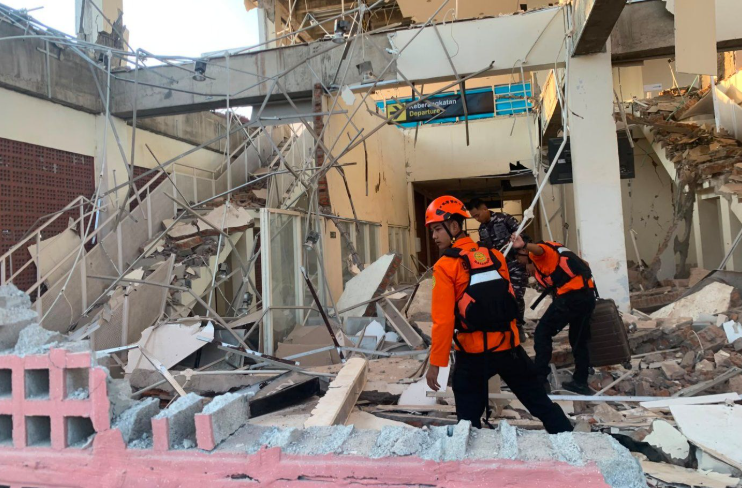
Schools, healthcare facilities and government offices were among the damaged structures. At Ruteng Regional Hospital, ceilings collapsed in the operating theatre and clinics, forcing staff to treat patients in tents. Officials said emergency supplies were being sent to Manggarai, but hospital staff reported that medical assistance had not yet arrived. At Maumere port, falling concrete and the collapse of a ferry gangway injured or endangered passengers, with some people thrown into the sea.
A tsunami warning prompted about 2,000 people to evacuate, but it was lifted after no significant rise in sea levels was detected. Landslides blocked access to some villages, complicating rescue efforts. Authorities advised residents to remain calm, avoid coastal areas and stay away from damaged structures. The disaster is Indonesia’s deadliest earthquake since 2022 and highlights the country’s vulnerability to earthquakes and volcanic activity because it lies along the meeting point of three major tectonic plates.
Entities: Indonesia, Flores island, Magnitude 7.7 earthquake, National Disaster Management Agency (BNPB), East Nusa Tenggara • Tone: urgent • Sentiment: negative • Intent: inform
17-08-2026
A magnitude-7.7 earthquake struck eastern Indonesia on Saturday, killing at least 53 people and injuring more than 130, many of them with broken bones. Approximately 5,000 people have been evacuated, including more than 3,300 residents in the Sikka region who either fled their homes or gathered in a sports arena. The earthquake blocked roads, triggered landslides, damaged buildings and caused widespread fear of further tremors.
More than 3,500 military and police personnel have been deployed to clear debris and search for people who may remain trapped in the worst-hit areas of Manggarai, East Manggarai and Nagekeo. Officials said landslides and continuing aftershocks were complicating rescue efforts, although no missing-person reports had been received. Nearly 1,000 aftershocks were recorded after the main earthquake.
Residents in Sikka and nearby communities have been sleeping outdoors or in makeshift tents because they are afraid to return indoors. In Maumere, a port damaged by the quake, residents gathered at evacuation centres while patients were treated in temporary facilities. Survivors described fleeing as tides rose and recalled earlier destructive earthquakes, including a magnitude-7.5 quake in 1992.
The East Nusa Tenggara government declared an emergency, allowing authorities to mobilize additional resources and funding. Electricity service was nearly restored, though repairs to distribution lines continued. Experts attributed the region’s seismic risk to the Flores back-arc thrust fault and Indonesia’s position along the Pacific Ring of Fire. The earthquake was described as Indonesia’s deadliest since a 2022 quake in West Java killed hundreds.
Entities: Magnitude-7.7 eastern Indonesia earthquake, Indonesia, East Nusa Tenggara province, Sikka, Maumere • Tone: urgent • Sentiment: negative • Intent: inform
17-08-2026
A magnitude 7.7 earthquake struck eastern Indonesia’s Flores region at 5:58 a.m. local time Saturday, followed shortly by a magnitude 6.4 earthquake on Sumatra. The disaster killed at least 53 people and injured more than 130, while officials warned that the death toll could rise as rescuers reach remote communities. Nearly 1,000 aftershocks were recorded, including one measuring magnitude 6.2, although only 46 were felt by residents.
The earthquake’s epicenter was located about 42 miles north-northwest of Ende in East Nusa Tenggara province. A tsunami warning prompted coastal residents to evacuate to higher ground, but the alert was later lifted after authorities detected no significant changes in sea levels. More than 900 homes were destroyed and another 450 damaged, displacing approximately 5,000 people into temporary shelters. More than 100 public facilities, including schools, medical centers and churches, were also damaged.
Rescue efforts have been complicated by power outages, communication disruptions and landslides that blocked the Trans-Flores highway and isolated villages across six regencies. Hospitals evacuated patients and moved medical equipment outdoors as a precaution. Indonesia’s National Disaster Management Agency deployed a helicopter to support logistics and possible evacuations, particularly because East Nusa Tenggara’s island geography makes transportation difficult.
Residents described intense shaking and widespread damage inside homes. Officials said landslides may have buried or cut off additional communities, raising fears that more casualties will be discovered. The earthquake occurred in Indonesia’s seismically active “Ring of Fire,” a region with a history of destructive earthquakes and tsunamis, including deadly disasters on Flores in 1992, in Indonesia in 2018 and off Sumatra in 2004.
Entities: Indonesia, Flores Island, East Nusa Tenggara province, Ende, Sikka • Tone: urgent • Sentiment: negative • Intent: inform
17-08-2026
A magnitude 7.7 earthquake struck off Indonesia’s Flores region early Saturday, August 15, 2026, killing at least 38 people, damaging homes and other buildings, and causing widespread panic. The U.S. Geological Survey said the shallow earthquake occurred at 5:58 a.m. local time at a depth of 10 kilometres, with its epicentre 68 kilometres north-northwest of Ende in East Nusa Tenggara province. Several aftershocks followed.
Authorities initially issued a tsunami warning for parts of East Nusa Tenggara, West Nusa Tenggara, South Sulawesi and Southeast Sulawesi. Residents were advised to move to higher ground and stay away from beaches and riverbanks. The warning was later cancelled after Indonesia’s Meteorology, Climatology and Geophysics Agency found no significant changes in sea levels.
The earthquake was felt across Flores Island and reportedly caused heavy damage in several communities. Hospital patients were evacuated as a precaution, while medical staff moved beds, oxygen cylinders and other equipment outdoors and established temporary treatment areas. In Maumere, a port-terminal waiting room reportedly collapsed. At St. Peter Major Seminary in Sikka, students and nuns fled after part of an assembly hall roof collapsed; the rector said at least one priest broke his leg after jumping from a second-floor building.
The article cites preliminary reports from the Maumere Search and Rescue Agency that two people had been killed and two injured, while the headline and opening report a death toll of at least 38, indicating that casualty figures were developing. Indonesia is highly vulnerable to earthquakes and tsunamis because it lies on the Pacific Ring of Fire. The article also recalls destructive earthquakes and tsunamis in Flores in 1992 and in Sulawesi in 2018.
Entities: Magnitude 7.7 earthquake, Flores Island, Ende, East Nusa Tenggara, Maumere • Tone: urgent • Sentiment: negative • Intent: inform
17-08-2026
A magnitude 5.7 earthquake struck north-northwest of Ende, Indonesia, on Monday morning, according to the US Geological Survey (USGS). The tremor occurred at a depth of 35 kilometers, and authorities reported no immediate casualties or property damage. It followed a much stronger magnitude 7.7 earthquake that struck eastern Indonesia days earlier and generated multiple aftershocks.
The earlier earthquake caused extensive destruction and a rising death toll. Rescue teams recovered six additional bodies on Sunday, bringing the reported number of fatalities to 53, although an earlier account had placed the toll above 35. Thousands of residents remained outdoors because of fears that further aftershocks could cause additional collapses.
Search-and-rescue teams continued working through debris and landslides across six regencies on Flores, a predominantly Catholic island in Indonesia’s Muslim-majority nation. Operations were concentrated in Manggarai, East Manggarai and Nagekeo, where access remained difficult and Manggarai was among the worst-affected areas. Fathur Rahman, head of the search-and-rescue office in Maumere, said most landslides had been cleared and roads to previously isolated villages reopened, but communication failures and power outages continued to hinder the response.
The disaster destroyed more than 900 homes and damaged another 450 in East Nusa Tenggara province, forcing approximately 5,000 people into temporary shelters. At least 241 homes were damaged in the Flores region alone. The magnitude 7.7 earthquake occurred shortly before 6 a.m. at a depth of 10 kilometers, prompting residents to flee after tsunami warnings were issued. Those warnings were subsequently lifted.
Entities: Indonesia, Ende, Flores, East Nusa Tenggara province, Sikka regency and Maumere • Tone: urgent • Sentiment: negative • Intent: inform