16-10-2026
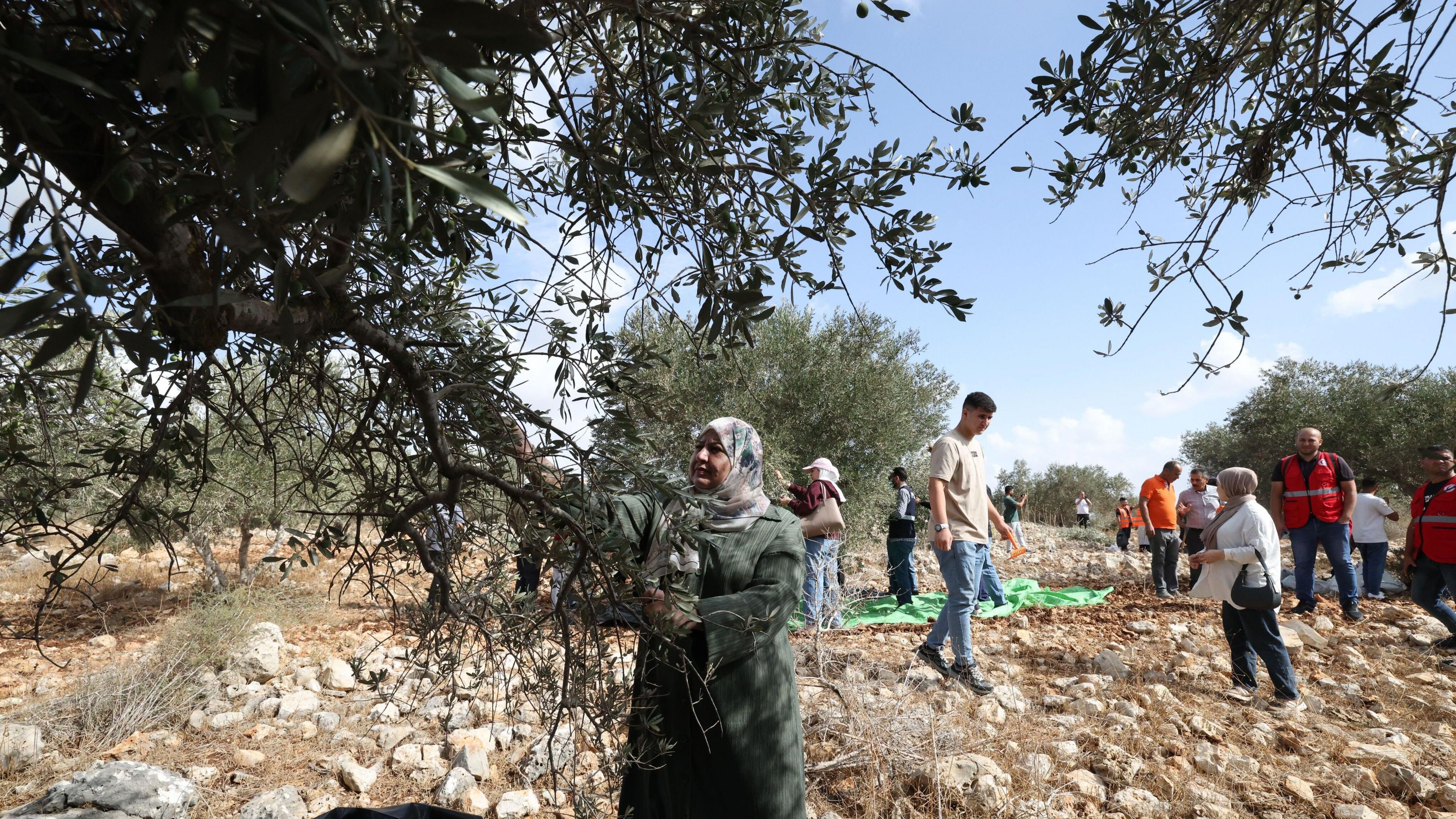
The article reports that masked Israeli settlers attacked Palestinians harvesting olives in Abu Falah, an occupied West Bank village, amid a wider increase in settler violence. About 80 settlers armed with clubs confronted the pickers, some using slingshots, while Palestinians responded by throwing rocks. Israeli military jeeps arrived, but the violence continued; soldiers fired tear gas toward the Palestinians. An independent journalist, Jasper Nathaniel, said additional settlers carrying machine guns arrived, and Reuters reported hearing live gunfire and seeing at least one armed settler fire a weapon.
Washington Post photographer Heidi Levine was knocked to the ground during the attack. Nathaniel described people beating and kicking her, striking her with clubs, and robbing her. Levine later said her helmet and flak jacket may have saved her life. The article places the incident in the context of increasingly frequent attacks on Palestinians and damage to olive trees during the harvest, an important source of income for Palestinian communities. It says the violence has intensified alongside government encouragement of settlement expansion on Palestinian land.
The article also cites Amnesty International, which said Israel had signed at least 15 land confiscation orders last month covering about 200 dunams (20 hectares) in Jenin, apparently to connect two planned settlements. The conflict-monitoring organization ACLED has reported that settler violence in the West Bank has reached record levels. The article concludes by noting that Israel’s expansionist policies and rising violence have drawn increased scrutiny. The UK and France have announced sanctions targeting purchases of goods from illegal settlements, a shift from the verbal criticism Western countries had previously relied on.
Entities: Abu Falah, Occupied West Bank, Jenin, Israeli settlers, Palestinian olive harvest • Tone: analytical • Sentiment: negative • Intent: inform
16-10-2026
Israeli settlers attacked Palestinian olive pickers in Abu Falah, northeast of Ramallah, on October 16, setting olive trees ablaze and beating farmers. Veteran photojournalist Heidi Levine, 64, who was documenting the harvest for The Washington Post, was also assaulted despite wearing a vest marked “PRESS.” Witnesses said she was knocked down, repeatedly kicked and beaten, and robbed of her cameras and phone. She was taken to a hospital in Ramallah with multiple injuries. An eyewitness said settlers attacked again as people tried to help Levine reach paramedics.
Witnesses and the Palestinian news agency Wafa reported that Israeli soldiers arrived after the settler assault, fired live ammunition and tear gas, and shot a Palestinian man in the thigh. Eyewitness Jasper Nathaniel said soldiers did not stop the settlers and also threatened or shoved people assisting the injured. The Washington Post’s executive editor called the attack on Levine unwarranted and urged a thorough investigation.
Further attacks on olive pickers were reported in Burqa, where four Palestinians were injured, and in nearby Turmus Aya, where settlers assaulted farmers and burned vehicles and olive trees. The article also cites the October 7 killing of Ali Hassan Yasser al-Bazzari during an olive-harvest assault near Burqa, and an October 6 beating of AFP photographer Jaafar Ashtiyeh near Aqraba.
The violence has intensified during the seasonal olive harvest. Israeli rights group Yesh Din recorded at least 170 settler pogroms since September 27, according to Reuters. The attacks damage livelihoods through assaults, destruction of trees, and theft of crops. Al Jazeera correspondent Tareq Abu Azzoum said intimidation has also affected homes and vehicles, contributing to pressure on Palestinian communities to leave areas that may later be used for Israeli settlements.
Entities: Heidi Levine, Jasper Nathaniel, Matt Murray, Tareq Abu Azzoum, The Washington Post • Tone: analytical • Sentiment: negative • Intent: inform
16-10-2026
During the West Bank olive harvest, masked Israeli settlers attacked Palestinian farmers near Abu Falah, injuring 12 people, according to a local official. Those hurt included four Palestinian-American citizens and American journalist Heidi Levine of The Washington Post. The BBC team witnessed farmers fleeing the area, with injured people being driven to hospital and fires burning nearby. Residents said settlers used guns, stones and sticks, damaged cars, and set fire to olive trees. Majdi Fheed, an American citizen, reportedly suffered deep head wounds, and his elderly mother was also injured.
The article describes how fear of attacks has changed the harvest: farmers pick olives quickly and gather in larger groups for protection. Landowner Amin Khalil said three villages joined together because isolated workers are more vulnerable, though his land is surrounded by seven Israeli settlements and outposts. The BBC witnessed settlers moving down a hillside, setting trees alight and throwing stones with slingshots; Palestinian youths threw stones in return. Israeli forces arrived, and the confrontation escalated. Palestinians retreated as live ammunition was heard, though it was unclear who fired. Israeli forces then used tear gas.
Levine said settlers knocked her down and kicked her while she tried to protect her camera and bag. The Washington Post called for a thorough investigation. The US State Department condemned criminal violence by any party and called for investigations and prosecutions. Israeli officials said the incident was under examination, while the prime minister’s office said the facts were unclear. The UN reported that settler attacks during this year’s harvest had killed one Palestinian and injured more than 120 across the West Bank, already exceeding the number of attacks recorded over the whole previous harvest season. The article presents the violence as part of a broader pattern linked to the growth of settler outposts and increasing pressure on Palestinians and their land.
Entities: Abu Falah, West Bank, Lucy Williamson, Majdi Fheed, Yaser AlKam • Tone: analytical • Sentiment: negative • Intent: inform
16-10-2026
Several Palestinians and Heidi Levine, an American photojournalist working for The Washington Post, were injured when masked men attacked Palestinians harvesting olives near Abu Falah in the occupied West Bank, according to video footage, eyewitnesses and Palestinian authorities. Videos showed roughly 20 masked men moving from an Israeli settlement outpost into an olive grove. Footage also showed vehicles on fire, a Palestinian man with a bloodied face, and masked men pushing Levine to the ground, beating her and taking her camera equipment. Levine said she was repeatedly kicked and credited her flak jacket and helmet with protecting her. The Washington Post said she was also robbed of her cameras and phone despite wearing clothing marked “PRESS.” She received treatment at a hospital in Ramallah.
Israeli police and military authorities said they were investigating. Prime Minister Benjamin Netanyahu’s office condemned the violence but said the facts remained unclear, citing footage it said showed people on both sides throwing objects and other footage that appeared to show Levine being helped to her feet. The Israeli military said it used riot-control measures, fired warning shots and shot toward a suspect it said ran at soldiers with a sharp object. The U.S. Embassy condemned criminal violence by any party and called for investigations, arrests and convictions. The Binyamin Regional Council, which is responsible for settlements in the area, alleged that Palestinian Authority activists had deliberately provoked residents.
The Palestine Red Crescent Society reported treating three Palestinians injured near Abu Falah, including a man reportedly shot in the thigh. WAFA also reported clashes and injuries near Burqa and Turmus Ayya. The article places the incident amid a broader increase in attacks on Palestinians, citing United Nations data and Yesh Din’s account of 486 violent incidents across 181 Palestinian localities in an 18-day period, 234 associated with the olive harvest. It notes criticism that Israeli authorities have not done enough to stop or prosecute settler violence, and recalls a separate attack on journalists in August.
Entities: Heidi Levine, The Washington Post, Abu Falah, Ramallah, West Bank • Tone: analytical • Sentiment: negative • Intent: inform
16-10-2026
Washington Post photojournalist Heidi Levine, a US citizen, was injured Friday while reporting near Abu Falah, northeast of Ramallah, in the occupied West Bank. The newspaper said dozens of masked Israeli settlers attacked Palestinian villagers who were gathering the autumn olive harvest, and that Levine was attacked during the confrontation. Levine said she was pushed to the ground and repeatedly kicked. She credited her flak jacket and helmet with protecting her and was reported to be in stable condition after receiving medical care. The Post said she was clearly marked as a journalist. Its executive editor, Matt Murray, condemned the attack and called for a thorough investigation.
Blogger Andrey Khrzhanovskiy, who filmed the incident, told the Post that settlers beat Levine with sticks while journalists and villagers were pushed back. The office of Israeli Prime Minister Benjamin Netanyahu said the facts remained unclear and were under investigation. Its statement described reports of a confrontation between about 200 Arabs and left-wing activists and roughly 40 Israeli youths, and said footage showed people from both sides throwing objects. It also said video appeared to show Levine being knocked down and then helped up by an unidentified person. The Israel Defense Forces said its troops and Border Police attended, used riot-dispersal measures, and would examine the incident; it condemned the violence.
The US condemned criminal violence by any party in the West Bank and supported investigations and legal accountability. A State Department official said the department had offered consular assistance to the Post. Democratic Senator Chris Coons called the attack appalling and urged swift justice, saying settler violence threatens regional peace and worsens an already dangerous situation.
The Foreign Press Association said Levine’s passport, phone, wallet and equipment were stolen, and described the assault as part of a broader pattern of violence against journalists and civilians. Reporters Without Borders also condemned the attack and called for the perpetrators to be prosecuted, criticizing what it characterized as impunity for extremist settlers.
Entities: Heidi Levine, Washington Post, Abu Falah, Ramallah, occupied West Bank • Tone: neutral • Sentiment: negative • Intent: inform
16-10-2026
Masked Israeli settlers attacked Palestinians harvesting olives in the occupied West Bank on Friday, injuring several people, including Heidi Levine, an American photojournalist working for The Washington Post. Levine said she was wearing a vest marked “press” when at least 50 masked men approached and beat her, kicking her after she was knocked to the ground. The attackers also stole her cameras and phone. She was taken by ambulance to a hospital in Ramallah for treatment.
The Washington Post condemned the assault and called for a thorough investigation. Israeli police said they would investigate and seek to bring those responsible to justice. The office of Prime Minister Benjamin Netanyahu said the facts remained unclear and were under investigation; the Post’s executive editor, Matt Murray, responded that Levine’s press identification and the fact that she was beaten were not in dispute. The U.S. State Department said it had contacted the newspaper to offer consular assistance and condemned criminal violence in the West Bank, without specifically mentioning Levine’s assault.
The Palestinian Red Crescent Society reported two dozen attacks on olive harvesters that day, with 20 people injured. The U.N. humanitarian office said settler attacks during the harvest season had killed one Palestinian and damaged more than 2,500 olive trees or saplings. The article places the incident amid an increase in settler assaults and notes that Agence France-Presse photographer Jaafar Ashtiyeh was beaten earlier in the month while covering violence against olive farmers. The Committee to Protect Journalists described Levine’s beating as part of a broader pattern of violence and harassment against journalists, while the Palestinian Journalists Syndicate called it an assault on press freedom.
Entities: Heidi Levine, Matt Murray, Hadeel Al-Shalchi, Abu Falah, Ramallah • Tone: neutral • Sentiment: negative • Intent: inform
16-10-2026
A Washington Post photojournalist, Heidi Levine, was among several people attacked by Israeli settlers while accompanying Palestinian villagers during the olive harvest near Abu Falah in the occupied West Bank. Levine was wearing a protective vest marked “Press” when, according to the Post, she was knocked down, kicked repeatedly, and had her cameras and phone taken. She was hospitalized in Ramallah with several injuries. From the hospital, Levine said her flak jacket and helmet may have saved her from more serious harm.
Witnesses told Reuters that about 80 settlers, some carrying gas canisters, descended on the olive grove. A farmer who witnessed the assault said settlers wanted to drive Palestinians from their homes. The Israeli military appeared, but the attack continued. The article also notes reports by rights groups, witnesses, and victims of incidents in which settlers were protected by the Israeli army. Reuters reported hearing live gunfire and seeing at least one settler fire a gun.
The attack occurred as the official olive harvest began. Palestinian farmers had already been working in their groves for weeks, fearing that settlers would steal olives; some settlers had reportedly promoted theft through social media campaigns. The article places the assault amid a broader increase in West Bank violence since October 7, 2023. The UN said violence reached its highest level recorded since 2006 last year. September was the most violent month of 2026 to date, and attacks rose sharply in October. Acled recorded an average of 39 incidents per day from October 1 to 9, compared with about 20 per day in September.
Entities: Heidi Levine, Moutaz Abdelhadi, The Washington Post, The National, Abu Falah • Tone: neutral • Sentiment: negative • Intent: inform