16-10-2026
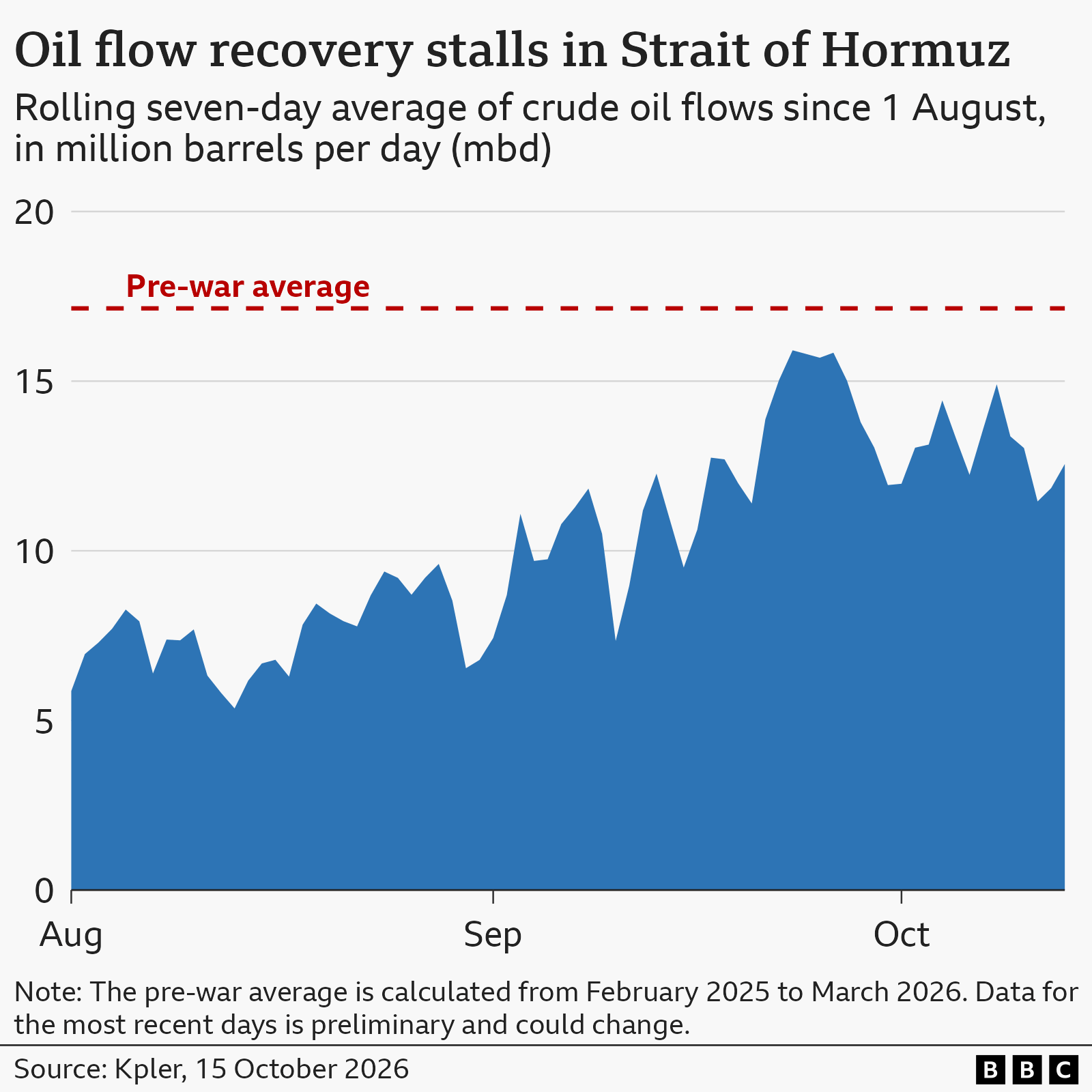
Reports of attacks on ships in and around the Strait of Hormuz reached a weekly record in early October, according to BBC Verify’s analysis of UK Maritime Trade Operations (UKMTO) incident reports. Twelve vessels reported attacks between 5 and 11 October, up from 10 the previous week; six attacks were reported on Sunday alone. The rise coincides with a slowdown in oil shipments through the strait, after flows had moved closer to pre-war levels in September.
Some attacks have taken place far from the strait. A drone struck the Nicaragua-flagged tanker Petro Dolphin near Oman’s Sohar Anchorage, leaving two crew members missing after 11 Indian seafarers were rescued. The container ship GFS Pride sank in the strait on Tuesday after being hit by an unknown projectile; all 21 crew were evacuated. Iran’s Islamic Revolutionary Guard Corps said the ship was carrying contraband and had taken an unauthorised route.
Kpler data puts oil flows through the strait at about 12.6 million barrels per day on 13 October, down from 15 million at the end of September and below a pre-war baseline of roughly 17 million. The article says assisted transits by the US Navy and a shuttle-tanker system had helped restore flows. Iran objects to the shuttle vessels’ route near Oman, demanding that ships use a route closer to Iran’s coast. Iranian exports, meanwhile, have stalled under a US blockade of Iranian ports and ships.
Experts cited by BBC Verify say Iran has expanded its attacks in response to efforts to increase shipping through the strait, with incidents also reported near Qatar and the UAE. The US military says commercial traffic continues with protection from US forces and regional partners. The article presents the attacks as both a threat to crews and a means of deterring shipping, with implications for regional security and oil exports.
Entities: Strait of Hormuz, Iran, US-Israeli war with Iran, UK Maritime Trade Operations (UKMTO), US Central Command • Tone: analytical • Sentiment: negative • Intent: analyze
16-10-2026
The live update reports escalating risks and economic consequences linked to the U.S.-Iran war. Iranian army spokesman Mohammad Akraminia said the Strait of Hormuz would reopen if the United States left the Middle East, warning that Iran would otherwise expel it. The statement comes amid conflicting claims about the waterway: the Trump administration says it is open, while Tehran says ships may pass only with Iranian permission. Maritime risk firm Marisks warned that vessels remain vulnerable to indiscriminate attacks even when they disable tracking systems; three vessels have reportedly been struck this week. Iran's navy also said a tanker was burning in a prohibited area in the Gulf of Oman, without explaining what caused the fire.
The article describes substantial financial damage to Iraq, whose oil exports depend heavily on passage through Hormuz. Foreign Minister Fuad Hussein estimated that the country had lost about $60 billion during the conflict. Disrupted shipping forced Iraq to halt most oil production because it lacks storage capacity, while its foreign currency reserves fell by $20 billion and consumer prices rose sharply. Limited exports have continued by truck through Syria and by pipeline through Turkey.
Other updates include an attack by Iran-backed Houthis on the presidential palace in Aden, Yemen, which the internationally recognized government said killed and injured security staff; and the sentencing of Norwegian teenager Johannes Kongsnes Natland to 20 years in Britain for conspiring to carry out a contract killing for an Iran-linked crime network. Iranian President Masoud Pezeshkian separately described environmental damage from regional conflicts as “ecocide” and called for international condemnation. Finally, the article begins a report that the White House and Pentagon have prepared plans to use a Massive Ordnance Air Blast bomb against military sites in Iran if President Trump orders it, but the supplied text cuts off before further details.
Entities: Strait of Hormuz, Iran, United States, Mohammad Akraminia, Iraq • Tone: analytical • Sentiment: negative • Intent: inform
16-10-2026
Two attacks on Singapore-flagged container ships in the Strait of Hormuz have raised fresh concerns about the safety of commercial shipping, but maritime experts say the incidents are unlikely to stop all vessels from using the route. The GFS Pride sank after being hit by a projectile and catching fire, while the GFS Giselle was damaged. Crew members on both ships were reported safe. Crossings fell from 176 to 131 in the week ending October 14, according to Kpler, though the decline cannot be attributed solely to the attacks.
Experts say demand for Middle Eastern energy and the potential returns from shipping can outweigh the risks for some operators. Collin Koh of Singapore’s S. Rajaratnam School of International Studies said companies may still seek opportunities to transit. Singapore Foreign Minister Vivian Balakrishnan recounted a Gulf official’s description of a “Hormuz shuttle,” in which about 20 very large crude carriers moved oil and were effectively self-insured. Higher crude prices reportedly made those voyages worthwhile despite the danger.
The Singapore Shipping Association expects operators to adjust trading patterns rather than withdraw broadly from the region. Still, further attacks could deter some companies, with decisions varying according to vessel type and each operator’s assessment of risk and crew safety.
The global container shipping industry has already made more extensive changes: according to Drewry Maritime Advisors, major container lines have not resumed Hormuz services since suspending them after the conflict began in February. Some regional operators continue sporadic services using smaller feeder vessels. Analysts warn that escalation into the Gulf of Oman would be more serious, potentially disrupting alternative gateways such as Khorfakkan in the United Arab Emirates and Oman’s Sohar, which have become important routes for supplies entering Gulf countries.
Entities: Strait of Hormuz, GFS Pride, GFS Giselle, Collin Koh, S. Rajaratnam School of International Studies • Tone: analytical • Sentiment: neutral • Intent: inform
16-10-2026
U.S. crude prices climbed sharply Friday as attacks and conflict-related disruptions threatened energy supplies across the Middle East and Europe. Brent crude reached $110 per barrel for the first time since May before settling at $109.86, up 3.7%. U.S. West Texas Intermediate rose 3.5% to $101.41 per barrel. For the week, WTI gained more than 10% and Brent nearly 5%, pushing U.S. crude above $100.
The Strait of Hormuz is a central concern: at least nine tankers and cargo ships have reportedly been attacked since Sunday as Iran seeks to restrict oil exports through the waterway. Iran sank the container ship GFS Pride, though its crew was safely evacuated. The International Maritime Organization reported three seafarers injured and two missing. Hormuz crude shipments were 9.4 million barrels per day for the week ended Wednesday, about 70% of the prewar average.
Regional risks also include repeated attacks by Iran-allied Houthi militants on Saudi Arabia. Saudi forces intercepted missiles, including one headed toward the Yanbu oil export terminal, and destroyed drones. The article also notes earlier attacks on Aramco’s Dhahran administrative building and Riyadh’s international airport.
Meanwhile, a proposed “energy ceasefire” between Ukraine and Russia has unraveled. Russia continued attacks on Ukrainian infrastructure, and President Volodymyr Zelenskyy said Ukraine would resume strikes on Russian refineries. These attacks, along with Iranian strikes on Middle Eastern energy infrastructure, have contributed to a sharp rise in diesel prices: the U.S. average reached $6.33 per gallon, more than 70% above the same period last year. U.S. crude prices were further supported by an inventory decline of more than 8 million barrels, partly attributed to Gulf Coast production shut-ins caused by Hurricane Isaias.
Entities: Brent crude oil, West Texas Intermediate (WTI), Strait of Hormuz, Iran, Houthi militants • Tone: analytical • Sentiment: negative • Intent: inform
16-10-2026
A crude oil tanker carrying 15 Indian crew members was struck by a projectile in the Strait of Hormuz on Friday, October 16, 2026, according to India’s minister of ports, shipping and waterways, Sarbananda Sonowal. Sonowal said all Indian crew aboard the MT ST 3 were safe and uninjured, and that officials were monitoring the situation and coordinating with the ship’s management to protect the crew. The incident follows other attacks in the strategic waterway. Earlier in the month, the MT On Peace, owned by Dubai-based shipping company Onex, was hit; 12 crew members were injured, 11 of them Indian, according to India’s Ministry of External Affairs. On Thursday, the Singapore-registered container ship GFS Pride was struck by an unidentified projectile, caught fire and sank. Its 21 crew members were evacuated safely, with no injuries reported by Singapore’s maritime authority. The article presents these incidents as evidence that the US-Iran war has sharply increased risks to commercial shipping in the Strait of Hormuz, a vital passage for global energy supplies. It reports that attacks on vessels there have reached a record high and that at least two ships have sunk. Strikes attributed to Iran have also driven crude oil prices above $100 a barrel in the US. The article says Iran’s Islamic Revolutionary Guard Corps has used drones, missiles and sea mines in the strait to disrupt exports and raise oil prices, seeking to apply economic pressure on the United States.
Entities: Sarbananda Sonowal, India, Strait of Hormuz, Oman, MT ST 3 • Tone: analytical • Sentiment: negative • Intent: inform