16-10-2026
Students at the University of Buenos Aires’ Exact and Natural Sciences building announced a one-day occupation to protest President Javier Milei’s austerity policies and warn that public higher education is at risk. The university hall was covered with banners, and students and professors described dwindling funding, eroding salaries and the departure of experienced academics to better-paid private institutions. Physics student Emiliano Gato said the cuts have made him uncertain whether he can pursue his ambitions in research and teaching at the public university.
The article places the campus protest within Milei’s broader programme, which since he took office in 2023 has included laying off state employees, closing ministries, reducing subsidies and cutting government-funded programmes. Inflation has fallen to around 2 percent a month, and Milei has claimed that Argentina is experiencing sustained economic growth. However, critics say the cuts are harming public education and welfare services, including support for people with disabilities and pensioners.
Congress passed laws to increase university funding and declare a disability emergency after overriding presidential vetoes. The government has declined to implement the measures, arguing that Congress did not specify how they would be financed. A federal judge has begun imposing daily fines over the failure to implement parts of the university financing law, which calls for restoring salaries and scholarships and updating budgets, among other provisions.
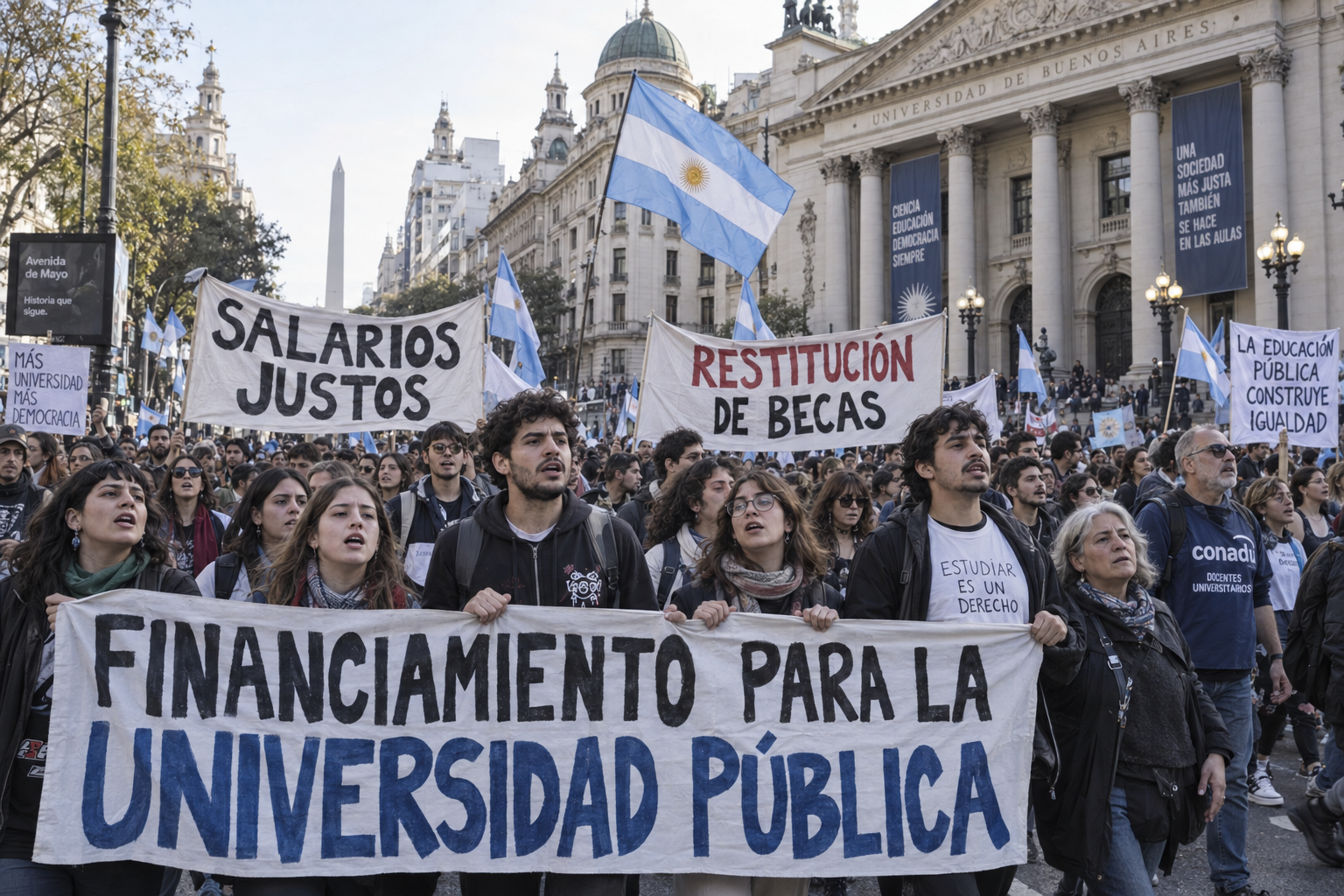
Thousands of people marched in Buenos Aires to demand implementation of the law and call for a general strike. The protest turned violent when police used tear gas and rubber bullets and demonstrators threw rocks. At least 25 people were detained and several were injured. Professor Maria Teresa de Jesus, who earns about $700 a month, said she was protesting as a last resort and argued that public education is essential to making education accessible. While some Argentines continue to back Milei’s economic plan in the hope that natural-resource development will bring jobs and higher living standards, others believe its costs are falling unfairly on the majority.
Entities: Javier Milei, Teresa Bo, Emiliano Gato, Maria Teresa de Jesus, University of Buenos Aires • Tone: analytical • Sentiment: negative • Intent: inform
16-10-2026
Al Jazeera reports that protesters clashed with police in Buenos Aires during demonstrations over Argentina’s university funding law. Students and teachers were protesting the government’s refusal to enact legislation intended to increase education funding. President Javier Milei argues that putting the law into effect would threaten his plan to balance the national budget. The brief report describes the confrontation and the dispute at its center: education funding advocates are demanding increased support, while the president says the measure conflicts with his fiscal policy. The article does not provide further details about the scale of the clashes, injuries, arrests, or the government’s next steps.
Entities: Argentina, Buenos Aires, Javier Milei, Al Jazeera, university funding law • Tone: neutral • Sentiment: negative • Intent: inform
16-10-2026
Thousands of students, university employees, trade unionists and opposition supporters demonstrated outside Argentina’s parliament in Buenos Aires against President Javier Milei’s education spending cuts. They called on the government to implement a university funding law. Although the rally was largely peaceful, clashes broke out after masked individuals reportedly threw stones at police, injuring at least eight officers. Some protesters reportedly tried to stop the stone-throwers. Police used tear gas and water cannons to disperse the crowd, and the National Security Ministry said 25 people were arrested. Security Minister Alejandra Monteoliva accused protesters of seeking to “sow chaos,” while saying that the right to protest does not include a right to violence.
The demonstration was the fifth protest against the government’s education spending since Milei took office in 2023. Organizers said a protest in May drew about 1.5 million people. The dispute centers on a law passed by Congress in 2025 that would increase funding for public universities, link employee salary adjustments to inflation since December 2023, restore student scholarships and provide more money for university operations. Milei vetoed the measure, arguing that the state could not afford inflation-linked increases. Congress overrode his veto, and court rulings have instructed the government to release the funds, but it has not done so. A government spokesperson said the law had been “suspended” because of legal action by the government.
The Center for National Economic Research at the University of Buenos Aires reported that real public spending on universities fell by 41% in the first half of 2026. Argentina’s public universities provide free education and attract students from across the region; the country’s education system is considered among South America’s best. The protests reflect a wider conflict over Milei’s austerity program and the future funding of public higher education.
Entities: Javier Milei, Argentina, Buenos Aires, Argentine Parliament, University Funding Law • Tone: analytical • Sentiment: neutral • Intent: inform