16-10-2026
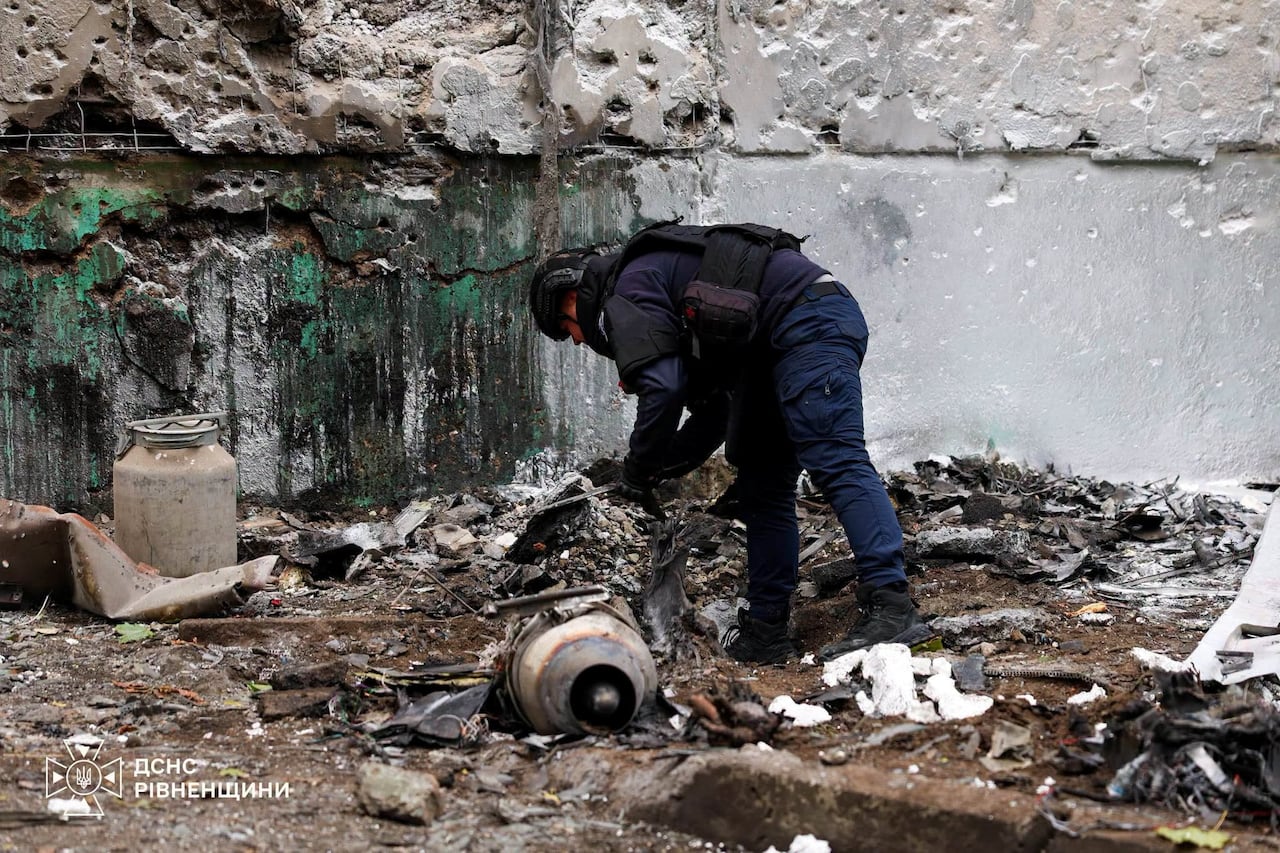
Russian drone attacks across Ukraine killed at least three people and wounded many others, while disrupting electricity for more than 370,000 people, according to Ukrainian officials. In Kharkiv, two people were killed and 12 wounded in attacks on three districts; the regional governor had earlier reported three deaths. A strike on a food-processing facility in the north-western region of Volyn killed one person and wounded eight. Damage to energy infrastructure cut power to around 370,000 people in the north-west. Repair crews restored electricity to about 100,000 by later in the morning, but Lutsk’s mayor said the blackout in the regional capital could last at least 24 hours. Drones also hit shopping centres in Sumy and Rivne; seven people were wounded in the Rivne region.
The article also describes the dispute over attacks on energy infrastructure. Russia publicly showed footage of a Ukrainian drone strike on the Ryazan oil refinery, an unusual step for state television. The refinery was identified by a regional governor, and the broadcast showed a plume of smoke but no visible fire. The strike came four days after US President Donald Trump announced an energy ceasefire between Russia and Ukraine, though neither country confirmed agreeing to it. Ukraine said it had paused attacks for three days in deference to Trump, then resumed them because Russia continued striking Ukrainian power plants and other energy infrastructure.
At a Brussels summit, European Union leaders reaffirmed support for Ukrainian President Volodymyr Zelenskyy and discussed help with Ukraine’s budget shortfall. Zelenskyy said there were no signs Russia was ready to end the war and called for preparations for winter that include energy supplies, air defence and funding. Estonia’s prime minister said the EU would probably need to provide a new loan, warning that Ukraine faced another extremely difficult winter. The article places the attacks and blackout within wider concerns about energy security, military support and Ukraine’s finances.
Entities: Russian drone attacks, Ukraine, Kharkiv, Volyn, Lutsk • Tone: neutral • Sentiment: negative • Intent: inform
16-10-2026
Poland scrambled fighter jets overnight as Russian attacks struck western Ukraine near the Polish border. Poland’s armed forces said no violation of Polish airspace was detected. The incident adds to repeated alerts on NATO’s eastern flank, where governments are increasingly concerned about the risk of the war spreading beyond Ukraine. Bulgaria also asked NATO for assistance, seeking additional combat aircraft and counter-drone systems.
The attacks caused casualties and disruption across Ukraine. Strikes in the Volyn region cut electricity to about 370,000 people and injured two, according to the regional governor. A drone attack in Kharkiv killed three people and injured five, while strikes on an apartment building in Uman injured several people. Kyiv experienced emergency power cuts. Russian officials, meanwhile, said Ukrainian attacks killed two people in the Russian-controlled Luhansk region and that air defences had intercepted 644 Ukrainian drones, including 94 said to be heading toward Moscow. Drone attacks also temporarily halted operations at airports in Moscow and St Petersburg.
The article places these events amid growing concern about drone incursions and attacks near NATO territory. Romania, Moldova, Poland and the Baltic states have reported intrusions, while drones have struck cargo ships off Romania and Bulgaria, with 25 people reported dead or missing. Bulgaria’s government said evidence pointed to Russia in a recent ship sinking but acknowledged it had no proof. Sofia has asked NATO to strengthen Bulgarian defences and plans to coordinate with Romania and Turkey on security in the Black Sea. Bulgaria also expects to join a NATO counter-drone initiative, while Romania has requested additional equipment. The article also notes that Ukraine’s attacks on Russian energy infrastructure have drawn criticism from US President Donald Trump, who blamed them for raising global oil prices.
Entities: Poland, Russia, Ukraine, NATO, Bulgaria • Tone: analytical • Sentiment: neutral • Intent: inform
16-10-2026
European Union leaders welcomed Ukrainian President Volodymyr Zelenskyy to a Brussels summit as Ukraine faced renewed Russian attacks and uncertainty about continued U.S. support. Russian drones killed at least three people on Friday, injured others, struck shopping centres and a food-processing facility, and damaged the energy grid, leaving about 370,000 people without power in northwestern Ukraine. Zelenskyy said there was no sign Russia was ready to end the war and that Ukraine needed a winter package covering energy, air defence and funding.
The summit comes amid strained relations between Zelenskyy and U.S. President Donald Trump. Trump criticized Ukrainian strikes on Russian oil refineries, calling them a “disgrace” and arguing they were raising oil prices ahead of U.S. midterm elections. His criticism followed an announcement of a diesel transaction with Russia and a claim that the two countries had agreed not to target energy facilities. Ukraine said it was abandoning the energy ceasefire Trump had announced because Russia continued its attacks.
European officials are weighing how to fill Ukraine’s financial and military needs. Estonia’s prime minister said the EU would likely need to provide a new loan to help cover next year’s budget gap. Ukraine has described a $27-billion shortfall in military spending this year and a $32.6-billion unfunded budget gap for next year, separate from an estimated $40 billion in direct military supplies it needs from allies. Austria’s chancellor cautioned that the figures require clarification before leaders make major commitments.
The article also highlights uncertainty over Ukraine’s access to Starlink and the military-grade Starshield system, which is used for battlefield communications and drone operations. Some Ukrainian units reported restored connectivity, but the cause of restrictions remained unclear. EU foreign policy chief Kaja Kallas said Europe could not replace Starlink in the short term. Together, the attacks, funding needs and questions about U.S. support raise concerns about Ukraine’s ability to sustain its defence through another winter.
Entities: Volodymyr Zelenskyy, Donald Trump, Vladimir Putin, European Union, Brussels • Tone: analytical • Sentiment: negative • Intent: inform
16-10-2026
At a summit in Brussels, European Union leaders pledged continued support for Ukraine as Russian attacks intensify and US policy toward Russia and Ukraine shifts. European Council President António Costa said it was not the time to reduce support or lift sanctions, while European Commission President Ursula von der Leyen said sanctions would remain until Russia stops the war. Their statements followed US President Donald Trump’s decision to lift sanctions on Russian oil exports and buy diesel from Russia, as well as consideration of easing sanctions on Russia’s so-called shadow fleet. The article also reports Trump’s criticism of Ukrainian President Volodymyr Zelenskyy and Ukraine’s attacks on Russian energy infrastructure.
Zelenskyy told leaders that Ukraine wants to end the war but sees no indication that Russia is ready to do so. He said Ukraine must prepare for winter with energy supplies, air defenses and funding. He asked the EU for an additional €70 billion next year, saying Ukraine’s total war costs would reach €155 billion and the requested assistance was needed for defense, weapons and resilience. Asked whether Trump was blaming him for problems in the United States, Zelenskyy responded with a smile and a brief remark that drew laughter from reporters.
The article also describes concerns around US policy and military support. Ukraine reported restrictions on its use of Starshield, a military-grade satellite service used for battlefield communications and operations. Separately, Zelenskyy praised his first bilateral meeting with Hungary’s new prime minister, Péter Magyar. The two discussed relations, the economy and logistics. Magyar said Hungary stood in solidarity with Ukraine and would help diplomatically toward a ceasefire and lasting peace. The meeting followed Ukrainian legislation addressing Hungary’s concerns about the rights of the ethnic Hungarian minority in western Ukraine.
Entities: Volodymyr Zelenskyy, Ursula von der Leyen, António Costa, Donald Trump, Vladimir Putin • Tone: analytical • Sentiment: negative • Intent: inform
16-10-2026
The France 24 live report, dated October 16, 2026, centers on Ukrainian President Volodymyr Zelensky’s statement that Ukraine depends on the US satellite service Starlink to intercept Russian jet-powered drones. Zelensky made the remarks at a summit of European Union leaders in Brussels. The report says disruptions to Starlink earlier in the week had hampered the Ukrainian military’s ability to respond to intense Russian bombardment, as winter approaches. The interruptions have angered Kyiv because the satellite system is described as critical to Ukraine’s military operations.
The article’s recap of the previous day’s developments says Zelensky met NATO Secretary General Mark Rutte in Brussels to seek support from European allies against Russia. It also reports that Zelensky urged the United States not to align itself with Moscow and called for “honesty” after Kyiv said it had been let down by gaps in US intelligence sharing. Separately, Elon Musk suggested that slowdowns in Starlink—which Ukraine uses for battlefield communications and frontline logistics—were caused by President Donald Trump and the US military.
The report presents these developments as part of Ukraine’s effort to maintain military capabilities and secure allied backing amid Russian attacks and concerns about access to communications and intelligence support. The supplied page includes only a short liveblog introduction and a recap, rather than the full stream of updates; its trailing “Page not found” notice is website clutter, not article content.
Entities: Volodymyr Zelensky, Elon Musk, Donald Trump, Mark Rutte, Ukraine • Tone: analytical • Sentiment: negative • Intent: inform
16-10-2026
The provided NPR page describes Ukrainian strikes inside Russia against the backdrop of Russia’s attacks on Ukraine’s energy infrastructure and a growing rift between Ukrainian President Volodymyr Zelenskyy and the United States. Russian authorities say Ukraine struck a major oil refinery southeast of Moscow on Thursday. The page characterizes the strike as a response to Russian attacks on Ukrainian energy facilities, but the supplied text does not provide further details about damage, casualties, the refinery’s name, or the specific Russian attacks. The headline also signals that the report examines Russia’s perspective on the strikes and the worsening tensions between Zelenskyy and the U.S., though the excerpt contains no explanation of that dispute or comments from either side about it. The item is identified as a World report for NPR’s Morning Edition, published October 16, 2026, and credited to Charles Maynes and A Martínez. The supplied content is only a short summary and page metadata rather than a full transcript or complete article, so it does not support a more detailed account of Russia’s response, Ukraine’s rationale beyond the stated retaliation, or the diplomatic implications of the U.S.-Ukraine rift. Overall, the report presents the refinery strike and the broader political context in concise, factual language, without supplying enough information to assess the claims independently or draw conclusions about the conflict’s next steps.
Entities: Russia, Ukraine, Volodymyr Zelenskyy, United States, Moscow • Tone: neutral • Sentiment: neutral • Intent: inform
16-10-2026
Ukrainian President Volodymyr Zelenskyy says Kyiv will resume attacks on Russian oil refineries after Russia continued striking Ukraine’s energy infrastructure during a three-day pause requested by Washington. “The block [on attacking refineries] is out. We’re done,” he told the Financial Times. Zelenskyy said more than 100 civilians had been killed in Russian attacks over the previous week. After his remarks, Russia’s Ryazan governor reported a fire at a Rosneft refinery caused by Ukrainian drone strikes; a Ukrainian official said the facility had been targeted in retaliation for Russian attacks. Separately, Ukraine’s Naftogaz said a Russian strike on a gas production site east of Kyiv forced operations to stop.
Zelenskyy accused the United States of weakening its support. He said Ukraine had lost access to US early-warning alerts for incoming ballistic missiles and that reduced Starlink speeds had hindered frontline operations. He alleged US officials had warned that attacks on Russian energy infrastructure could lead to intelligence being blocked, and said the disruption was later described as a technical problem. His office subsequently confirmed Starlink service had been restored, while President Donald Trump denied that Washington had cut off intelligence-sharing.
Zelenskyy also criticized US efforts to pursue business deals with Moscow, warning that arrangements such as a possible gas deal could give Russia more resources for its war. He suggested Trump respects leaders who stay in power for decades and rejected the idea that mending relations with Washington was solely his responsibility. He said he might consider halting attacks on Russian energy infrastructure if the United States supplied additional Patriot air-defence interceptors. Despite the growing rift, Zelenskyy emphasized that cooperation with the United States and Europe remains essential to Ukraine.
Entities: Volodymyr Zelenskyy, Donald Trump, Vladimir Putin, Ukraine, Russia • Tone: analytical • Sentiment: negative • Intent: inform
16-10-2026
Ukraine resumed attacks on Russian oil infrastructure after a brief pause in energy-related strikes, escalating tensions with both Moscow and Washington. A Ukrainian drone struck a refinery in Russia’s Ryazan region, about 300 kilometres southeast of Moscow, and caused a fire, according to Russian officials. A senior Ukrainian official confirmed that Ukraine had hit the refinery. The strike followed Ukrainian President Volodymyr Zelenskyy’s accusation that Russia continued bombing Ukrainian energy infrastructure despite US President Donald Trump’s demand that both sides stop such attacks.
Zelenskyy said Ukraine had observed the requested truce but was also denied its usual Western intelligence about Russian ballistic missile attacks and faced restrictions on its use of US-made Starlink terminals—resources he described as vital to Ukraine’s military. In an interview with the Financial Times, he said his patience had run out and that Ukrainian strikes on Russian refineries would resume. Kremlin spokesman Dmitry Peskov countered that Ukraine had never stopped attacking refineries, strikes that have harmed Russia. The article notes that claims from both sides could not be independently verified.
The dispute threatens to further strain Kyiv’s relationship with Trump, amid concerns that his administration may reduce support for Ukraine. Zelenskyy travelled to Brussels for talks with European Union leaders at a two-day summit and said he would meet NATO chief Mark Rutte, French President Emmanuel Macron, and the prime ministers of Poland, Denmark and Belgium.
Separately, Ukrainian emergency services reported that a Russian drone attack lasting more than ten hours killed three people and injured six in the central Ukrainian region of Kirovohrad. The article portrays a renewed cycle of attacks on energy targets alongside uncertainty over US support and efforts by Ukraine to coordinate with European leaders.
Entities: Volodymyr Zelenskyy, Donald Trump, Dmitry Peskov, Pavel Malkov, Ukraine • Tone: analytical • Sentiment: negative • Intent: inform
16-10-2026
US President Donald Trump called Ukraine’s renewed attacks on Russian oil refineries a “disgrace,” arguing that they push up global oil prices and harm the world’s energy supply. His comments, made in an interview with Newsmax aired on Oct 15, followed a Ukrainian strike on a Rosneft refinery south-east of Moscow that helps supply the Russian capital. The attack came after Ukrainian President Volodymyr Zelensky said Kyiv was abandoning a ceasefire covering energy sites, which Trump had announced, and criticised Trump’s willingness to make deals with Moscow.
Zelensky told the Financial Times that Ukraine’s patience had run out after Russia launched missile and drone attacks on energy infrastructure, including power stations. Those attacks left hundreds of thousands without electricity. Trump’s administration has been trying to mediate a ceasefire to end the war, which began with Russia’s full-scale invasion of Ukraine in 2022. Trump said Zelensky and Russian President Vladimir Putin hate each other, making an agreement difficult, and said he found Zelensky more difficult to deal with than Putin.
The article also reports that Ukraine was facing reduced access to a satellite system it relies on for battlefield communications and drone operations while Trump was pressing Kyiv to stop strikes on Russian oil refineries. The order to reduce usage came from within the White House, according to two US officials and a Western official briefed on the matter. They did not identify who made the decision or who was responsible for carrying it out.
Entities: Donald Trump, Volodymyr Zelensky, Vladimir Putin, Ukraine, Russia • Tone: analytical • Sentiment: neutral • Intent: inform