16-10-2026
BBC Verify analysis of UK Maritime Trade Operations (UKMTO) incident reports finds that reported attacks on ships in and around the Strait of Hormuz reached a weekly record after the US-Israeli war with Iran began. Twelve vessels reported attacks between 5 and 11 October, including six in one day; the previous week had seen 10 reports. Four more attacks had been reported so far in the following week. Experts say Iran is increasing pressure on shipping to assert control over the waterway, while the US military has expanded its protection of tankers. US Central Command says commercial traffic continues under coordinated protection from US forces and regional partners.
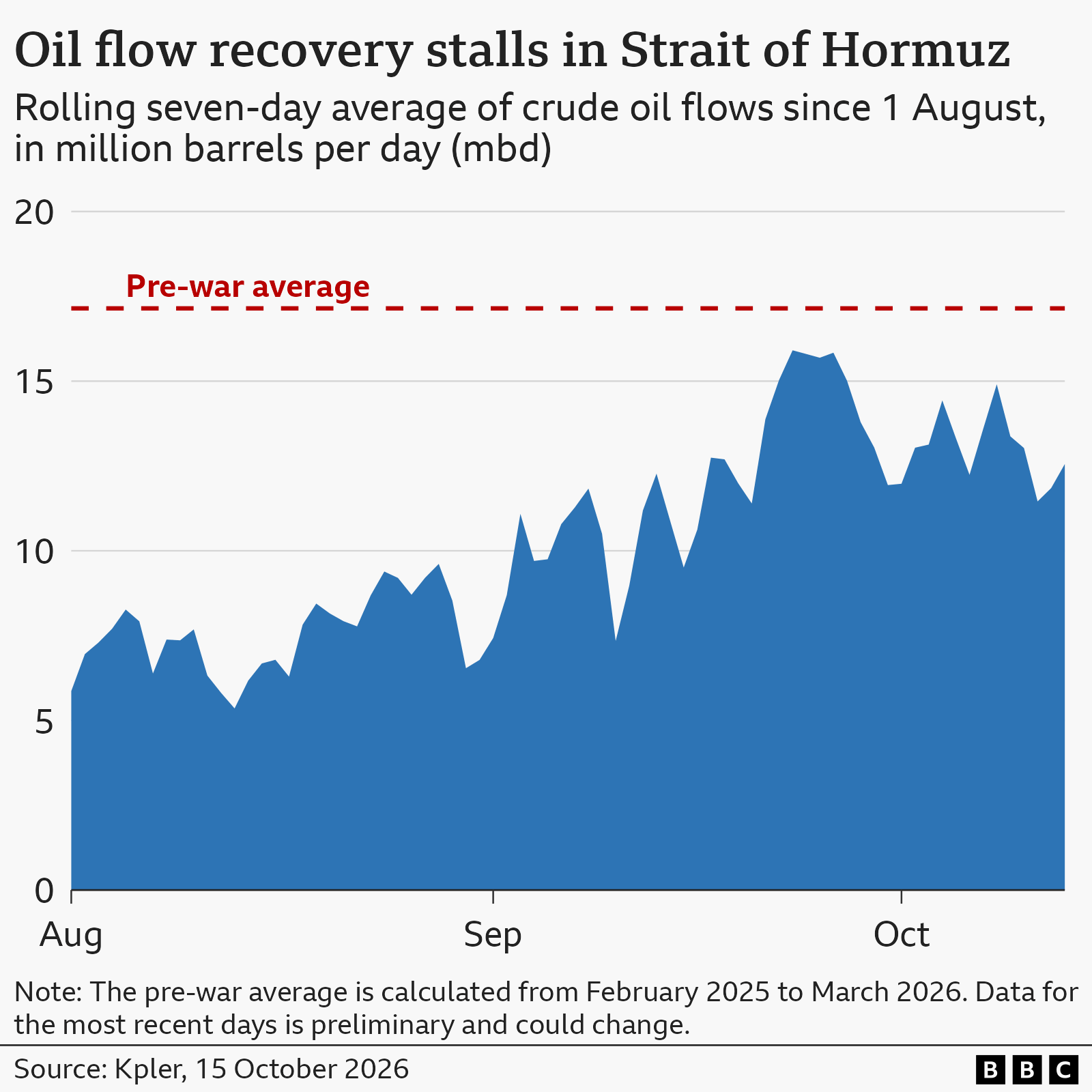
The attacks have coincided with a slowdown in oil shipments through the strait. Kpler data indicates that daily flows fell to about 12.6 million barrels on 13 October, from 15 million at the end of September and a pre-war baseline of roughly 17 million. US Navy data shows assisted transits were up 85% in the first 10 days of October compared with the same period in August. Recent Gulf Arab oil exports have relied on a shuttle system: tankers travel close to Oman’s coast through the strait, then transfer cargo to larger vessels in the Gulf of Oman. Iran calls this route unauthorised and demands ships use a route closer to its coast. Iranian exports, meanwhile, have stopped amid a US blockade of Iranian ports and ships.
Incidents described include the Petro Dolphin, a Nicaragua-flagged tanker struck by a drone near Oman. Eleven Indian crew members were rescued, while two remained missing. The container ship GFS Pride sank after being hit by an unknown projectile in the strait, though all 21 crew were evacuated. The IRGC said the ship was carrying contraband and had taken an unauthorised route. Other reported strikes occurred near Qatar and the UAE, well beyond the strait. Risk analyst Martin Kelly says Iran has broadened its campaign, with frequent attacks intended to stop ships passing and deter others.
Entities: Strait of Hormuz, Iran, United States, UK Maritime Trade Operations (UKMTO), US Central Command • Tone: analytical • Sentiment: negative • Intent: inform
16-10-2026
The CBS News live update describes escalating conflict and its effects across the Middle East as of October 15–16, 2026. A maritime monitor warns that ships in the Strait of Hormuz remain vulnerable to indiscriminate attacks, even when they disable tracking systems, and confirms three vessel strikes that week. In Yemen, the Houthis attacked a presidential palace in government-controlled territory, causing deaths and injuries among security staff. The Saudi-led coalition said it intercepted a Houthi cruise missile over the Medina region; the Houthis denied the claim as a lie.
Other updates cover Iran’s president, Masoud Pezeshkian, who called the environmental damage from regional wars “ecocide” and urged international condemnation and solutions. U.S. Secretary of State Marco Rubio asked Lebanon’s president, Joseph Aoun, not to return explosives seized from Hezbollah and urged accountability for those behind the shipment. Rubio also criticized Lebanon’s 1955 Boycott Law and called for direct military communication between Lebanon and Israel. Aoun separately asked Rubio to press Israel to stop attacks in southern Lebanon.
The report says the White House and Pentagon have prepared plans for possible use of the Massive Ordnance Air Blast bomb against military sites in Iran, while emphasizing that no decision to use it has been announced. It also reports that ousted Army Chief of Staff Randy George had warned before the war of a prolonged shortage of Patriot and THAAD missile-defense munitions, projected to last until 2030. The shortages were attributed to transfers to Ukraine, defense of Israel, and limits in industrial production. The conflict has also disrupted sporting events in Saudi Arabia: the Saudi International golf tournament was postponed, following delays to a tennis exhibition and several Saudi Pro League matches.
Entities: Strait of Hormuz, Masoud Pezeshkian, Iran, Houthis, Yemen • Tone: analytical • Sentiment: negative • Intent: inform
16-10-2026
The supplied page identifies itself as a live Middle East news update dated October 16, 2026, and leads with a report that the death toll from a Houthi attack on Yemen’s presidential palace has risen to five. The excerpt does not provide details about the victims, the circumstances of the palace attack, or how the updated toll was confirmed. Its other headlines describe a rapidly developing regional security situation: a Saudi-led coalition reportedly intercepted a drone targeting Saudi Arabia’s Eastern Province and a cruise missile over Madinah, while the Houthis threatened retaliatory attacks and warned that Saudi airports were unsafe. The page also says an EU-GCC summit was postponed amid the attacks and that the Houthis were urged to lift their siege of Taiz, with Yemen warning of a humanitarian catastrophe.
Additional linked headlines point to related developments, including attacks in Riyadh, a funeral for an Egyptian flight attendant killed in an attack there, and comments by Jordan’s King calling for work on de-escalation. Other headlines concern economic risks to Gulf recovery, missing Indian seafarers after a drone attack in the Gulf of Oman, and US military action involving vessels in the Gulf of Oman and an Iran blockade. One teaser says former US President Donald Trump was considering joining Saudi strikes after an attack on Riyadh airport.
The provided material is largely a collection of headlines and video labels rather than a full article or complete live blog. It therefore establishes the reported events and the breadth of regional concerns, but offers little supporting detail, chronology, attribution beyond the brief headline wording, or explanation of the parties’ positions. The central themes are escalating attacks, threatened retaliation, regional security, and the risk of humanitarian and economic consequences.
Entities: Houthis, Yemen, Yemen's presidential palace, Saudi Arabia, Saudi-led coalition • Tone: urgent • Sentiment: negative • Intent: inform
16-10-2026
Yemen’s internationally recognised government will continue operating from Aden despite a Houthi missile attack on the presidential palace, according to Marwan Ali Noman, an adviser to Foreign Minister Afrah Al Zouba. Noman said the attack would not disrupt public life or weaken state authority, and that the government remained committed to its constitutional responsibilities and campaign against the Houthis. The government has directed military and security authorities to protect state institutions and respond to threats.
Yemen’s Health Ministry reported that five security personnel were killed and 16 injured in Thursday’s strike on Al Maashiq Palace. The attack was the first Houthi targeting of the palace since fighting resumed last month after a four-year lull. The government is continuing Operation Dawn of Yemen, launched this month with the stated aim of retaking the country, including the capital Sanaa, which the Houthis seized in 2014, and restoring state institutions.
The article also describes the wider conflict. Government forces, supported by the Saudi-led coalition, have partly reversed Houthi advances along the Red Sea coast in south-west Yemen. The Houthis continue to besiege Taiz, contributing to shortages of food, fuel and other essentials. They have also carried out missile and drone attacks on Saudi airports and oil sites in recent weeks; the article reports 19 people killed and hundreds injured, with most casualties resulting from an October 10 strike on Riyadh’s King Khalid International Airport. Saudi coalition forces said they intercepted a drone heading towards the kingdom’s Eastern Province on Friday.
Finally, the article notes recent Saudi-Syrian diplomatic contacts. Syria’s Foreign Minister Asaad Al Shibani met Saudi officials in Riyadh, following President Ahmad Al Shara’s visit earlier in the month. Reports that Riyadh had asked Damascus to send troops to help counter the Houthis were strongly denied by Syria.
Entities: Marwan Ali Noman, Afrah Al Zouba, Aden, Al Maashiq Palace, Yemen’s internationally recognised government • Tone: neutral • Sentiment: negative • Intent: inform
16-10-2026
Two attacks on Singapore-flagged container ships in the Strait of Hormuz have raised fresh concerns about the safety of commercial shipping, but maritime experts say the incidents are unlikely to stop all vessels from using the route. The GFS Pride sank after being hit by a projectile and catching fire, while the GFS Giselle was damaged. Crew members on both ships were reported safe. Crossings fell from 176 to 131 in the week ending October 14, according to Kpler, though the decline cannot be attributed solely to the attacks.
Experts say demand for Middle Eastern energy and the potential returns from shipping can outweigh the risks for some operators. Collin Koh of Singapore’s S. Rajaratnam School of International Studies said companies may still seek opportunities to transit. Singapore Foreign Minister Vivian Balakrishnan recounted a Gulf official’s description of a “Hormuz shuttle,” in which about 20 very large crude carriers moved oil and were effectively self-insured. Higher crude prices reportedly made those voyages worthwhile despite the danger.
The Singapore Shipping Association expects operators to adjust trading patterns rather than withdraw broadly from the region. Still, further attacks could deter some companies, with decisions varying according to vessel type and each operator’s assessment of risk and crew safety.
The global container shipping industry has already made more extensive changes: according to Drewry Maritime Advisors, major container lines have not resumed Hormuz services since suspending them after the conflict began in February. Some regional operators continue sporadic services using smaller feeder vessels. Analysts warn that escalation into the Gulf of Oman would be more serious, potentially disrupting alternative gateways such as Khorfakkan in the United Arab Emirates and Oman’s Sohar, which have become important routes for supplies entering Gulf countries.
Entities: Strait of Hormuz, GFS Pride, GFS Giselle, Collin Koh, S. Rajaratnam School of International Studies • Tone: analytical • Sentiment: neutral • Intent: inform
16-10-2026
Five people were killed and 16 injured when five Houthi ballistic missiles struck al-Maashiq Palace in Aden, the seat of Yemen’s internationally recognised government, according to officials. Information Minister Moammar al-Eryani said the prime minister and other ministers were unharmed. Health Minister Qasim Buhaibeh said those killed or injured included palace guards and civilian employees. Houthi military spokesman Yahya Sarea said the group had targeted what he called the Saudi military operations headquarters in Aden. Prime Minister Shaya Zindani condemned the attack and said it would not weaken government forces’ resolve to continue fighting.
The strike comes amid escalating attacks between the Houthis and Saudi Arabia, which leads a coalition backing Yemen’s government. The Houthis have launched missiles and drones at Saudi airports, energy facilities and military bases, describing their actions as retaliation for Saudi-led strikes and a blockade of territory they control. A recent missile attack at Riyadh’s international airport killed 13 people. Saudi Deputy Foreign Minister Rayed Krimly accused Iran of encouraging Houthi escalation and supporting the group; Iran has denied supplying weapons, while saying it supports the Houthis politically. There was no immediate Iranian response to the latest accusation.
Yemen’s civil war began in 2014, when the Houthis ousted the internationally recognised government from Sanaa. A Saudi-led coalition intervened in 2015. An informal ceasefire that had lasted four years began to unravel in July, and fighting intensified after Houthi advances near the Bab al-Mandab Strait, an important global shipping chokepoint. Government forces said they recently retook territory overlooking the strait with Saudi air support. Since 6 August, fighting has killed at least 1,282 people and injured 5,890, according to the government’s health ministry. The UN reports that 201,000 people have been displaced and suspected cholera cases have risen sharply.
Entities: Aden, Yemen, al-Maashiq Palace, Houthis, Moammar al-Eryani • Tone: analytical • Sentiment: negative • Intent: inform