16-10-2026
At least 10 students have died from Ebola in Ituri Province, eastern Democratic Republic of the Congo, according to authorities. The deaths occurred more than a month after schools reopened for the new academic year, while the outbreak has continued to spread. Education officials in Bunia, the provincial capital, reported 25 confirmed Ebola cases among students at several schools in the province. Of those infected students, 10 have died and seven are receiving treatment; the article does not provide the status of the remaining cases. A provincial education official called on schools to use protective equipment properly and follow health guidelines to reduce the risk of transmission. The World Health Organization’s Regional Office for Africa described the outbreak as continuing to evolve in a situation report issued Wednesday, noting that it is expanding geographically and in its number of cases and deaths. The report said the outbreak has affected more than 65 health zones across eight provinces. The article presents the student deaths as part of a wider and ongoing outbreak, while highlighting precautions schools are being urged to take. It does not provide further details about the students, the schools involved, the precise timing of the cases, or specific measures beyond protective equipment and adherence to health guidance.
Entities: Democratic Republic of the Congo, Ituri Province, Bunia, World Health Organization Regional Office for Africa, Ebola • Tone: urgent • Sentiment: negative • Intent: inform
16-10-2026
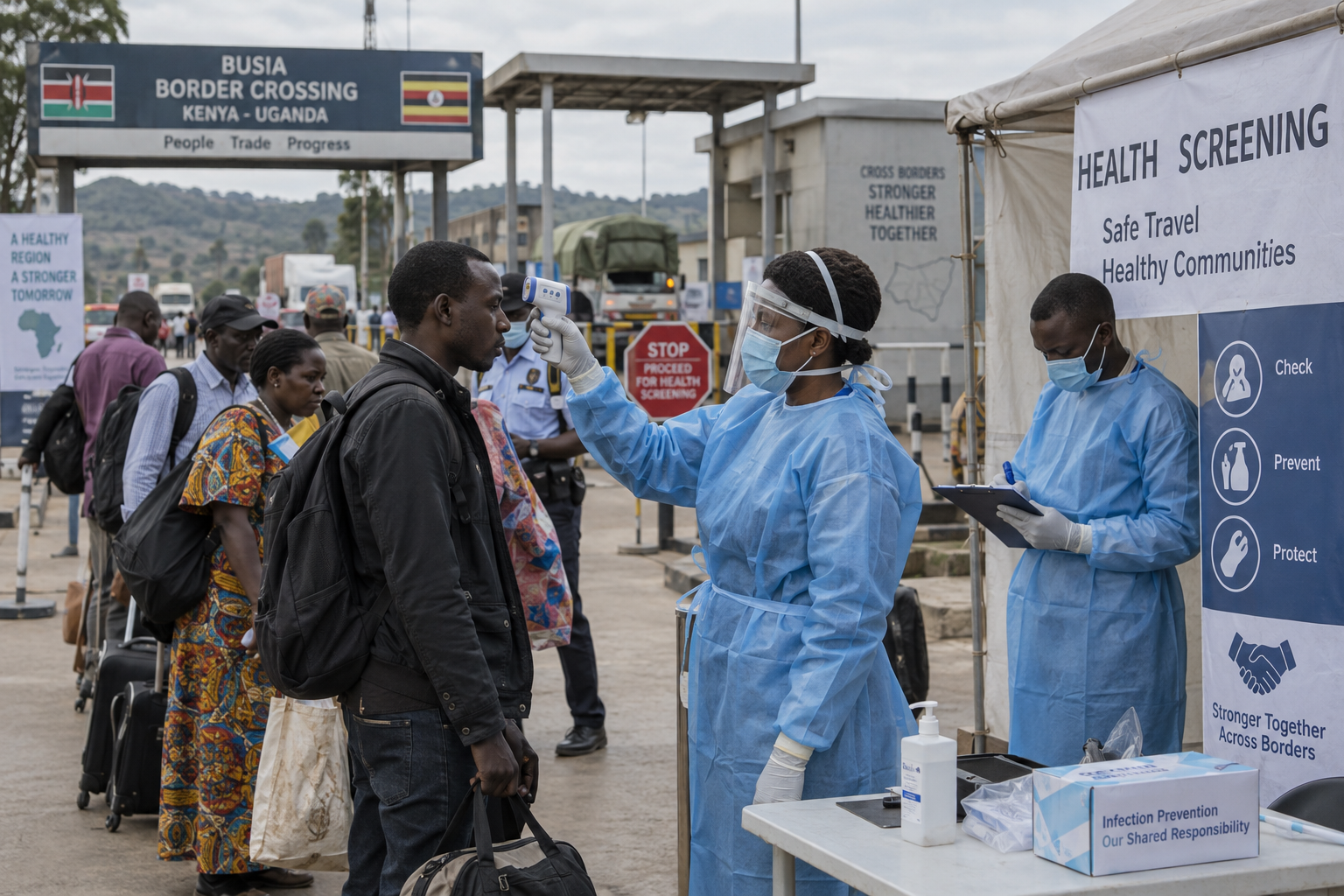
Kenya has heightened health screening at border crossings and airports after confirming a second Ebola case linked to an outbreak in the Democratic Republic of Congo. The second patient, a 39-year-old close relative of Kenya’s first case, developed symptoms while in quarantine and tested positive. Kenya’s Health Ministry said the two cases were connected and that there was no evidence of community transmission. Officials identified about 128 contacts connected to the first patient, with 108 placed in quarantine.
The first patient, a 40-year-old Kenyan who had been living in Congo, became ill there, traveled overland to Uganda and then flew to Nairobi. He later tested positive and died on October 5. His journey through three countries has raised questions about the strength of border surveillance. At the Busia crossing with Uganda, residents and transport workers expressed concern about infection risks and the possibility that travelers could enter through informal routes that avoid official screening.
Uganda previously declared its outbreak over after reporting 20 cases linked to infections originating in Congo. The World Health Organization has cautioned against border closures, warning that they may redirect travel and trade to unmonitored crossings. Congo has reported 9,066 confirmed cases and 4,381 deaths. The outbreak has spread across seven provinces, while fighting, population movements, limited medical supplies and treatment centers, and difficulties with contact tracing hinder containment. Africa CDC Director-General Jean Kaseya said more than 70% of new cases in Congo involved people not previously identified as contacts, making detection and isolation harder. The outbreak is caused by the rare Bundibugyo virus, for which there is no approved vaccine or treatment; Ebola spreads through infected bodily fluids and contaminated materials.
Entities: Kenya, Democratic Republic of Congo, Uganda, Busia border crossing, David Makhoha • Tone: analytical • Sentiment: negative • Intent: inform
16-10-2026
Kenya is trying to contain two Ebola cases linked to an outbreak in the Democratic Republic of Congo (DRC), which has reported more than 9,000 cases and 4,400 deaths. Kenya’s first patient, a 40-year-old man who traveled from the DRC through Uganda, died at a Nairobi hospital on October 5. A relative, aged 39, later tested positive after being quarantined. Kenya’s health ministry says the cases are linked and that there is no evidence of wider community transmission. Officials have been tracing contacts: 113 of 128 people exposed to the first patient have been identified, and all but five, who are abroad, have been quarantined.
The cases have prompted public anxiety, including fears of lockdowns and economic disruption, as well as criticism that the government was unprepared. Residents have called for better public information. Health Cabinet Secretary Aden Duale has urged vigilance and advised people with symptoms to seek medical care. The article outlines Ebola’s possible symptoms, while noting they can resemble illnesses such as malaria or typhoid and that testing is needed to confirm infection.
Politicians and medical representatives have questioned how the first patient passed airport screening. Union representative Dennis Miskellah argues that the cases expose weaknesses in Kenya’s pandemic readiness, despite earlier alerts, airport and border screening, designated isolation hospitals, and mobile laboratories. He points to unclear leadership between the national Ministry of Health and county governments, limited isolation capacity, shortages of protective equipment and health workers, and healthcare workers’ concerns about their safety.
The article also raises questions about regional cooperation, given that borders have remained largely open amid rising cases and deaths. Miskellah calls for agreements among affected countries to be audited rather than trusted without scrutiny. Kenya requires travelers arriving from several countries in the region to complete a health declaration form truthfully. Overall, the article examines both the immediate containment effort and broader gaps in preparedness, governance, healthcare capacity, and cross-border coordination.
Entities: Kenya, Democratic Republic of Congo (DRC), Uganda, Nairobi, Ebola outbreak • Tone: analytical • Sentiment: neutral • Intent: analyze
16-10-2026
Africa CDC and Congolese health authorities are calling for greater transparency over money provided for Ebola response activities in the Democratic Republic of Congo. Africa CDC Director General Dr. Jean Kaseya told Reuters that international donors had disbursed about $962 million to organisations carrying out response work, rather than to the Congolese government. Yet financial information shared by aid organisations leaves more than $700 million unaccounted for, according to the authorities’ assessment.
Kaseya said the discrepancy should not yet be described as embezzlement. He characterized it instead as a major transparency and financial-reporting problem that makes it difficult for authorities to know the full amount of resources mobilised and spent. At a recent meeting organised by Congo’s health ministry, only about one-third of implementing partners attended and provided financial information. Those organisations reported receiving $228 million, spending $127 million, and having roughly $100 million still available.
Health Minister Samuel-Roger Kamba also called for aid groups to report their funding sources, objectives and implementation levels to his ministry. Kaseya warned that organisations that fail to comply could be barred from operating in Congo and blacklisted across Africa.
The reporting gap raises concerns for an Ebola response already challenged by public mistrust of health workers and agencies. The article notes that previous Ebola responses in Congo were marked by allegations of favouritism and corruption, making transparent accounting particularly important to maintaining confidence in the response. The report does not establish that funds were stolen; it focuses on the lack of financial information and authorities’ demand for clearer reporting.
Entities: Africa CDC, Democratic Republic of Congo, Congo’s health ministry, Dr. Jean Kaseya, Samuel-Roger Kamba • Tone: analytical • Sentiment: negative • Intent: inform