16-10-2026
Yemen’s internationally recognised government accused the Houthis of firing two missiles near Aden International Airport on Friday, one day after a deadly attack on the presidential palace in the city. Information Minister Moammar al-Eryani said the missiles landed near the runway, about 500 metres from an aircraft preparing to depart. He said passengers and crew were safe and condemned the attack as a serious breach of international law. The Houthis said they had targeted the Saudi forces’ command headquarters at Badr camp in Aden province and a weapons depot.
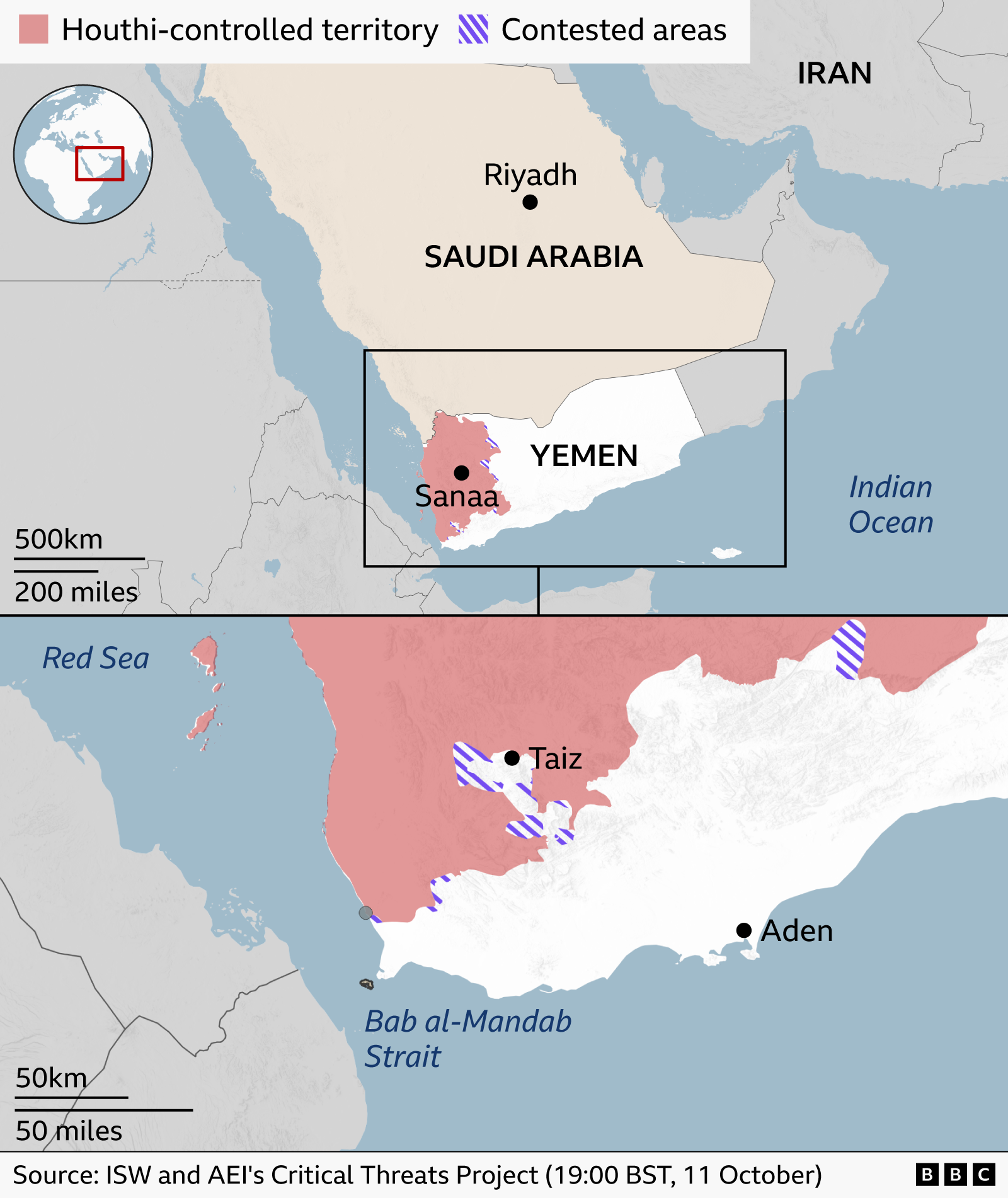
The report places the incident within renewed heavy fighting in Yemen’s civil war. Government forces said they had advanced in Marib province, northeast of Sanaa, with air support, and claimed to have secured key positions and neutralised more than 430 Houthi fighters in 24 hours. They also said they had destroyed or disabled more than 100 Houthi vehicles and military assets. In Taiz, government forces said they had repelled several large-scale Houthi attacks and captured a specialised drone team. Houthi forces have encircled Taiz by cutting its main road south to Aden, worsening displacement and an already severe humanitarian crisis.
Separately, the Saudi-led coalition said it had intercepted missiles and drones over Riyadh and elsewhere in Saudi Arabia. Saudi Arabia accused Iran of encouraging Houthi attacks, while Iran denied involvement and again offered to mediate between the Houthis and Riyadh. The article recounts the war’s origins in 2014, Saudi-led intervention in 2015, and the 2022 UN-backed truce, which halted most fighting. It also notes heightened tensions following a Houthi-declared naval blockade in July and territorial advances around Mocha, the western coast and the strategically important Bab al-Mandeb Strait in September.
Entities: Aden International Airport, Aden, Moammar al-Eryani, Majed al-Nazili, Houthis (Ansar Allah) • Tone: analytical • Sentiment: negative • Intent: inform
16-10-2026
Five people were killed and 16 injured when five Houthi ballistic missiles struck al-Maashiq Palace in Aden, the seat of Yemen’s internationally recognised government, according to officials. Information Minister Moammar al-Eryani said the prime minister and other ministers were unharmed. Health Minister Qasim Buhaibeh said those killed or injured included palace guards and civilian employees. Houthi military spokesman Yahya Sarea said the group had targeted what he called the Saudi military operations headquarters in Aden. Prime Minister Shaya Zindani condemned the attack and said it would not weaken government forces’ resolve to continue fighting.
The strike comes amid escalating attacks between the Houthis and Saudi Arabia, which leads a coalition backing Yemen’s government. The Houthis have launched missiles and drones at Saudi airports, energy facilities and military bases, describing their actions as retaliation for Saudi-led strikes and a blockade of territory they control. A recent missile attack at Riyadh’s international airport killed 13 people. Saudi Deputy Foreign Minister Rayed Krimly accused Iran of encouraging Houthi escalation and supporting the group; Iran has denied supplying weapons, while saying it supports the Houthis politically. There was no immediate Iranian response to the latest accusation.
Yemen’s civil war began in 2014, when the Houthis ousted the internationally recognised government from Sanaa. A Saudi-led coalition intervened in 2015. An informal ceasefire that had lasted four years began to unravel in July, and fighting intensified after Houthi advances near the Bab al-Mandab Strait, an important global shipping chokepoint. Government forces said they recently retook territory overlooking the strait with Saudi air support. Since 6 August, fighting has killed at least 1,282 people and injured 5,890, according to the government’s health ministry. The UN reports that 201,000 people have been displaced and suspected cholera cases have risen sharply.
Entities: Aden, Yemen, al-Maashiq Palace, Houthis, Moammar al-Eryani • Tone: analytical • Sentiment: negative • Intent: inform
16-10-2026
The CBS News live update reports developments in the Middle East conflict on October 15–16, 2026, with particular attention to maritime security, Iran, Yemen, Lebanon, and Saudi Arabia. A maritime monitor warned that ships in the Strait of Hormuz remain vulnerable to indiscriminate attacks even when they turn off tracking systems, and confirmed three vessel strikes that week. In Yemen, the Houthis attacked a presidential palace in government-controlled territory, causing deaths and injuries among security staff. The Saudi-led coalition said it intercepted a Houthi cruise missile over the Medina region; the Houthis denied the claim.
Iranian President Masoud Pezeshkian described the environmental effects of regional wars as “ecocide” and called for international condemnation and solutions. Separately, U.S. Secretary of State Marco Rubio urged Lebanese President Joseph Aoun not to return explosives seized from Hezbollah, and called for accountability over the shipment. Rubio also criticized Lebanon’s 1955 Boycott Law, arguing that it obstructs steps toward peace, and advocated direct military communication between Lebanon and Israel.
The report says the White House and Pentagon have prepared contingency plans for using a Massive Ordnance Air Blast bomb against Iranian military sites, while officials declined to confirm sensitive plans. It also reports that former Army Chief of Staff Gen. Randy George had warned before the war of a prolonged shortage of Patriot and THAAD missile-defense munitions, a shortage he expected to persist until 2030. Meanwhile, security concerns prompted postponements of Saudi Arabia’s Asian Tour golf finale and other sporting events. The final visible update begins with Aoun asking Rubio to press Israel to stop assaults in southern Lebanon, but the supplied article cuts off before completing that report.
Entities: Strait of Hormuz, Iran, Masoud Pezeshkian, Houthis, Yemen • Tone: analytical • Sentiment: negative • Intent: inform
16-10-2026
Former U.S. special envoy for Yemen Tim Lenderking warns that the Houthis have become a serious international security threat and are increasingly capable of acting independently of Iran. He says the group has developed indigenous weapons and targeting capabilities, even though Iran’s military assistance and training helped it become a powerful force. Saudi officials, he recalls, warned more than a decade ago that the Houthis were building their capabilities and pursuing an agenda to lead Yemen.
The warning follows a series of Houthi missile and drone attacks on Saudi Arabia. Saudi-led coalition spokesperson Turki al-Maliki said attacks on King Khalid International Airport in Riyadh from Oct. 7 through 11 killed 17 people and injured 333. He reported that the airport had been attacked 20 times since Oct. 1, and that one attack involved 10 drones, missiles and other projectiles. Reports also described missiles traveling more than 620 miles to Riyadh, the interception of two additional ballistic missiles, and a strike that damaged Aramco’s headquarters in Dhahran and started a fire.
Lenderking argues that the Houthis’ ability to strike targets with greater precision has transformed them from a regional insurgency into an international concern. Their control of Yemen’s western coast and their reach toward the northern Red Sea also threaten shipping and critical infrastructure. The attacks have raised questions about Saudi air defenses and whether the United States could be drawn into a wider regional conflict. Asked whether Washington would defend Saudi Arabia against further attacks, President Donald Trump replied, “You'll find out soon.” The article’s supplied text ends during its account of the Dhahran strike.
Entities: Tim Lenderking, Turki al-Maliki, Donald Trump, Houthis, Iran • Tone: urgent • Sentiment: negative • Intent: warn
16-10-2026
Missiles struck the grounds of Aden International Airport in southern Yemen on October 16, while a Yemenia Airways flight to Cairo was preparing to take off. No casualties were reported. Yemen’s Aden Security Department blamed the Iran-aligned Houthi group and said it was the airport’s second attack in less than a week, although the Houthis did not immediately claim responsibility.
Separately, the Saudi-led coalition said it intercepted a ballistic missile headed for Yanbu, a major Saudi oil-export hub on the Red Sea, and destroyed two cruise missiles and three drones. Saudi authorities also issued and then cleared security alerts for several areas, including Abha, Jazan and Khamis Mushait. The coalition said it had destroyed two ballistic missile launchers near Saada, where Houthi-affiliated media reported strikes.
The incidents come amid renewed fighting between the Houthis and the coalition backing Yemen’s internationally recognised government, and broader regional conflict following US and Israeli attacks on Iran in February. The article links insecurity around Yanbu and the Red Sea to concerns about shipping and global energy supplies. Brent crude briefly reached US$110 a barrel on October 16, its highest level since May. Yanbu provides Saudi Arabia with a route for oil exports that avoids the Strait of Hormuz, which the article says Iran has largely throttled.
The fighting has also heightened concern about Yemen’s humanitarian crisis, with aid agencies warning that conditions are deteriorating rapidly. The conflict began in 2014, followed by Saudi-led intervention in 2015 and a truce in 2022 that lasted until 2026. A Houthi-run health ministry spokesperson claimed that 124 civilians had been killed and 327 wounded since the latest escalation began on September 3; Reuters said it could not independently verify those figures.
Entities: Aden International Airport, Aden, Yemen, Yanbu, Saudi Arabia, Saudi-led coalition, Houthi group • Tone: analytical • Sentiment: negative • Intent: inform
16-10-2026
The supplied page identifies itself as a live Middle East news update dated October 16, 2026, and leads with a report that the death toll from a Houthi attack on Yemen’s presidential palace has risen to five. The excerpt does not provide details about the victims, the circumstances of the palace attack, or how the updated toll was confirmed. Its other headlines describe a rapidly developing regional security situation: a Saudi-led coalition reportedly intercepted a drone targeting Saudi Arabia’s Eastern Province and a cruise missile over Madinah, while the Houthis threatened retaliatory attacks and warned that Saudi airports were unsafe. The page also says an EU-GCC summit was postponed amid the attacks and that the Houthis were urged to lift their siege of Taiz, with Yemen warning of a humanitarian catastrophe.
Additional linked headlines point to related developments, including attacks in Riyadh, a funeral for an Egyptian flight attendant killed in an attack there, and comments by Jordan’s King calling for work on de-escalation. Other headlines concern economic risks to Gulf recovery, missing Indian seafarers after a drone attack in the Gulf of Oman, and US military action involving vessels in the Gulf of Oman and an Iran blockade. One teaser says former US President Donald Trump was considering joining Saudi strikes after an attack on Riyadh airport.
The provided material is largely a collection of headlines and video labels rather than a full article or complete live blog. It therefore establishes the reported events and the breadth of regional concerns, but offers little supporting detail, chronology, attribution beyond the brief headline wording, or explanation of the parties’ positions. The central themes are escalating attacks, threatened retaliation, regional security, and the risk of humanitarian and economic consequences.
Entities: Houthis, Yemen, Yemen's presidential palace, Saudi Arabia, Saudi-led coalition • Tone: urgent • Sentiment: negative • Intent: inform
16-10-2026
Yemen’s internationally recognised government will continue operating from Aden despite a Houthi missile attack on the presidential palace, according to Marwan Ali Noman, an adviser to Foreign Minister Afrah Al Zouba. Noman said the attack would not disrupt public life or weaken state authority, and that the government remained committed to its constitutional responsibilities and campaign against the Houthis. The government has directed military and security authorities to protect state institutions and respond to threats.
Yemen’s Health Ministry reported that five security personnel were killed and 16 injured in Thursday’s strike on Al Maashiq Palace. The attack was the first Houthi targeting of the palace since fighting resumed last month after a four-year lull. The government is continuing Operation Dawn of Yemen, launched this month with the stated aim of retaking the country, including the capital Sanaa, which the Houthis seized in 2014, and restoring state institutions.
The article also describes the wider conflict. Government forces, supported by the Saudi-led coalition, have partly reversed Houthi advances along the Red Sea coast in south-west Yemen. The Houthis continue to besiege Taiz, contributing to shortages of food, fuel and other essentials. They have also carried out missile and drone attacks on Saudi airports and oil sites in recent weeks; the article reports 19 people killed and hundreds injured, with most casualties resulting from an October 10 strike on Riyadh’s King Khalid International Airport. Saudi coalition forces said they intercepted a drone heading towards the kingdom’s Eastern Province on Friday.
Finally, the article notes recent Saudi-Syrian diplomatic contacts. Syria’s Foreign Minister Asaad Al Shibani met Saudi officials in Riyadh, following President Ahmad Al Shara’s visit earlier in the month. Reports that Riyadh had asked Damascus to send troops to help counter the Houthis were strongly denied by Syria.
Entities: Marwan Ali Noman, Afrah Al Zouba, Aden, Al Maashiq Palace, Yemen’s internationally recognised government • Tone: neutral • Sentiment: negative • Intent: inform