16-10-2026
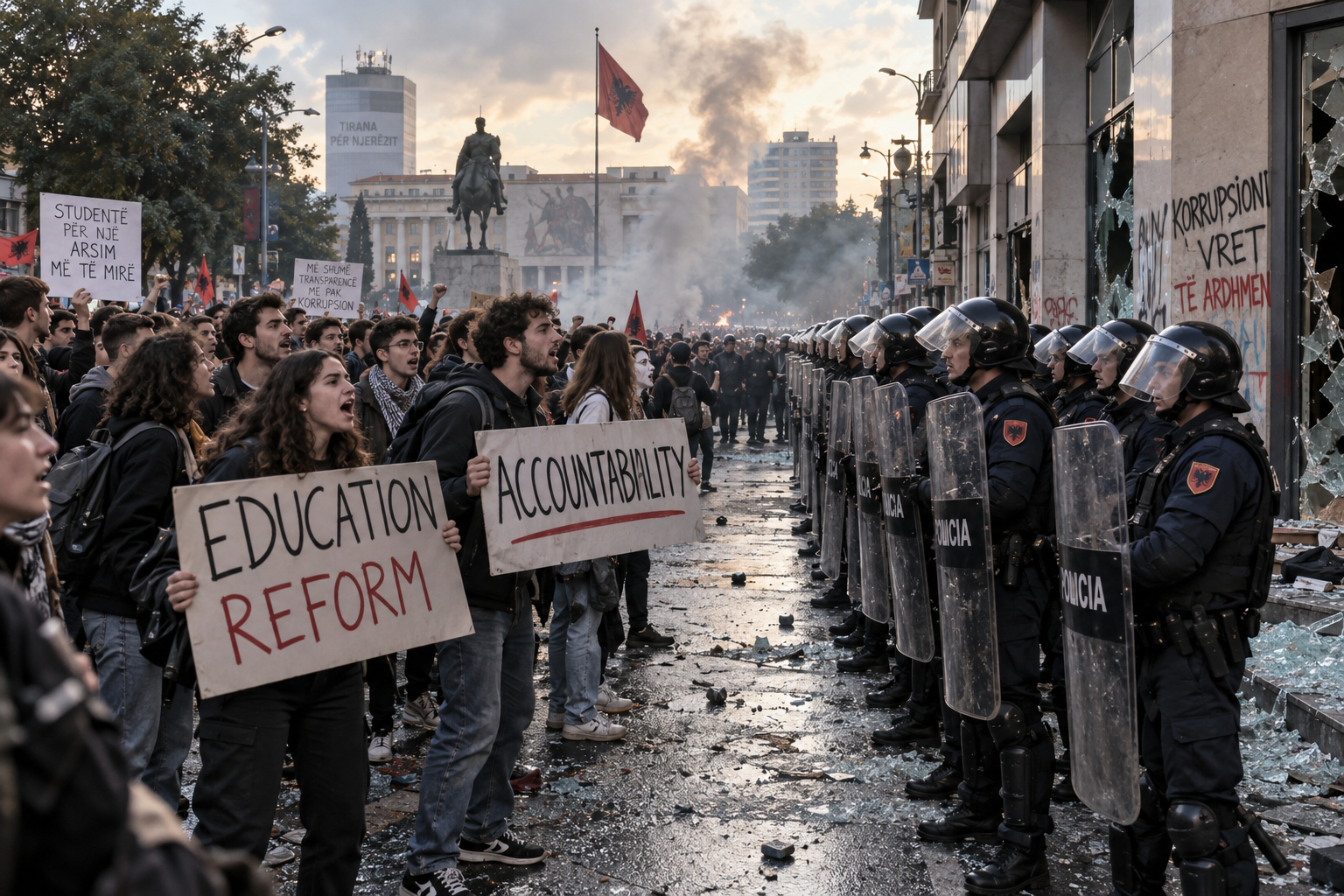
Albania has seen several days of violent protests in Tirana and other major cities, following months of largely peaceful demonstrations against Prime Minister Edi Rama. The latest protests were presented as a student movement focused on education costs and the cost of living, with secondary-school pupils joining. Clashes escalated when masked protesters threw stones and police responded with water cannon, tear gas and batons. Government buildings were attacked and set on fire, and dozens of police officers were injured. Images of an injured young protester and the government’s failure to address longstanding demands have further inflamed public anger.
The unrest overlaps with the “Flamingo” movement, whose supporters spent much of the summer calling for Rama to resign. That movement began in opposition to a luxury tourism development on the Adriatic coast associated with Jared Kushner, amid concerns about its environmental impact. More broadly, demonstrators have voiced anger over corruption allegations involving senior officials. While Flamingo protesters say they are not aligned with political parties, some young people describe the current violence as a new phase after months of peaceful protests they felt were ignored or mocked. It remains unclear whether the two movements are formally connected.
Rama has rejected calls to resign, said he would address legitimate concerns, and accused opposition leader Sali Berisha of encouraging the violence. Berisha’s Democratic Party has previously sought to mobilize protests, but its supporters have been fewer than those taking part in the current demonstrations. Albanian media have also raised claims of foreign involvement, including speculation about Serbia, but the article describes these allegations as unfounded. The unrest is being closely watched in Europe as Albania seeks EU membership. For visitors, violence has so far remained contained, but the UK government advises avoiding demonstrations and large gatherings and following local authorities’ guidance. The unrest could also damage tourism and Albania’s European ambitions.
Entities: Albania, Tirana, Edi Rama, Sali Berisha, Jared Kushner • Tone: analytical • Sentiment: negative • Intent: inform
16-10-2026
Student protests in Tirana, Albania, have escalated into violent clashes after months of demonstrations against Prime Minister Edi Rama’s government. The protests began in late May as part of the “Flamingo Revolution,” prompted by a multimillion-euro tourism development linked to Jared Kushner in the protected coastal area of Zvernec. They have since broadened into a challenge to the government and the political establishment more generally.
Students have boycotted classes and taken to the streets over university conditions, higher education costs, poor job prospects, economic hardship and corruption. Their central demand is Rama’s resignation, and they say they will not negotiate other demands with him. Over three days, fires damaged bins, businesses, buildings and banks, while tear gas filled the streets. Authorities reported 152 arrests, 324 people under investigation and 71 injured police officers; injuries were also reported among demonstrators.
Rama initially remained silent, then blamed opposition forces for the violence and rejected calls to step down, arguing that governments change through elections. He also alleged that foreign actors were trying to obstruct Albania’s European Union accession. The EU called for calm, restraint and dialogue. Opposition leader Sali Berisha denied responsibility for the violence, supported the protest and demanded Rama’s immediate resignation.
Student and civil society voices describe the revolt as the result of months of ignored peaceful protests, economic strain, corruption cases and political scandals. Some demonstrators reject not only Rama’s administration but the political class that has governed Albania for decades. Analysts see the protests as a generational turning point, while warning that Rama’s resignation or new elections alone may not create new leadership without a credible political alternative. One proposed route is for the president to convene parties and establish a nonpartisan caretaker government ahead of local and parliamentary elections scheduled for May 2027.
Entities: Edi Rama, Samanta, Sali Berisha, Rigels Xhemollari, Skerdi Topalli • Tone: analytical • Sentiment: negative • Intent: inform
16-10-2026
Albanian Prime Minister Edi Rama called for calm on Friday as anti-government protests continued for a fourth consecutive day, accusing unnamed “foreign hands” of fueling the unrest. Police said 160 people had been detained after violent incidents on Thursday evening. Rama alleged that outside forces were working against Albania’s stability and had influenced the opposition, but he did not identify them.
Thousands of young people gathered in Tirana, where protesters called for Rama’s resignation and education reforms. Demonstrations included acts of vandalism: some participants smashed windows, damaged traffic lights, set rubbish bins on fire to block roads, and threw stones at police. Police responded with tear gas and water cannon. A high school student said the government’s indifference and arrogance had worsened the situation. Eighteen-year-old protester Ledia said participants were not criminals and wanted a better life in Albania rather than having to leave the country.
The demonstrations began on Tuesday and have spread from Tirana to other Albanian cities. Students have also boycotted classes. The latest escalation follows months of anti-government protests, including opposition to a luxury tourism development linked to Ivanka Trump and Jared Kushner. That project has become a symbol of allegations of corruption and inequality in Albania.
On Wednesday, the European Union delegation in Albania called on authorities to respond proportionately and voiced concern about the violent escalation in Tirana. Rama’s Socialist Party won a fourth consecutive election victory last year; parliamentary elections are not due again until 2029. His government has set a goal of joining the European Union by 2028.
Entities: Edi Rama, Albania, Tirana, Albanian Socialist Party, European Union delegation in Albania • Tone: neutral • Sentiment: negative • Intent: inform
16-10-2026
Clashes between protesters and police continued in Tirana on Friday for a fourth day, as Albanian Prime Minister Edi Rama accused unnamed “foreign hands” of encouraging unrest and trying to obstruct Albania’s bid to join the European Union. Police fired tear gas and water cannons, while demonstrators threw stones and set fire to rubbish bins to block roads. Fighting continued into the night, and protesters reportedly tried to enter government offices on the capital’s main boulevard.
Thousands of people have demonstrated since Tuesday, demanding Rama’s resignation and protesting university conditions and high tuition fees. The unrest has also spread to other cities, where smaller-scale violence and student boycotts have been reported. One 18-year-old protester told AFP that demonstrators wanted a better life in Albania and did not want to leave the country, while criticizing what she described as the government’s indifference and arrogance.
The week’s violence has included smashed shopfronts, looting and attacks on government buildings, including the finance ministry. Police said 160 people were detained for violent acts on Thursday. Interior Minister Ervin Demo said 156 people had been injured in recent days, including 97 police officers. He called for the country to work together rather than clash, characterized the protests as an attempt to seize power through violence, and acknowledged that excessive police force had been recorded in two instances; two officers were suspended.
The demonstrations form part of months of anti-government protests, initially sparked by a controversial resort development linked to US President Donald Trump’s family. Rama rejected the claim that the demonstrations reflect people’s hardships or legitimate aspirations. He blamed foreign actors for fuelling unrest and said they did not want Albania to be at peace. The article notes that Rama has repeatedly accused protesters of being manipulated by foreign interests, without providing details or evidence.
Entities: Tirana, Albania, Edi Rama, Ervin Demo, Ledia • Tone: analytical • Sentiment: negative • Intent: inform
16-10-2026
Thousands of young people demonstrated in Tirana on Friday, the fourth day of a student-led campaign demanding the resignation of Prime Minister Edi Rama. The protests have spread to other Albanian cities and become increasingly violent. In Tirana, demonstrators broke windows and traffic lights; the previous day, a riot included smashed windows, a bank raid and clashes with police. Protests in Lezha, Elbasan, Shkodra and Korca also involved stone-throwing, broken windows and burning rubbish bins. Students say they had protested peacefully for 140 days without being heard and are now resorting to more disruptive action to demand their rights. They accuse officials of corruption and neglecting education, and oppose plans for a luxury resort on Albania’s coast. The project is backed by Jared Kushner, the son-in-law of US President Donald Trump, and has faced legal challenges. Reuters reported that villagers say their land was wrongfully sold, and that the man who sold it was wanted by prosecutors on drug-trafficking charges, which his lawyer denied. Reuters found no evidence of wrongdoing by Kushner, who is not directly involved in the villagers’ dispute. Rama, who is serving a fourth term and has pledged to bring Albania into the European Union as early as 2028, said the government would not yield to violence. Some local businesses expressed support for the students while asking protesters not to damage their premises. Analyst Afrim Krasniqi said young people see little future in Albania and believe national resources are controlled by oligarchs. The article places the unrest amid wider concerns about corruption, criminal money laundering and Albania’s EU accession efforts, and notes parallel student activism in France over school conditions and resources.
Entities: Tirana, Albania, Edi Rama, Jared Kushner, Donald Trump • Tone: analytical • Sentiment: negative • Intent: inform