14-09-2026
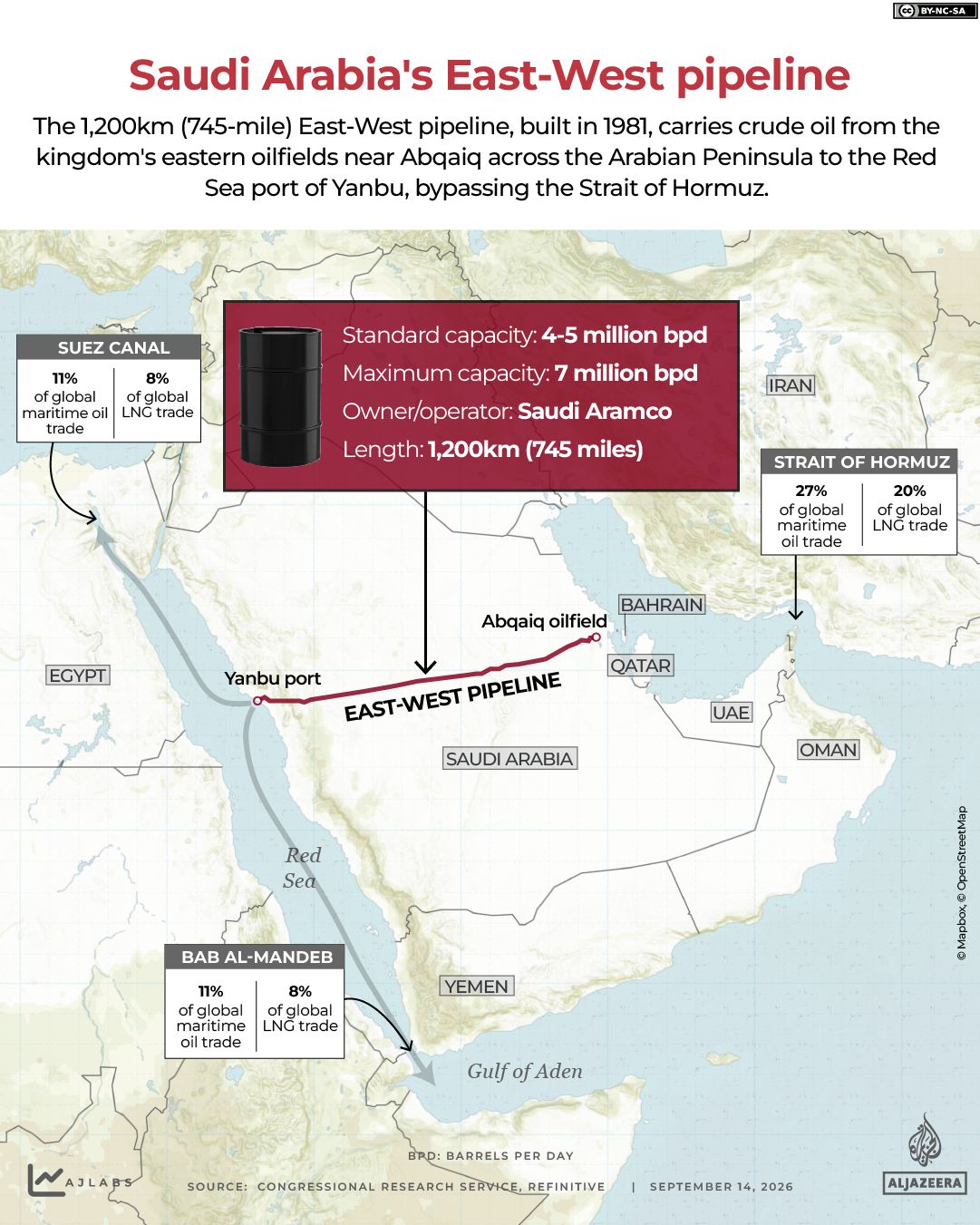
Saudi Arabia’s East-West oil pipeline, also known as the Petroline, was shut down after drone attacks damaged infrastructure and caused injuries in the Riyadh and Medina regions. The 1,200km pipeline connects Saudi Arabia’s oil fields in the east with the Red Sea port of Yanbu, allowing the kingdom to bypass the Strait of Hormuz. This alternative route has become increasingly important since the outbreak of the US-Israel war on Iran in February, which has severely reduced shipping through the strait, while Houthi attacks have made Red Sea routes more dangerous.
The pipeline has a maximum capacity of seven million barrels per day, although recent flows have varied. Saudi Arabia increased westbound shipments to approximately four to five million barrels per day during the conflict, equivalent to roughly 4–5 percent of global oil supply. The shutdown therefore threatens one of the few remaining routes for moving Saudi crude when Gulf shipping is already heavily disrupted.
The damage’s severity remains uncertain. Reuters sources estimated repairs could take five to six weeks, although other sources suggested operations might resume sooner. Saudi authorities said the drones were traced to Maysan province in southeastern Iraq, where Iran-aligned armed groups have a longstanding presence.
Yanbu reportedly has enough stocks to sustain exports for five to seven days, with Egyptian storage facilities providing additional short-term support. However, global inventories are already declining. The International Energy Agency projects that world oil supplies will fall by about 5.7 million barrels per day this year. Strategic stockpiles and reserve releases have so far limited price increases, but prolonged disruptions could push Brent crude substantially higher, potentially toward $150 per barrel if inventories reach exceptionally low levels. Further threats to Yanbu, refining infrastructure, or shipping routes could leave Saudi Arabia unable to compensate for lost exports and intensify pressure on an already tight global oil market.
Entities: Saudi Arabia, East-West pipeline (Petroline), Strait of Hormuz, Yanbu, Red Sea • Tone: analytical • Sentiment: negative • Intent: inform
14-09-2026
Fighting has intensified in Yemen’s southwestern Taiz province, where forces aligned with the internationally recognised government have retaken positions from the Houthis and advanced along western front lines. Al Jazeera Arabic correspondent Yasser Hassan reported that the government forces repelled a Houthi offensive with support from Saudi-led air strikes targeting Houthi positions around Mocha, Dhubab and nearby areas.
The escalation has also spread across Yemen’s borders. The Houthis, also known as Ansar Allah, claimed that they launched dozens of ballistic missiles and drones at Saudi military facilities and infrastructure, including aircraft hangars, radar installations, runways and ammunition depots at King Khalid airbase near Khamis Mushait. The group said the attacks were retaliation for more than 300 Saudi air strikes across Yemen over five days. Saudi Arabia had not immediately commented, although civil defence alerts issued for Abha and the Khamis Mushait region were later lifted.
The renewed violence threatens a United Nations-brokered truce that ended large-scale fighting in 2022. According to the article, the conflict reignited in July after the Houthis declared a maritime blockade on Saudi Arabia and began targeting ships in the Red Sea. The fighting has reportedly affected strategic territory around the Bab al-Mandeb strait, a major global trade route, and the Houthis have captured parts of the Red Sea coast and deployed fighters on the islands of Greater Hanish and Lesser Hanish.
The conflict is creating a worsening humanitarian crisis. The International Organization for Migration said that nearly 86,000 people had been displaced inside Yemen in recent weeks, while more than 2,000 others had fled across the water to Djibouti. The article presents the latest battlefield developments, regional attacks, strategic maritime consequences and growing civilian displacement as signs that Yemen’s fragile ceasefire framework is under severe strain.
Entities: Yemen, Taiz province, Yemeni government forces, Houthis (Ansar Allah), Saudi Arabia • Tone: urgent • Sentiment: negative • Intent: inform
14-09-2026
Satellite imagery from Vantor, published through Getty Images, shows extensive fire damage at a pumping station on Saudi Arabia’s East-West oil pipeline following drone strikes on September 11, 2026. The pipeline, also known as Petroline, runs approximately 750 miles from Abqaiq on Saudi Arabia’s eastern Gulf coast to Yanbu on the Red Sea. It is a strategically important alternative export route that allows Saudi Arabia to bypass the Strait of Hormuz, particularly as fighting between the United States and Iran continues.
Saudi Arabia temporarily closed the pipeline on Friday as a precaution after several drone attacks launched from Iraq targeted sections of the system in the Riyadh and Medina regions. The Saudi government said several people were injured. The imagery shows burned structures and large blackened areas around the pumping station, providing a visual indication of the strikes’ impact.
The East-West pipeline has an estimated total design capacity of 7 million barrels per day after recent expansions. Its closure comes amid broader threats to regional energy infrastructure and maritime trade. Yemen’s Iran-backed Houthis have intensified attacks on targets in Saudi Arabia and launched a ground offensive aimed at controlling the Bab el-Mandeb Strait, a major oil and shipping chokepoint linking the Red Sea and the Gulf of Aden. Any escalation against shipping in the Red Sea could have significant consequences for global trade and energy markets.
Oil prices have risen sharply as concerns about Middle Eastern supply disruptions deepen. Brent crude futures for November delivery increased 3.3% to $108.02 per barrel on Monday, extending a gain of more than 20% over the previous month. West Texas Intermediate futures rose nearly 3% to $102.98 per barrel and had gained almost 25% over the month, surpassing $100 for the first time since May.
Entities: Saudi Arabia, East-West oil pipeline (Petroline), Vantor satellite imagery, Getty Images, Abqaiq • Tone: analytical • Sentiment: negative • Intent: inform
14-09-2026
Saudi Arabia has shut down its East-West oil pipeline after drone attacks in the Riyadh and Medina regions, raising concerns about the kingdom’s ability to maintain crude exports to Europe and Asia. The Saudi energy ministry said the shutdown was a precautionary measure while emergency and technical teams assess the pipeline and secure it, but it did not provide a restart timeline or a detailed account of the damage. Saudi and Iraqi officials said the attack originated in Iraq.
Traders and oil buyers cited in reports estimated that a prolonged shutdown could place as much as 4 million barrels per day at risk, equivalent to roughly 4% of global oil supply. However, Saudi authorities have not confirmed those figures. Stored oil at the Red Sea port of Yanbu could reportedly sustain exports for five to seven days, depending on available inventories and the speed at which pumping resumes.
The approximately 1,200-kilometre pipeline transports oil from eastern Saudi Arabia to Yanbu, allowing exports to avoid the Strait of Hormuz. Although the pipeline has a maximum capacity of 7 million barrels per day, the shutdown would not immediately remove that entire volume from global markets because tankers can continue loading oil already stored near export terminals. Those supplies would eventually decline without new deliveries.
Exports to Europe can travel through the Red Sea, Suez Canal and Mediterranean, while Asian shipments normally pass through Bab el-Mandeb. That route faces threats from Yemen’s Houthis, and an alternative voyage around Africa would be significantly longer. The disruption comes as global oil inventories and Gulf exports have already fallen sharply. Brent crude rose about 3% in early Monday trading, while diesel prices in Europe and Asia increased as fuel supplies tightened.
Entities: Saudi Arabia, East-West oil pipeline, Riyadh and Medina regions, Yanbu, Red Sea • Tone: analytical • Sentiment: negative • Intent: inform
14-09-2026
Oil prices climbed sharply on September 14, 2026, after Saudi Arabia suspended operations on its East-West oil pipeline following multiple attacks in the Riyadh and Madinah regions. Brent crude, the benchmark for roughly two-thirds of the world’s oil, rose as much as 3.7 per cent before easing to a 3.19 per cent gain at $107.95 a barrel. West Texas Intermediate increased 3.14 per cent to $103.19.
Saudi Arabia’s Energy Ministry said the pipeline shutdown was a precautionary measure after the attacks, which caused several injuries. The ministry did not provide details on possible pipeline damage or say when crude flows would resume. The East-West pipeline links oil production facilities in Saudi Arabia’s Eastern Province with Yanbu on the Red Sea coast and has a total pumping capacity of about seven million barrels per day.
The pipeline is particularly important because it enables Saudi Arabia to export crude through Yanbu while avoiding the Strait of Hormuz, where shipping has been severely disrupted amid the US-Iran war. Its closure removes a major alternative route for Gulf oil exports and heightens concerns about a global supply shortage.
Ahmad Assiri, a research strategist at Pepperstone, said the pipeline had reportedly carried between six million and seven million barrels per day before the suspension, equivalent to 30 to 40 per cent of crude supplies from the Gulf. He said oil prices had already moved above $100 and briefly approached $110 in response to the closure. If the disruption continues, markets could reprice crude significantly higher, potentially reaching levels seen earlier in the conflict. Assiri added that escalating regional tensions may have exhausted temporary measures for managing supply disruptions and that a lasting resolution to the Strait of Hormuz crisis may now be required.
Entities: Saudi Arabia, East-West oil pipeline, Saudi Arabia’s Energy Ministry, Riyadh, Madinah • Tone: analytical • Sentiment: negative • Intent: inform