14-09-2026
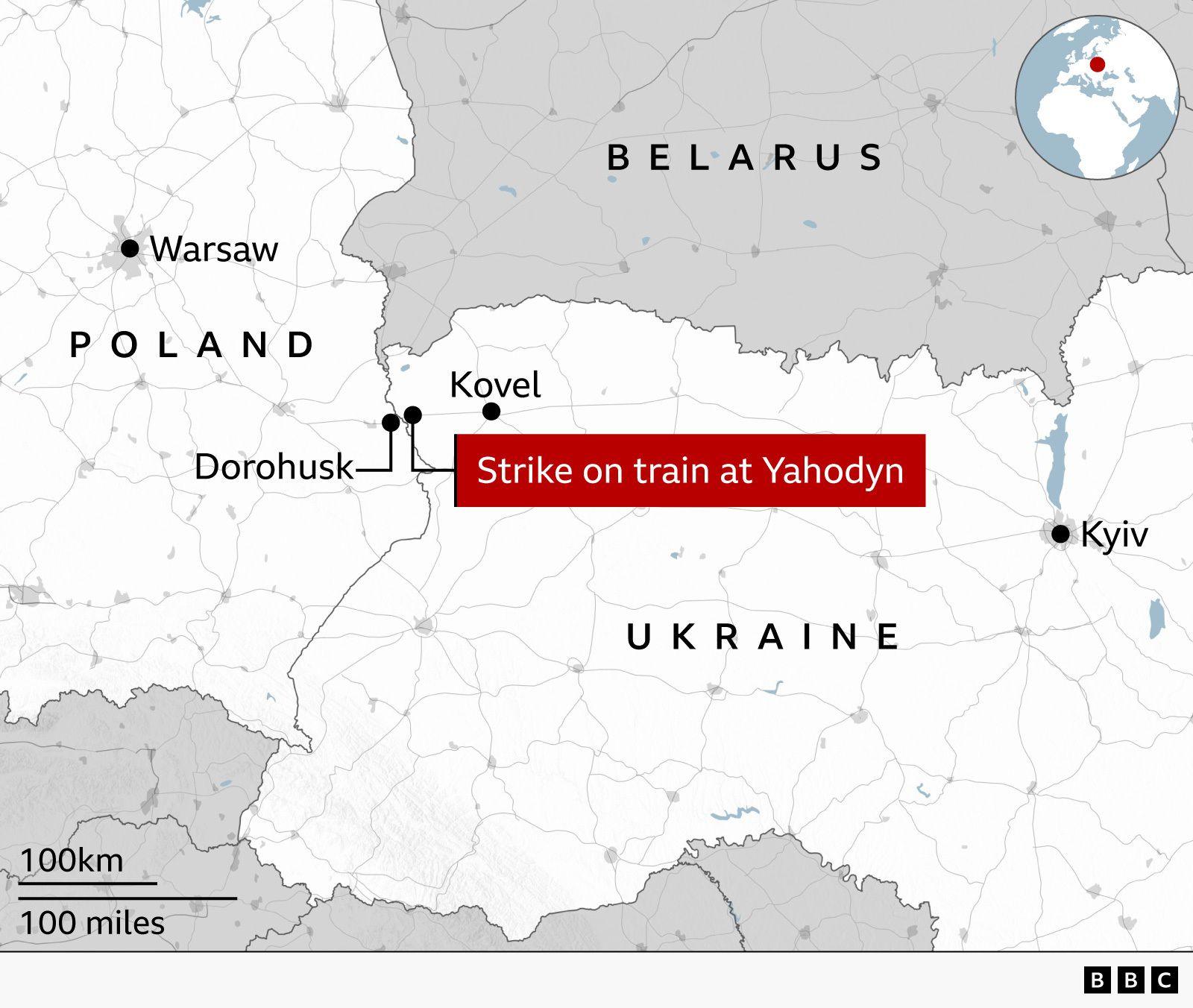
Drone strikes in western Ukraine caused fires and temporary disruption near the Yahodyn-Dorohusk border crossing with Poland, a major route for military and humanitarian supplies. Falling drone debris ignited a petrol station and several trucks near the crossing, according to Valentyna Chernysh of the Volyn Customs Service. The checkpoint itself was not damaged, and no injuries were reported. Border operations were suspended during an air-raid alert while customs workers and travellers sought shelter, but processing later resumed as emergency crews responded to the damage. Images from the scene showed firefighters and other emergency personnel at the petrol station, along with damage to a nearby road.
The strikes formed part of a wider overnight Russian drone attack on several areas of western Ukraine, a region that has generally experienced less intense fighting than the country’s eastern areas. A Kyiv-Warsaw passenger train was also hit near the border. Ukraine’s state railway operator, Ukrzaliznytsia, said the train’s locomotive was damaged approximately two kilometres from Poland. Passengers and crew were evacuated after receiving advance warning, and no one was injured.
Ukrainian Foreign Minister Andrii Sybiha described the attacks as a direct threat to the European Union and NATO, calling them “Putin’s terror ‘knocking’ directly on the doors of the EU and NATO.” He urged European countries to strengthen sanctions against Moscow. Polish officials said the strike site was approximately 800 metres from the Polish border and confirmed that there were no injuries on the Polish side. Ukrainian and Polish authorities continued assessing the damage and broader impact of the attacks.
Entities: Yahodyn-Dorohusk border crossing, Western Ukraine, Volyn Customs Service, Valentyna Chernysh, Suspilne • Tone: urgent • Sentiment: negative • Intent: inform
14-09-2026
The article reports that a Russian drone struck a Ukrainian train near Ukraine’s border with Poland. The incident occurred shortly after former UK Prime Minister Boris Johnson and other diplomats had departed from the station, making the timing a central feature of the report. According to Ukrainian authorities, passengers on the affected train had been instructed to evacuate approximately 15 minutes before the strike took place.
The report presents the event as a potentially serious security incident involving civilian rail transport in an area close to an international border. The presence of Johnson and other diplomats shortly before the attack adds political and diplomatic significance, although the article does not state that they were targeted or that they remained in danger after leaving the station. It also does not provide details about casualties, the extent of damage, the precise location of the station, the train’s destination, or the reason for the evacuation order.
The account is brief and relies primarily on information attributed to Ukraine. It does not include a response from Russia, independent verification of the strike, or additional context about the wider military situation. The wording emphasizes the narrow interval between the diplomats’ departure, the evacuation warning, and the drone attack. Overall, the article informs readers about a reported strike on railway infrastructure and highlights the potential risks faced by passengers and high-profile visitors in a conflict zone. Its focus is on the timing of the attack and the evacuation of passengers rather than on broader political analysis or detailed battlefield developments.
Entities: Russia, Ukraine, Boris Johnson, United Kingdom, Poland • Tone: urgent • Sentiment: negative • Intent: inform
14-09-2026
A Russian drone struck the engine of a Ukrainian passenger train at Yahodyn, about 2km from the Ukraine-Poland border, shortly after former UK Prime Minister Boris Johnson and senior European security officials had traveled through the area on a separate train. No casualties were reported, and all passengers on the targeted train were evacuated. Ukrainian railway authorities said the evacuation order came only 15 minutes before the strike, while the diplomatic train carrying Johnson and officials had departed earlier than scheduled because of ongoing threats. The train carrying the officials crossed into Poland approximately 30 minutes before the attack.
Russia’s Defence Ministry said it had targeted railway infrastructure. Ukraine’s state railway company, Ukrzaliznytsia, suggested that the drone may have been aimed at the diplomatic train. Johnson described the attack as a random and senseless assault on civilians and called for more air-defence interceptors for Ukraine. Former CIA director David Petraeus, who was at Yahodyn station, called the incident terrifying. Ukrainian Foreign Minister Andrii Sybiha said the strike showed that Russian aggression was reaching the borders of the EU and NATO. Polish Prime Minister Donald Tusk held an emergency meeting, while EU foreign-policy chief Kaja Kallas accused Moscow of trying to intimidate Western countries. Kremlin spokesman Dmitry Peskov confirmed that Russian forces were operating throughout Ukraine but did not specifically address the alleged targeting of the officials.
The incident comes amid intensified Russian attacks on Ukrainian railways, depots, border crossings and other infrastructure. Ukraine reported that 85 of 108 Russian drones launched overnight had been destroyed, while three people were killed in a separate strike on an agricultural warehouse. The article also describes recent fatal attacks on a border crossing, a passenger train and a railway depot. Because Ukraine’s airspace has been closed since Russia’s full-scale invasion in 2022, its rail network remains essential for civilian transport. The article places the strike within wider accusations of Russian sabotage and attacks across Europe, alongside reciprocal Ukrainian and Russian claims of attacks on transport infrastructure.
Entities: Boris Johnson, Jonathan Powell, David Petraeus, Vladimir Putin, Andrii Sybiha • Tone: urgent • Sentiment: negative • Intent: inform
14-09-2026
A Russian drone struck the locomotive of a passenger train at a railway station in Ukraine’s Volyn region, approximately two kilometers from the Polish border. The attack occurred shortly after a diplomatic train carrying former British Prime Minister Boris Johnson and other European diplomats had been at the station. The incident has prompted senior European officials to warn that Moscow is attempting to intimidate Ukraine’s supporters and divide European countries.
EU foreign policy chief Kaja Kallas said the attack was intended to discourage Western governments from supporting Ukraine or visiting the country. She argued that Europe should respond by demonstrating greater solidarity and refusing to be intimidated. Finnish Prime Minister Petteri Orpo likewise called for increased assistance to Kyiv, stronger sanctions, and additional political measures against Russia, emphasizing European unity.
Lithuanian President Gitanas Nauseda described the strike as part of a broader Russian challenge to Europe’s rule of law, democratic systems, and way of life. French Foreign Affairs Minister Jean-Noel Barrot said Russia’s goal was to frighten Europeans and create divisions within the EU and NATO. He argued that Europe’s unity was its main source of strength.
Germany’s Foreign Minister Boris Pistorius adopted a more cautious position, saying the incident should be taken seriously but warning that European governments must not be pushed into an escalation with Russia. The Kremlin has offered limited public comment, stating only that Russian forces operate throughout Ukrainian territory and will continue doing so. Ukraine’s Foreign Minister Andriy Sybiga said the attack showed that Russian President Vladimir Putin regards Russia as effectively being at war with Europe. Overall, the article presents the strike as a test of European resolve, while noting disagreement over how strongly and rapidly Europe should respond.
Entities: Kaja Kallas, Boris Johnson, Petteri Orpo, Gitanas Nauseda, Jean-Noel Barrot • Tone: analytical • Sentiment: negative • Intent: inform
14-09-2026
The France 24 video examines how the European Union may respond to Russian strikes that hit a Warsaw-bound train near Ukraine’s border with Poland. The incident occurred shortly after senior Western figures had passed through the area, adding to concerns that the attack was intended not only to damage Ukrainian infrastructure but also to send a warning to Ukraine’s international supporters.
Kaja Kallas, the EU’s foreign policy chief, said the strikes were clearly designed to intimidate Western countries and discourage them from supporting Ukraine or visiting the country to demonstrate solidarity. She argued that the intended response should be the opposite: Kyiv’s backers should not be deterred and should continue providing political support and visibly standing with Ukraine.
The report frames the incident as part of a broader escalation involving Russia, Ukraine, Poland and the wider European security environment. Because the train was traveling toward Warsaw and the strike occurred close to Poland, the attack carries particular significance for an EU and NATO member bordering Ukraine. The proximity to Poland and the timing after visits by Western officials raise concerns about possible Russian efforts to pressure or intimidate European governments.
France 24 correspondent Dave Keating reports from Brussels, focusing on the likely political implications for the EU. The available article text does not detail a specific package of sanctions, military measures or other formal EU decisions. Instead, it highlights Kallas’s initial political message: that Russia’s apparent attempt to scare away Ukraine’s supporters should strengthen, rather than weaken, European resolve to assist Kyiv.
Entities: European Union (EU), Russia, Ukraine, Poland, Warsaw • Tone: analytical • Sentiment: negative • Intent: inform
14-09-2026
France 24 reports that Russia launched a large overnight drone assault against Ukraine, firing 453 drones as part of what the outlet describes as a ramped-up air campaign. The attack prompted heightened concern in neighboring Poland after one of the drones struck approximately 800 metres from a border crossing. In response, the Polish military scrambled fighter jets and helicopters to monitor and respond to the potential cross-border threat.
The incident has raised warnings about a possible escalation of the conflict beyond Ukraine’s borders. Although the report does not provide details about casualties, damage, the precise location of the strike, or whether the drone intentionally approached Polish territory, its proximity to a Polish border crossing underscores the risks posed by Russia’s intensified aerial operations. The deployment of Polish aircraft signals the seriousness with which Warsaw treated the incident and reflects broader regional anxiety over spillover from the war.
The two-minute France 24 video, issued on 14 September 2026, focuses on the scale of the drone attack and Poland’s military response. It does not provide further information about the outcome of the intercepted or targeted drones, nor does it describe any official explanation from Moscow or Kyiv. The report’s central message is that Russia’s continuing air campaign is increasing pressure on Ukraine while creating new security concerns for NATO-member Poland. The episode illustrates how attacks near Ukraine’s western frontier can quickly become a regional security issue, particularly when military forces in neighboring countries are placed on alert.
Entities: Russia, Ukraine, Poland, France 24, Russian drone assault • Tone: urgent • Sentiment: negative • Intent: inform
14-09-2026
France 24 reports on a Russian strike that hit a Warsaw-bound train near Ukraine’s border with Poland. The incident occurred shortly after senior Western figures had passed through the area, prompting questions about whether the attack was intended not only as a military action but also as a warning to countries supporting Ukraine. The European Union’s top diplomat said the strikes were designed to “scare” Kyiv’s backers and discourage continued Western assistance.
The report is presented by France 24 correspondent Gulliver Cragg from Kyiv. Its central focus is the possible political and psychological purpose of the train strike: whether Russia sought to intimidate Western governments by demonstrating that transport routes near NATO territory or the Polish-Ukrainian border could be placed at risk. The brief provided text does not identify the train’s passengers, specify the exact location of the strike, or provide details about casualties, damage, or the Russian government’s response. It also does not include a full interview, timeline, or independent assessment of the EU diplomat’s claim.
The item therefore frames the event primarily as a question of signaling and escalation. By highlighting the timing of the attack and its proximity to Poland, the report connects the incident to broader concerns over Russia’s attempts to pressure Ukraine’s international supporters. The story remains measured and attribution-based, presenting the EU diplomat’s interpretation rather than asserting definitively that intimidation was the strike’s purpose. Overall, the video aims to inform viewers about the incident and its possible implications for Western involvement in the war in Ukraine.
Entities: Russia, Ukraine, Poland, Warsaw, European Union • Tone: analytical • Sentiment: neutral • Intent: inform
14-09-2026
A Russian drone struck a locomotive at or near Yahodyn railway station in northwestern Ukraine, close to the Ukraine-Poland border, on Sunday, according to Ukraine’s state rail operator, Ukrzaliznytsia. The attack occurred shortly after a diplomatic train carrying former British Prime Minister Boris Johnson, former Swedish Prime Minister Carl Bildt, and security advisers from several European Union countries had departed the station ahead of schedule. The officials were returning from the Yalta European Strategy conference in Kyiv.
Ukrzaliznytsia said it was highly probable that the diplomatic train had been the intended target. Bildt posted video of the attack and said that the struck train was not theirs, but another train that passed through the border crossing only minutes later. That train was evacuated as the drone approached, and no one was injured. Bildt said his own train received an evacuation warning.
A separate train carrying former CIA Director David Petraeus was still at Yahodyn station when the drone struck, although there were no immediate reports of casualties on any of the trains. Ukrzaliznytsia said it regularly changes train schedules to reduce the risk of attacks.
Johnson condemned the strike as a random and senseless attack on civilian railway infrastructure, questioning why Russian President Vladimir Putin would target a stationary locomotive near the Polish border. Earlier the same day, a Russian drone struck a truck less than a mile from Polish territory, according to Ukrainian border guards. The incident temporarily closed the Yahodyn-Dorohusk crossing with Poland, underscoring the growing danger posed by Russian attacks near Ukraine’s western border.
Entities: Russian drone attack on civilian railway infrastructure, Ukraine-Poland border, Yahodyn railway station, Ukrzaliznytsia, Boris Johnson • Tone: urgent • Sentiment: negative • Intent: inform
14-09-2026
A Russian drone struck a train near Yahodyn station, close to Ukraine’s border with Poland, on Sunday, according to Ukraine’s state rail operator, Ukrzaliznytsia. The attack occurred shortly after a diplomatic train carrying former British Prime Minister Boris Johnson, former Swedish Prime Minister Carl Bildt, and security advisers from several European Union countries had departed the station earlier than planned. The officials were returning from the Yalta European Strategy conference in Kyiv.
Ukrzaliznytsia said it was highly probable that the diplomatic train had been the intended target. Bildt posted video of the attack on X and said the train struck was traveling only minutes behind the diplomatic train. The passenger train was evacuated as the drone approached, and no one was injured. The diplomatic train itself had received an evacuation warning. A separate train carrying former CIA Director David Petraeus was still at Yahodyn station when the drone hit.
There were no immediate reports of casualties on any of the trains. Ukrzaliznytsia said it frequently changes schedules to help protect passengers from Russian strikes. Johnson condemned the attack, describing it as a random and senseless assault on a stationary Ukrainian locomotive and comparing it with the attacks civilians endure across Ukraine.
Earlier the same day, a Russian drone struck a truck less than a mile from Polish territory, prompting the temporary closure of the Yahodyn-Dorohusk border crossing. The incidents highlight the risks to civilian transportation and the potential danger posed by Russian attacks near Ukraine’s western border and neighboring Poland.
Entities: Russian drone strike on a train, Ukraine-Poland border, Yahodyn railway station, Yahodyn-Dorohusk border crossing, Ukrzaliznytsia • Tone: urgent • Sentiment: negative • Intent: inform
14-09-2026
Former CIA director David Petraeus narrowly escaped a Russian drone strike near Yahodyn station in north-western Ukraine, close to the Polish border, on Sept 13. Petraeus was travelling on a civilian train that had recently passed through Ukrainian Customs when passengers were evacuated after drones were heard overhead. A jet-powered drone subsequently struck the locomotive of a neighbouring train, causing a large explosion. Petraeus described the experience as terrifying for civilians and condemned the attack as an effort to terrorise Ukrainians.
The strike occurred shortly after a separate diplomatic train carrying former British prime minister Boris Johnson, European politicians, diplomats and national security advisers from European Union and NATO countries had left the station. Ukrainian state railway officials said the drone may have been targeting that train, which departed earlier than scheduled because of the ongoing threat of Russian attacks. If senior American, British and European officials were deliberately targeted, the incident would represent a major escalation in the conflict.
Petraeus and the other officials had been in Kyiv for the YES security forum. He said the train struck was neither a military target nor connected to military operations, and noted that another drone hit a petrol station nearby. The incident formed part of a broader Russian campaign against Ukraine’s railway infrastructure. Other attacks in September targeted railway property in central Ukraine and border crossings with Moldova and Romania, apparently seeking to disrupt Ukrainian logistics.
Ukrainian President Volodymyr Zelensky said Moscow was seeking to cripple the economy and destroy people’s lives. Petraeus eventually continued safely into Poland and said he was unaware of any casualties. Despite the expanding attacks, he argued that Russia’s campaign to exhaust the Ukrainian population would not succeed, describing Ukrainians as tired but “unbreakable.”
Entities: David Petraeus, Boris Johnson, Volodymyr Zelensky, Russia, Ukraine • Tone: urgent • Sentiment: negative • Intent: inform
14-09-2026
A Russian drone strike on a passenger train near the Ukraine-Poland border was a deliberate escalation intended to frighten Europe, German Defence Minister Boris Pistorius said on September 14. Speaking to reporters in Wolgast, northeastern Germany, Pistorius attributed the action directly to Russian President Vladimir Putin and said Putin understood that the move was dangerous. The minister urged European countries and their allies to remain calm and avoid being provoked, while simultaneously making clear that they must demonstrate their ability to defend themselves and would not retreat if tensions worsened.
The remarks followed a drone attack on Sunday involving a passenger train near Ukraine’s border with Poland, which is a member of NATO. The strike occurred shortly after a diplomatic train carrying former British Prime Minister Boris Johnson and European diplomats had been present in the area. The article does not provide further details about casualties, damage, the train’s passengers, or the circumstances surrounding the strike.
Pistorius’s comments frame the incident as part of a broader Russian effort to increase pressure on Europe through fear and intimidation. His emphasis on remaining “level-headed” reflects concern that the attack could provoke a wider confrontation, particularly because it occurred close to NATO territory. At the same time, his warning that Germany and its allies would defend themselves signals a firm response to any further escalation. The report presents the incident and the minister’s reaction without independently confirming Russia’s motive or providing a response from Moscow.
Entities: Russian drone strike on a passenger train, Vladimir Putin, Boris Pistorius, Germany, Wolgast • Tone: urgent • Sentiment: negative • Intent: inform