14-09-2026
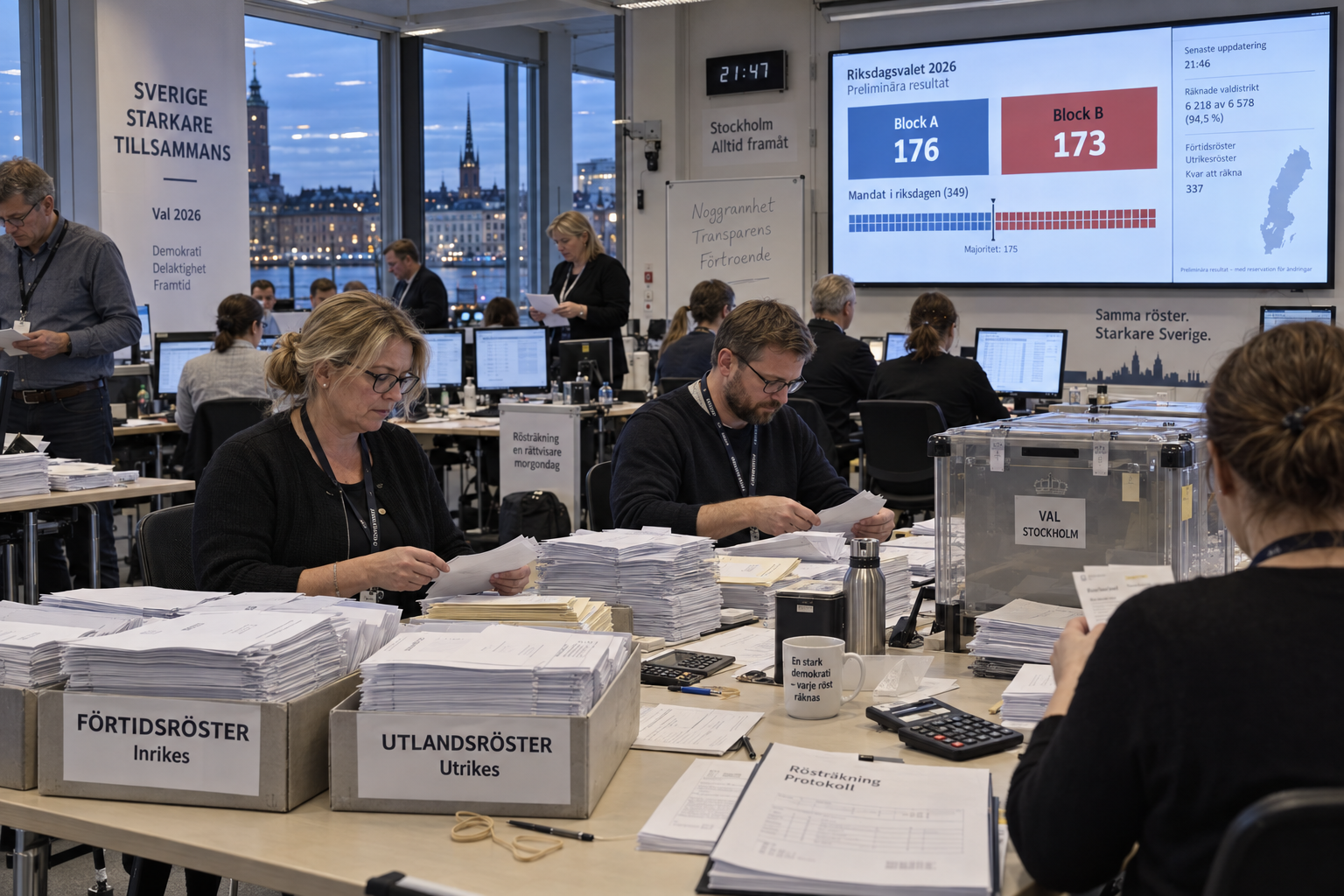
Sweden’s general election remains undecided as vote counting continues, with the left-wing bloc holding a narrow lead over the governing right-wing alliance. After more than 90% of ballots had been processed, the left was ahead by roughly 20,000 votes. Projections from Sweden’s electoral authority indicated that the Social Democrats, led by former Prime Minister Magdalena Andersson, could secure 176 parliamentary mandates—three more than the right-wing bloc’s 173.
The result is significant because Prime Minister Ulf Kristersson’s conservative coalition has relied on support from the Sweden Democrats (SD), a far-right party with roots among neo-Nazi sympathisers. Kristersson has pledged to offer the party cabinet positions if his alliance remains in power. Neither major media organisations nor the political leaders had declared a definitive winner, and Kristersson acknowledged that the formation of the next government was still uncertain.
Sweden uses proportional representation to distribute seats in the 349-member Riksdag. Parties must win at least 4% of the national vote to enter parliament, and the country’s two broad blocs each contain four parties, making coalition and minority governments common.
Early results suggested that both the Social Democrats and the Sweden Democrats were losing support. The Social Democrats were projected to receive 28% of the vote, potentially their weakest result in more than a century, while the Sweden Democrats appeared to be declining for the first time since entering parliament in 2010. The Left Party, Greens and Centre Party, which are part of the left-wing bloc, gained support. Turnout was approximately 80%, four percentage points lower than in 2022.
The campaign focused heavily on national security, gang crime and welfare spending. Andersson framed the election as a choice between a government dominated by the Sweden Democrats and one led by her that would promote cooperation. Kristersson argued that voters wanted his alliance to continue its work. The final result will determine whether Andersson returns as prime minister or Kristersson remains in office with expanded cooperation from the far right.
Entities: Sweden, Magdalena Andersson, Ulf Kristersson, Social Democrats, Sweden Democrats (SD) • Tone: analytical • Sentiment: neutral • Intent: inform
14-09-2026
Sweden’s parliamentary election remained undecided after preliminary results showed the left-wing bloc led by former Prime Minister Magdalena Andersson narrowly ahead of the conservative alliance headed by incumbent Prime Minister Ulf Kristersson. With more than 90% of ballots counted, the Social Democrats were projected to win 176 of the Riksdag’s 349 seats, compared with 173 seats for the right-wing alliance. Andersson said the result was “very close” but declared that Sweden would have a new government if her bloc’s lead was confirmed. The Social Democrats were projected to receive 28% of the vote, which would be their weakest performance in more than a century, despite remaining Sweden’s largest party.
The final result was not expected before Wednesday because early ballots and votes cast abroad still had to be counted. Kristersson said voters had spoken but acknowledged that the formation of the next government remained uncertain. He planned to contact other party leaders about possible coalition negotiations and said he would respect Andersson’s effort to form a left-wing government.
The election’s most notable development was the Sweden Democrats’ decline. The far-right, anti-immigration party won 17.9% of the vote, down from 20.5% in the previous election, despite hoping to enter government for the first time. Kristersson had promised the party important government positions, including the post of migration minister for its leader, Jimmie Akesson. The article contrasts this arrangement with Germany’s refusal to cooperate with the far-right Alternative for Germany.
The Social Democrats campaigned on strengthening the welfare state and addressing rising living costs, while Kristersson emphasized his government’s record on violent and organized crime and tighter immigration policies. About eight million people were eligible to vote, turnout exceeded 80%, and roughly half of the ballots were submitted in advance.
Entities: Sweden, Magdalena Andersson, Swedish Social Democrats, Ulf Kristersson, Riksdag • Tone: analytical • Sentiment: neutral • Intent: inform
14-09-2026
Sweden’s centre-left opposition bloc held a narrow lead in the country’s parliamentary election, according to preliminary results from the Swedish Election Authority. The bloc, which supports Social Democrat leader Magdalena Andersson as prime minister, was allocated 176 of the Riksdag’s 349 seats, compared with 173 for the right-wing bloc supporting incumbent Prime Minister Ulf Kristersson. The three-seat margin leaves the election finely balanced and is likely to produce difficult negotiations over the formation of the next government.
The Social Democrats remained Sweden’s largest party, receiving 28.1% of the preliminary vote. However, that result would be one of the party’s weakest in more than a century and represents a decline from the 30.3% it won in 2022. Kristersson’s Moderate Party was in second place with 19.9%, while the Sweden Democrats ranked third with 17.6%.
Kristersson is seeking another term after leading a minority government formed by the Moderates, Christian Democrats and Liberals. His administration has depended on parliamentary support from the Sweden Democrats, an increasingly influential far-right party. If the right-wing bloc prevails and Kristersson follows through on his stated willingness to include the Sweden Democrats in a formal coalition, the party would enter government for the first time—a historic breakthrough after four years of supporting the government from outside.
The preliminary figures suggest that the right may struggle to retain power, but a centre-left victory would also leave Andersson facing challenging coalition talks. About eight million people were eligible to vote, and more than half had voted in advance. Official results were expected within a week.
Entities: Sweden, Swedish Election Authority, Magdalena Andersson, Social Democratic Party, Ulf Kristersson • Tone: analytical • Sentiment: neutral • Intent: inform