13-10-2026
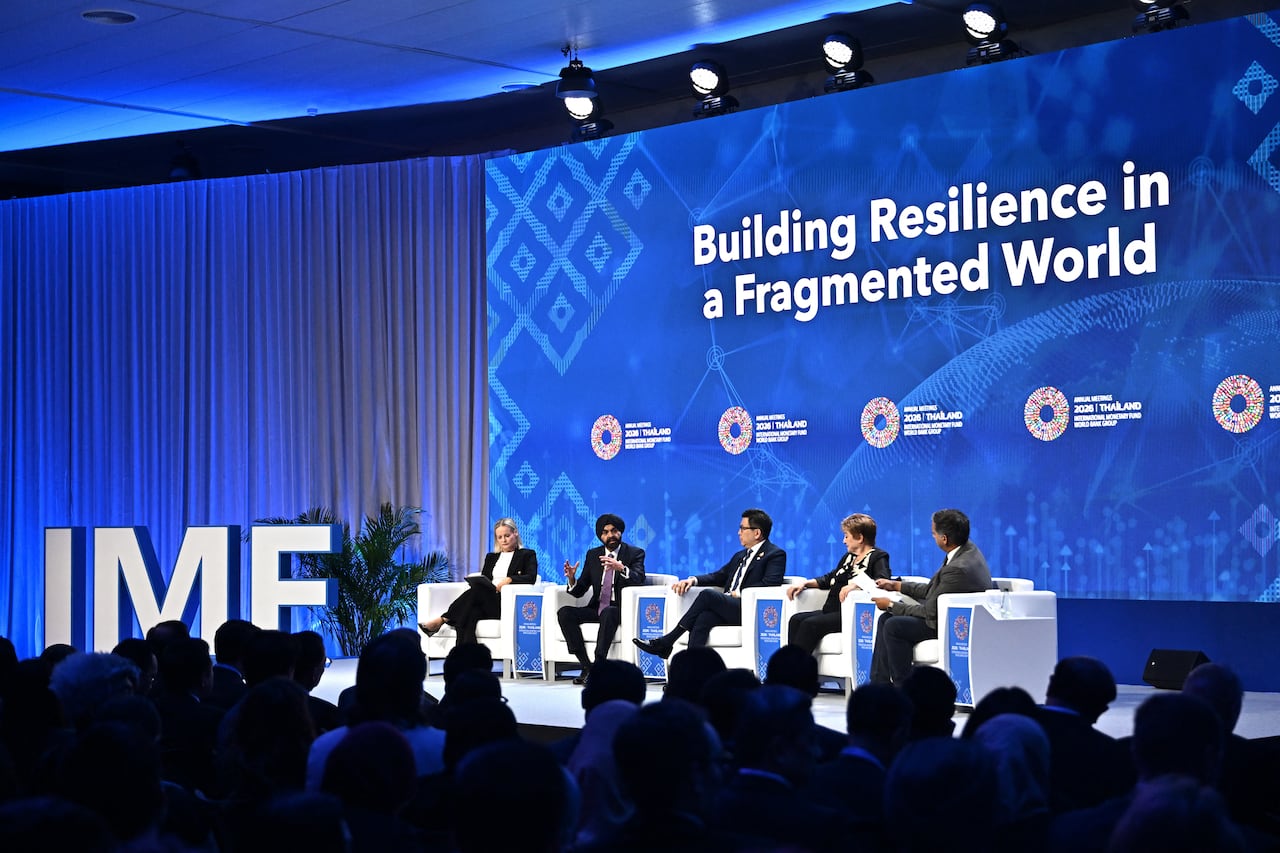
The International Monetary Fund has modestly raised its forecast for global economic growth, projecting a 3.1 per cent expansion in 2026, up from its previous estimate of 3 per cent. It expects growth to reach 3.4 per cent in 2027, though the 2026 rate remains below the 3.5 per cent recorded in 2025. The forecasts appear in the IMF’s latest Economic Outlook, released as finance ministers and central bank governors meet in Bangkok for the IMF and World Bank’s fall meetings.
The IMF expects U.S. growth to hold at 2.3 per cent in both 2026 and 2027. Advanced economies are forecast to grow 2.1 per cent this year and 1.9 per cent next year. The projections assume oil prices rise nearly 41 per cent to an average of US$96 a barrel, energy shipments through the Strait of Hormuz resume by March, and demand for AI moderates. Global inflation is forecast at 4.7 per cent in 2026, easing to 4.1 per cent in 2027.
AI investment is helping offset the economic effects of higher oil and gas prices, but its benefits are concentrated, particularly in the United States and China. The IMF says global growth is increasingly uneven, with 32 countries accounting for 95 per cent of it. Officials warn that an AI-related stock-market correction, rising bond yields and cyberthreats could threaten financial stability. Managing director Kristalina Georgieva also cautions that AI could affect about 40 per cent of jobs through augmentation, downgrading or elimination.
Rising government debt is another major concern, especially amid high borrowing costs. Developing and emerging economies are forecast to slow to 3.7 per cent growth in 2026 before recovering to 4.4 per cent in 2027. The Middle East and Central Asia are expected to contract this year, while the euro area is forecast to grow only 1.1 per cent. China’s growth is projected at 4.5 per cent and India’s at 7 per cent in 2026. The IMF urges governments to strengthen public finances while supporting stability and sustained growth.
Entities: International Monetary Fund (IMF), World Bank, Kristalina Georgieva, Silvana Tenreyro, Athanasios Vamvakidis • Tone: analytical • Sentiment: neutral • Intent: analyze
13-10-2026
The International Monetary Fund has raised its forecast for global economic growth in 2026 to 3.1%, a 0.2-percentage-point increase from its July outlook. The upgrade reflects resilient advanced economies and stronger investment related to artificial intelligence, but growth is still expected to slow from 3.5% in 2025. The IMF warns that high energy prices—driven in part by the US–Iran war and Russia’s war against Ukraine—pose a significant downside risk, especially for energy-importing and low-income countries that are not benefiting from the AI investment boom.
Eurozone growth is forecast at 1.1% in 2026, followed by only 1.2% in 2027. Persistently high energy costs and weak consumer confidence are expected to weigh on activity. Inflation is projected at 3.1% this year and 2.8% next year, above the European Central Bank’s 2% target, while core inflation is expected to return to target only gradually. The IMF also notes that European gas inventories are below seasonal norms in some areas, increasing vulnerability ahead of winter.
Economic prospects vary across Europe: Germany is forecast to grow 1.3% and Spain 2.5% in 2026, while France is expected to expand by just 0.4%, with unemployment rising. The UK’s forecast was upgraded to 1.3% for this year, but growth is expected to ease to 1.2% in 2027. China’s growth is projected to slow to 4.5%, largely because of weak domestic demand. Global inflation, meanwhile, is expected to rise to 4.7% in 2026.
IMF Chief Economist Tenreyro called for urgent action, recommending temporary, targeted fiscal support and monetary policy focused on price stability. She cautioned that the economy’s resilience is nearing its limits and urged governments to rebuild fiscal capacity and supply-side resilience. The IMF describes the global outlook as increasingly divided: conflict and energy costs threaten vulnerable economies, while a reassessment of AI-related returns could abruptly weaken investment and financial conditions.
Entities: International Monetary Fund (IMF), World Economic Outlook, Tenreyro, Eurozone, European Central Bank (ECB) • Tone: analytical • Sentiment: neutral • Intent: analyze
13-10-2026
The France 24 report says the International Monetary Fund has slightly raised its forecast for global economic growth in 2026 to 3.1%. The stated reasons include resilience among advanced economies and investment in artificial intelligence. The forecast upgrade comes despite rising energy prices associated with the US-Iran war, which the report identifies as a source of economic pressure. The IMF also warns that the outlook is split: low-income countries are especially vulnerable to the crisis, in contrast with the relative resilience cited for advanced economies. This points to an uneven distribution of economic risks and capacity to withstand them.
The supplied article text is brief and appears to introduce a video analysis by France 24 correspondent Douglas Herbert rather than provide the analysis itself. It does not include further details about the IMF’s assumptions, the scale of the forecast change, country-level projections, or the specific channels through which the conflict and energy prices may affect economies. Accordingly, the central message available here is limited: the global growth projection has improved modestly, but the improvement masks significant differences in countries’ exposure and resilience. The report’s framing emphasizes both the positive forecast revision and the risks facing low-income countries, rather than presenting the upgrade as an unqualified indication of global economic strength.
Entities: International Monetary Fund (IMF), France 24, Douglas Herbert, 2026 global growth forecast, 3.1% growth projection • Tone: analytical • Sentiment: neutral • Intent: analyze
13-10-2026
The International Monetary Fund’s October Global Financial Stability Report identifies three major risks to the global economy: a correction in the artificial-intelligence market, a sharp rise in government bond yields, and cyberattacks. Although economies have remained mostly resilient, the IMF’s directors say risks are weighted to the downside and urge policymakers and business leaders to prepare for potential shocks, including by improving their ability to deliver targeted support quickly.
The article focuses primarily on bond yields, which have risen amid economic uncertainty, geopolitical conflict, inflation and growing government debt. Bonds are loans made by investors to governments or companies; the yield is the return paid to bondholders. Yields change with economic conditions and supply and demand. The article reports that the 10-year U.S. Treasury yield stood at 5.22 per cent when the story was published. That was below a recent peak of more than 5.3 per cent, but above its level of 4.24 per cent six months earlier.
The IMF says risks in bond markets have worsened since its April report, with higher energy prices contributing to rising yields. Renewed inflation or concerns about government finances could push sovereign yields sharply higher and unsettle broader markets. The Fund warns that high public debt and the risk of governments needing to refinance obligations make a sudden, disorderly increase more likely, potentially crystallizing existing vulnerabilities into market turmoil.
The article also describes concern that rapid investment in artificial-intelligence companies could leave the sector overvalued. A market correction could prompt investors to sell technology stocks and other assets. The supplied article ends while discussing this risk and does not provide further detail on the cyberattack threat.
Entities: International Monetary Fund (IMF), Global Financial Stability Report, Ariel Rabinovitch, Carrie Freestone, Nivrita Ganguly • Tone: analytical • Sentiment: negative • Intent: warn
13-10-2026
The International Monetary Fund has sharply reduced its 2026 growth forecasts for Gulf economies because the Iran war has prolonged the closure of the Strait of Hormuz, disrupting energy exports and shipping. The IMF expects the Middle East and North Africa economy to contract by 2 per cent in 2026, a 3.1-percentage-point downgrade from its April outlook and the only regional contraction forecast worldwide. Bahrain, Kuwait and Qatar are expected to suffer double-digit contractions; the UAE is forecast to shrink 3.9 per cent and Saudi Arabia 3.3 per cent. Oman is the only Gulf Co-operation Council member expected to grow this year, at 4.1 per cent.
The revised outlook assumes the strait will begin reopening gradually in March 2027 and return to pre-war conditions by October. If shipping routes normalise, the IMF anticipates a strong rebound in oil-exporting economies in 2027. It forecasts growth of 7.7 per cent in the UAE, 7.9 per cent in Saudi Arabia, and double-digit expansion in Bahrain, Kuwait and Qatar. Saudi Arabia’s diversified export routes are expected to cushion its downturn compared with some Gulf neighbours.
The IMF maintained its forecast for global growth at 3.1 per cent in 2026 and raised its 2027 projection to 3.4 per cent. It said the global economy has so far absorbed the energy shock through supply adjustments, inventory use and adaptation to higher prices, but warned that resilience is reaching its limits. The Iran war’s negative supply shock and a positive demand shock from the AI infrastructure boom are both contributing to inflation. Global inflation is projected to rise to 4.7 per cent in 2026 before easing to 4.1 per cent in 2027, increasing pressure on borrowing costs and already high public debt. The IMF urged governments to restore fiscal capacity and strengthen supply-side resilience.
Entities: International Monetary Fund (IMF), Silvana Tenreyro, Strait of Hormuz, Middle East and North Africa, Iran war • Tone: analytical • Sentiment: negative • Intent: inform
13-10-2026
The International Monetary Fund warned that government bond yields could rise sharply and disorderly as record public debt, resurgent inflation, and heavier borrowing by artificial intelligence companies put pressure on sovereign bond markets. In its Global Financial Stability Report, released during the IMF-World Bank annual meetings in Bangkok, the fund said high debt and refinancing needs leave markets more vulnerable to fiscal and inflation shocks. It had recently warned that global public debt was near its highest level since World War II and could soon exceed 100% of GDP. A steep increase in yields could reduce asset values, including AI-related assets, and weaken the value of government bonds used as collateral.
AI borrowing adds competition for investor capital. Hyperscalers’ share of global investment-grade bond issuance has climbed to 10% from less than 1% since 2024, as major technology companies and AI firms raise large sums to finance development. The IMF said this issuance is not necessarily the main cause of higher yields, but is an added source of strain.
The fund also cautioned that hedge funds’ expanding and leveraged Treasury positions could unwind in a disorderly way. Their share of U.S. Treasuries rose to about 9% in 2025 from roughly 4% in 2022, and overlapping trades could magnify the effects of a collective retreat. Bond-market liquidity has remained resilient in the U.S., Europe and the U.K., while Japan’s has deteriorated amid increased yield volatility. The IMF urged debt managers to issue more long-term debt rather than rely heavily on short-term borrowing, which can increase rollover risk.
Finally, the IMF highlighted “circular” AI financing arrangements. Fourteen disclosed deals since 2023 involved about $300 billion in equity and $650 billion in debt, with investors receiving $1.4 trillion in future revenue commitments. If AI commercialization disappoints, equity values, debt repayment capacity and promised revenues could all weaken together, creating concentrated risks for the market.
Entities: International Monetary Fund (IMF), Global Financial Stability Report, IMF-World Bank annual meetings, Bangkok, Thailand, U.S. Treasury market • Tone: analytical • Sentiment: negative • Intent: warn