13-05-2026
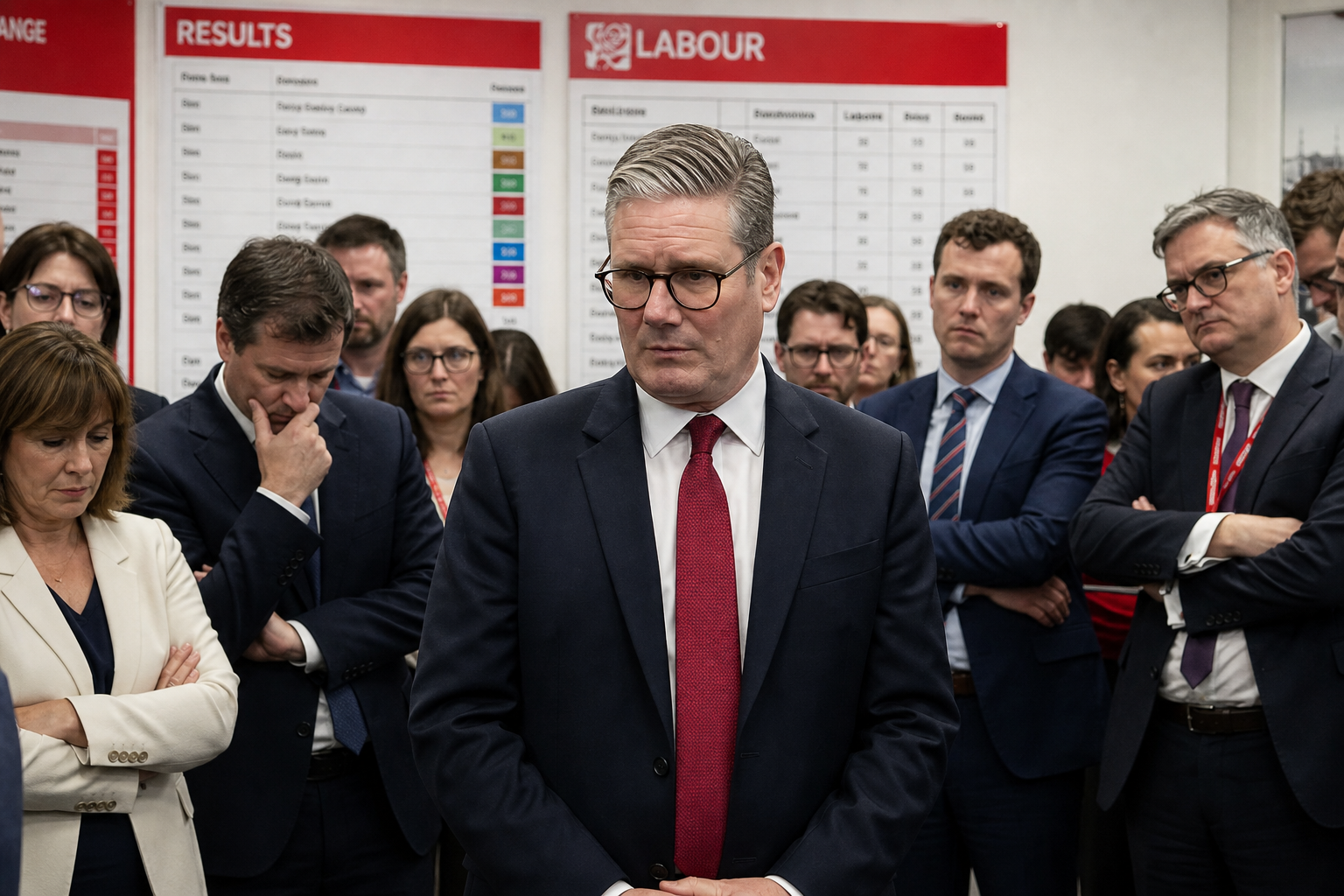
British Prime Minister Keir Starmer is facing the most serious internal challenge of his premiership after disastrous local election results triggered a wave of resignations and public calls for him to step down. On Tuesday, Starmer rejected those demands and said he would continue “getting on with governing,” insisting that he accepted responsibility for Labour’s poor performance and intended to prove critics wrong. The pressure is coming from both inside and outside his party: at least four junior ministers resigned on Tuesday, more ministerial departures were reported as likely, and dozens of Labour MPs have publicly called for him to quit. Under Labour rules, Starmer could be forced out if enough elected members unite behind an alternative leader, though that threshold has not yet been met.
The article links the crisis to Labour’s heavy losses in local elections across England, Wales, and Scotland, where Reform UK — led by Nigel Farage — made major gains. Those results have intensified criticism of Starmer’s leadership style, which some MPs describe as overly managerial and uninspiring, as well as frustration over Labour’s failure to improve living standards and revive the economy. His difficulties also predate the election setback: criticism grew sharply after he appointed Peter Mandelson, a former friend of Jeffrey Epstein, as ambassador to Washington, prompting accusations of poor judgment and possible deception.
Still, many Labour MPs are backing Starmer, arguing that the party’s problems are deeper than one person and stem from long-term neglect of post-industrial and coastal communities. The piece portrays a leader under severe pressure but not yet politically finished, with the question now centered on whether Labour’s revolt will coalesce into a formal attempt to remove him or whether Starmer can stabilize the party and recover public support.
Entities: Keir Starmer, Labour Party, House of Commons, Jess Phillips, Alex Davies-Jones • Tone: analytical • Sentiment: negative • Intent: inform
13-05-2026
Prime Minister Keir Starmer is preparing to present a major reset in the U.K.’s relationship with the European Union at a July summit, describing it as a “new direction for Britain.” The article argues, however, that his pro-EU signaling faces a political reality shaped by last week’s local elections, which revealed deep fractures in Labour’s coalition. Younger, more socially liberal and pro-EU voters have drifted toward the Green Party, while many socially conservative working-class voters in former Labour strongholds such as Sunderland, St Helens, and Barnsley have moved toward Reform UK, the party led by Nigel Farage. That makes a straightforward “EU reset” risky for Starmer: a more ambitious rapprochement may please businesses, investors, and some pro-European politicians, but could further alienate voters who are skeptical of Brussels and resentful of any suggestion Britain may be pulled back toward the EU. The piece outlines what the government may realistically pursue instead: selective cooperation such as a youth mobility or Erasmus-style arrangement, alignment with EU food standards to reduce border checks, possible exemptions from the EU’s carbon border levy, participation in the EU electricity market, and legislation in the King’s Speech aimed at resetting ties. But it emphasizes that Starmer remains constrained by manifesto promises not to restore freedom of movement or rejoin the single market or customs union. Overall, the article portrays Starmer’s EU strategy as cautious, incremental, and politically precarious at a time when his leadership is under pressure and his premiership may be on the line.
Entities: Keir Starmer, Labour Party, European Union (EU), Reform UK, Nigel Farage • Tone: analytical • Sentiment: neutral • Intent: analyze
13-05-2026
This short Economist newsletter item frames British politics through the fate of Sir Keir Starmer, suggesting that he may be nearing the end of his time in power. The headline, “Keir today, gone tomorrow?”, signals a speculative, politically curious mood rather than a definitive claim. The text identifies Starmer as trying to hold on to office for now, and it situates that observation within the magazine’s broader coverage of Britain’s political and economic landscape. Because the content provided is mostly the newsletter header and surrounding site navigation rather than a full article body, the main substantive message is limited: Starmer is depicted as vulnerable, and readers are pointed toward related Economist pieces about Labour’s leadership, bond markets, Nigel Farage, and Britain’s political divisions.
The surrounding links reinforce the article’s likely themes: Labour’s internal leadership prospects, market discipline, the implications of local-election losses, and the broader instability of British politics. The newsletter title and associated headlines suggest an analysis of Labour’s precarious position and of the likely succession politics that could follow if Starmer exits. The piece appears to be part of a commentary/newsletter package that uses a concise, slightly wry framing to draw attention to political uncertainty. Overall, the article is best understood as a brief, analytical political teaser rather than a full standalone report, emphasizing speculation about leadership durability and the consequences for Labour and Britain more broadly.
Entities: Sir Keir Starmer, James Fransham, Britain, Labour Party, Nigel Farage • Tone: analytical • Sentiment: neutral • Intent: analyze
13-05-2026
The article argues that Labour leadership hopefuls, especially Andy Burnham, risk underestimating the power of bond markets as the party’s post-local-election turmoil opens a contest not only for leadership but also for credibility with investors. After Labour’s poor showing in the May 7 local elections, pressure has intensified on Sir Keir Starmer and speculation has begun over who might replace him. Burnham and his allies have adopted a combative line toward financial markets, complaining that Britain is “in hock to the bond markets” and suggesting markets would need to “fall in line” under his leadership. The Economist warns that such rhetoric is politically tempting but economically dangerous: gilt investors have already responded, pushing ten-year gilt yields up by nearly 0.2 percentage points over May 11-12. The article’s central lesson is that bond markets cannot be bullied or commanded by politicians. Any leadership contender will have to respect investors’ concerns about fiscal discipline, borrowing, and market confidence if they want to avoid a damaging confrontation. In effect, the article frames the leadership race as a test of whether Labour’s next leader can combine political ambition with financial credibility.
Entities: Labour, Sir Keir Starmer, Andy Burnham, bond market, gilt market • Tone: analytical • Sentiment: negative • Intent: analyze
13-05-2026
The article argues that Nigel Farage’s apparent political triumph in the local elections should be interpreted with caution. Although Reform UK’s gains were dramatic and symbolically important, the piece suggests they do not necessarily amount to a complete realignment of British politics or an assured path to national power. The example of Barnsley council illustrates the scale of Labour’s defeat in some places: a Labour-run authority that had existed since 1973 was taken over by Reform UK, ending Sir Stephen Houghton’s long tenure as leader after nearly three decades. The article frames this as a devastating setback for Labour and a noteworthy breakthrough for Reform, but implies that local-election results can overstate wider national momentum. In other words, Farage may have won a striking victory, yet the broader political consequences may be more limited or more complicated than the headline suggests. The article’s placement and wording indicate a cautionary, analytical take rather than a celebratory one, emphasizing that immediate electoral gains do not automatically translate into durable power or a clear mandate for governing.
Entities: Nigel Farage, Reform UK, Labour Party, Barnsley council, Sir Stephen Houghton • Tone: analytical • Sentiment: negative • Intent: analyze
13-05-2026
The article reports that Sir Keir Starmer’s position as prime minister has become precarious after a wave of Labour discontent intensified into open calls for his resignation. By Tuesday morning, nearly 100 Labour MPs, including ministers, had publicly urged him to step down, while other senior figures such as Home Secretary Shabana Mahmood were said to have made the same argument privately. The piece suggests that Starmer may struggle to remain in office for long, despite his pledge to fight on. The framing implies a leadership crisis within Labour rather than a settled transition, with Starmer now facing a rapidly narrowing path to survival.
Beyond the immediate political drama, the article’s wording signals concern about the succession problem looming for Labour. The headline and subheading suggest that Starmer’s departure, if it comes, may not resolve the party’s difficulties but merely pass them on to his replacement. The short article is written as a brief political update, emphasizing the speed and breadth of the revolt rather than detailed policy disputes. Its tone is sharply skeptical about Starmer’s prospects and implicitly critical of the instability surrounding Labour’s leadership. The piece functions as a snapshot of a government in crisis, with resignation pressure building and few observers expecting Starmer to last much longer.
Entities: Sir Keir Starmer, Labour MPs, Labour Party, Shabana Mahmood, Home Secretary • Tone: negative • Sentiment: negative • Intent: inform
13-05-2026
U.K. Prime Minister Keir Starmer is facing the most serious internal challenge of his leadership so far, as more than 70 Labour MPs publicly urged him to resign after a disappointing run of political and economic setbacks. The article says the immediate catalyst was Labour’s poor performance in local elections on May 8, in which the party lost hundreds of council seats in England, surrendered long-held ground in Wales, and trailed rivals in Scotland. Starmer’s position was further weakened by a YouGov poll showing roughly half of Britons believe he should step down, along with rising U.K. borrowing costs and criticism over government handling of living costs and public services.
The rebellion has spread beyond backbench criticism, with several parliamentary aides resigning in protest and former minister Catherine West pushing for a timetable to choose a new leader as early as September. The article describes three possible successors: Andy Burnham, Angela Rayner, and Wes Streeting. Starmer responded defiantly in a “reset” speech, insisting he would not resign and framing his decision to stay as a defense against political chaos.
The article also notes that Starmer has suffered politically from his appointment of Peter Mandelson as ambassador to Washington, because of Mandelson’s ties to Jeffrey Epstein. It further highlights tensions with U.S. President Donald Trump, who congratulated Scottish First Minister John Swinney after Labour’s losses and criticized Starmer’s reluctance to allow U.S. warplanes to use British bases during the conflict with Iran. Overall, the piece portrays a prime minister under mounting pressure from party rebels, public dissatisfaction, and a weakened authority within Labour.
Entities: Keir Starmer, Labour Party, United Kingdom, England, Wales • Tone: analytical • Sentiment: negative • Intent: inform
13-05-2026
The article examines Britain’s unusually rapid turnover of prime ministers over the past decade and asks whether the current Labour government under Keir Starmer is now heading toward the same instability that plagued the Conservatives. Starmer came to power in 2024 promising stability after years of turmoil, but his position is now under strain after Labour’s poor local election results and growing calls from within his own party for him to resign. The article places this moment in a broader historical context, noting that Britain had five Conservative leaders between 2016 and 2024 and that each fell for different but related reasons tied to Brexit, scandal, and political dysfunction.
It recounts the exits of David Cameron, Theresa May, Boris Johnson, Liz Truss, and Rishi Sunak, showing how Brexit drove Cameron’s resignation, undermined May, and helped define Johnson’s rise before scandals ended his tenure. Truss’s brief and chaotic premiership is described as collapsing after her unfunded tax-cut plan rattled the markets, while Sunak inherited the fallout and then lost the 2024 general election. The article emphasizes that these leadership changes did not solve Britain’s deeper structural problems, including weak growth, overstretched public services, and the lingering effects of Brexit and other crises.
Political scientists and Labour allies caution that replacing Starmer may simply reproduce the same cycle of instability, especially in a parliamentary system where leadership changes are easy but underlying governance challenges remain. The piece frames the current debate as a test of whether Labour will learn from Conservative turmoil or repeat it, suggesting that Britain’s appetite for rapid leadership turnover may persist even as voters and lawmakers seek steadiness.
Entities: Keir Starmer, Labour Party, Conservative Party, David Cameron, Theresa May • Tone: analytical • Sentiment: neutral • Intent: analyze